From Surf Wiki (app.surf) — the open knowledge base
1864 Democratic National Convention
U.S. political event held in Chicago, Illinois
U.S. political event held in Chicago, Illinois
| Field | Value |
|---|---|
| year | 1864 |
| party | Democratic |
| image | GeorgeMcClellan2.jpg |
| image2 | GeorgeHPendleton.png |
| image_size2 | 105 |
| caption | Nominees |
| McClellan and Pendleton | |
| date | August 29–31, 1864 |
| venue | The Amphitheater |
| city | Chicago, Illinois |
| presidential_nominee | George B. McClellan |
| presidential_nominee_state | |
| New Jersey | |
| vice_presidential_nominee | George H. Pendleton |
| vice_presidential_nominee_state | |
| Ohio | |
| previous_year | 1860 |
| next_year | 1868 |
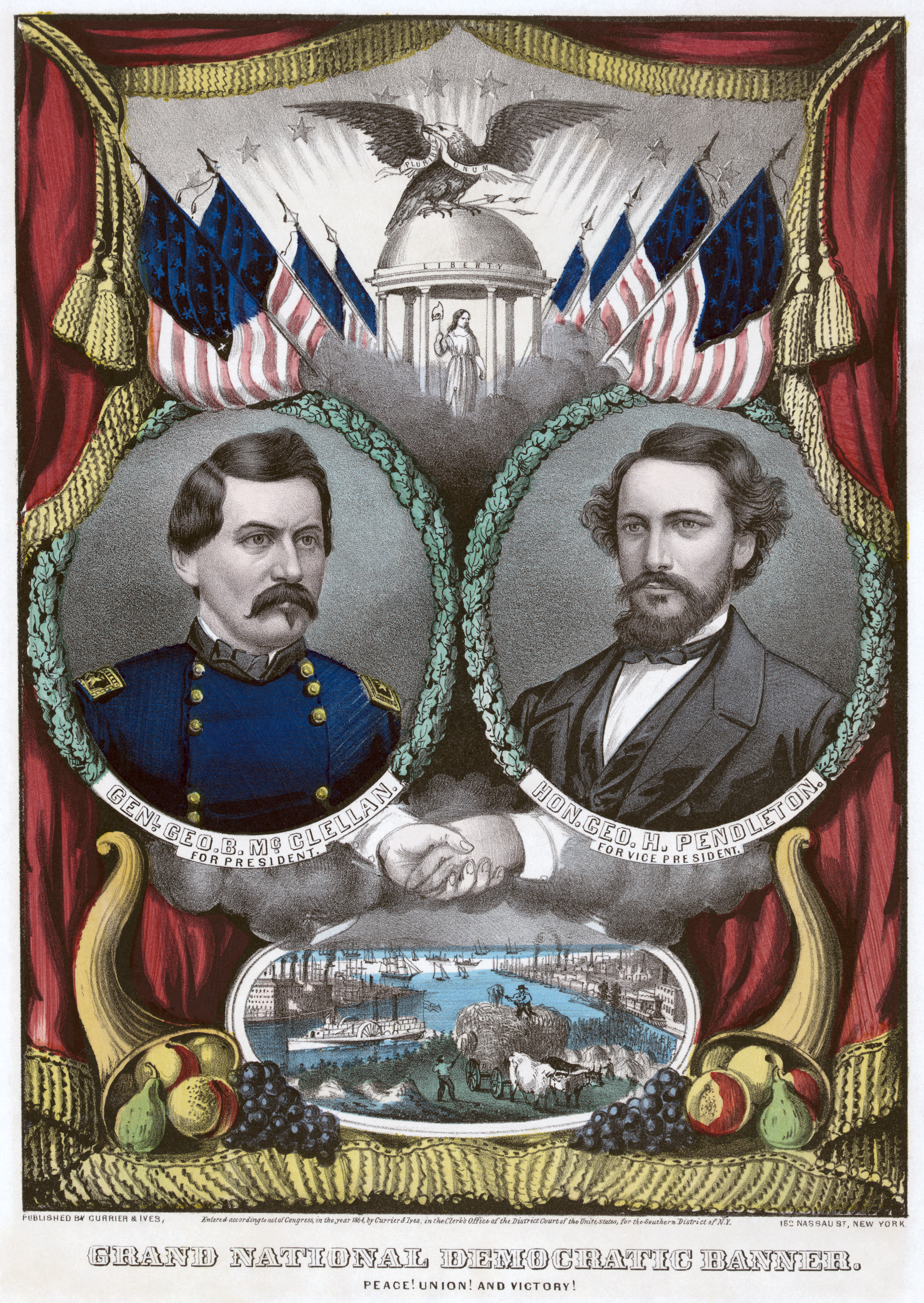
McClellan and Pendleton New Jersey Ohio The 1864 Democratic National Convention was held at The Amphitheatre in Chicago, Illinois, United States.
The Convention nominated Major General George B. McClellan from New Jersey for president, and Representative George H. Pendleton of Ohio for vice president. McClellan, age 37 at the time of the convention, and Pendleton, age 39, are the youngest major party presidential ticket ever nominated in the United States.
Background
The Democratic Party was bitterly split over the American Civil War between the War Democrats and the Peace Democrats. Also making matters complicated were the factions that existed among the Peace Democrats. For much of the war they had been dominated by the Copperheads, led by Clement Vallandigham. The Copperheads declared the war to be a failure and favored an immediate end to hostilities without securing Union victory, either via re-admitting all the Confederate states with slavery intact and legally protected, or by formally recognizing the Confederacy as a sovereign nation and attempting to re-establish peaceful relationships.
In 1863, the Peace Democrats started to splinter between the Copperheads and their more moderate members. Moderate Peace Democrats such as Horatio Seymour proposed a negotiated peace that would secure Union victory. They believed this was the best course of action because an armistice could finish the war without destroying the South. The Copperheads continued to advocate allowing the Confederate states to rejoin with slavery intact, however, believing that to do otherwise would merely lead to another Civil War sooner or later.
Platform
On the first day of the convention, a peace platform was adopted. McClellan, the front-runner for the Democratic nomination, was personally opposed to a peace platform. McClellan supported the continuation of the war and restoration of the Union, but the party platform, written by Vallandigham, was opposed to this position.
Presidential nomination
Presidential candidates
File:GeorgeMcClellan2.jpg|Major General George B. McClellan of New Jersey File:ThomasHartSeymour (3x4b).jpg|Former Governor Thomas H. Seymour of Connecticut
Declined
File:Lazarus W. Powell - Brady-Handy.jpg|Senator Lazarus W. Powell of Kentucky File:Franklin Pierce - Cropped.jpg|Former President Franklin Pierce from New Hampshire Image:Hon. Horatio Seymour, N.Y - NARA - 528568 (cropped).jpg|Governor Horatio Seymour of New York File:Clement Vallandigham - Brady-Handy.jpg|Former Representative Clement Vallandigham from Ohio
General George B. McClellan had widespread support from the War Democrats, and was generally seen as the front-runner. The Peace Democrats, however, found it much harder to come up with a candidate. Many of them had hoped that Horatio Seymour would act as their standard-bearer, but early in 1864 he broke with the Copperheads and aligned himself with the more moderate Peace Democrats. Many of his allies tried to get him to run anyway, believing that he would be an acceptable compromise candidate who could stop McClellan from being nominated, but on the day before the convention commenced, Seymour announced positively that he would not be a candidate. Nonetheless, a portion of the Illinois delegation placed Seymour's name in nomination during the convention. Seymour himself, acting as chairman of the convention, declared that the Illinois delegate was "not in order" since a different motion was already under discussion.
Vallandigham, the ideological leader of the Copperheads, recognized that he was too divisive a figure to earn the required two-thirds majority at the convention (indeed, he would be loudly booed by the War Democrats and even some of the more moderate Peace Democrats when he delivered a speech on the first day), and declined to put his name forward. Instead, the Copperheads eventually put forward former governor Thomas H. Seymour of Connecticut. Other candidates were placed in nomination before eventually being withdrawn. Senator Lazarus W. Powell was placed in nomination by the Delaware delegation, but Powell personally asked that his name be withdrawn since he believed the eventual Democratic presidential candidate "should come from one of the non-slaveholding States." Amid "great applause", a portion of the Kentucky delegation placed the name of former President Franklin Pierce before the convention. But Pierce's name was withdrawn from consideration when a delegate revealed that he had received both written and verbal instructions from Pierce stating that he did not wish to be presented as a candidate.
As the first ballot began, McClellan took a commanding lead over Seymour, with the support of both the War Democrats and the moderate Peace Democrats. The Copperheads, realizing that trying to stop McClellan's nomination would most likely be futile, soon started to throw their votes behind the general, who finished comfortably in excess of the required two-thirds majority at the end of the first ballot. A motion to have McClellan's nomination be declared unanimous was carried.
| **Presidential Ballot** | 1st | 1st (Revised) | Unanimous | McClellan | T. Seymour | H. Seymour | O'Conor | Not Voting | ||||
|---|---|---|---|---|---|---|---|---|---|---|---|---|
| 174 | 202.5 | 226 | ||||||||||
| 38 | 23.5 | |||||||||||
| 12 | 0 | |||||||||||
| 0.5 | 0 | |||||||||||
| 1.5 | 0 |
File:1864DemocraticPresidentialNomination1stBallot.png|1st Ballot File:1864DemocraticPresidentialNomination1stBallotRevised.png|1st Ballot (Revised)
Vice presidential nomination
Vice presidential candidates
File:GeorgeHPendleton.png|Representative George H. Pendleton of Ohio File:GeorgeWCasscirca1875.jpg|Railroad President George W. Cass of Pennsylvania Sen Daniel W Voorhees 04790r.jpg|Representative Daniel W. Voorhees of Indiana File:Augustus Caesar Dodge.jpg|Former Senator Augustus C. Dodge of Iowa
Declined
File:JamesGuthrie.png|Former Treasury Secretary James Guthrie of Kentucky File:Lazarus W. Powell - Brady-Handy.jpg|Senator Lazarus W. Powell of Kentucky File:JohnDCaton.png|Former Chief Justice John D. Caton of Illinois File:John S. Phelps - Brady-Handy.jpg|Former Representative John S. Phelps of Missouri
Eight names were placed in nomination: George H. Pendleton, James Guthrie, Lazarus W. Powell, George W. Cass, John D. Caton, Daniel W. Voorhees, Augustus C. Dodge, and John S. Phelps. Following the first ballot roll call, the names of Guthrie, Powell, Caton, and Phelps were withdrawn from consideration when it was revealed none of them desired the nomination. Before the first ballot could be finalized, 70 delegates who had supported one of the withdrawn candidates shifted their votes to Pendleton. As a result, Pendleton was supported by a majority of the delegates when the vote for the first ballot was finalized. With the exception of Pendleton, the remaining contenders were favorite son candidates who only had the support of their home states. During the second ballot roll call, each state recorded its vote for Pendleton.
Pendleton, a close associate of Vallandigham, was an Extreme Peace Democrat representative from the electoral-rich state of Ohio. Since the Democrats were divided by issues of war and peace, Pendleton's well-known rejection of the Lincoln administration's assertion of the constitutional right to coerce a state back into the Union balanced the ticket.
| **Vice Presidential Ballot** | 1st (Before Shifts) | 1st (After Shifts) | 2nd | Pendleton | Guthrie | Powell | Cass | Caton | Voorhees | Dodge | Phelps | Not Voting | ||||
|---|---|---|---|---|---|---|---|---|---|---|---|---|---|---|---|---|
| 55.5 | 125.5 | 226 | ||||||||||||||
| 65.5 | 27 | 0 | ||||||||||||||
| 32.5 | 26 | 0 | ||||||||||||||
| 26 | 26 | 0 | ||||||||||||||
| 16 | 0 | 0 | ||||||||||||||
| 13 | 13 | 0 | ||||||||||||||
| 9 | 8 | 0 | ||||||||||||||
| 8 | 0 | 0 | ||||||||||||||
| 0.5 | 0.5 | 0 |
File:1864DemocraticVicePresidentialNomination1stBallotBefore.png|1st Ballot (Before Shifts) File:1864DemocraticVicePresidentialNomination1stBallotAfter.png|1st Ballot (After Shifts) File:1864DemocraticVicePresidentialNomination2ndBallot.png|2nd Ballot
References
Bibliography
References
- (1999). "The 1864 Democratic National Convention". Chicago Historical Society.
- [[The American Pageant]]
- [[They Also Ran]]
- "1864 Democratic Platform".
- "George B. McClellan". Ohio History Central.
- ''[https://books.google.com/books/about/The_life_and_public_services_of_Horatio.html?id=cZELAAAAIAAJ The Life and Public Services of Horatio Seymour: Together with a Complete and Authentic Life of Francis P. Blair, Jr]'', pg. 180
- ''[https://books.google.com/books?id=Bsj8Y9RUnkwC Official proceedings of the Democratic national convention, held in 1864 at Chicago]'', pg. 38
- ''Proceedings'', pg. 29
- ''Proceedings'', pgs 29-30
- ''Proceedings'', pg. 36
- "George Pendleton - Ohio History Central".
This article was imported from Wikipedia and is available under the Creative Commons Attribution-ShareAlike 4.0 License. Content has been adapted to SurfDoc format. Original contributors can be found on the article history page.
Ask Mako anything about 1864 Democratic National Convention — get instant answers, deeper analysis, and related topics.
Research with MakoFree with your Surf account
Create a free account to save articles, ask Mako questions, and organize your research.
Sign up freeThis content may have been generated or modified by AI. CloudSurf Software LLC is not responsible for the accuracy, completeness, or reliability of AI-generated content. Always verify important information from primary sources.
Report