From Surf Wiki (app.surf) — the open knowledge base
1830 in science
none
none
The year 1830 in science and technology involved some significant events, listed below.
Astronomy
- March 16 – Great Comet of 1830 (C/1830 F1, 1830 I) first observed from Mauritius.
- Johann Heinrich Mädler and Wilhelm Beer produce the first map of the surface of Mars.
Biology
- Charles Bell publishes his Nervous System of the Human Body.
- Johannes Peter Müller publishes his Bildungsgeschichte der Genitalien in which he traces the development of the paramesonephric duct.
- William Jackson Hooker commences publication of The British Flora.
Exploration
- October 14 – returns to England from her first voyage, a hydrographic survey of the Patagonia and Tierra del Fuego regions of South America.
- Southern Ocean Expedition – John Biscoe sets out from England on an expedition to find new seal-hunting grounds in the Southern Ocean.
Geology
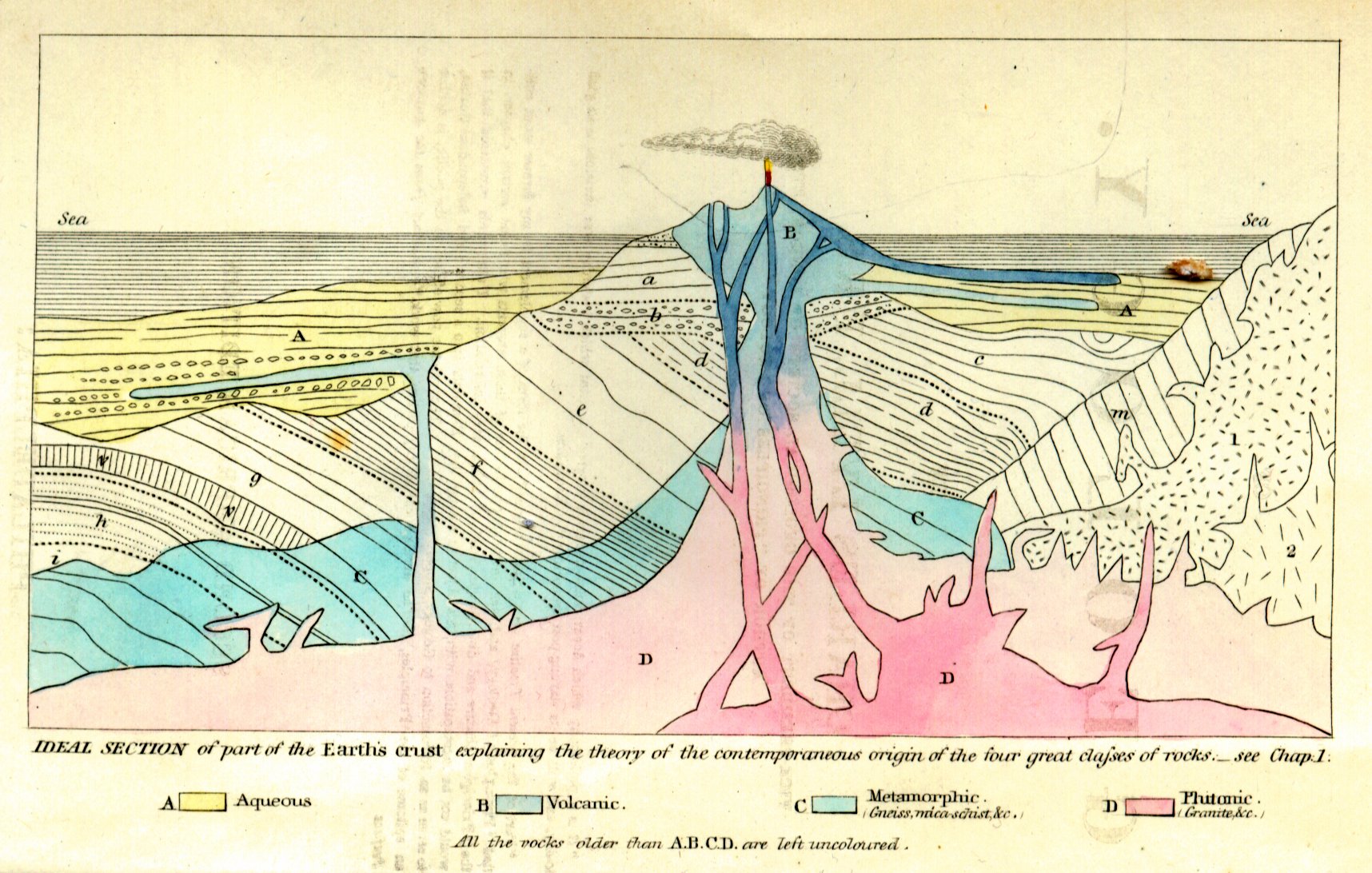
- Charles Lyell publishes the first volume of his Principles of Geology, being an attempt to explain the former changes of the Earth's surface, by reference to causes now in operation.
Medicine
- Thomas Southwood Smith publishes the standard textbook A Treatise on Fever in London.
- Approximate date – The chain osteotome, a form of chainsaw, is invented by German orthopaedist Bernhard Heine.
Technology
- July 13 – John Ruggles is granted United States patent No. 1, for applying rack railway equipment to the "Locomotive steam-engine for rail and other roads".
- July 17 – Barthélemy Thimonnier is granted a French patent (#7454) for a sewing machine: it chain stitches at 200/minute.
- August 31 – Edwin Budding is granted a United Kingdom patent for the lawnmower.
- October 20 – Thomas Cochrane is granted a patent for the first airlock.
- Aeneas Coffey is granted a United Kingdom patent for an improved column still.
- Eaton Hodgkinson publishes his pioneering paper on the optimum cross section for cast iron structural beams.
- Stephen H. Long designs the Long truss wooden bridge.
Veterinary medicine
- Sheep dip is invented by George Wilson of Coldstream, Scotland.
Institutions
- Geographical Society of London established.
Publications
- Charles Babbage publishes Reflections on the Decline of Science in England, and on Some of Its Causes.
- Auguste Comte begins publication of his Course of Positive Philosophy (Cours de Philosophie Positive).
Awards
- Copley Medal: not awarded
Births
- March 5 – Étienne-Jules Marey (died 1904), French physiologist.
- March 5 – Charles Wyville Thomson (died 1882), Scottish marine biologist.
- April 21 – Clémence Royer (died 1902), French anthropologist.
- May 10 – François-Marie Raoult (died 1901), French chemist.
- May 11 (April 29 O.S.) – Emanoil Bacaloglu (died 1891), Romanian polymath.
- August 19 – Lothar Meyer (died 1895), German chemist.
- September 7 – Mary Treat (died 1923), American naturalist.
- October 24 – Marianne North (died 1890), English botanist.
- November 20 – Sigismond Jaccoud (died 1913), Swiss physician.
Deaths
- March 2 – Samuel Thomas von Sömmerring (born 1755), German physician, anatomist, paleontologist and inventor.
- March 29 – James Rennell (born 1742), English cartographer and oceanographer.
- May 16 – Joseph Fourier (born 1768), French mathematician.
- August 24 – Louis Pierre Vieillot (born 1748), French ornithologist.
- Clelia Durazzo Grimaldi (born 1760), Italian botanist.
References
References
- "Antarctic History, antarcticaonline.com".
- Heine, Bernhard. (1834-09-27). "New Instrument Called the Osteotome Designed for the Ablation of Bones". [[The Lancet]].
- (1980). "The Chain Osteotome by Heine". Journal of the History of Medicine and Allied Sciences.
- Peltier, Leonard F.. (1993). "Orthopedics: History and Iconography". Norman Publishing.
- Tillmanns, Hermann. (1895). "The principles of surgery and surgical pathology: general rules governing operations and the application of dressings". D. Appleton & Company.
- "Theoretical and Experimental Researches to Ascertain the strength and best forms of Iron beams". ''Memoirs of the [[Manchester Literary and Philosophical Society]]'' 2nd ser. '''5''':407-544.
- "W. E. Howden". Coldstream.
- "History of the Society". Royal Geographical Society.
- "Copley Medal {{!}} British scientific award".
This article was imported from Wikipedia and is available under the Creative Commons Attribution-ShareAlike 4.0 License. Content has been adapted to SurfDoc format. Original contributors can be found on the article history page.
Ask Mako anything about 1830 in science — get instant answers, deeper analysis, and related topics.
Research with MakoFree with your Surf account
Create a free account to save articles, ask Mako questions, and organize your research.
Sign up freeThis content may have been generated or modified by AI. CloudSurf Software LLC is not responsible for the accuracy, completeness, or reliability of AI-generated content. Always verify important information from primary sources.
Report