From Surf Wiki (app.surf) — the open knowledge base
1727 British general election
Election in Great Britain
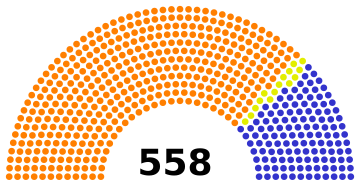
Election in Great Britain
| Field | Value | |
|---|---|---|
| country | Kingdom of Great Britain | |
| type | parliamentary | |
| ongoing | no | |
| previous_election | 1722 British general election | |
| previous_year | 1722 | |
| previous_mps | elected members | |
| next_election | 1734 British general election | |
| next_year | 1734 | |
| seats_for_election | All 558 seats in the House of Commons | majority_seats= 280 |
| elected_mps | elected members | |
| election_date | ||
| image_size | 150x150px | |
| image1 | Robert-Walpole-1st-Earl-of-Orford.jpg | |
| leader1 | Sir Robert Walpole | |
| party1 | Whigs (British political party) | |
| leaders_seat1 | King's Lynn | |
| seats1 | **415** | |
| seat_change1 | 26 | |
| image2 | Henry St John, 1st Viscount_Bolingbroke (1678-1751).jpg | |
| leader2 | Viscount Bolingbroke | |
| party2 | Tories (British political party) | |
| leaders_seat2 | House of Lords | |
| seats2 | 128 | |
| seat_change2 | 41 | |
| image3 | 1stEarlOfBath.jpg | |
| leader3 | William Pulteney | |
| colour3 | FFFF00 | |
| party3 | Opposition / Patriot Whigs | |
| leaders_seat3 | Hedon | |
| seats3 | 15 | |
| seat_change3 | 15 | |
| title | Prime Minister | |
| posttitle | Prime Minister after election | |
| before_election | Sir Robert Walpole | |
| before_party | Whigs (British political party) | |
| after_election | Sir Robert Walpole | |
| after_party | Whigs (British political party) | |
| map2 | [[File:Results of the 1727 GB General Election.svg]] | |
| map2_caption | Composition of the House of Commons after the election |
The 1727 British general election returned members to serve in the House of Commons of the 7th Parliament of Great Britain to be summoned, after the merger of the Parliament of England and the Parliament of Scotland in 1707. The election was triggered by the death of King George I; at the time, it was the convention to hold new elections following the succession of a new monarch. The Tories, led in the House of Commons by William Wyndham, and under the direction of Bolingbroke, who had returned to the country in 1723 after being pardoned for his role in the Jacobite rising of 1715, lost further ground to the Whigs, rendering them ineffectual and largely irrelevant to practical politics. A group known as the Patriot Whigs, led by William Pulteney, who were disenchanted with Robert Walpole's government and believed he was betraying Whig principles, had been formed prior to the election. Bolingbroke and Pulteney had not expected the next election to occur until 1729, and were consequently caught unprepared. They failed to make any gains against the government party.
Summary of the constituencies
See 1796 British general election for details. The constituencies used were the same throughout the existence of the Parliament of Great Britain.
Dates of election
The general election was held between 14 August 1727 and 17 October 1727.
At this period, elections did not take place at the same time in every constituency. The returning officer in each county or parliamentary borough fixed the precise date (see hustings for details of the conduct of the elections).
Results
Seats summary
References
- British Electoral Facts 1832–1999, compiled and edited by Colin Rallings and Michael Thrasher (Ashgate Publishing Ltd 2000). (For dates of elections before 1832, see the footnote to Table 5.02).
References
- Nulle, Stebelton H.. (1937). "The Duke of Newcastle and the Election of 1727". The Journal of Modern History.
This article was imported from Wikipedia and is available under the Creative Commons Attribution-ShareAlike 4.0 License. Content has been adapted to SurfDoc format. Original contributors can be found on the article history page.
Ask Mako anything about 1727 British general election — get instant answers, deeper analysis, and related topics.
Research with MakoFree with your Surf account
Create a free account to save articles, ask Mako questions, and organize your research.
Sign up freeThis content may have been generated or modified by AI. CloudSurf Software LLC is not responsible for the accuracy, completeness, or reliability of AI-generated content. Always verify important information from primary sources.
Report