From Surf Wiki (app.surf) — the open knowledge base
1705 English general election
General election in England
General election in England
| Field | Value | |
|---|---|---|
| country | Kingdom of England | |
| type | parliamentary | |
| ongoing | no | |
| previous_election | 1702 English general election | |
| previous_year | 1702 | |
| next_election | 1708 British general election | |
| next_year | 1708 (GB) | |
| seats_for_election | All 513 seats in the House of Commons | |
| majority_seats | 257 | |
| election_date | 7 May – 6 June 1705 | |
| image_upright | 0.7 | |
| <!-- Tory --> | image1 | File:John Churchill, 1st Duke of Marlborough, Captain-General of the English forces and Master-General of the Ordnance, 1702 (c), attributed to Michael Dahl 91996.jpg |
| leader1 | Duke of Marlborough | |
| party1 | Tories (British political party) | |
| seats1 | **260** | |
| seat_change1 | 38 | |
| percentage1 | ||
| image2 | ||
| leader2 | Whig Junto | |
| party2 | Whigs (British political party) | |
| seats2 | 233 | |
| seat_change2 | 49 | |
| percentage2 | ||
| map_image | House of Commons elected members, 1705.svg | |
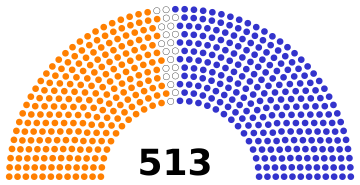
| map_caption | House of Commons after election (Whigs-orange, Tories-blue) | |
| elected_members | List of members of the House of Commons at Westminster 1705–1708 |
(Baron Somers, Charles Montagu, Thomas Wharton)
The 1705 English general election saw contests in 110 constituencies in England and Wales, roughly 41% of the total. The election was fiercely fought, with mob violence and cries of "Church in Danger" occurring in several boroughs. During the previous session of Parliament the Tories had become increasingly unpopular, and their position was therefore somewhat weakened by the election, particularly by the Tackers controversy. Due to the uncertain loyalty of a group of 'moderate' Tories led by Robert Harley, the parties were roughly balanced in the House of Commons following the election, encouraging the Whigs to demand a greater share in the government led by Marlborough.
This was the final election to be held in the Kingdom of England.
Summary of the constituencies
See 1796 British general election for details. The constituencies used in England and Wales were the same throughout the period. In 1707 alone the 45 Scottish members were not elected from the constituencies, but were returned by co-option in a part of the membership of the last Parliament of Scotland elected before the Acts of Union 1707.
Party strengths are an approximation, with many MPs' allegiances being unknown.
Involved parties
In 1705 the House of Commons was controlled by two parties: the Tory party led by John Churchill, Duke of Marlborough, and the Whig party led by a group of leading party members known as the Whig Junto. The four members of the Whig Junto were John Somers, Charles Montagu, Thomas Wharton, and Edward Russell.
Overview of 18th-century British politics
The politics of Britain in 1705 was chaotic. The government was very decentralised and led to unrest in the general population. This led to the mob violence that occurred during this election process across the country.
References
References
- Redlich, Josef. "The Procedure of the House of Commons: A Study of Its History and Present Form." (1903).
- Bradlaugh, Charles. "John Churchill, Duke of Marlborough: The Mob, the Scum, and the Dregs." (1884).
- O'Gorman, Frank. "The long eighteenth century: British political and social history 1688-1832." (2016).
This article was imported from Wikipedia and is available under the Creative Commons Attribution-ShareAlike 4.0 License. Content has been adapted to SurfDoc format. Original contributors can be found on the article history page.
Ask Mako anything about 1705 English general election — get instant answers, deeper analysis, and related topics.
Research with MakoFree with your Surf account
Create a free account to save articles, ask Mako questions, and organize your research.
Sign up freeThis content may have been generated or modified by AI. CloudSurf Software LLC is not responsible for the accuracy, completeness, or reliability of AI-generated content. Always verify important information from primary sources.
Report