From Surf Wiki (app.surf) — the open knowledge base
17 equal temperament
Musical tuning system with 17 pitches equally-spaced on a logarithmic scale
Musical tuning system with 17 pitches equally-spaced on a logarithmic scale
In music, 17 equal temperament is the tempered scale derived by dividing the octave into 17 equal steps (equal frequency ratios). Each step represents a frequency ratio of , or 70.6 cents.
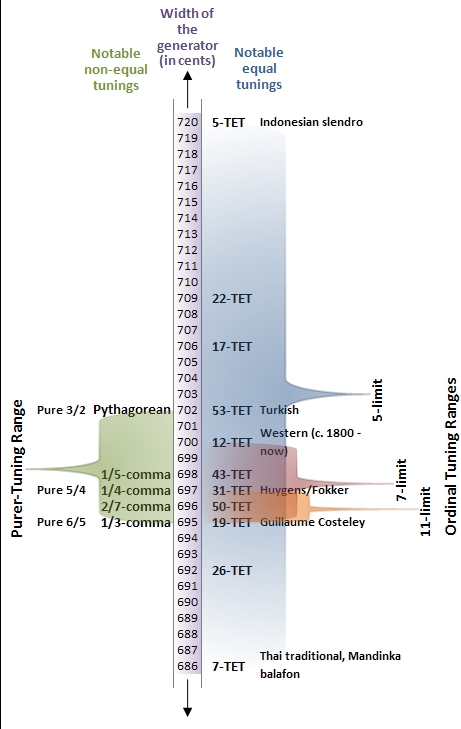
17-ET is the tuning of the regular diatonic tuning in which the tempered perfect fifth is equal to 705.88 cents, as shown in Figure 1 (look for the label "17-TET").
History and use
Alexander J. Ellis refers to a tuning of seventeen tones based on perfect fourths and fifths as the Arabic scale. In the thirteenth century, Middle-Eastern musician Safi al-Din Urmawi developed a theoretical system of seventeen tones to describe Arabic and Persian music, although the tones were not equally spaced. This 17-tone system remained the primary theoretical system until the development of the quarter tone scale.
Notation

Easley Blackwood Jr. created a notation system where sharps and flats raised/lowered 2 steps, identical to ups and downs notation for 17-EDO. ((10*7) mod 17 = 2.) This yields the chromatic scale: :C, D, C, D, E, D, E, F, G, F, G, A, G, A, B, A, B, C Quarter tone sharps and flats can also be used, yielding the following chromatic scale: :C, C/D, C/D, D, D/E, D/E, E, F, F/G, F/G, G, G/A, G/A, A, A/B, A/B, B, C
Interval size
Below are some intervals in compared to just.
| [[File:Major chord on C.mid]] |
|---|
]]

:{| class="wikitable sortable" style="vertical-align:center;text-align:center;" |- style="vertical-align:bottom;" ! interval name ! size (steps) ! size (cents) ! audio ! just ratio ! just (cents) ! audio ! error |- style="text-align:center;" | octave | 17 | 1200 | | 2:1 | 1200 | | 0 |- style="text-align:center;" | minor seventh | 14 | 988.23 | | 16:9 | 996.09 | | −7.77 |- style="text-align:center;background:#D4D4D4;" | harmonic seventh | 14 | 988.23 | | 7:4 | 968.83 | | +19.41 |- style="text-align:center;" | perfect fifth | 10 | 705.88 | [[File:10 steps in 17-et on C.mid|120px]] | 3:2 | 701.96 | [[File:Just perfect fifth on C.mid|120px]] | +3.93 |- style="text-align:center;background:#D4D4D4;" | septimal tritone | 8 | 564.71 | [[File:8 steps in 17-et on C.mid|120px]] | 7:5 | 582.51 | [[File:Lesser septimal tritone on C.mid|120px]] | −17.81 |- style="text-align:center;" | tridecimal narrow tritone | 8 | 564.71 | [[File:8 steps in 17-et on C.mid|120px]] | 18:13 | 563.38 | [[File:Tridecimal narrow tritone on C.mid|120px]] | +1.32 |- style="text-align:center;" | undecimal super-fourth | 8 | 564.71 | [[File:8 steps in 17-et on C.mid|120px]] | 11:8 | 551.32 | [[File:Eleventh harmonic on C.mid|120px]] | +13.39 |- style="text-align:center;" | perfect fourth | 7 | 494.12 | [[File:7 steps in 17-et on C.mid|120px]] | 4:3 | 498.04 | [[File:Just perfect fourth on C.mid|120px]] | −3.93 |- style="text-align:center;" | septimal major third | 6 | 423.53 | [[File:6 steps in 17-et on C.mid|120px]] | 9:7 | 435.08 | [[File:Septimal major third on C.mid|120px]] | −11.55 |- style="text-align:center;" | undecimal major third | 6 | 423.53 | [[File:6 steps in 17-et on C.mid|120px]] | 14:11 | 417.51 | [[File:Undecimal major third on C.mid|120px]] | +6.02 |- style="text-align:center;background:#D4D4D4;" | major third | 5 | 352.94 | [[File:5 steps in 17-et on C.mid|120px]] | 5:4 | 386.31 | [[File:Just major third on C.mid|120px]] | −33.37 |- style="text-align:center;" | tridecimal neutral third | 5 | 352.94 | [[File:5 steps in 17-et on C.mid|120px]] | 16:13 | 359.47 | [[File:Tridecimal neutral third on C.mid|120px]] | −6.53 |- style="text-align:center;" | undecimal neutral third | 5 | 352.94 | [[File:5 steps in 17-et on C.mid|120px]] | 11:9 | 347.41 | [[File:Undecimal neutral third on C.mid|120px]] | +5.53 |- style="text-align:center;background:#D4D4D4;" | minor third | 4 | 282.35 | [[File:4 steps in 17-et on C.mid|120px]] | 6:5 | 315.64 | [[File:Just minor third on C.mid|120px]] | −33.29 |- style="text-align:center;" | tridecimal minor third | 4 | 282.35 | [[File:4 steps in 17-et on C.mid|120px]] | 13:11 | 289.21 | [[File:Tridecimal minor third on C.mid|120px]] | −6.86 |- style="text-align:center;" | septimal minor third | 4 | 282.35 | [[File:4 steps in 17-et on C.mid|120px]] | 7:6 | 266.87 | [[File:Septimal minor third on C.mid|120px]] | +15.48 |- style="text-align:center;background:#D4D4D4;" | septimal whole tone | 3 | 211.76 | [[File:3 steps in 17-et on C.mid|120px]] | 8:7 | 231.17 | [[File:Septimal major second on C.mid|120px]] | −19.41 |- style="text-align:center;" | greater whole tone | 3 | 211.76 | [[File:3 steps in 17-et on C.mid|120px]] | 9:8 | 203.91 | [[File:Major tone on C.mid|120px]] | +7.85 |- style="text-align:center;background:#D4D4D4;" | lesser whole tone | 3 | 211.76 | [[File:3 steps in 17-et on C.mid|120px]] | 10:9 | 182.40 | [[File:Minor tone on C.mid|120px]] | +29.36 |- style="text-align:center;" | neutral second, lesser undecimal | 2 | 141.18 | [[File:2 steps in 17-et on C.mid|120px]] | 12:11 | 150.64 | [[File:Lesser undecimal neutral second on C.mid|120px]] | −9.46 |- style="text-align:center;" | greater tridecimal | 2 | 141.18 | [[File:2 steps in 17-et on C.mid|120px]] | 13:12 | 138.57 | [[File:Greater tridecimal two-third tone on C.mid|120px]] | +2.60 |- style="text-align:center;" | lesser tridecimal | 2 | 141.18 | [[File:2 steps in 17-et on C.mid|120px]] | 14:13 | 128.30 | [[File:Lesser tridecimal two-third tone on C.mid|120px]] | +12.88 |- style="text-align:center;background:#D4D4D4;" | septimal diatonic semitone | 2 | 141.18 | [[File:1_step_in_17-et_on_C.mid|120px]] | 15:14 | 119.44 | [[File:Septimal diatonic semitone on C.mid|120px]] | +21.73 |- style="text-align:center;background:#D4D4D4;" | diatonic semitone | 2 | 141.18 | [[File:2 steps in 17-et on C.mid|120px]] | 16:15 | 111.73 | [[File:Just diatonic semitone on C.mid|120px]] | +29.45 |- style="text-align:center;" | septimal chromatic semitone | 1 | 70.59 | [[File:1_step_in_17-et_on_C.mid|120px]] | 21:20 | 84.47 | [[File:Septimal chromatic semitone on C.mid|120px]] | −13.88 |- style="text-align:center;" | chromatic semitone | 1 | 70.59 | [[File:1_step_in_17-et_on_C.mid|120px]] | 25:24 | 70.67 | [[File:Just chromatic semitone on C.mid|120px]] | −0.08 |}
Relation to 34 EDO
is a subset of
References
Sources
- {{cite journal
References
- [[Alexander John Ellis. Ellis, Alexander J.]] (1863). "On the Temperament of Musical Instruments with Fixed Tones", ''[[Proceedings of the Royal Society of London]]'', vol. 13. (1863–1864), pp. 404–422.
- Blackwood, Easley. (Summer 1991). "Modes and Chord Progressions in Equal Tunings". [[Perspectives of New Music]].
This article was imported from Wikipedia and is available under the Creative Commons Attribution-ShareAlike 4.0 License. Content has been adapted to SurfDoc format. Original contributors can be found on the article history page.
Ask Mako anything about 17 equal temperament — get instant answers, deeper analysis, and related topics.
Research with MakoFree with your Surf account
Create a free account to save articles, ask Mako questions, and organize your research.
Sign up freeThis content may have been generated or modified by AI. CloudSurf Software LLC is not responsible for the accuracy, completeness, or reliability of AI-generated content. Always verify important information from primary sources.
Report