From Surf Wiki (app.surf) — the open knowledge base
163693 Atira
Asteroid
Asteroid
| Field | Value |
|---|---|
| minorplanet | yes |
| name | 163693 Atira |
| background | #FFC2E0 |
| image | Atira.20jan17.u2.s1p0.gif |
| caption | Arecibo discovery image of orbiting satellite taken on 20 January 2017 |
| discovery_ref | |
| discovered | 11 February 2003 |
| discoverer | LINEAR |
| discovery_site | Lincoln Lab ETS |
| mpc_name | (163693) Atira |
| alt_names | |
| pronounced | |
| named_after | Atíra "my/our mother" (Pawnee epithet of the earth goddess) |
| mp_category | {{Hlist |
| Atira<ref name | "MPC-object" / |
| orbit_ref | |
| epoch | 23 March 2018 (JD 2458200.5) |
| uncertainty | 0 |
| observation_arc | 14.21 yr (5,192 d) |
| aphelion | 0.9798 AU |
| perihelion | 0.5024 AU |
| semimajor | 0.7411 AU |
| eccentricity | 0.3221 |
| period | 233 days |
| mean_anomaly | 30.769° |
| mean_motion | / day |
| inclination | 25.618° |
| asc_node | 103.90° |
| arg_peri | 252.93° |
| moid | 0.2076 AU (80.88 LD) |
| satellites | 1 |
| mean_diameter | |
| rotation | |
| pole_ecliptic_lat | |
| pole_ecliptic_lon | |
| albedo | 0.0231 (derived) |
| spectral_type | S (assumed) |
| abs_magnitude | 16.3 |
| NEO | Atira | Venus-crosser
163693 Atira (; provisional designation ****) is a stony asteroid, dwelling in the interior of Earth's orbit. It is classified as a near-Earth object. Atira is a binary asteroid, a system of two asteroids orbiting their common barycenter. The primary component with a diameter of approximately 4.8 km is orbited by a minor-planet moon that measures about 1 km. Atira was discovered on 11 February 2003, by astronomers with the Lincoln Near-Earth Asteroid Research at Lincoln Laboratory's Experimental Test Site near Socorro, New Mexico, in the United States. To date, it is the only confirmed binary asteroid that orbits inside Earth's orbit.
It is the namesake and the first numbered body of the Atira asteroids, a new subclass of near-Earth asteroids, which have their orbits entirely within that of Earth and are therefore alternatively called Interior-Earth Objects (IEO). As of 2019, there are only 36 known members of the Atira group of asteroids.{{cite journal
Physical properties
Atira is a S-type asteroid and orbits the Sun at a distance of 0.5–1.0 AU once every 8 months (233 days). Its orbit has an eccentricity of 0.32 and an inclination of 26° with respect to the ecliptic. With a perihelion of 0.50 AU the body also classifies as a Venus-crosser as Venus orbits the Sun at a distance of 0.72–0.73 AU but does not get as close to the Sun as Mercury (which orbits between 0.31 and 0.47 AU). As no precoveries were found, Atiras observation arc begins with its discovery observation in 2003. It has a rotation period of 3.3984 hours with a brightness variation of 0.36 magnitude () and a very low albedo of 0.0231.
With a diameter of 4.8 kilometers, Atira is one of the largest Near-Earth objects. Early estimates of its size ranged from 1 to 2 kilometers, but those were based on an assumed higher albedo of 0.20. Its larger size and low albedo were discovered when Atira was imaged by radar in early 2017. These radar images also revealed that Atira is a binary asteroid.
Binary system
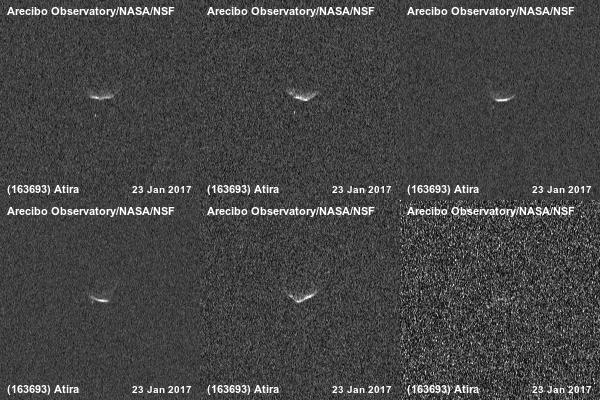
Atira came within 0.207 AU from Earth in January 2017, the closest since its discovery in 2003. This provided an opportunity to study the asteroid by radar. Images taken at Arecibo Observatory on 20 January 2017 revealed that Atira is a synchronous binary asteroid with a minor-planet moon. The primary with a diameter of is possibly elongated and very angular in shape. The secondary is tidally locked and has a diameter of . Additional images taken on 23 January 2017 showed that the two components are orbiting each other at a distance of about 6 km with an orbital period of 15.5 hours. It is currently the only confirmed binary asteroid that orbits inside Earths orbit.
Name
Because the first known object in a new class of asteroids will become the name of the new class, due consideration was given to the name for (163693). The other classes of near-Earth asteroids, Amors, Apollos, and Atens, are named after a Roman, Greek, and Egyptian god respectively, each of which begins with the letter 'A'. Atira follows this pattern, being named after Atíra [], an epithet of the Earth goddess of the Pawnee people. Atíra is the wife of the creator god, Tirawa, and goddess of Earth and the evening star. The official naming citation was published by the Minor Planet Center on 22 January 2008 (M.P.C. 61768).
References
|archive-url = https://web.archive.org/web/20020202160655/http://neo.jpl.nasa.gov/neo/groups.html |url-status = dead |archive-date = 2 February 2002
|archive-url = https://web.archive.org/web/20151010134026/http://www.ll.mit.edu/news/atira.html |archive-date = 10 October 2015 |url-status = dead}}
|display-authors = etal
References
- Douglas Parks & Lula Pratt, ''A Dictionary of Skiri Pawnee'', University of Nebraska Press, 2008. [http://zia.aisri.indiana.edu/~dictsearch/cgi-bin/testengltoxsrchNP.pl?host=zia&pass=&hasfont=&srchlang=Indian&srchstring=atira&database=skiri&srchtype=AND&sortlang=Indian&sndformat=mp3&maxhits=200&find=Run_Search atira], AISRI Dictionary Database Search, Indiana University.
- (2024-10-23). "Physical and Mutual Orbit Characteristics of Near-Earth Binary Asteroid (163693) Atira". The Planetary Science Journal.
- (2024-10-23). "Physical and Mutual Orbit Characteristics of Near-Earth Binary Asteroid (163693) Atira". The Planetary Science Journal.
This article was imported from Wikipedia and is available under the Creative Commons Attribution-ShareAlike 4.0 License. Content has been adapted to SurfDoc format. Original contributors can be found on the article history page.
Ask Mako anything about 163693 Atira — get instant answers, deeper analysis, and related topics.
Research with MakoFree with your Surf account
Create a free account to save articles, ask Mako questions, and organize your research.
Sign up freeThis content may have been generated or modified by AI. CloudSurf Software LLC is not responsible for the accuracy, completeness, or reliability of AI-generated content. Always verify important information from primary sources.
Report