From Surf Wiki (app.surf) — the open knowledge base
1556

1556
Year 1556 (MDLVI) was a leap year starting on Wednesday of the Julian calendar.
Events
January–March
- January 4 – In Japan, Saitō Yoshitatsu, the eldest son of Saitō Dōsan, arranges the murders of his two younger brothers, Magoshiro and Kiheiji, and forces his father to flee from the Sagiyama Castle.
- January 16 – Charles V abdicates the thrones of the Spanish Empire (including his colonies in the New World) in favor of his son, Philip II, and retires to a monastery.
- January 23 – The Shaanxi earthquake, the deadliest earthquake in history, occurs with its epicenter in Shaanxi province, China; 830,000 people may have been killed.
- January 24 – In India, at the Sher Mandal in Delhi, the Mughal Emperor Humayun trips while descending the stairs from his library and strikes the side of his head against a stone step, sustaining a fatal injury. He never regains consciousness and dies seven days later.
- February 5 – Truce of Vaucelles: Fighting temporarily ends between France and Spain.
- February 14 – Akbar the Great ascends the throne of the Mughal Empire in India at age 13; he will rule until his death in 1605, by which time most of the north and centre of the Indian subcontinent will be under his control.
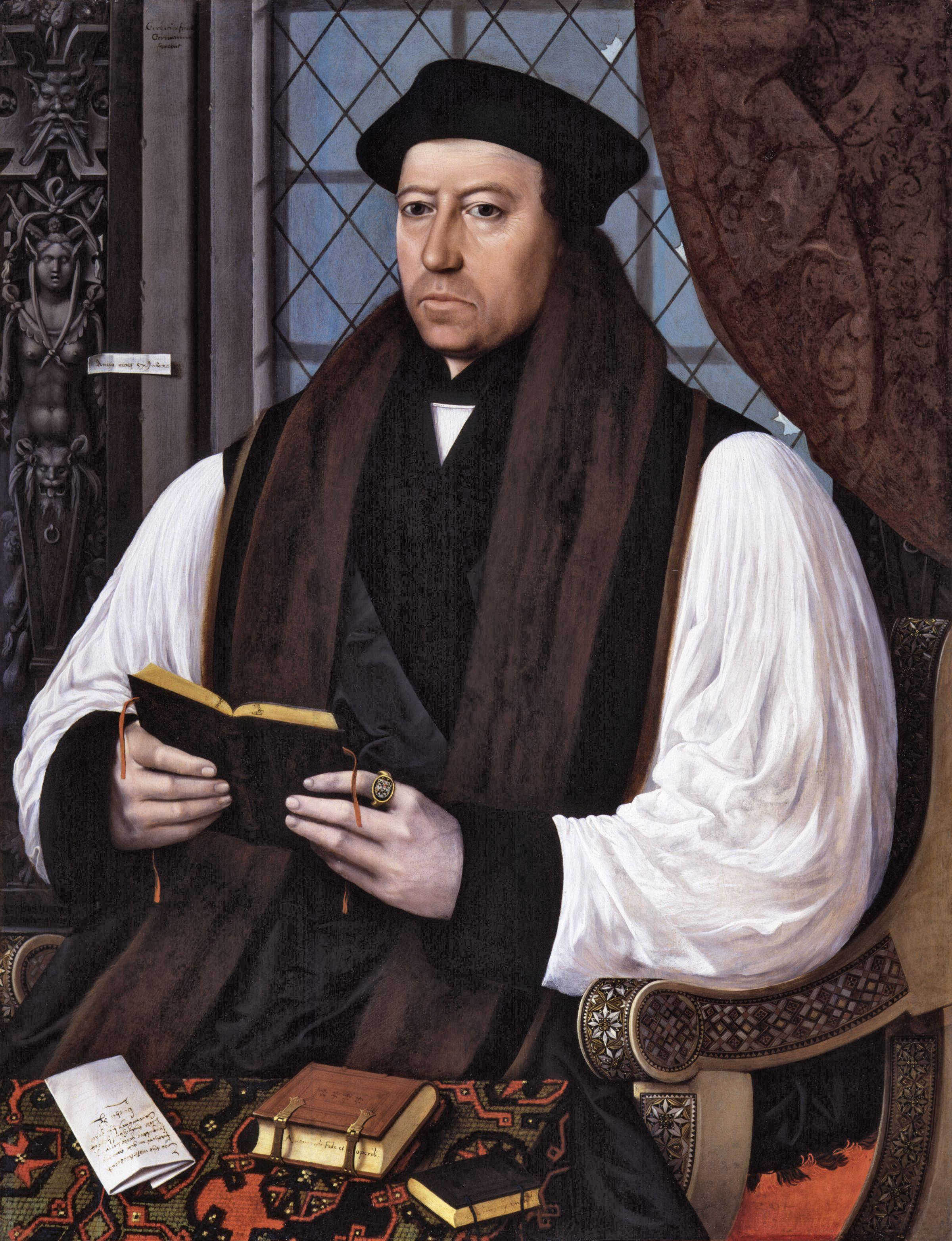
- March 21 – In Oxford, Thomas Cranmer, the former Archbishop of Canterbury, is burned at the stake for treason for his role in the English Reformation as chief bishop of the Anglican Church.
- March 22 – Reginald Pole, a Roman Catholic Cardinal, is appointed by Queen Mary of England as the new Archbishop of Canterbury and head of the Catholic Archdiocese of Canterbury.
April–June
- April 3 – In Qazvin, the Shah of Iran Tahmasp I, becomes enraged with the sexual orientation of his son Ismail II, and sends Ismail to Afghanistan to serve as the Iranian governor of Herat province.
- April 24 – Pál Márkházy surrenders the Hungarian fortress at Ajnácskő (now Hajnáčka in Slovakia) to the Ottoman Empire. Márkházy, accused of treachery, is stripped of his estates and title by the King of Hungary, and forced to flee to the Principality of Transylvania.
- May 28 (20th day of 4th month of Kōji 2) – In Japan, the Battle of Nagara-gawa takes place along the Nagara River in Mino Province near what is now the Gifu Prefecture. Saitō Yoshitatsu, with 17,500 troops, overwhelms and kills his father, Saitō Dōsan, who had attempted to avenge the Saitō family honor with less than 3,000 people.
- June 14 – Lorenzo Priuli becomes the new Doge of the Venetian Republic.
- June 27 – Thirteen English Protestants (11 men and two women), the "Stratford Martyrs", are burned at the stake at Stratford-le-Bow near London after being convicted of heresy.
July–September
- July 17 – Kostajnica Fortress in what is now Croatia falls to the Ottoman Empire and remains under Turkish control for the next 132 years.
- August 15 – Work begins on the Peresopnytsia Gospel at the Monastery of the Holy Trinity in the Grand Duchy of Lithuania, and continues for the next five years.
- August 27 – Charles V abdicates his position as Holy Roman Emperor in favor of his younger brother, Ferdinand, King of the Romans. The Imperial Diet postpones recognizing the abdication for the next 18 months.
- September 1 – After Pope Paul IV attempts to get King Henry II of France to join him in an invasion of Spanish-controlled Naples, Spain's Duke of Alba invades the Papal States in Italy.
October–December
- October 7 – The Battle of Delhi is fought in India, at Tughlaqabad) near Delhi between forces of the Sur Empire (ruled by Muhammad Adil Shah) and the Mughal Empire (ruled by Akbar the Great). General Hemchandra Vikramaditya (Hemu) of the Suris overwhelms the forces commanded by the Mughal Governor of Delhi, Tardi Beg Khan within one day.
- November 5 – Second Battle of Panipat: Fifty miles north of Delhi, a Mughal army defeats the forces of Hemu and recaptures Delhi for the Mughal Empire, guaranteeing Akbar's rule.
- November 10 – The English ship Edward Bonadventure, commanded by Richard Chancellor is wrecked on the coast of Scotland at Pitsligo, killing most of its crew, including Chancellor. The few survivors include the first Russian ambassador to England, Osip Nepeya.
- November 17 – In the Holy Roman Empire, the Steter Kriegsrat is founded as a War Council with five generals and five civil servants to advise the Habsburg rulers.
- December 7 – The Mughal Emperor Akbar personally travels with Bairam Khan to lead an invasion force to defeat the Sultan of the Sur Empire, Sikandar Shah Suri.
- December 27 – Péter Erdődy is appointed as the Ottoman Viceroy of Croatia after the death on September 7 of Nikola IV Zrinski.
- December 31 – All military authorities in the Holy Roman Empire are ordered to submit to the decisions of the Imperial War Council.
Date unknown
- The kings of Spain take control of what becomes the Flanders region, including the French département of Nord.
- The Plantations of Ireland are started in King's County (later County Offaly) and Queen's County (later County Laois), the earliest attempt at systematic ethnic cleansing in Ireland, by the Roman Catholic ruler Queen Mary I of England.
- Future King Prince John, younger son of King Gustav I of Sweden becomes Duke of Finland.
- Ivan the Terrible conquers Astrakhan, opening the Volga River to Russian traffic and trade.
- The Welser banking families of Augsburg lose colonial control of Venezuela.
- The false Martin Guerre appears in the French village of Artigat.
- The first printing press in India is introduced by Jesuits, at Saint Paul's College, Goa.
Births

- January 8 – Uesugi Kagekatsu, Japanese samurai and warlord (d. 1623)
- January 24 – Christian Barnekow, Danish noble, explorer and diplomat (d. 1612)
- February 4 – Dorothea of Hanau-Münzenberg, German noblewoman (d. 1638)
- February 7 – Countess Maria of Nassau (d. 1616)
- February 16 – Tōdō Takatora, Japanese daimyō (d. 1630)
- February 21 – Sethus Calvisius, German calendar reformer (d. 1615)
- March 7 – Guillaume du Vair, French statesman and philosopher (d. 1621)
- March 13 – Dirck van Os, Dutch merchant (d. 1615)
- April 8 – David Hoeschel, German librarian (d. 1617)
- April 9 – Andreas von Auersperg, Carniolan noble and military commander in the battle of Sisak (d. 1593)
- April 27 – François Béroalde de Verville, French writer (d. 1626)
- May 31 – Jerzy Radziwiłł, Polish Catholic cardinal (d. 1600)
- June 6 – Edward la Zouche, 11th Baron Zouche, English politician and diplomat (d. 1625)
- June 13 – Pomponio Nenna, Italian composer (d. 1608)
- June 24
- Victoria of Valois, French princess (d. 1556)
- Joan of Valois, French princess (d. 1556)
- July 9 – Elizabeth Finch, 1st Countess of Winchilsea, English countess (d. 1634)
- July 22 – Otto Henry, Count Palatine of Sulzbach (d. 1604)
- July 26 – James Melville, Scottish divine and reformer (d. 1614)
- August 10 – Philipp Nicolai, German Lutheran pastor (d. 1608)
- August 16 – Bartolomeo Cesi, Italian painter (d. 1629)
- September 21 – William Harris, English knight (d. 1616)
- October 18
- October 24 – Giovanni Battista Caccini, Italian artist (d. 1613)
- October 26 – Ahmad Baba al Massufi, Malian academic (d. 1627)
- November 25 – Jacques Davy Duperron, French cardinal (d. 1618)
- November 28 – Francesco Contarini, Doge of Venice (d. 1624)
- December 5 – Anne Cecil, Countess of Oxford, English countess (d. 1588)
- December 17 – Abdul Rahim Khan-I-Khana, Indian composer (d. 1627)
- December 27 – Jeanne de Lestonnac, French saint (d. 1640)
- date unknown
Deaths
_Founder_of_the_Jesuits.jpg)
- January 8 – Anne Shelton, English courtier, elder sister of Thomas Boleyn (b. 1475)
- January 27 – Humayun, 2nd Mughal Emperor (b. 1508)
- February 12 – Giovanni Poggio, Italian cardinal and diplomat (b. 1493)
- February 26 – Frederick II, Elector Palatine (1544–1556) (b. 1482)
- March 21 – Thomas Cranmer, Archbishop of Canterbury (burned at the stake) (b. 1489)
- April 18
- April 26 – Valentin Friedland, German scholar and educationist of the Reformation (b. 1490)
- May 4 – Luca Ghini, Italian physician and botanist (b. 1490)
- May 28 – Saitō Dōsan, Japanese warlord (b. 1494)
- June 10 – Martin Agricola, German composer (b. 1486)
- June 24 – Joan of Valois, French princess (b. 1556)
- July 31 – Ignatius of Loyola, Spanish founder of the Jesuit order and saint (b. 1491)
- August 1 – Girolamo da Carpi, Italian painter (b. 1501)
- August 11 – John Bell, Bishop of Worcester
- August 17 – Victoria of Valois, French princess (b. 1556)
- September – Patrick Hepburn, 3rd Earl of Bothwell, Scottish traitor (b. 1512)
- October 7 – Frederick of Denmark, Prince-bishop (b. 1532)
- October 21 – Pietro Aretino, Italian author (b. 1492)
- November 10 – Richard Chancellor, English Arctic explorer (drowned at sea) (b. c. 1521)
- November 14 – Giovanni della Casa, Italian poet (b. 1503)
- date unknown
- probable
- Brian mac Cathaoir O Conchobhair Failghe, last of the Kings of Ui Failghe
- Jacob Clemens non Papa, Flemish composer (b. 1510)
References
References
- Allied Powers (1919- ). Reparation Commission. (1921). "Belgian Claims to the Triptych of Saint Ildephonse and the Treasure of the Order of the Golden Fleece".
- (December 2020). "Geomorphology and Paleoseismology of the Weinan Fault, Shaanxi, Central China, and the Source of the 1556 Huaxian Earthquake". Journal of Geophysical Research: Solid Earth.
- (2005). "颤抖的地球: 地震科学". 清华大学出版社有限公司.
- Nath, Ram. (June 2019). "History of Mughal architecture.". Abhinav.
- (11 June 2014). "The Italian Wars 1494-1559: War, State and Society in Early Modern Europe". Routledge.
- (13 January 2023). "ANCIENT AND MEDIEVAL HISTORY: AN EAGLE'S VIEW FOR CIVIL SERVICES AND OTHER EXAMS". MJP Publisher.
- "Thomas Cranmer's Martyrdom as Parable".
- Duffy, Eamon. (2009). "Fires of Faith: Catholic England under Mary Tudor". Yale University Press.
- Newman, Andrew J.. (2008). "Safavid Iran: Rebirth of a Persian Empire". I.B.Tauris.
- Papp, Sándor. (2004). "From a Transylvanian principality to an Ottoman sanjak: The life of Pál Márkházi, a Hungarian renegade". Chronica.
- Turnbull, Stephen. (1998). "The Samurai Sourcebook". Cassell & Co..
- (1878). "The Doges of Venice Chronologically Arranged with Historical Notes by George Eric Mackay". F. Ongania.
- [http://www.exclassics.com/foxe/foxe347.htm Foxe's Book of Martyrs: 344. "Thirteen Martyrs Burned at Stratford-Le-Bow".] Exclassics.com. Retrieved 24 May 2013
- [https://web.archive.org/web/20140203103644/http://www.johnfoxe.org/freeman-marion.pdf List of martyrs according to Foxe]
- [https://web.archive.org/web/20070312070811/http://portal.unesco.org/ci/en/ev.php-URL_ID%3D17039%26URL_DO%3DDO_TOPIC%26URL_SECTION%3D201.html Information on the Peresopnytsia Gospel] from [[UNESCO]]
- (2013). "Philip II". Routledge.
- Sarkar, Jadunath. (1960). "Military History of India". Orient Longmans.
- (2000). "Hemu: Napoleon of Medieval India". Mittal Publications.
- (1902). "The Akbar Nama of Abu-l-Fazl". Low Price Publications.
- (2001). "The Oxford companion to military history".
- Majumdar, R.C. (ed.) (2007). ''The Mughul Empire'', Mumbai: Bharatiya Vidya Bhavan, {{Listed Invalid ISBN. 81-7276-407-1, pp.106-7
- (1887). "Diccionario Enciclopedico Hispano-Americano". W.M. Jackson.
- (1921). "The Aaland Islands Question: Report Submitted to the Council". League of Nations Commission of Rapporteurs on the Åland Islands Question.
- (2005). "Die Konquista der Augsburger Welser-Gesellschaft in Südamerika (1528-1556): historische Rekonstruktion, Historiografie und lokale Erinnerungskultur in Kolumbien und Venezuela". C.H.Beck.
- (21 December 2020). "Le retour de Martin Guerre: de la impostura a la metahistoria". FILMHISTORIA Online.
- (2000). "A History of Konkani Literature: From 1500 to 1992". Sahitya Akademi.
- (1850). "Der Bischofs-Roggen und die Güter des Bisthums Roeskild". Löffler.
- (1899). "Onder Neerlands vlag: album ter herdenking van het vijf en twintig jarig bestaan van den Nederlandschen militairen bond : 1874-1899". Van Holkema & Warendorf.
- (2022). "The Samurai Castle Master". Pen & Sword Books.
- (1881). "Compendium der Geschichte der Kirchenmusik mit besonderer Berücksichtigung des kirchlichen Gesanges: von Ambrosius zur Neuzeit". Levy & Müller.
- (1992). "Guide to French Literature: Beginnings to 1789". St. James Press.
- (1747). "Ehren-tempel der Deutschen Gelehrsamkeit: in welchem die Bildnisse gelehrter". Haid.
- (1852). "La France protestante: ou, Vies des protestants français". J. Cherbuliez.
- "The Cardinals of the Holy Roman Church - Biographical Dictionary - Consistory of December 12, 1583".
- (2004). "Zouche, Edward la, eleventh Baron Zouche".
- "NENNA, Pomponio".
- (1891). "Dictionary of National Biography". Macmillan.
- (1873). "Die evangelische Kirche im Lande zwischen Rhein, Mosel, Nahe und Glan bis zum Beginn des 30jährigen Krieges: ¬Theil ¬II, ¬Die Reformation der Kirche sowie der Kirche Schicksale und Gestaltung bis zum Jahre 1620; Abth. 1". Marcus.
- (1922). "The Dictionary of National Biography, Founded in 1882 by George Smith". H. Milford.
- (1859). "Dr. Philipp Nicolai". Nolte & Köhler.
- (1793). "La Certosa di Bologna descritta nelle sue pitture". A san Tommaso d'Aquino.
- (1836). "Histoire de ce qui s'est passé en Bretagne". Brest.
- "DORMER, Sir John (1556-1627), of Dorton and Long Crendon, Bucks.".
- (1986). "Italian High Renaissance and Baroque Sculpture". Phaidon.
- (2 February 2012). "Dictionary of African Biography". OUP USA.
- "The Cardinals of the Holy Roman Church - Biographical Dictionary - Consistory of June 9, 1604".
- (1984). "I dogi: storia e segreti". Newton Compton.
- (1 August 2003). "Monstrous Adversary: The Life of Edward de Vere, 17th Earl of Oxford". Liverpool University Press.
- (1992). "The Powers of Art: Patronage in Indian Culture". Oxford University Press.
- (1966). "A New Manuscript of Mush's Life of Margaret Clitherow". Journal for Manuscript Research.
- (1973). "International Bulletin". Africa Institute of South Africa.
- (2004). "Briant, Alexander [St Alexander Briant]".
- (2004). "Shelton family".
- (20 February 2022). "History of Indian Nation : Medieval India". K. K. Publications.
- "The Cardinals of the Holy Roman Church - Biographical Dictionary - Consistory of November 20, 1551".
- (1890). "Neues Archiv für die Geschichte der Stadt Heidelberg und der rheinischen Pfalz". G. Koester.
- J.R. Broome. (June 1998). "Thomas Cranmer". Gospel Standard Publications.
- (1806). "Efemeridi letterarie di Roma". Vincenzo Poggioli.
- (2004). "Gage, Sir John".
- (1890). "Jahrbücher der deutschen Turnkunst: Blätter für die Angelegenheiten die deutschen Turnwesens, vornehmlich in seiner Richtung auf Erziehung und Gesundheitspflege". Anhuth.
- (January 1957). "NEL QUARTO CENTENARIO DELLA MORTE DI LUCA GHINI 1490–1556". Webbia.
- Don Michael Randel. (30 October 2002). "The Harvard Concise Dictionary of Music and Musicians". Harvard University Press.
- (2019). "Becoming a Queen in Early Modern Europe: East and West". Springer International Publishing.
- (1900). "The autobiography of St. Ignatius". Benziger Brothers.
- (2008). "Sixteenth-century Italian Drawings". Harvey Miller.
- (1723). "The Antiquities of the Cathedral Church of Worcester". W. Mears; and J. Hooke.
- (1894). "The Historical Journal". Gazette and Bulletin Print. House.
- (1873). "Historiske Kildeskrifter og Bearbejdelser af Dansk Historie". G. E. C. Gad.
- (1909). "L'oeuvre du divin Arétin". Bibliothèque des Curieux.
- (9 December 2011). "Encyclopedia of Tudor England". Bloomsbury Publishing USA.
- (1806). "Opere di Monsignor Giovanni Della Casa". Società tipografica de'Classici italiani.
- "Tullia d'Aragona".
- DEMİREL, Hamide. "A study of the poet Fuzuli (c. 1480-1556) with special reference to his Turkish, Persian, and Arabic divians". University of Durham.
- (1789). "A General History of Music, from the Earliest Ages to the Present Period. To which is Prefixed, a Dissertation on the Music of the Ancients.". Robson and Clark, Bond-Street.
This article was imported from Wikipedia and is available under the Creative Commons Attribution-ShareAlike 4.0 License. Content has been adapted to SurfDoc format. Original contributors can be found on the article history page.
Ask Mako anything about 1556 — get instant answers, deeper analysis, and related topics.
Research with MakoFree with your Surf account
Create a free account to save articles, ask Mako questions, and organize your research.
Sign up freeThis content may have been generated or modified by AI. CloudSurf Software LLC is not responsible for the accuracy, completeness, or reliability of AI-generated content. Always verify important information from primary sources.
Report