From Surf Wiki (app.surf) — the open knowledge base
155 mm gun M1
Towed field cannon
Towed field cannon
| Field | Value |
|---|---|
| name | M1 155 mm Long Tom |
| image | 155 mm Long Tom 2.jpg |
| image_size | 300 |
| caption | Long Tom in travelling position, US Army Ordnance Museum |
| origin | United States |
| type | Towed field artillery |
| is_ranged | yes |
| is_artillery | yes |
| wars | World War II |
| Korean War | |
| Cambodian Civil War | |
| Croatian War of Independence | |
| design_date | 1918–1938 |
| production_date | 1940–1945 |
| number | 1,882 |
| weight | Travel: 13,880 kg |
| length | Travel: 11 m |
| part_length | 6.97 m L/45 |
| width | Travel: 2.5 m |
| height | Travel: 2.7 m |
| crew | 14 |
| cartridge | Separate loading charge and projectile |
| caliber | 155 mm |
| rate | 40 rounds per hour |
| velocity | 853 m/s |
| max_range | 23.7 km |
| breech | Asbury mechanism |
| recoil | Hydro-pneumatic |
| carriage | M1 Carriage |
| elevation | −2°/+65° |
| traverse | 60° |
Korean War Cambodian Civil War Croatian War of Independence
The 155 mm gun M1 was a 155 millimeter caliber field gun developed and used by the United States military. Nicknamed "Long Tom" (an appellation with a long and storied history in U.S. field and naval artillery), it was produced in M1 and **M2 ** variants, later known as the M59. Developed to replace the Canon de 155mm GPF, the gun was deployed as a heavy field weapon during World War II and the Korean War, and also classed as secondary armament for seacoast defense. The gun could fire a 100 lb shell to a maximum range of 14 mi, with an estimated accuracy life of 1,500 rounds.
The Long Tom was also adopted by a number of other nations, including the United Kingdom, Austria, Israel, and the Netherlands.
Development
Before entering World War I, the United States was poorly equipped with heavy artillery. To address this problem a number of foreign heavy artillery guns were adopted, including the Canon de 155 mm GPF. After the end of the war the Westervelt Board, named for its president, Brigadier General William I. Westervelt, was convened to assess the artillery experience of the combatant powers and map out future directions for the US Army artillery. The conclusion of the board vis-a-vis heavy field artillery was that the French 155 mm GPF should be adopted as the standard heavy field piece but further development work should occur to achieve a heavy field gun with a max. range of 25,000 yd, a vertical arc of fire from 0° to 65° (for comparison, GPF had only 35°), a projectile not exceeding 100 lb and the capability to be installed on a mount with either caterpillar tracks or rubber tires. A number of prototypes were produced in the 1920s (M1920 and M1920M1 were even standardized) and 1930s (a new design was started from scratch after 1929), the projects were repeatedly put on hold due to lack of funds. Developed in the summer of 1930, the radical split-trail carriage for both 155-mm gun and 8-inch howitzer designated T2 was the first in the US to feature an all-welded construction as well as a 8-wheel 2-axle roll-bearing bogie for high-speed mobility. In 1938 the 155 mm gun T4 on carriage T2 was finally adopted as 155 mm gun M1 on carriage M1.
155 mm gun M1
The new gun design used a barrel similar to the earlier 155 mm GPF, but with an Asbury mechanism that incorporated a vertically-hinged breech plug support. This type of breech used an interrupted-thread breech plug with a lock that opened and closed the breech by moving a single lever. The ammunition for the 155 mm gun was "separate-loading", that is with the shell and the powder charge packaged, shipped and stored separately. The shell is lifted into position behind the breech and then rammed into the chamber to engage the shell's rotating band into the barrel rifling.
Ramming the shell home is followed by loading a number of powder bags, as required for the desired range. The powder charge could be loaded in up to seven charge settings. Once the powder is loaded, the breech plug is closed and locked, and a primer is placed in the breech plug's firing mechanism. After setting the elevation and azimuth, the gun is ready to fire. The firing mechanism is a device for initiating the ammunition primer. The primer then sets off the igniter which ignites the propelling charge of the ammunition. A continuous-pull lanyard first cocks the firing pin, then fires the primer when pulled.
The gun was developed into M1A1 and M2 variants. After World War II, the United States Army re-organized, and the gun was re-designated as the M59.
Carriage M1
The gun carriage provides a stable, yet mobile, base for the gun. The new split-trail carriage featured an eight-wheel integral two-axle bogie and a two-wheel limber that supported the trails for transport. The carriage was a two-piece design. The upper carriage included the side frames with trunnion bearings that supported the recoil mechanism that carried the gun cradle, slide and gun tube. The upper carriage also incorporated the elevating and azimuth gearing. The upper carriage pivoted in azimuth on the lower carriage. The lower carriage included the transport suspension and the split-trail that stabilized and absorbed recoil when the gun was fired.
After the gun was placed in a firing position with the gun pointing in the desired direction, the trails were lowered to the ground and the limber was removed. The carriage wheels would then be raised using built-in ratcheting screw-jacks, lowering the gun carriage to the ground. Once on the ground, the limber-end of the trail legs were separated to form a wide "vee" shape with its apex at the center of the carriage pivot point. A recoil spade at the limber-end of each trail leg required a correctly positioned hole to be dug for the spade, which was attached to the trail end, to transmit the recoil from gun carriage through the trails and into the earth. This made the gun very stable and assisted its accuracy. The removable spades were transported in brackets on the trail legs.
The carriage M1 and M2 were shared with the 8 in Howitzer M1, differing only in the gun tube, sleigh, cradle, recoil and equilibrators, weight due to the heavier barrel.
| Bottom carriage | Top carriage |
|---|---|
| Firing support base | Elevating mechanism |
| Trails | Traversing mechanism |
| Retractable suspension system | Gun support components |
| Axle | Equilibrator |
| Brakes | Cradle (Connects gun assembly to the top carriage) |
| Wheels | Recoil mechanism |
| Sleigh (Sliding support for the gun tube) | |
| Gun tube |
Specifications
| Type of firing mechanism | continuous pull percussion hammer |
|---|
Service

The Long Tom saw combat for the first time in the North African Campaign on 24 December 1942, with "A" Battery of the 36th Field Artillery Regiment. Eventually it equipped 33 U.S. Army corps-level artillery battalions in the European and Mediterranean Theaters (the 173rd, 190th, 200th, 208th, 240th, 261st, 273rd, 514th–516th, 528th, 530th, 540th, 541st, 546th–549th, 559th, 561st, 634th, 635th, 731st, 733rd, 734th, 766th, 976th–981st, 985th and 989th), and 8 in the Pacific Theater (the 168th, 223rd, 226th, 433rd, 517th, 531st, 532nd, and 983rd). The 353rd, 732nd, and 993rd Field Artillery Battalions were segregated 155 mm gun units that never went overseas. The 353rd was converted to the 1697th Engineer Combat Battalion (Colored) on 19 March 1944 at Camp Van Dorn, Mississippi, the 732nd was converted to the 1695th Engineer Combat Battalion (Colored) on 15 March 1944 at Camp Pickett, Virginia, and the 993rd was converted to the 1696th Engineer Combat Battalion (Colored) on 19 March 1944 at Camp Swift, Texas.
The 155 mm gun was also used by several Marine defense battalions, notably during Operation Cartwheel in 1943.
The preferred prime mover was initially the Mack NO 7½-ton 6x6 truck but from 1943 this was generally replaced by the tracked M4 high-speed tractor. 72 rounds of ammunition plus propelling charges could be carried in the M21 4-ton, 2-wheel ammunition trailer; 16 rounds of ammunition plus propelling charges could be carried in the M10 1-ton, 2-wheel ammunition trailer that was often used because of shortages of the former. The later heavy M23 8-ton, 4-wheel ammunition trailer introduced in 1945 could carry 96 rounds of ammunition plus propelling charges.
A small number of Long Tom guns were authorised for supply via Lend-Lease channels, to the United Kingdom (184) and France (25). The authorised establishment of British batteries (excluding training units), including four batteries from the Dominion of Newfoundland, totalled 88 guns.
Variants


Gun variants:
- M1920 – prototype
- T4 – prototype
- M1 (1938) – first production variant, 20 built
- M1A1 (1941) – modified breech ring
- M1A1E1 – prototype with chromium-plated bore
- M1A1E3 – prototype with liquid cooling
- M2 Standard (1945) – with modified breech ring
Carriage variants:
- T2 – prototype
- M1 (1938)
- M1A1 – refurbished T2 carriages
- M2 standard
Limber variants:
- M1 standard (1938)
- M5 heavy (1945)
The gun was also mounted on a modified M4 medium tank chassis, in mount M13. The resulting vehicle was initially designated 155 mm gun motor carriage T83 and eventually standardized as 155 mm gun motor carriage M40. 155 mm gun motor carriage T79, based on T23 medium tank chassis, never advanced past proposal stage. A portable "Panama mount" M1 was also provided.
Ammunition

The gun used separate loading, bagged charge ammunition. The propelling charge consisted of base (9.23 kg) and increment (4.69 kg). The data in the table below is for supercharge (base and increment).
| Type | Model | Weight | Filler | Muzzle velocity | Range |
|---|---|---|---|---|---|
| APBC/HE | AP M112 Shell | 45.36 kg | Explosive D | 2746 ft/s (837 m/s) | 24,075 yds (22,014 m) |
| HE | HE M101 Shell | 42.96 kg | TNT | 2800 ft/s (853 m/s) | 25,714 yds (23,513 m) |
| Smoke | WP M104 Shell | 44.53 kg | White phosphorus (WP) | 2800 ft/s (853 m/s) | 25,940 yds (23,720 m) |
| Smoke | FS M104 Shell | Sulfur trioxide in chlorosulfonic acid | 2800 ft/s (853 m/s) | 25,940 yds (23,720 m) | |
| Chemical | H M104 Shell | Mustard gas, 5.3 kg | 2800 ft/s (853 m/s) | 25,940 yds (23,720 m) | |
| Dummy | Dummy Mk I Projectile | – | – | – | |
| Dummy | Dummy M7 Projectile | 43.09 kg | – | – | – |
| Distance | Ammunition | 457 m | |||||
|---|---|---|---|---|---|---|---|
| (500 yd) | 914 m | ||||||
| (1,000 yd) | 1,371 m | ||||||
| (1,500 yd) | Ammunition | 914 m | 4572 m | ||||
| AP M112 Shell (homogeneous armor, meet angle 30°) | 160 | 152 | |||||
| AP M112 Shell (face hardened armor, meet angle 30°) | 135 | 130 | |||||
| AP M112 Shell (homogeneous armor, meet angle 0°) | 193 | 191 | 183 | ||||
| **Concrete penetration, mm** | |||||||
| HE M101 Shell (meet angle 0°) | 2,011 | 1,402 | |||||
| Different methods of measurement were used in different countries / periods. Therefore, direct comparison is often impossible. |
Operators
Existing examples
Pakistan
- Pakistan Army Museum, Rawalpindi
Austria
- Bunkermuseum Wurzenpass, Wurzen Pass (near Villach)
Australia
- Fort Lytton Military Museum, Brisbane.
Canada
- St. John's Newfoundland, Royal Canadian Legion Pleasantville Branch 56.
Germany
- Grafenwoehr Training Area – this particular cannon is apparently a return from Italy, based on Italian language markings added, and old Pirelli tires.
Israel
- Batey ha-Osef Museum, Tel Aviv, Israel
Japan
- JGSDF Camp Kita-Chitose, Chitose, Hokkaido, Japan
- JGSDF Ordnance School, Ami, Ibaraki, Japan
Netherlands
- Wings of Liberation Museum Park in Best (near Eindhoven), Netherlands
Slovenia
- Pivka Military History Park, Pivka, Slovenia
United Kingdom
- Pendennis Castle, Cornwall, UK
- Royal Armouries, Fort Nelson, Hampshire, UK
- Muckleburgh Military Collection, Norfolk, UK
- Eden Camp Museum, North Yorkshire, UK
United States
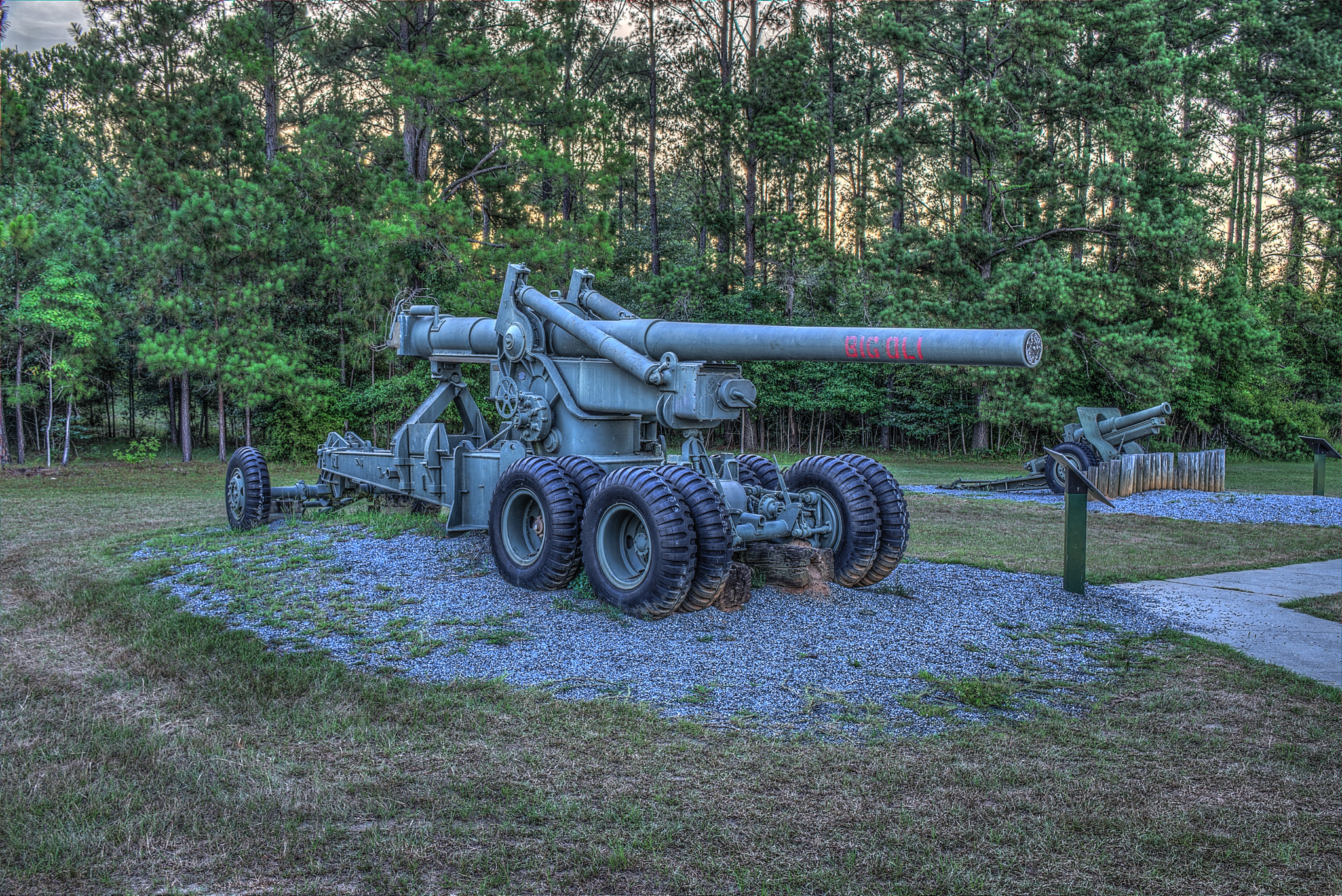
- International Artillery Museum, Saint Jo, Texas
- Fort Jackson, Columbia, South Carolina
- Battleship Memorial Park, Mobile, Alabama
- Timber Linn Park, Albany, Oregon
- US Army Ordnance Museum, Aberdeen, Maryland
- VFW Zachary Taylor Post 3784, Baton Rouge, Louisiana.
- Georgia Veterans Memorial State Park, Cordele, Georgia
- Fort Sill Field Artillery Museum, Fort Sill, Oklahoma
- Iowa Gold Star Military Museum, Camp Dodge, Johnston, Iowa
- VFW Post 2330, Searcy, AR
- Museum of American Armor, Old Bethpage, New York
- Scotland Meadows Park, New Castle, Pennsylvania
- General George Patton Museum and Center of Leadership, Fort Knox, Kentucky.
- VFW Post 61, Kansas City, MO
- Flying Heritage & Combat Armor Museum, Everett, WA
- Watervliet Arsenal, Watervliet, NY
- American Legion George Johns Post 447, Round Rock, Texas
- Camp Mabry, Austin, Texas
- Museum of the Kansas National Guard, Topeka, Kansas
Notes
References
- {{cite book
- {{cite book
- {{cite book
- {{cite book
- {{cite book | author-link = Steven Zaloga
- {{cite book
- {{cite book
- {{cite book
- {{cite book
- {{cite book
- {{cite book
References
- Foss, Christopher. (1977). "Jane's pocket book of towed artillery". Collier.
- http://morrisswett.contentdm.oclc.org/cdm/singleitem/collection/p15766coll2/id/529/rec/1 {{Webarchive. link. (2017-03-01 The Report of the Westervelt Board 1919 p 29-31)
- Hogg, Ian V.. (2001). "Allied Artillery of World War Two". Crowood Press, Ramsbury.
- https://tradocfcoeccafcoepfwprod.blob.core.usgovcloudapi.net/fires-bulletin-archive/1980/NOV_DEC_1980/NOV_DEC_1980_FULL_EDITION.pdf, p. 44
- TM 9-3305 p 2-8, Figure 2-12, M1 155-mm gun on M2 (Long Tom) carriage.
- "Breachblock".
- "TM 9-3305 p 5-1, Figure 5-2, Hand loading and ramming for weapons firing separate-loading ammunition".
- TM 9-3305 p 4-1, Figure 4-2. Lands and grooves and Figure 4-3. Projectile with rotating band.
- TM 9-3305 p 4-15, Figure 4-27 M13 firing mechanism.
- TM 9-3305 p 7-2, Figure 7-1, Top and bottom carriages.
- (November 1942). "Popular Science Magazine November 1942".
- TM 9-3305 p 2-11, Figure 2-18. M1 8-inch howitzer on M1 (M1 5) carriage.
- TM 9-3305 p 7-3, Figure 7-2, gun support assembly.
- TM 9-3305 p 7-7, Figure 7-6. Pneumatic equilibrator.
- Stanton, Shelby. (1984). "Order of Battle, U.S. Army, World War II". Presidio Press.
- Zaloga – ''US Field Artillery of World War II'', pp. 20–22.
- Zaloga, ''US Field Artillery of World War II'', p. 37.
- Hunnicutt – ''Sherman: A History of the American Medium Tank'', p 353–355, 570.
- Hunnicutt – ''Pershing, A History of the Medium Tank T20 Series'', p 158.
- ''Technical Manual TM 9-1901, Ammunition'', p 197–202.
- ''Technical Manual TM 9-1904, Ammunition Inspection Guide'', p 490–518.
- "TM9-1901 WAR DEPARTMENT TECHNICAL MANUAL ARTILLERY AMMUNITION".
- "Bunkermuseum Wurzenpass/Kärnten".
- "155mm Long Tom Gun {{!}} Fort Lytton Historic Military Precinct".
- "Artillery in Canada (10) Newfoundland and Labrador: St. John's, and HMCS Cabot".
- [[:File:PikiWiki Israel 32427 Israel Defense Forces.JPG]]
- "北千歳駐屯地基地祭レポート". Tori-meshi Blog.
- "土浦武器学校の3". Goinkyox.
- [[:File:Museum Bevrijdende Vleugels 3.JPG]]
This article was imported from Wikipedia and is available under the Creative Commons Attribution-ShareAlike 4.0 License. Content has been adapted to SurfDoc format. Original contributors can be found on the article history page.
Ask Mako anything about 155 mm gun M1 — get instant answers, deeper analysis, and related topics.
Research with MakoFree with your Surf account
Create a free account to save articles, ask Mako questions, and organize your research.
Sign up freeThis content may have been generated or modified by AI. CloudSurf Software LLC is not responsible for the accuracy, completeness, or reliability of AI-generated content. Always verify important information from primary sources.
Report