From Surf Wiki (app.surf) — the open knowledge base
14-3-3 protein
Family of conserved regulatory molecules
Family of conserved regulatory molecules
| Field | Value |
|---|---|
| Symbol | 14-3-3 |
| Name | 14-3-3 |
| image | File:2bq0 14-3-3.png |
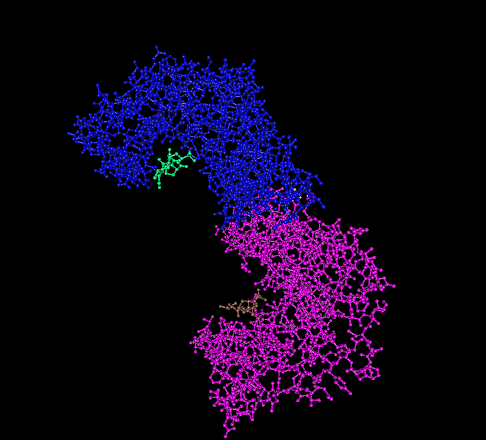
| caption | Cartoon diagram of Human 14-3-3 protein beta PDB entry |
| Pfam | PF00244 |
| InterPro | IPR000308 |
| SMART | 14_3_3 |
| PROSITE | PDOC00633 |
| SCOP | 1a4o |
14-3-3 proteins are a family of conserved regulatory molecules that are expressed in all eukaryotic cells. 14-3-3 proteins have the ability to bind a multitude of functionally diverse signaling proteins, including kinases, phosphatases, and transmembrane receptors. More than 200 signaling proteins have been reported as 14-3-3 ligands.
Elevated amounts of 14-3-3 protein in cerebrospinal fluid are usually a sign of rapid neurodegeneration; a common indicator of Creutzfeldt–Jakob disease.
Properties
Seven genes encode seven distinct 14-3-3 proteins in most mammals (See Human genes below) and 13–15 genes in many higher plants, though typically in fungi they are present only in pairs. Protists have at least one. Eukaryotes can tolerate the loss of a single 14-3-3 gene if multiple genes are expressed, but deletion of all 14-3-3s (as experimentally determined in yeast) results in death.
14-3-3 proteins are structurally similar to the Tetratrico Peptide Repeat (TPR) superfamily, which generally have 9 or 10 alpha helices, and usually form homo- and/or hetero-dimer interactions along their amino-termini helices. These proteins contain a number of known common modification domains, including regions for divalent cation interaction, phosphorylation & acetylation, and proteolytic cleavage, among others established and predicted.
14-3-3 binds to peptides. There are common recognition motifs for 14-3-3 proteins that contain a phosphorylated serine or threonine residue, although binding to non-phosphorylated ligands has also been reported. This interaction occurs along a so-called binding groove or cleft that is amphipathic in nature. To date, the crystal structures of six classes of these proteins have been resolved and deposited in the public domain.
| Canonical | C-terminal | Non-phos (ATP) |
|---|---|---|
| All entrys are in regular expression format. Newlines are added in "or" cases for readability. Phosphorylation sites are in bold. |
Discovery and naming
14-3-3 proteins were initially found in brain tissue in 1967 and purified using chromatography and gel electrophoresis. In bovine brain samples, 14-3-3 proteins were located in the 14th fraction eluting from a DEAE-cellulose column and in position 3.3 on a starch electrophoresis gel.
Function
14-3-3 proteins play an isoform-specific role in class switch recombination. They are believed to interact with the protein Activation-Induced (Cytidine) Deaminase in mediating class switch recombination.
Phosphorylation of Cdc25C by CDS1 and CHEK1 creates a binding site for the 14-3-3 family of phosphoserine binding proteins. Binding of 14-3-3 has little effect on Cdc25C activity, and it is believed that 14-3-3 regulates Cdc25C by sequestering it to the cytoplasm, thereby preventing the interactions with CycB-Cdk1 that are localized to the nucleus at the G2/M transition.
The eta (YWHAH) isoform is reported to be a biomarker (in synovial fluid) for rheumatoid arthritis. In a systematic review, 14-3-3η has been described as a welcome addition to the rheumatology field. The authors indicate that the serum based 14-3-3η marker is additive to the armamentarium of existing tools available to clinicians, and that there is adequate clinical evidence to support its clinical benefits in the management of patients diagnosed with rheumatoid arthritis (RA).
14-3-3 proteins bind to and sequester the transcriptional coregulators YAP/TAZ to the cytoplasm, inhibiting their function.
14-3-3 regulating cell-signalling
- Raf-1
- Bad – see Bcl-2
- Bax
- Cdc25
- Akt
- SOS1 – see RSK
Human genes
- – "14-3-3 beta"
- – "14-3-3 epsilon"
- – "14-3-3 gamma"
- – "14-3-3 eta"
- – "14-3-3 theta"
- – "14-3-3 zeta"
- or – "14-3-3 sigma" (Stratifin)
The 14-3-3 proteins alpha and delta (YWHAA and YWHAD) are phosphorylated forms of YWHAB and YWHAZ, respectively.
In plants
The presence of large gene families of 14-3-3 proteins in the Viridiplantae kingdom reflects their essential role in plant physiology. A phylogenetic analysis of 27 plant species clustered the 14-3-3 proteins into four groups.
14-3-3 proteins activate the auto-inhibited plasma membrane P-type H+ ATPases. They bind the ATPases' C-terminus at a conserved threonine.
References
References
- (2006). "Structural basis for protein-protein interactions in the 14-3-3 protein family.". Proc. Natl. Acad. Sci. U.S.A..
- (November 1999). "Increased levels of epsilon and gamma isoforms of 14-3-3 proteins in cerebrospinal fluid in patients with Creutzfeldt-Jakob disease". Clinical and Diagnostic Laboratory Immunology.
- (August 2005). "14-3-3 proteins: a number of functions for a numbered protein". Science's STKE.
- "ELM search: "14-3-3"".
- (July 2015). "14-3-3-Pred: improved methods to predict 14-3-3-binding phosphopeptides". Bioinformatics.
- (2006). "14-3-3 proteins: a historic overview". Semin Cancer Biol.
- (June 2012). "Immunoglobulin class-switch DNA recombination: induction, targeting and beyond". Nat Rev Immunol.
- (December 2007). "Regulation of the cellular DNA double-strand break response". Biochemistry and Cell Biology.
- (2007). "Detection of high levels of 2 specific isoforms of 14-3-3 proteins in synovial fluid from patients with joint inflammation". The Journal of Rheumatology.
- (June 2021). "The role of 14-3-3 η as a biomarker in rheumatoid arthritis". Rheumatology and Immunology Research..
- (2019). "YAPping about and not forgetting TAZ". FEBS Letters.
- (October 2012). "RSK phosphorylates SOS1 creating 14-3-3-docking sites and negatively regulating MAPK activation". The Biochemical Journal.
- (February 2002). "Post-translational modification of plant plasma membrane H(+)-ATPase as a requirement for functional complementation of a yeast transport mutant". The Journal of Biological Chemistry.
This article was imported from Wikipedia and is available under the Creative Commons Attribution-ShareAlike 4.0 License. Content has been adapted to SurfDoc format. Original contributors can be found on the article history page.
Ask Mako anything about 14-3-3 protein — get instant answers, deeper analysis, and related topics.
Research with MakoFree with your Surf account
Create a free account to save articles, ask Mako questions, and organize your research.
Sign up freeThis content may have been generated or modified by AI. CloudSurf Software LLC is not responsible for the accuracy, completeness, or reliability of AI-generated content. Always verify important information from primary sources.
Report