From Surf Wiki (app.surf) — the open knowledge base
135th Street station (IRT Lenox Avenue Line)
New York City Subway station in Manhattan
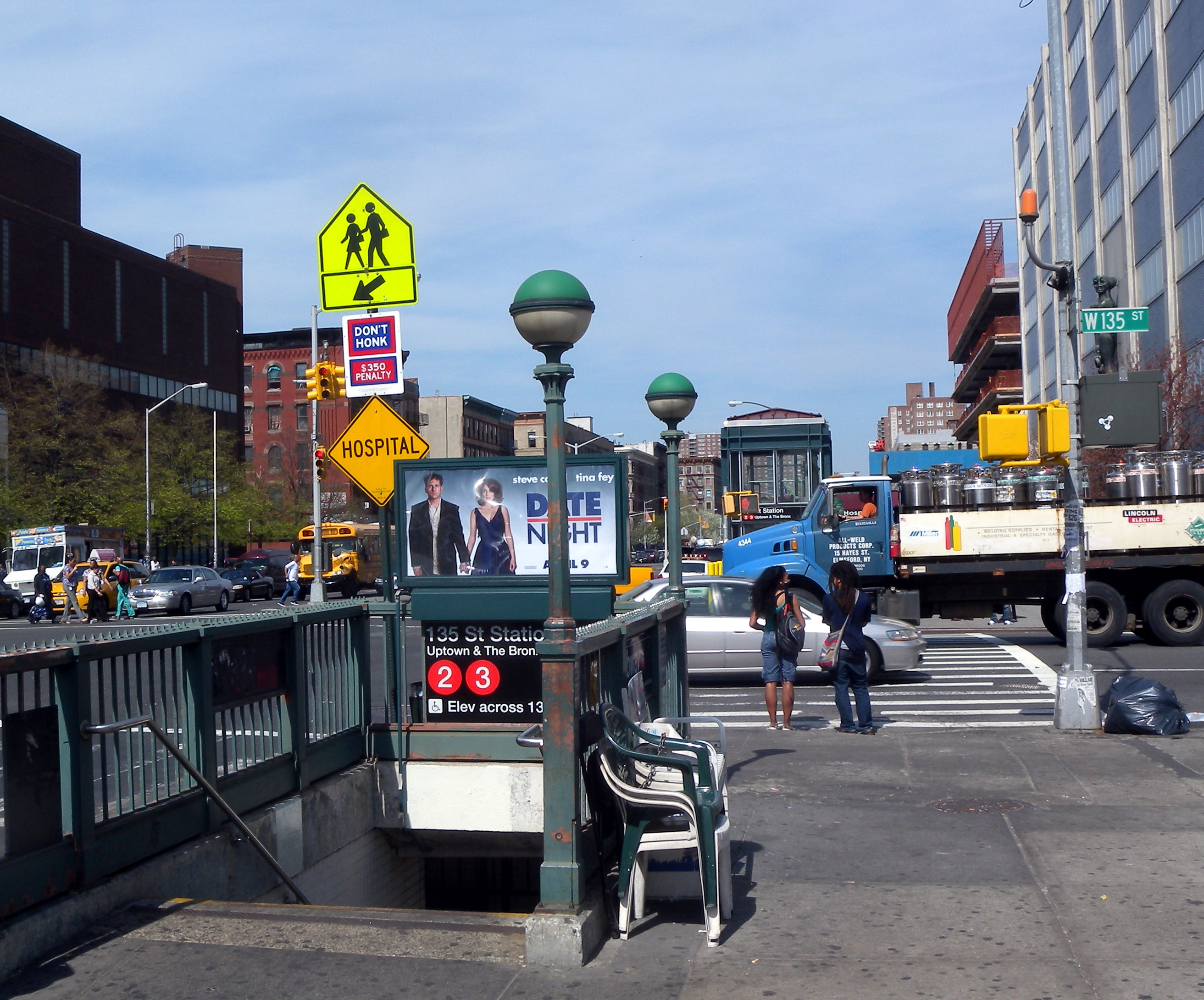
New York City Subway station in Manhattan
| Field | Value | ||
|---|---|---|---|
| name | 135 Street | ||
| accessible | yes | ||
| image | 135 St NB plat FC jeh.jpg | ||
| image_caption | Northbound platform | ||
| address | West 135th Street & Malcolm X Boulevard | ||
| New York, New York | |||
| borough | Manhattan | ||
| locale | Harlem | ||
| coordinates | |||
| division | IRT | ||
| line | IRT Lenox Avenue Line | ||
| service | Lenox south | ||
| other | NYCT Bus: | ||
| Short Line Bus: | |||
| platforms | 2 side platforms | ||
| tracks | 3 (2 in regular service) | ||
| cross_platform | same | ||
| structure | Underground | ||
| opened | |||
| services | {{Adjacent stations | system=New York City Subway | |
| line1 | Lenox via White Plains | left1=149th Street–Grand Concourse | right1=125th Street |
| line2 | Lenox north | left2=145th Street | right2=125th Street}} |
| footnotes | |||
| route_map | {{Routemap | inline=y | |
| legend | track |
New York, New York
Short Line Bus:
uvSTR!~MFADEg\uvSTRc2!~MFADEfq ~~ ~~ ~~ to
uvSTRfg!~uvSTRc2\uvSTR3+1!~MFADEfq~~ ~~ ~~ to
uvABZg+1v\uvSTRc4!~MFADEfq
uvSTR
uvÜST\numN330
uvSTRfg
uvSTR
udSTR\uvSHI2gl-\d
cPLT\uvSTR\udSTR\cPLT\d
cPLT\uvSTR\udSTR\cPLT\d
cPLT\uvSTR\udSTR\cPLT\d
cPLT\uvSTR\udSTR\cPLT\d
udSHI2g+l\uvSHI2r\d
uvSTRfg
uvSTR!MFADEf~ ~~ ~~to
The 135th Street station is a station on the IRT Lenox Avenue Line of the New York City Subway. Located at the intersection of 135th Street and Lenox Avenue in Harlem, it is served by the 2 and 3 trains at all times.
The 135th Street station was constructed for the Interborough Rapid Transit Company (IRT) as part of the city's first subway line, which was approved in 1900. Construction on the tunnel segment that includes the 135th Street station started on October 2 of the same year. The station opened on November 23, 1904. The station platforms were lengthened in 1910.
The 135th Street station contains two side platforms and three tracks. The station was built with tile and mosaic decorations. The platforms contain exits to Lenox Avenue's intersection with 135th Street and are not connected to each other within fare control. The platforms contain elevators from the street, which make the station compliant with the Americans with Disabilities Act of 1990.
History
Construction and opening
Planning for a subway line in New York City dates to 1864. However, development of what would become the city's first subway line did not start until 1894, when the New York State Legislature passed the Rapid Transit Act. The subway plans were drawn up by a team of engineers led by William Barclay Parsons, the Rapid Transit Commission's chief engineer. It called for a subway line from New York City Hall in lower Manhattan to the Upper West Side, where two branches would lead north into the Bronx. A plan was formally adopted in 1897, and legal challenges were resolved near the end of 1899. The Rapid Transit Construction Company, organized by John B. McDonald and funded by August Belmont Jr., signed the initial Contract 1 with the Rapid Transit Commission in February 1900, in which it would construct the subway and maintain a 50-year operating lease from the opening of the line. In 1901, the firm of Heins & LaFarge was hired to design the underground stations. Belmont incorporated the Interborough Rapid Transit Company (IRT) in April 1902 to operate the subway.
The 135th Street station was constructed as part of the IRT's East Side Branch (now the Lenox Avenue Line). Farrell & Hopper began building the section from 110th Street to 135th Street on August 30, 1900, subcontracting the section north of 116th Street to John C. Rodgers. The excavation was relatively easy because the subway was under one side of Lenox Avenue and there were no street railway tracks to work around.
On November 23, 1904, the East Side Branch opened to 145th Street. Initially, the station was served by East Side local and express trains. Local trains ran from City Hall to Lenox Avenue (145th Street). Express trains had their southern terminus at South Ferry or Atlantic Avenue and had their northern terminus at 145th Street or West Farms (180th Street). Express trains to 145th Street were eliminated in 1906, and West Farms express trains operated through to Atlantic Avenue in Brooklyn.
Service changes and station renovations
To address overcrowding, in 1909, the New York Public Service Commission proposed lengthening the platforms at stations along the original IRT subway. As part of a modification to the IRT's construction contracts made on January 18, 1910, the company was to lengthen station platforms to accommodate ten-car express and six-car local trains. In addition to $1.5 million (equivalent to $ million in ) spent on platform lengthening, $500,000 (equivalent to $ million in ) was spent on building additional entrances and exits. It was anticipated that these improvements would increase capacity by 25 percent. The platforms at the 135th Street station were extended 110 ft to the north and 30 ft to the south. On January 23, 1911, ten-car express trains began running on the East Side Branch.
In 1918, the Broadway–Seventh Avenue Line opened south of Times Square–42nd Street, and the original line was divided into an H-shaped system. Local trains were sent to South Ferry, while express trains used the new Clark Street Tunnel to Brooklyn.
The city government took over the IRT's operations on June 12, 1940. The IRT routes were given numbered designations with the introduction of "R-type" rolling stock. These fleet contained rollsigns with numbered designations for each service. The first such fleet, the R12, was put into service in 1948. The route to White Plains Road, formerly the route to West Farms, became known as the 2, while the route to Lenox Avenue–145th Street became the 3. The New York City Transit Authority (NYCTA) announced plans in 1956 to add fluorescent lights above the edges of the station's platforms. In 1959, all 2 and 3 trains became express.
Starting on March 2, 1998, the tunnel was reconstructed along with the cracked tunnel floor. This was done to correct a major water problem that had existed for many years due to the presence of the Harlem Creek and other underground streams, which caused extensive flooding, water damage, and seepage problems that occasionally contributed to severe service disruptions. The project cost $82 million and was finished on October 12, 1998. During the reconstruction, many trains were rerouted via the IRT Lexington Avenue Line, while the trains were rerouted to the 137th Street–City College station on the IRT Broadway–Seventh Avenue Line. Each of the two Lenox Avenue Line tracks were alternately taken out of service and supplemental shuttle bus service connecting to other lines in the area were provided for much of this time.
Station layout
| Side platform |
|---|
The station has three tracks and two side platforms; the center track is not used in regular service. The 2 and 3 trains stop here at all times. The next stop to the south is 125th Street, while the next stop to the north is 149th Street–Grand Concourse for trains and 145th Street for trains. The platforms were originally 350 ft long, like at other stations north of 96th Street. The platform extensions are at the north ends of the original platforms. Fixed platform barriers, which are intended to prevent commuters falling to the tracks, are positioned near the platform edges. Fare control is at platform level. There are no crossovers or crossunders between the two side platforms to allow free transfer between directions.
The northbound outer track merges with the center track just north of the station and the center track merges with the southbound outer one just south of the station. North of the station, a diamond crossover allows trains to switch between the two tracks. At the 142nd Street Junction, the 2 train provides service to the Bronx via the IRT White Plains Road Line while the 3 continues on the IRT Lenox Avenue Line to 145th Street and Harlem–148th Street.
Design

As with other stations built as part of the original IRT, the station was constructed using a cut-and-cover method. The tunnel is covered by a U-shaped trough that contains utility pipes and wires. This trough contains a foundation of concrete no less than 4 in thick. The platforms consist of 3 in concrete slabs, beneath which are drainage basins. The original platforms contain circular, cast-iron Doric-style columns spaced every 15 ft, while the platform extensions contain I-beam columns. Additional columns between the tracks, spaced every 5 ft, support the jack-arched concrete station roofs. There is a 1 in gap between the trough wall and the platform walls, which are made of 4 in-thick brick covered over by a tiled finish.
The original decorative scheme consisted of blue/green tile station-name tablets, violet tile bands, a white terracotta cornice, and green terracotta plaques. The mosaic tiles at all original IRT stations were manufactured by the American Encaustic Tile Company, which subcontracted the installations at each station. The decorative work was performed by tile contractor Manhattan Glass Tile Company and terracotta contractor Atlantic Terra Cotta Company. Many of the original name tablets have since been replaced with newer renditions, but most of the plaques remain intact.

The 1995 artwork here is called Harlem Timeline by Willie Birch. It features mosaics of notable Harlem residents on the station platforms. The one on the southbound side includes Adam Clayton Powell, Joe Louis, the Schomburg Center for Research in Black Culture, Charlie Parker, Clara Ward, and Louis Armstrong while one on the northbound side includes the Harlem Globetrotters, the NAACP, Abyssian Baptist Church, Cotton Club, and Randall's Island football team.
Exits
Each platform has one same-level fare control area at the center, containing a turnstile bank, token booth, two stairs to street-level, and an elevator. The northbound platform has exits to the eastern corners of Lenox Avenue and West 135th Street and the southbound side has exits to the western corners of that intersection. The elevators make this station fully ADA-accessible. The elevator for the southbound platform leads to the southwestern corner of West 135th Street and Lenox Avenue, while the elevator for the northbound platform leads to the northeastern corner.
References
References
- (1918). "Fifty Years of Rapid Transit — 1864 to 1917". Law Printing.
- (October 23, 1979). "Interborough Rapid Transit System, Underground Interior". [[New York City Landmarks Preservation Commission]].
- (1905). "Report of the Board of Rapid Transit Railroad Commissioners for the City of New York For The Year Ending December 31, 1904 Accompanied By Reports of the Chief Engineer and of the Auditor". Board of Rapid Transit Railroad Commissioners.
- Scott, Charles. (1978). "Design and Construction of the IRT: Civil Engineering". Historic American Engineering Record.
- (1910). "Report of the Public Service Commission For The First District of the State of New York For The Year Ending December 31, 1909". Public Service Commission.
- (November 23, 1904). "East Side Subway Open — Train from 145th Street to Broadway in 9 Minutes and 40 Seconds". The New York Times.
- (March 1906). "The Merchants' Association of New York Pocket Guide to New York". Merchants' Association of New York.
- (1916). "Brooklyn Daily Eagle Almanac". Brooklyn Daily Eagle.
- Hood, Clifton. (1978). "The Impact of the IRT in New York City". Historic American Engineering Record.
- (1911). "Report of the Public Service Commission for the First District of the State of New York For The Year Ending December 31, 1910". Public Service Commission.
- (January 23, 1911). "Ten-car Trains in Subway to-day; New Service Begins on Lenox Av. Line and Will Be Extended to Broadway To-morrow.". The New York Times.
- (August 2, 1918). "Open New Subway Lines to Traffic; Called a Triumph — Great H System Put in Operation Marks an Era in Railroad Construction — No Hitch in the Plans — But Public Gropes Blindly to Find the Way in Maze of New Stations — Thousands Go Astray — Leaders in City's Life Hail Accomplishment of Great Task at Meeting at the Astor". The New York Times.
- (1940-06-13). "City Transit Unity Is Now a Reality; Title to I.R.T. Lines Passes to Municipality, Ending 19-Year Campaign". The New York Times.
- (June 13, 1940). "Transit Unification Completed As City Takes Over I. R. T. Lines: Systems Come Under Single Control After Efforts Begun in 1921; Mayor Is Jubilant at City Hall Ceremony Recalling 1904 Celebration". New York Herald Tribune.
- Brown, Nicole. (May 17, 2019). "How did the MTA subway lines get their letter or number? NYCurious".
- (April 1960). "A Summary of Services on the IRT Division, NYCTA". Electric Railroaders' Association.
- Katz, Ralph. (1956-01-27). "Subway Stations to Get New Lights; $3,750,000 to Be Spent on Fluorescents for I.R.T. and B.M.T. Transfer Points". The New York Times.
- (February 7, 1959). "Wagner Praises Modernized IRT — Mayor and Transit Authority Are Hailed as West Side Changes Take Effect". The New York Times.
- "New York City Transit - History and Chronology". Metropolitan Transportation Authority.
- Lii, Jane H.. (February 28, 1998). "Tunnel Work To Cut Service On 2 Subways". The New York Times.
- Lueck, Thomas J.. (October 13, 1998). "Beating Deadline, Normal Service Returns for the Nos. 2 and 3 Subway Lines". The New York Times.
- Newman, Andy. (December 12, 1997). "Repairs to Lenox Ave. Tunnel To Affect Many Subway Lines". The New York Times.
- (1998). "Lenox Rehab '98 2 3 Lenox Line Service Guide March 2-October 1998". New York City Transit.
- {{NYCS const. trackref. trackbook3
- {{NYCS const. timetable. 2
- {{NYCS const. timetable. 3
- {{NYCS const. map
- Wassef, Mira. (July 18, 2025). "Platform barriers installed at 56 subway stations in NYC".
- Russo-Lennon, Barbara. (July 20, 2025). "These are the NYC subway stations that now have protective platform barriers".
- Framberger, David J.. (1978). "Architectural Designs for New York's First Subway". Historic American Engineering Record.
- "135th Street - Willie Birch - Harlem Timeline, 1995". Metropolitan Transportation Authority.
- "Artwork: Harlem Timeline (Willie Birch)".
- {{Cite NYC neighborhood map. Harlem/Hamilton Heights
This article was imported from Wikipedia and is available under the Creative Commons Attribution-ShareAlike 4.0 License. Content has been adapted to SurfDoc format. Original contributors can be found on the article history page.
Ask Mako anything about 135th Street station (IRT Lenox Avenue Line) — get instant answers, deeper analysis, and related topics.
Research with MakoFree with your Surf account
Create a free account to save articles, ask Mako questions, and organize your research.
Sign up freeThis content may have been generated or modified by AI. CloudSurf Software LLC is not responsible for the accuracy, completeness, or reliability of AI-generated content. Always verify important information from primary sources.
Report