From Surf Wiki (app.surf) — the open knowledge base
120-cell
Four-dimensional analog of the dodecahedron

Four-dimensional analog of the dodecahedron
| Field | Value | ||
|---|---|---|---|
| Name | 120-cell | ||
| Image_File | Schlegel wireframe 120-cell.png | ||
| Image_Caption | Schlegel diagram | ||
| (vertices and edges) | |||
| Type | Convex regular 4-polytope | ||
| Last | 31 | ||
| Index | 32 | ||
| Next | 33 | ||
| Schläfli | {5,3,3} | ||
| CD | |||
| Cell_List | 120 {5,3} [[Image:Dodecahedron.png | 20px]] | |
| Face_List | 720 {5} [[File:Regular pentagon.svg | 20px]] | |
| Edge_Count | 1200 | ||
| Vertex_Count | 600 | ||
| Petrie_Polygon | 30-gon | ||
| Coxeter_Group | H4, [3,3,5] | ||
| Vertex_Figure | [[File:120-cell verf.svg | 80px]] | |
| tetrahedron | |||
| Dual | [600-cell](600-cell) | ||
| Property_List | convex, isogonal, isotoxal, isohedral |
(vertices and edges) CD=| Cell_List=120 {5,3} [[Image:Dodecahedron.png|20px]]| Face_List=720 {5} [[File:Regular pentagon.svg|20px]]| Edge_Count=1200| Vertex_Count= 600| Petrie_Polygon=30-gon| Coxeter_Group=H4, [3,3,5]| Vertex_Figure=[[File:120-cell verf.svg|80px]] tetrahedron| Dual=600-cell| Property_List=convex, isogonal, isotoxal, isohedral
In geometry, the 120-cell is the convex regular 4-polytope (four-dimensional analogue of a Platonic solid) with Schläfli symbol {5,3,3}. It is also called a C120, dodecaplex (short for "dodecahedral complex"), hyperdodecahedron, polydodecahedron, hecatonicosachoron, dodecacontachoron and hecatonicosahedroid.
The boundary of the 120-cell is composed of 120 dodecahedral cells with 4 meeting at each vertex. Together they form 720 pentagonal faces, 1200 edges, and 600 vertices. It is the 4-dimensional analogue of the regular dodecahedron, since just as a dodecahedron has 12 pentagonal facets, with 3 around each vertex, the dodecaplex has 120 dodecahedral facets, with 3 around each edge. Its dual polytope is the 600-cell.
Geometry
The 120-cell incorporates the geometries of every convex regular polytope in the first four dimensions (except the polygons {7} and above). As the sixth and largest regular convex 4-polytope, it contains inscribed instances of its four predecessors (recursively). It also contains 120 inscribed instances of the first in the sequence, the 5-cell, which is not found in any of the others.
The 120-cell contains examples of every relationship among all the convex regular polytopes found in the first four dimensions. Conversely, it can only be understood by first understanding each of its predecessors, and the sequence of increasingly complex symmetries they exhibit.{{Sfn|Dechant|2021|loc=Abstract|ps=; "[E]very 3D root system allows the construction of a corresponding 4D root system via an ‘induction theorem’. In this paper, we look at the icosahedral case of H3 → H4 in detail and perform the calculations explicitly. Clifford algebra is used to perform group theoretic calculations based on the versor theorem and the Cartan-Dieudonné theorem ... shed[ding] light on geometric aspects of the H4 root system (the 600-cell) as well as other related polytopes and their symmetries ... including the construction of the Coxeter plane, which is used for visualising the complementary pairs of invariant polytopes.... This approach therefore constitutes a more systematic and general way of performing calculations concerning groups, in particular reflection groups and root systems, in a Clifford algebraic framework."}} That is why Stillwell titled his paper on the 4-polytopes and the history of mathematics of more than 3 dimensions The Story of the 120-cell.
Cartesian coordinates
Natural Cartesian coordinates for a 4-polytope centered at the origin of 4-space occur in different frames of reference, depending on the long radius (center-to-vertex) chosen.
√8 radius coordinates
The 120-cell with long radius = 2 ≈ 2.828 has edge length 4−2φ = 3− ≈ 0.764.
In this frame of reference, its 600 vertex coordinates are the {permutations} and of the following:
| 24 | 64 | 64 | 64 | 96 | 96 | 192 |
|---|---|---|---|---|---|---|
| ({0, 0, ±2, ±2}) | [24-cell](24-cell-squares) | 600-point 120-cell | ||||
| ({±φ, ±φ, ±φ, ±φ−2}) | ||||||
| ({±1, ±1, ±1, ±}) | ||||||
| ({±φ−1, ±φ−1, ±φ−1, ±φ2}) | ||||||
| ([0, ±φ−1, ±φ, ±]) | Snub 24-cell | |||||
| ([0, ±φ−2, ±1, ±φ2]) | Snub 24-cell | |||||
| ([±φ−1, ±1, ±φ, ±2]) |
where φ (also called 𝝉) is the golden ratio, ≈ 1.618.
Unit radius coordinates
The unit-radius 120-cell has edge length ≈ 0.270.
In this frame of reference the 120-cell lies vertex up in standard orientation, and its coordinates are the {permutations} and in the left column below:
| 120 | 8 | 16 | 96 | 480 | Diminished 120-cell | 5-point [5-cell](5-cell-coordinates) | [24-cell](24-cell-squares) | [600-cell](600-cell-coordinates) | 32 | 32 | 32 | 96 | 96 | 192 |
|---|---|---|---|---|---|---|---|---|---|---|---|---|---|---|
| ({±1, 0, 0, 0}) | [16-cell](16-cell-coordinates) | [24-cell](24-cell-hexagons) | [600-cell](600-cell-coordinates) | 120-cell | ||||||||||
| ({±1, ±1, ±1, ±1}) / 2 | Tesseract | |||||||||||||
| ([0, ±φ−1, ±1, ±φ]) / 2 | Snub 24-cell | |||||||||||||
| ([±φ, ±φ, ±φ, ±φ−2]) / | (1, 0, 0, 0) | |||||||||||||
| ({±, ±, 0, 0}) | ({±1, 0, 0, 0}) | |||||||||||||
| ([±1, ±1, ±1, ±]) / | ||||||||||||||
| ([±φ−1, ±φ−1, ±φ−1, ±φ2]) / | ||||||||||||||
| ([0, ±φ−1, ±φ, ±]) / | ||||||||||||||
| ([0, ±φ−2, ±1, ±φ2]) / | ||||||||||||||
| ([±φ−1, ±1, ±φ, ±2]) / | ||||||||||||||
| The unit-radius coordinates of uniform convex 4-polytopes are related by quaternion multiplication. Since the regular 4-polytopes are compounds of each other, their sets of Cartesian 4-coordinates (quaternions) are set products of each other. The unit-radius coordinates of the 600 vertices of the 120-cell (in the left column above) are all the possible quaternion products{{Sfn | Mamone | Pileio | Levitt | 2010 | p=1433 | loc=§4.1 | ps=; A Cartesian 4-coordinate point (w,x,y,z) is a vector in 4D space from (0,0,0,0). Four-dimensional real space is a vector space: any two vectors can be added or multiplied by a scalar to give another vector. Quaternions extend the vectorial structure of 4D real space by allowing the multiplication of two 4D vectors \left(w,x,y,z\right)_1 and \left(w,x,y,z\right)_2 according to |
The table gives the coordinates of at least one instance of each 4-polytope, but the 120-cell contains multiples-of-five inscribed instances of each of its precursor 4-polytopes, occupying different subsets of its vertices. The (600-point) 120-cell is the convex hull of 5 disjoint (120-point) 600-cells. Each (120-point) 600-cell is the convex hull of 5 disjoint (24-point) 24-cells, so the 120-cell is the convex hull of 25 disjoint 24-cells. Each 24-cell is the convex hull of 3 disjoint (8-point) 16-cells, so the 120-cell is the convex hull of 75 disjoint 16-cells. Uniquely, the (600-point) 120-cell is the convex hull of 120 disjoint (5-point) 5-cells.
Chords
The 600-point 120-cell has all 8 of the 120-point 600-cell's distinct chord lengths, plus two additional important chords: its own shorter edges, and the edges of its 120 inscribed regular 5-cells. These two additional chords give the 120-cell its characteristic isoclinic rotation, in addition to all the rotations of the other regular 4-polytopes which it inherits. They also give the 120-cell a characteristic great circle polygon: an irregular great hexagon in which three 120-cell edges alternate with three 5-cell edges.
The 120-cell's edges do not form regular great circle polygons in a single central plane the way the edges of the 600-cell, 24-cell, and 16-cell do. Like the edges of the 5-cell and the 8-cell tesseract, they form zig-zag Petrie polygons instead. The 120-cell's Petrie polygon is a triacontagon {30} zig-zag skew polygon.
Since the 120-cell has a circumference of 30 edges, it has 15 distinct chord lengths, ranging from its edge length to its diameter. Every regular convex 4-polytope is inscribed in the 120-cell, and the 15 chords enumerated in the rows of the following table are all the distinct chords that make up the regular 4-polytopes and their great circle polygons.
The first thing to notice about this table is that it has eight columns, not six; in addition to the six regular convex 4-polytopes, two irregular 4-polytopes occur naturally in the sequence of nested 4-polytopes: the 96-point snub 24-cell and the 480-point diminished 120-cell.
The second thing to notice is that each numbered row (each chord) is marked with a triangle △, square ☐, phi symbol 𝜙 or pentagram ✩. The 15 chords form polygons of four kinds: great squares ☐ characteristic of the 16-cell, great hexagons and great triangles △ characteristic of the 24-cell, great decagons and great pentagons 𝜙 characteristic of the 600-cell, and skew pentagrams ✩ characteristic of the 5-cell which circle through a set of central planes and form face polygons but not great polygons.
| Chords of the 120-cell and its inscribed 4-polytopes | Inscribed | [5-cell](5-cell) | [16-cell](16-cell) | [8-cell](8-cell) | [24-cell](24-cell) | Snub | [600-cell](600-cell) | Dimin | 120-cell | Vertices | Edges | Edge chord | [Isocline chord](600-cell-rotations-on-polygram-isoclines) | Clifford polygon | Chord | Arc | Edge | Squared lengths total | |
|---|---|---|---|---|---|---|---|---|---|---|---|---|---|---|---|---|---|---|---|
| 5 | 8 | 16 | 24 | 96 | 120 | 480 | 600 | ||||||||||||
| 10 | 24 | 32 | 96 | 432 | 720 | 1200 | 1200 | ||||||||||||
| #8 | #7 | #5 | #5 | #3 | #3 | #1 | #1 | ||||||||||||
| [#8](5-cell-geodesics-and-rotations) | [#15](16-cell-helical-construction) | #10 | [#10](24-cell-helical-hexagrams-and-their-isoclines) | #5 | [#5](600-cell-decagons-and-pentadecagrams) | #4 | #4 | ||||||||||||
| [{5/2}](5-cell-boerdijk-coxeter-helix) | [{8/3}](16-cell-helical-construction) | [{6/2}](24-cell-helical-hexagrams-and-their-isoclines) | [{15/2}](600-cell-decagons-and-pentadecagrams) | {15/4} | |||||||||||||||
| #1 | |||||||||||||||||||
| △ | [[File:Regular_polygon_30.svg | 50px | {30}]] | 30 | 120-cell edge | ||||||||||||||
| 1200 | |||||||||||||||||||
| {3,3} | |||||||||||||||||||
| 15.5~° | {{Efn | 1=The fractional square root chord lengths are given as decimal fractions where: | 0.270~ | ||||||||||||||||
| #2 | |||||||||||||||||||
| ☐ | [[File:Regular_star_figure_2(15,1).svg | 50px | {30/2}=2{15}]] | 15 | face diagonal | ||||||||||||||
| 3600 | |||||||||||||||||||
| 2{3,4} | |||||||||||||||||||
| 25.2~° | 0.437~ | ||||||||||||||||||
| #3 | |||||||||||||||||||
| 𝜙 | [[File:Regular_star_figure_3(10,1).svg | 50px | {30/3}=3{10}]] | 10 | 𝝅/5 | [great decagon](600-cell-decagons) \phi^{-1} | |||||||||||||
| 720 | |||||||||||||||||||
| 7200 | |||||||||||||||||||
| 2{3,5} | |||||||||||||||||||
| 36° | 0.618~ | ||||||||||||||||||
| #4 | |||||||||||||||||||
| △ | [[File:Regular_star_figure_2(15,2).svg | 50px | {30/4}=2{15/2}]] | cell diameter{{Efn | name=dodecahedral cell metrics}} | ||||||||||||||
| 1200 | |||||||||||||||||||
| {3,3} | |||||||||||||||||||
| 44.5~° | 0.757~ | ||||||||||||||||||
| #5 | |||||||||||||||||||
| △ | [[File:Regular_star_figure_5(6,1).svg | 50px | {30/5}=5{6}]] | 6 | 𝝅/3 | [great hexagon](600-cell-hexagons) | |||||||||||||
| 32 | |||||||||||||||||||
| 96 | |||||||||||||||||||
| 1200 | |||||||||||||||||||
| 2400 | |||||||||||||||||||
| 4{4,3} | |||||||||||||||||||
| 60° | 1 | ||||||||||||||||||
| #6 | |||||||||||||||||||
| 𝜙 | [[File:Regular_star_figure_6(5,1).svg | 50px | {30/6}=6{5}]] | 5 | 2𝝅/5 | [great pentagon](600-cell-decagons-and-pentadecagrams) | |||||||||||||
| 720 | |||||||||||||||||||
| 7200 | |||||||||||||||||||
| 2{3,5} | |||||||||||||||||||
| 72° | 1.175~ | ||||||||||||||||||
| #7 | |||||||||||||||||||
| ☐ | [[File:Regular_star_polygon_30-7.svg | 50px | {30/7}]] | 𝝅/2 | [great square](600-cell-squares) | ||||||||||||||
| 24 | |||||||||||||||||||
| 48 | |||||||||||||||||||
| 72 | |||||||||||||||||||
| 1800 | |||||||||||||||||||
| 9000 | |||||||||||||||||||
| 9{3,4} | |||||||||||||||||||
| 90° | 1.414~ | ||||||||||||||||||
| #8 | |||||||||||||||||||
| ✩ | [[File:Regular_star_figure_2(15,4).svg | 50px | {30/8}=2{15/4}]] | [5-cell edge](5-cell-boerdijk-coxeter-helix) | |||||||||||||||
| 10 | |||||||||||||||||||
| 720 | |||||||||||||||||||
| 1200 | |||||||||||||||||||
| {3,3} | |||||||||||||||||||
| 104.5~° | 1.581~ | ||||||||||||||||||
| #9 | |||||||||||||||||||
| 𝜙 | [[File:Regular_star_figure_3(10,3).svg | 50px | {30/9}=3{10/3}]] | 3𝝅/5 | golden section \phi | ||||||||||||||
| 720 | |||||||||||||||||||
| 7200 | |||||||||||||||||||
| 2{3,5} | |||||||||||||||||||
| 108° | 1.618~ | ||||||||||||||||||
| #10 | |||||||||||||||||||
| △ | [[File:Regular_star_figure_10(3,1).svg | 50px | {30/10}=10{3}]] | 3 | 2𝝅/3 | [great triangle](24-cell-triangles) | |||||||||||||
| 32 | |||||||||||||||||||
| 96 | |||||||||||||||||||
| 1200 | |||||||||||||||||||
| 2400 | |||||||||||||||||||
| 4{4,3} | |||||||||||||||||||
| 120° | 1.732~ | ||||||||||||||||||
| #11 | |||||||||||||||||||
| ✩ | [[File:Regular_star_polygon_30-11.svg | 50px | {30/11}]] | [{30/11}-gram](600-cell-boerdijk-coxeter-helix-rings) | |||||||||||||||
| 1200 | |||||||||||||||||||
| {3,3} | |||||||||||||||||||
| 135.5~° | 1.851~ | ||||||||||||||||||
| #12 | |||||||||||||||||||
| 𝜙 | [[File:Regular_star_figure_6(5,2).svg | 50px | {30/12}=6{5/2}]] | 4𝝅/5 | great pent diag | ||||||||||||||
| 720 | |||||||||||||||||||
| 7200 | |||||||||||||||||||
| 2{3,5} | |||||||||||||||||||
| 144° | 1.902~ | ||||||||||||||||||
| #13 | |||||||||||||||||||
| ✩ | [[File:Regular_star_polygon_30-13.svg | 50px | {30/13}]] | {30/13}-gram | |||||||||||||||
| 3600 | |||||||||||||||||||
| 2{3,4} | |||||||||||||||||||
| 154.8~° | 1.952~ | ||||||||||||||||||
| #14 | |||||||||||||||||||
| △ | [[File:Regular_star_figure_2(15,7).svg | 50px | {30/14}=2{15/7}]] | {30/14}=2{15/7} | |||||||||||||||
| 1200 | |||||||||||||||||||
| {3,3} | |||||||||||||||||||
| 164.5~° | 1.982~ | ||||||||||||||||||
| #15 | |||||||||||||||||||
| △☐𝜙 | [[File:Regular_star_figure_15(2,1).svg | 50px | 30/15}=15{2}]] | 2 | 𝝅 | diameter | |||||||||||||
| 4 | |||||||||||||||||||
| 8 | |||||||||||||||||||
| 12 | |||||||||||||||||||
| 48 | |||||||||||||||||||
| 60 | |||||||||||||||||||
| 240 | |||||||||||||||||||
| 300 | |||||||||||||||||||
| 180° | 2 | ||||||||||||||||||
| 25 | 64 | 256 | 576 | 14400 | 360000 |

The annotated chord table is a complete bill of materials for constructing the 120-cell. All of the 2-polytopes, 3-polytopes and 4-polytopes in the 120-cell are made from the 15 1-polytopes in the table.
The black integers in table cells are incidence counts of the row's chord in the column's 4-polytope. For example, in the #3 chord row, the 600-cell's 72 great decagons contain 720 #3 chords in all.
The **** integers are the number of disjoint 4-polytopes above (the column label) which compounded form a 120-cell. For example, the 120-cell is a compound of disjoint 24-cells (25 * 24 vertices = 600 vertices).
The **** integers are the number of distinct 4-polytopes above (the column label) which can be picked out in the 120-cell. For example, the 120-cell contains distinct 24-cells which share components.
The **** integers in the right column are incidence counts of the row's chord at each 120-cell vertex. For example, in the #3 chord row, #3 chords converge at each of the 120-cell's 600 vertices, forming a double icosahedral vertex figure 2{3,5}. In total major chords of 15 distinct lengths meet at each vertex of the 120-cell.
Relationships among interior polytopes
The 120-cell is the compound of all five of the other regular convex 4-polytopes. All the relationships among the regular 1-, 2-, 3- and 4-polytopes occur in the 120-cell. It is a four-dimensional jigsaw puzzle in which all those polytopes are the parts. Although there are many sequences in which to construct the 120-cell by putting those parts together, ultimately they only fit together one way. The 120-cell is the unique solution to the combination of all these polytopes.
The regular 1-polytope occurs in only 15 distinct lengths in any of the component polytopes of the 120-cell. By Alexandrov's uniqueness theorem, convex polyhedra with shapes distinct from each other also have distinct metric spaces of surface distances, so each regular 4-polytope has its own unique subset of these 15 chords.
Only 4 of those 15 chords occur in the 16-cell, 8-cell and 24-cell. The four , , and are sufficient to build the 24-cell and all its component parts. The 24-cell is the unique solution to the combination of these 4 chords and all the regular polytopes that can be built from them.
An additional 4 of the 15 chords are required to build the 600-cell. The four are square roots of irrational fractions that are functions of . The 600-cell is the unique solution to the combination of these 8 chords and all the regular polytopes that can be built from them. Notable among the new parts found in the 600-cell which do not occur in the 24-cell are pentagons, and icosahedra.
All 15 chords, and 15 other distinct chordal distances enumerated below, occur in the 120-cell. Notable among the new parts found in the 120-cell which do not occur in the 600-cell are The relationships between the regular 5-cell (the simplex regular 4-polytope) and the other regular 4-polytopes are manifest directly only in the 120-cell. The 600-point 120-cell is a compound of 120 disjoint 5-point 5-cells, and it is also a compound of 5 disjoint 120-point 600-cells (two different ways). Each 5-cell has one vertex in each of 5 disjoint 600-cells, and therefore in each of 5 disjoint 24-cells, 5 disjoint 8-cells, and 5 disjoint 16-cells. Each 5-cell is a ring (two different ways) joining 5 disjoint instances of each of the other regular 4-polytopes.
Compound of five 600-cells
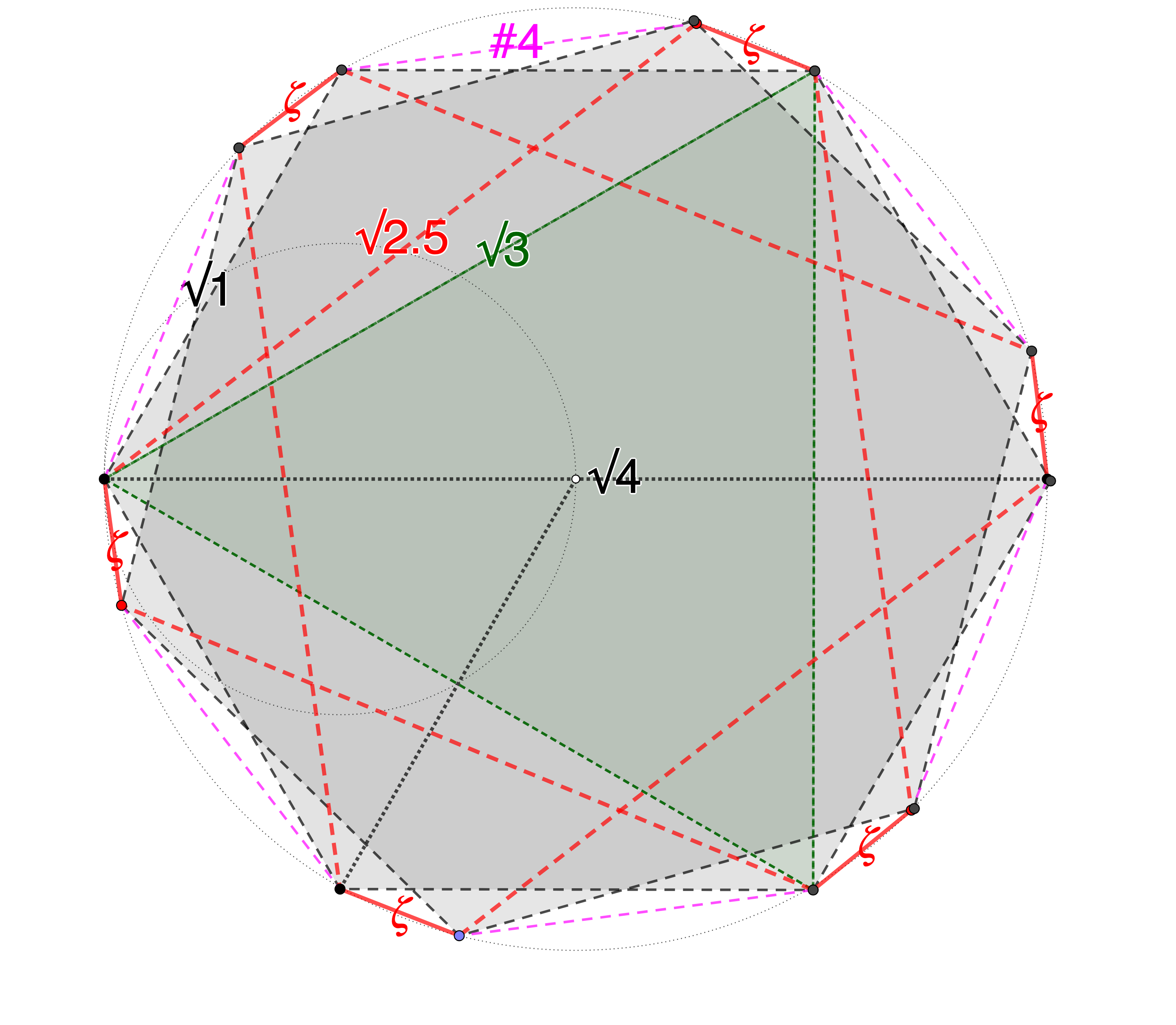
The 120-cell contains ten 600-cells which can be partitioned into five completely disjoint 600-cells two different ways. As a consequence of being a compound of five disjoint 600-cells, the 120-cell has 200 irregular great dodecagon {12} central planes, which are compounds of several of its great circle polygons that share the same central plane, as illustrated. The 200 {12} central planes originate as the compounds of the hexagonal central planes of the 25 disjoint inscribed 24-cells and the digon central planes of the 120 disjoint inscribed regular 5-cells; they contain all the 24-cell and 5-cell edges, and also the 120-cell edges. Thus the edges and characteristic rotations of the regular 5-cell, the 8-cell hypercube, the 24-cell, and the 120-cell all lie in these same 200 rotation planes. Each of the ten 600-cells occupies the entire set of 200 planes.
The 120-cell's irregular dodecagon {12} great circle polygon has 6 short edges (#1 chords marked ) alternating with 6 longer dodecahedron cell-diameters ( chords). Inscribed in the irregular great dodecagon are two irregular great hexagons () in alternate positions. Two regular great hexagons with edges of a third size (, the #5 chord) are also inscribed in the dodecagon. The 120-cell's irregular great dodecagon planes, its irregular great hexagon planes, its regular great hexagon planes, and its equilateral great triangle planes, are the same set of 200 dodecagon planes. They occur as 100 completely orthogonal pairs, and they are the same 200 central planes each containing a hexagon that are found in each of the 10 inscribed 600-cells.
There are exactly 400 regular hexagons in the 120-cell (two in each dodecagon central plane), and each of the ten 600-cells contains its own distinct subset of 200 of them (one from each dodecagon central plane). Each 600-cell contains only one of the two opposing regular hexagons inscribed in any dodecagon central plane, just as it contains only one of two opposing tetrahedra inscribed in any dodecahedral cell. Each 600-cell is disjoint from 4 other 600-cells, and shares regular hexagons with 5 other 600-cells. Each disjoint pair of 600-cells occupies the opposing pair of disjoint regular hexagons in every dodecagon central plane. Each non-disjoint pair of 600-cells intersects in 16 hexagons that comprise a 24-cell. The 120-cell contains 9 times as many distinct 24-cells (225) as disjoint 24-cells (25). Each 24-cell occurs in 9 600-cells, is absent from just one 600-cell, and is shared by two 600-cells.
Geodesic rectangles
The 30 distinct chords found in the 120-cell occur as 15 pairs of 180° complements. They form 15 distinct kinds of great circle polygon that lie in central planes of several kinds: in an irregular great dodecagon, in a regular decagon, and ☐ planes that intersect {4} vertices in several kinds of , including a .
Each great circle polygon is characterized by its pair of 180° complementary chords. The chord pairs form great circle polygons with parallel opposing edges, so each great polygon is either a rectangle or a compound of a rectangle, with the two chords as the rectangle's edges.
Each of the 15 complementary chord pairs corresponds to a distinct pair of opposing polyhedral sections of the 120-cell, beginning with a vertex, the 00 section. The correspondence is that each 120-cell vertex is surrounded by each polyhedral section's vertices at a uniform distance (the chord length), the way a polyhedron's vertices surround its center at the distance of its long radius. The #1 chord is the "radius" of the 10 section, the tetrahedral vertex figure of the 120-cell. The #14 chord is the "radius" of its congruent opposing 290 section. The #7 chord is the "radius" of the central section of the 120-cell, in which two opposing 150 sections are coincident.
| 30 chords (15 180° pairs) make 15 kinds of great circle polygons and polyhedral sections | Short chord | Great circle polygons | Long chord | |
|---|---|---|---|---|
| 10 | ||||
| #1 | 1 / \phi^2\sqrt{2} | [[File:Irregular great hexagons of the 120-cell.png | 100px]] | |
| 15.5~° | 0.270~ | 164.5~° | ||
| 20 | ||||
| #2 | 1 / \phi\sqrt{2} | [[File:25.2° × 154.8° chords great rectangle.png | 100px]] | |
| 25.2~° | 0.437~ | 154.8~° | ||
| 30 | ||||
| #3 | \pi / 5 | 1 / \phi | [[File:Great decagon rectangle.png | 100px]] |
| 36° | 0.618~ | 144° | ||
| 40 | ||||
| #3~4 | \sqrt{1}/\sqrt{2} | [[File:√0.5 × √3.5 great rectangle.png | 100px]] | |
| 41.4~° | 0.707~ | 138.6~° | ||
| 50 | ||||
| #4 | \sqrt{3} / \phi\sqrt{2} | [[File:Irregular great dodecagon.png | 100px]] | |
| 44.5~° | 0.757~ | 135.5~° | ||
| 60 | ||||
| #4~5 | [[File:49.1° × 130.9° great rectangle.png | 100px]] | ||
| 49.1~° | 0.831~ | 130.9~° | ||
| 70 | ||||
| #4~5~5 | [[File:56° × 124° great rectangle.png | 100px]] | ||
| 56° | 0.939~ | 124° | ||
| 80 | ||||
| #5 | \pi / 3 | [[File:Great hexagon.png | 100px]] | |
| 60° | 1 | 120° | ||
| 90 | ||||
| #5~6 | [[File:66.1° × 113.9° great rectangle.png | 100px]] | ||
| 66.1~° | 1.091~ | 113.9~° | ||
| 100 | ||||
| #5~6~6 | [[File:69.8° × 110.2° great rectangle.png | 100px]] | ||
| 69.8~° | 1.144~ | 110.2~° | ||
| 110 | ||||
| #6 | 2\pi/5 | \sqrt{3-\phi} | [[File:Great pentagons rectangle.png | 100px]] |
| 72° | 1.175~ | 108° | ||
| 120 | ||||
| #6~6~7 | \sqrt{3} / \sqrt{2} | [[File:Great 5-cell digons rectangle.png | 100px]] | |
| 75.5~° | 1.224~ | 104.5~° | ||
| 130 | ||||
| #6~7 | [[File:81.1° × 98.9° great rectangle.png | 100px]] | ||
| 81.1~° | 1.300~ | 98.9~° | ||
| 140 | ||||
| #6~7~7 | [[File:84.5° × 95.5° great rectangle.png | 100px]] | ||
| 84.5~° | 1.345~ | 95.5~° | ||
| 150 | ||||
| #7 | \pi / 2 | [[File:Great square rectangle.png | 100px]] | |
| 90° | 1.414~ | 90° |
Concentric hulls
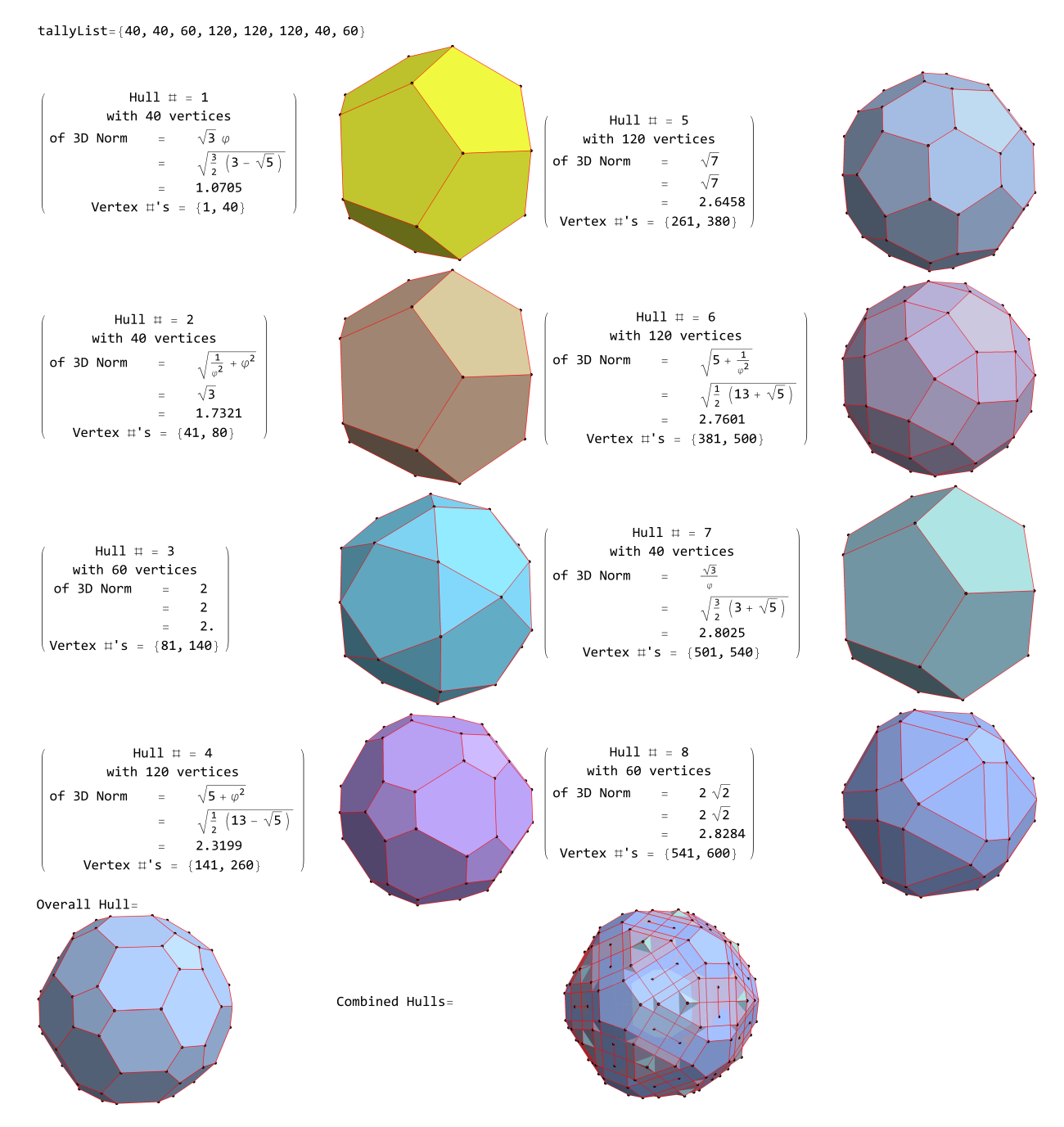
Orthogonal projection of the 120-cell using any 3 of these Cartesian coordinate dimensions forms an Overall Hull that is a chamfered dodecahedron of Norm=.
Hulls 1, 2, & 7 are each pairs of dodecahedrons.
Hull 3 is a pair of icosidodecahedrons.
Hulls 4 & 5 are each pairs of truncated icosahedrons.
Hull 6 is a pair of semi-regular rhombicosidodecahedrons.
Hull 8 is a single non-uniform rhombicosidodecahedron, the central section.]] These hulls illustrate sections 1 - 8 of the 120-cell beginning with a cell (hull 1). A section is a flat 3-dimensional hyperplane slice through the 3-sphere: a 2-sphere (ordinary sphere). It is dimensionally analogous to a flat 2-dimensional plane slice through a 2-sphere: a 1-sphere (ordinary circle).
The hulls are illustrated as if they were all the same size, but actually they increase in radius as numbered: they are concentric 2-spheres that nest inside each other. Every cell of the 120-cell is the smallest hull in its own set of 8 concentric hulls. There are 120 distinct nesting sets of 8 hulls.
The cell-first projection of the 120-cell actually has 15 sections beginning with a cell, numbered 1 - 15 with number 8 in the center. After increasing in size from 1 to 8, the hulls get smaller again. Sections 1 and 15 are both a hull 1, the smallest hull, a dodecahedral cell of the 120-cell. Section 8 is the central section, the largest hull, with the same radius as the 120-cell. Except for the central section 8, the sections occur in parallel pairs, on either side of the central section. Hull 8 is dimensionally analogous to the equator, while hulls 1 - 7 are dimensionally analogous to lines of latitude. There are 120 of each kind of hull 1 - 7 in the 120-cell, but only 60 of the central hull 8. A visualization of these 15 simplified sections is available in WP Commons with subgroup sections (when the inscribed solid has more than one permutation in its orbit) is here. The vertex-first projection (below) of the {5,3,3} 120-cell has 31 sections.


Coxeter's Table V-v sectioning of the {5,3,3} vertex-first 120-cell, showing the orbit sections and subgroup sections (when the inscribed solid has more than one permutation in its orbit), as well as the convex-hull of each orbit on the right.]]
Polyhedral graph
Considering the adjacency matrix of the vertices representing the polyhedral graph of the unit-radius 120-cell, the graph diameter is 15, connecting each vertex to its coordinate-negation at a Euclidean distance of 2 away (its circumdiameter), and there are 24 different paths to connect them along the polytope edges. From each vertex, there are 4 vertices at distance 1, 12 at distance 2, 24 at distance 3, 36 at distance 4, 52 at distance 5, 68 at distance 6, 76 at distance 7, 78 at distance 8, 72 at distance 9, 64 at distance 10, 56 at distance 11, 40 at distance 12, 12 at distance 13, 4 at distance 14, and 1 at distance 15. The adjacency matrix has 27 distinct eigenvalues ranging from ≈ 0.270, with a multiplicity of 4, to 2, with a multiplicity of 1. The multiplicity of eigenvalue 0 is 18, and the rank of the adjacency matrix is 582.
The vertices of the 120-cell polyhedral graph are 3-colorable.
The graph is Eulerian having degree 4 in every vertex. Its edge set can be decomposed into two Hamiltonian cycles.
Constructions
The 120-cell is the sixth in the sequence of 6 convex regular 4-polytopes (in order of size and complexity). It can be deconstructed into ten distinct instances (or five disjoint instances) of its predecessor (and dual) the 600-cell, just as the 600-cell can be deconstructed into twenty-five distinct instances (or five disjoint instances) of its predecessor the 24-cell, the 24-cell can be deconstructed into three distinct instances of its predecessor the tesseract (8-cell), and the 8-cell can be deconstructed into two disjoint instances of its predecessor (and dual) the 16-cell. The 120-cell contains 675 distinct instances (75 disjoint instances) of the 16-cell.
The reverse procedure to construct each of these from an instance of its predecessor preserves the radius of the predecessor, but generally produces a successor with a smaller edge length. The 600-cell's edge length is ~0.618 times its radius (the inverse golden ratio), but the 120-cell's edge length is ~0.270 times its radius.
The 120-cell is also the convex hull of the regular compound of 120 disjoint regular 5-cells. This can be seen to be equivalent to the compound of 5 disjoint 600-cells, as follows. Beginning with a single 120-point 600-cell, expand each vertex into a regular 5-cell. For each of the 120 vertices, add 4 new equidistant vertices, such that the 5 vertices form a regular 5-cell inscribed in the 3-sphere. The 120 5-cells are disjoint, and the 600 vertices form 5 disjoint 120-point 600-cells: a 120-cell.
Dual 600-cells

Since the 120-cell is the dual of the 600-cell, it can be constructed from the 600-cell by placing its 600 vertices at the center of volume of each of the 600 tetrahedral cells. From a 600-cell of unit long radius, this results in a 120-cell of slightly smaller long radius ( ≈ 0.926) and edge length of exactly 1/4. Thus the unit edge-length 120-cell (with long radius φ2 ≈ 3.702) can be constructed in this manner just inside a 600-cell of long radius 4. The unit radius 120-cell (with edge-length ≈ 0.270) can be constructed in this manner just inside a 600-cell of long radius ≈ 1.080.

Reciprocally, the unit-radius 120-cell can be constructed just outside a 600-cell of slightly smaller long radius ≈ 0.926, by placing the center of each dodecahedral cell at one of the 120 600-cell vertices. The 120-cell whose coordinates are given above of long radius = 2 ≈ 2.828 and edge-length = 3− ≈ 0.764 can be constructed in this manner just outside a 600-cell of long radius φ2, which is smaller than in the same ratio of ≈ 0.926; it is in the golden ratio to the edge length of the 600-cell, so that must be φ. The 120-cell of edge-length 2 and long radius φ2 ≈ 7.405 given by Coxeter can be constructed in this manner just outside a 600-cell of long radius φ4 and edge-length φ3.
Therefore, the unit-radius 120-cell can be constructed from its predecessor the unit-radius 600-cell in three reciprocation steps.
Cell rotations of inscribed duals
Since the 120-cell contains inscribed 600-cells, it contains its own dual of the same radius. The 120-cell contains five disjoint 600-cells (ten overlapping inscribed 600-cells of which we can pick out five disjoint 600-cells in two different ways), so it can be seen as a compound of five of its own dual (in two ways). The vertices of each inscribed 600-cell are vertices of the 120-cell, and (dually) each dodecahedral cell center is a tetrahedral cell center in each of the inscribed 600-cells.
The dodecahedral cells of the 120-cell have tetrahedral cells of the 600-cells inscribed in them. Just as the 120-cell is a compound of five 600-cells (in two ways), the dodecahedron is a compound of five regular tetrahedra (in two ways). As two opposing tetrahedra can be inscribed in a cube, and five cubes can be inscribed in a dodecahedron, ten tetrahedra in five cubes can be inscribed in a dodecahedron: two opposing sets of five, with each set covering all 20 vertices and each vertex in two tetrahedra (one from each set, but not the opposing pair of a cube obviously). This shows that the 120-cell contains, among its many interior features, 120 compounds of ten tetrahedra, each of which is dimensionally analogous to the whole 120-cell as a compound of ten 600-cells.
All ten tetrahedra can be generated by two chiral five-click rotations of any one tetrahedron. In each dodecahedral cell, one tetrahedral cell comes from each of the ten 600-cells inscribed in the 120-cell. Therefore, the whole 120-cell, with all ten inscribed 600-cells, can be generated from just one 600-cell by rotating its cells.
Augmentation
Another consequence of the 120-cell containing inscribed 600-cells is that it is possible to construct it by placing 4-pyramids of some kind on the cells of the 600-cell. These tetrahedral pyramids must be quite irregular in this case (with the apex blunted into four 'apexes'), but we can discern their shape in the way a tetrahedron lies inscribed in a dodecahedron.
Only 120 tetrahedral cells of each 600-cell can be inscribed in the 120-cell's dodecahedra; its other 480 tetrahedra span dodecahedral cells. Each dodecahedron-inscribed tetrahedron is the center cell of a cluster of five tetrahedra, with the four others face-bonded around it lying only partially within the dodecahedron. The central tetrahedron is edge-bonded to an additional 12 tetrahedral cells, also lying only partially within the dodecahedron. The central cell is vertex-bonded to 40 other tetrahedral cells which lie entirely outside the dodecahedron.
Weyl orbits
Another construction method uses quaternions and the Icosahedral symmetry of Weyl group orbits O(\Lambda)=W(H_4)=I of order 120. The following describe T and T' 24-cells as quaternion orbit weights of D4 under the Weyl group W(D4):
O(0100) : T = {±1,±e1,±e2,±e3,(±1±e1±e2±e3)/2}
O(1000) : V1
O(0010) : V2
O(0001) : V3
T'=\sqrt{2}{V1\oplus V2\oplus V3 } = \begin{pmatrix} \frac{-1-e_1}{\sqrt{2}} & \frac{1-e_1}{\sqrt{2}} & \frac{-1+e_1}{\sqrt{2}} & \frac{1+e_1}{\sqrt{2}} & \frac{-e_2-e_3}{\sqrt{2}} & \frac{e_2-e_3}{\sqrt{2}} & \frac{-e_2+e_3}{\sqrt{2}} & \frac{e_2+e_3}{\sqrt{2}} \ \frac{-1-e_2}{\sqrt{2}} & \frac{1-e_2}{\sqrt{2}} & \frac{-1+e_2}{\sqrt{2}} & \frac{1+e_2}{\sqrt{2}} & \frac{-e_1-e_3}{\sqrt{2}} & \frac{e_1-e_3}{\sqrt{2}} & \frac{-e_1+e_3}{\sqrt{2}} & \frac{e_1+e_3}{\sqrt{2}} \ \frac{-e_1-e_2}{\sqrt{2}} & \frac{e_1-e_2}{\sqrt{2}} & \frac{-e_1+e_2}{\sqrt{2}} & \frac{e_1+e_2}{\sqrt{2}} & \frac{-1-e_3}{\sqrt{2}} & \frac{1-e_3}{\sqrt{2}} & \frac{-1+e_3}{\sqrt{2}} & \frac{1+e_3}{\sqrt{2}} \end{pmatrix};
With quaternions (p,q) where \bar p is the conjugate of p and [p,q]:r\rightarrow r'=prq and [p,q]^:r\rightarrow r''=p\bar rq, then the Coxeter group W(H_4)=\lbrace[p,\bar p] \oplus [p,\bar p]^\rbrace is the symmetry group of the 600-cell and the 120-cell of order 14400.
Given p \in T such that \bar p=\pm p^4, \bar p^2=\pm p^3, \bar p^3=\pm p^2, \bar p^4=\pm p and p^\dagger as an exchange of -1/\varphi \leftrightarrow \varphi within p, we can construct:
- the snub 24-cell S=\sum_{i=1}^4\oplus p^i T
- the 600-cell I=T+S=\sum_{i=0}^4\oplus p^i T
- the 120-cell J=\sum_{i,j=0}^4\oplus p^i\bar p^{\dagger j}T'
- the alternate snub 24-cell S'=\sum_{i=1}^4\oplus p^i\bar p^{\dagger i}T'
- the dual snub 24-cell = T \oplus T' \oplus S'.
As a configuration
This configuration matrix represents the 120-cell. The rows and columns correspond to vertices, edges, faces, and cells. The diagonal numbers say how many of each element occur in the whole 120-cell. The nondiagonal numbers say how many of the column's element occur in or at the row's element.
\begin{bmatrix}\begin{matrix}600 & 4 & 6 & 4 \ 2 & 1200 & 3 & 3 \ 5 & 5 & 720 & 2 \ 20 & 30 & 12 & 120 \end{matrix}\end{bmatrix}
Here is the configuration expanded with k-face elements and k-figures. The diagonal element counts are the ratio of the full Coxeter group order, 14400, divided by the order of the subgroup with mirror removal.
| H4 | *k*-face | fk | f0 | f1 | f2 | f3 | *k*-fig | Notes | f0 | f1 | f2 | f3 | ||||||||
|---|---|---|---|---|---|---|---|---|---|---|---|---|---|---|---|---|---|---|---|---|
| A3 | ( ) | 600 | 4 | 6 | 4 | |||||||||||||||
| A1A2 | { } | 2 | 1200 | 3 | 3 | |||||||||||||||
| H2A1 | {5} | 5 | 5 | 720 | 2 | |||||||||||||||
| H3 | {5,3} | 20 | 30 | 12 | 120 |
Visualization
The 120-cell consists of 120 dodecahedral cells. For visualization purposes, it is convenient that the dodecahedron has opposing parallel faces (a trait it shares with the cells of the tesseract and the 24-cell). One can stack dodecahedrons face to face in a straight line bent in the 4th direction into a great circle with a circumference of 10 cells. Starting from this initial ten cell construct there are two common visualizations one can use: a layered stereographic projection, and a structure of intertwining rings (discrete Hopf fibration).
Layered stereographic projection
The cell locations lend themselves to a hyperspherical description. Pick an arbitrary dodecahedron and label it the "north pole". Twelve great circle meridians (four cells long) radiate out in 3 dimensions, converging at the fifth "south pole" cell. This skeleton accounts for 50 of the 120 cells (2 + 4 × 12).
Starting at the North Pole, we can build up the 120-cell in 9 latitudinal layers, with allusions to terrestrial 2-sphere topography in the table below. With the exception of the poles, the centroids of the cells of each layer lie on a separate 2-sphere, with the equatorial centroids lying on a great 2-sphere. The centroids of the 30 equatorial cells form the vertices of an icosidodecahedron, with the meridians (as described above) passing through the center of each pentagonal face. The cells labeled "interstitial" in the following table do not fall on meridian great circles.
| Layer # | Number of Cells | Description | Colatitude | Region | Total | 120 cells |
|---|---|---|---|---|---|---|
| 1 | 1 cell | North Pole | 0° | Northern Hemisphere | ||
| 2 | 12 cells | First layer of meridional cells / "Arctic Circle" | 36° | |||
| 3 | 20 cells | Non-meridian / interstitial | 60° | |||
| 4 | 12 cells | Second layer of meridional cells / "Tropic of Cancer" | 72° | |||
| 5 | 30 cells | Non-meridian / interstitial | 90° | Equator | ||
| 6 | 12 cells | Third layer of meridional cells / "Tropic of Capricorn" | 108° | Southern Hemisphere | ||
| 7 | 20 cells | Non-meridian / interstitial | 120° | |||
| 8 | 12 cells | Fourth layer of meridional cells / "Antarctic Circle" | 144° | |||
| 9 | 1 cell | South Pole | 180° |
The cells of layers 2, 4, 6 and 8 are located over the faces of the pole cell. The cells of layers 3 and 7 are located directly over the vertices of the pole cell. The cells of layer 5 are located over the edges of the pole cell.
Intertwining rings


The 120-cell can be partitioned into 12 disjoint 10-cell great circle rings, forming a discrete/quantized Hopf fibration. Starting with one 10-cell ring, one can place another ring alongside it that spirals around the original ring one complete revolution in ten cells. Five such 10-cell rings can be placed adjacent to the original 10-cell ring. Although the outer rings "spiral" around the inner ring (and each other), they actually have no helical torsion. They are all equivalent. The spiraling is a result of the 3-sphere curvature. The inner ring and the five outer rings now form a six ring, 60-cell solid torus. One can continue adding 10-cell rings adjacent to the previous ones, but it's more instructive to construct a second torus, disjoint from the one above, from the remaining 60 cells, that interlocks with the first. The 120-cell, like the 3-sphere, is the union of these two (Clifford) tori. If the center ring of the first torus is a meridian great circle as defined above, the center ring of the second torus is the equatorial great circle that is centered on the meridian circle. Also note that the spiraling shell of 50 cells around a center ring can be either left handed or right handed. It's just a matter of partitioning the cells in the shell differently, i.e. picking another set of disjoint (Clifford parallel) great circles.
Other great circle constructs
There is another great circle path of interest that alternately passes through opposing cell vertices, then along an edge. This path consists of 6 edges alternating with 6 cell diameter chords, forming an irregular dodecagon in a central plane. Both these great circle paths have dual great circle paths in the 600-cell. The 10 cell face to face path above maps to a 10 vertex path solely traversing along edges in the 600-cell, forming a decagon. The alternating cell/edge path maps to a path consisting of 12 tetrahedrons alternately meeting face to face then vertex to vertex (six triangular bipyramids) in the 600-cell. This latter path corresponds to a ring of six icosahedra meeting face to face in the snub 24-cell (or icosahedral pyramids in the 600-cell), forming a hexagon.
Another great circle polygon path exists which is unique to the 120-cell and has no dual counterpart in the 600-cell. This path consists of 3 120-cell edges alternating with 3 inscribed 5-cell edges (#8 chords), forming the irregular great hexagon with alternating short and long edges illustrated above. Each 5-cell edge runs through the volume of three dodecahedral cells (in a ring of ten face-bonded dodecahedral cells), to the opposite pentagonal face of the third dodecahedron. This irregular great hexagon lies in the same central plane (on the same great circle) as the irregular great dodecagon described above, but it intersects only {6} of the {12} dodecagon vertices. There are two irregular great hexagons inscribed in each irregular great dodecagon, in alternate positions.
2D Orthogonal projections
Orthogonal projections of the 120-cell can be done in 2D by defining two orthonormal basis vectors for a specific view direction. The 30-gonal projection was made in 1963 by B. L. Chilton.
The H3 decagonal projection shows the plane of the van Oss polygon.
| H4 | - | F4 | H3 | A2 / B3 / D4 | A3 / B2 |
|---|---|---|---|---|---|
| [[File:120-cell graph H4.svg | 240px]] | ||||
| [30] | |||||
| (Red=1) | [[File:120-cell t0 p20.svg | 240px]] | |||
| [20] | |||||
| (Red=1) | [[File:120-cell t0 F4.svg | 240px]] | |||
| [12] | |||||
| (Red=1) | |||||
| [[File:120-cell t0 H3.svg | 240px]] | ||||
| [10] | |||||
| (Red=5, orange=10) | [[File:120-cell t0 A2.svg | 240px]] | |||
| [6] | |||||
| (Red=1, orange=3, yellow=6, lime=9, green=12) | [[File:120-cell t0 A3.svg | 240px]] | |||
| [4] | |||||
| (Red=1, orange=2, yellow=4, lime=6, green=8) |
3D Perspective projections
These projections use perspective projection, from a specific viewpoint in four dimensions, projecting the model as a 3D shadow. Therefore, faces and cells that look larger are merely closer to the 4D viewpoint.
A comparison of perspective projections of the 3D dodecahedron to 2D (above left), and projections of the 4D 120-cell to 3D (below right), demonstrates two related perspective projection methods, by dimensional analogy. Schlegel diagrams use perspective to show depth in the dimension which has been flattened, choosing a view point above a specific cell, thus making that cell the envelope of the model, with other cells appearing smaller inside it. Stereographic projections use the same approach, but are shown with curved edges, representing the spherical polytope as a tiling of a 3-sphere. Both these methods distort the object, because the cells are not actually nested inside each other (they meet face-to-face), and they are all the same size. Other perspective projection methods exist, such as the rotating animations below, which do not exhibit this particular kind of distortion, but rather some other kind of distortion (as all projections must).
| Projection | Dodecahedron | 120-cell | Schlegel diagram | Stereographic projection |
|---|---|---|---|---|
| [[Image:Dodecahedron schlegel.svg | 220px]] | |||
| 12 pentagon faces in the plane | [[File:Schlegel wireframe 120-cell.png | 220px]] | ||
| 120 dodecahedral cells in 3-space | ||||
| [[Image:Dodecahedron stereographic projection.png | 220px]] | [[Image:Stereographic polytope 120cell faces.png | 220px]] | |
| With transparent faces |
| Enhanced perspective projections | |
|---|---|
| [[Image:120-cell perspective-cell-first-02.png | 240px]] |
| [[Image:120-cell perspective-vertex-first-02.png | 240px]] |
Animations
| Projections to 3D of a 4D 120-cell performing a simple rotation | |
|---|---|
| [[File:120-cell.gif | 256px]] |
| From outside the [3-sphere](3-sphere) in 4-space. |
In all the above projections of the 120-cell, only the edges of the 120-cell appear. All the other chords are not shown. The complex interior parts of the 120-cell, all its inscribed 600-cells, 24-cells, 8-cells, 16-cells and 5-cells, are completely invisible in all illustrations. The viewer must imagine them.
The following animation is an exception, which does show some chords of the 14400 vertex omnitruncated 120-cell (identical to the omnitruncated 600-cell given the symmetry of their Coxeter-Dynkin diagram), although it does not reveal the inscribed 4-polytopes. For a full display of each section orbits along with sub-section orbits, see this WP Commons omnitruncated 120-Cell SVG.

| Coxeter section views | |
|---|---|
| [[File:Cell120-OmniTruncated-Sections.webm | 300px]] |
| Sections of an omnitrucated 4D 600/120-cell 97 frames (=48x2 L/R+1 Center) shown in 4D to 3D Flatlander views. The center section is highlighted by also showing it as a combined set of convex hulls. |
Related polyhedra and honeycombs
H4 polytopes
The 120-cell is one of 15 regular and uniform polytopes with the same H4 symmetry [3,3,5]:
{p,3,3} polytopes
The 120-cell is similar to three regular 4-polytopes: the 5-cell {3,3,3} and tesseract {4,3,3} of Euclidean 4-space, and the hexagonal tiling honeycomb {6,3,3} of hyperbolic space. All of these have a tetrahedral vertex figure {3,3}:
{5,3,p} polytopes
The 120-cell is a part of a sequence of 4-polytopes and honeycombs with dodecahedral cells:
Tetrahedrally diminished 120-cell
Since the 600-point 120-cell has 5 disjoint inscribed 600-cells, it can be diminished by the removal of one of those 120-point 600-cells, creating an irregular 480-point 4-polytope.

Each dodecahedral cell of the 120-cell is diminished by removal of 4 of its 20 vertices, creating an irregular 16-point polyhedron called the tetrahedrally diminished dodecahedron because the 4 vertices removed formed a tetrahedron inscribed in the dodecahedron. Since the vertex figure of the dodecahedron is the triangle, each truncated vertex is replaced by a triangle. The 12 pentagon faces are replaced by 12 trapezoids, as one vertex of each pentagon is removed and two of its edges are replaced by the pentagon's diagonal chord. The tetrahedrally diminished dodecahedron has 16 vertices and 16 faces: 12 trapezoid faces and four equilateral triangle faces.
Since the vertex figure of the 120-cell is the tetrahedron, each truncated vertex is replaced by a tetrahedron, leaving 120 tetrahedrally diminished dodecahedron cells and 120 regular tetrahedron cells. The regular dodecahedron and the tetrahedrally diminished dodecahedron both have 30 edges, and the regular 120-cell and the tetrahedrally diminished 120-cell both have 1200 edges.
The 480-point diminished 120-cell may be called the tetrahedrally diminished 120-cell because its cells are tetrahedrally diminished, or the 600-cell diminished 120-cell because the vertices removed formed a 600-cell inscribed in the 120-cell, or even the regular 5-cells diminished 120-cell because removing the 120 vertices removes one vertex from each of the 120 inscribed regular 5-cells, leaving 120 regular tetrahedra.
Davis 120-cell manifold
The Davis 120-cell manifold, introduced by , is a compact 4-dimensional hyperbolic manifold obtained by identifying opposite faces of the 120-cell, whose universal cover gives the regular honeycomb {5,3,3,5} of 4-dimensional hyperbolic space.
Notes
Citations
References
-
- (Paper 22) H.S.M. Coxeter, Regular and Semi Regular Polytopes I, [Math. Zeit. 46 (1940) 380–407, MR 2,10]
- (Paper 23) H.S.M. Coxeter, Regular and Semi-Regular Polytopes II, [Math. Zeit. 188 (1985) 559-591]
- (Paper 24) H.S.M. Coxeter, Regular and Semi-Regular Polytopes III, [Math. Zeit. 200 (1988) 3-45]
- J.H. Conway and M.J.T. Guy: Four-Dimensional Archimedean Polytopes, Proceedings of the Colloquium on Convexity at Copenhagen, page 38 und 39, 1965
- N.W. Johnson: The Theory of Uniform Polytopes and Honeycombs, Ph.D. Dissertation, University of Toronto, 1966
- Four-dimensional Archimedean Polytopes (German), Marco Möller, 2004 PhD dissertation http://www.sub.uni-hamburg.de/opus/volltexte/2004/2196/pdf/Dissertation.pdf
References
- [[Norman Johnson (mathematician). N.W. Johnson]]: ''Geometries and Transformations'', (2018) {{ISBN. 978-1-107-10340-5 Chapter 11: ''Finite Symmetry Groups'', 11.5 ''Spherical Coxeter groups'', p.249
- Matila Ghyka, ''The Geometry of Art and Life'' (1977), p.68
- ''Mathematics and Its History'', John Stillwell, 1989, 3rd edition 2010, {{isbn. 0-387-95336-1
- Carlo H. Séquin. (July 2005). "Symmetrical Hamiltonian manifolds on regular 3D and 4D polytopes". Mathartfun.com.
This article was imported from Wikipedia and is available under the Creative Commons Attribution-ShareAlike 4.0 License. Content has been adapted to SurfDoc format. Original contributors can be found on the article history page.
Ask Mako anything about 120-cell — get instant answers, deeper analysis, and related topics.
Research with MakoFree with your Surf account
Create a free account to save articles, ask Mako questions, and organize your research.
Sign up freeThis content may have been generated or modified by AI. CloudSurf Software LLC is not responsible for the accuracy, completeness, or reliability of AI-generated content. Always verify important information from primary sources.
Report