From Surf Wiki (app.surf) — the open knowledge base
(119951) 2002 KX14
Classical Kuiper belt object

Classical Kuiper belt object
| Field | Value |
|---|---|
| minorplanet | yes |
| name | |
| background | #C2E0FF |
| image | 2002 KX14 Hubble 8x upscale.png |
| caption | imaged by the Hubble Space Telescope on 7 April 2006 |
| discovery_ref | |
| discovered | 17 May 2002 |
| discoverer | Chadwick A. Trujillo |
| Michael E. Brown | |
| discovery_site | Palomar Obs. |
| mpc_name | |
| mp_category | TNOclassical (inner/cold) |
| distant | |
| orbit_ref | |
| barycentric | yes |
| epoch | 25 February 2023 (JD 2460000.5) |
| uncertainty | 2 |
| observation_arc | 38.96 yr (14,230 d) |
| earliest_precovery_date | 31 May 1984 |
| aphelion | 40.515 AU |
| perihelion | 37.055 AU |
| time_periastron | ≈ 30 May 2085 |
| ±3.0 days | |
| semimajor | 38.785 AU |
| eccentricity | 0.04461 |
| period | 241.39 yr (88,166 d) |
| mean_anomaly | 270.086° |
| mean_motion | / day |
| inclination | 0.403° |
| asc_node | 286.795° |
| arg_peri | 73.695° |
| satellites | 0 |
| dimensions | () × () (projected) |
| mean_diameter | (area equivalent) |
| albedo | |
| spectral_type | IR–RR (red) |
| B−V= | |
| V−R= | |
| abs_magnitude | (2016) |
| (2012) | |
| 4.71 (JPL) | |
| magnitude | 20.8 |
| single_temperature |
Michael E. Brown distant ±3.0 days B−V= V−R= (2012) 4.71 (JPL)
**** (provisional designation ****) is a trans-Neptunian object located in the inner classical Kuiper belt. It was discovered on 17 May 2002 by Michael E. Brown and Chad Trujillo during their search for bright, Pluto-sized Kuiper belt objects at Palomar Observatory. has been categorized as a dynamically "cold" classical Kuiper belt object (KBO) by some astronomers due to its nearly circular and low-inclination orbit, although this classification has been debated due to its location in the inner classical Kuiper belt. If does belong to the cold classical KBO population, then it would be one of the largest cold classical KBOs known, having a diameter of about 390 km. has a reddish surface and a flattened shape, with very little rotational variation in its brightness.
History
Discovery
was discovered on 17 May 2002 by astronomers Chad Trujillo and Michael Brown at Palomar Observatory in San Diego County, California, United States. The discovery formed part of their Caltech Wide Area Sky Survey for bright, Pluto-sized Kuiper belt objects using the observatory's 1.22 m Samuel Oschin telescope with its wide-field CCD camera, which was operated jointly with the nightly Near Earth Asteroid Tracking program at Palomar. This survey was responsible for the discovery of several other large objects beyond Neptune, which includes the dwarf planets , , and .
was found through manual vetting of potential moving objects identified by the team's automatic image-searching software. It was detected at a red-filter apparent magnitude of 20.6, marginally brighter than the survey's limiting magnitude of 20.7. Follow-up observations were conducted one month later with Palomar Observatory's 1.52 m telescope on 13–14 June 2002. The discovery was announced by the Minor Planet Center on 20 July 2002 and the object was given the minor planet provisional designation of .
Further observations
After the publication of 's discovery, astronomers continued observing the object and identified additional observations from the time of or before its discovery. In particular, had been identified in pre-discovery observations by the Cerro Tololo Observatory from August 2001 and the Siding Spring Observatory's Digitized Sky Survey from May 1984 and April 1993. These additional observations helped reduce the uncertainty of 's orbit. , has been observed for over 38 years, or about 16% of its orbital period.
Numbering and naming
received its permanent minor planet catalog number of 119951 from the Minor Planet Center on 16 November 2005. does not have a proper name and the discoverers' privilege for naming this object has expired ten years after it was numbered. According to naming guidelines by the International Astronomical Union's Working Group for Small Bodies Nomenclature, is open for name suggestions that relate to creation myths, as encouraged for Kuiper belt objects in general.
Orbit and classification
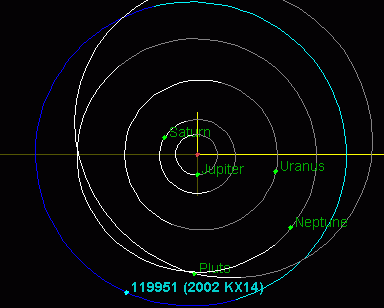
is a trans-Neptunian object (TNO) orbiting the Sun at a semi-major axis or average distance of 38.8 astronomical units (AU). Its orbit is nearly circular with a low orbital eccentricity of 0.04. In its 241-year-long orbit, comes within 37.1 AU from the Sun at perihelion and up to 40.5 AU at aphelion. It has a low orbital inclination of 0.4° with respect to the ecliptic, closely aligned with the orbits of the Solar System's planets. last passed perihelion in July 1840 and will make its next perihelion passage in May 2085.
's orbit is not resonant with Neptune and is located in the inner classical region of the Kuiper belt within 39.4 AU from the Sun, making it an inner classical Kuiper belt object (KBO). The 2:3 orbital resonance by Neptune (which contains the plutinos) separates the inner classical Kuiper belt from the main classical Kuiper belt (which spans from the Sun). 's low orbital inclination and eccentricity qualifies it as a dynamically "cold" member of the classical Kuiper belt. Cold classical KBOs are believed to be primordial planetesimals whose orbits have remained relatively unchanged since their formation, although this may not apply to the inner classical Kuiper belt. Astronomer Esa Vilenius and collaborators argued that inner classical KBOs like more likely belong to the dynamically "hot" population of classical KBOs, especially if they have relatively large diameters. In contrast to cold classical KBOs, hot classical KBOs are typically found on inclined and eccentric orbits because they have been gravitationally scattered by Neptune's migration during the early Solar System.
Physical characteristics
Size and shape

is a highly flattened object with an equatorial diameter of 482.0 ± 14.4 km and a projected polar diameter of 314.2 ± 10.4 km. It is one of the largest known cold classical KBOs. The size and shape of was directly measured via observations of stellar occultations, which occur whenever the object passes in front of a background star and briefly blocks out its light. A 2025 study led by Juan Luis Rizos analyzed observations of five different occultations from May 2020 to July 2023 and found that the object's shape remained the same in all dates, indicating the object's shape does not vary significantly as it rotates. 's consistent shape alongside low brightness variations over time suggest that the object may be shaped like an oblate spheroid, whose equatorial axes are roughly equal to each other. If is a Maclaurin spheroid (a self-gravitating fluid body in hydrostatic equilibrium) and has an average TNO rotation period of 7 hours, then it would have a density of . However, this prediction for 's density cannot be confirmed as the object's rotation period is unknown and its true shape has not been confirmed.
Rotation
The rotation period of is unknown. Astronomers have attempted to photometrically measure 's rotation period by monitoring changes in its brightness over time (light curves), but were unable to find any significant brightness variations exceeding 0.05 magnitudes. If is spheroidal, its low brightness variations may be caused by surface albedo features rotating in and out of view. The photometric measurement of 's rotation is further complicated by the object's location in the sky overlapping with the Milky Way's dense star fields, where background stars can obscure the object.
Surface and spectrum
The surface of is dark and reddish in visible light, with a geometric albedo of 0.119. In Barucci et al.'s classification scheme for TNO color indices, either belongs to the IR or RR group of TNOs with "red" colors, which are common within the classical Kuiper belt population. Visible and near-infrared spectroscopy of by ground-based telescopes show that it has a featureless spectrum lacking absorption bands from materials such as ices. The reddish color and featureless spectrum of indicates that its surface is probably covered with complex organic compounds (tholins) or silicates. The red coloration of other TNOs is typically attributed to tholins on their surface, which are formed by the irradiation of ices and simple organic compounds by solar and cosmic radiation.
Notes
References
This article was imported from Wikipedia and is available under the Creative Commons Attribution-ShareAlike 4.0 License. Content has been adapted to SurfDoc format. Original contributors can be found on the article history page.
Ask Mako anything about (119951) 2002 KX14 — get instant answers, deeper analysis, and related topics.
Research with MakoFree with your Surf account
Create a free account to save articles, ask Mako questions, and organize your research.
Sign up freeThis content may have been generated or modified by AI. CloudSurf Software LLC is not responsible for the accuracy, completeness, or reliability of AI-generated content. Always verify important information from primary sources.
Report