From Surf Wiki (app.surf) — the open knowledge base
10 yen coin
Denomination of Japanese yen

Denomination of Japanese yen
| Field | Value |
|---|---|
| Country | Japan |
| Denomination | Ten yen |
| Value | 10 |
| Unit | Japanese yen |
| Mass | 4.5 |
| Diameter | 23.5 |
| Thickness | 1.5 |
| Edge | Reeded (1951-1958) |
| Smooth (1959-present) | |
| Composition | 95% Cu |
| 3-4% Zn | |
| 1-2% Sn | |
| Years of Minting | 1871–present |
| Catalog Number | - |
| Obverse | 10_Yen_Showa_obverse.png |
| Obverse Design | Phoenix Hall of Byōdō-in |
| Obverse Design Date | 1951 |
| Reverse | 10_Yen_Showa_reverse.png |
| Reverse Design | Bay laurel leaves |
| Reverse Design Date | 1951 |
Smooth (1959-present) 3-4% Zn 1-2% Sn
The 10 yen coin is one denomination of the Japanese yen.
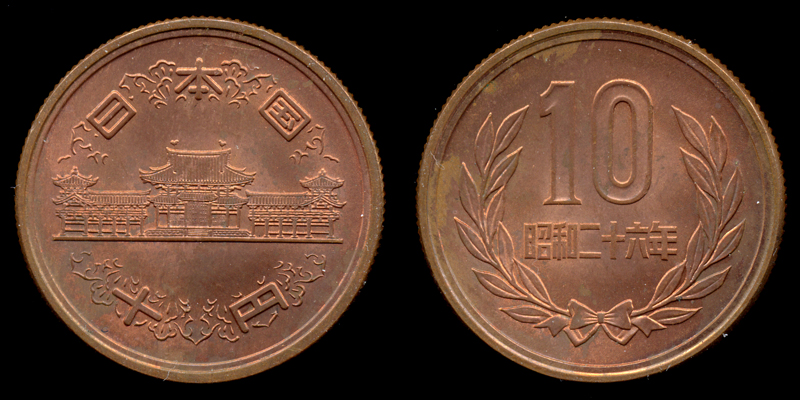
The obverse of the coin depicts the Phoenix Hall of Byōdō-in, a Buddhist temple in Uji, Kyoto prefecture, with the kanji for "Japan" and "Ten Yen". The reverse shows the numerals "10" and the date of issue in kanji surrounded by bay laurel leaves.
History
Gold ten yen (1871-1910)
Ten yen coins were first issued in 1871 from a newly established mint at Osaka. The origin of mintage is not clear as there are conflicting reports stating that ten yen coins were either minted in San Francisco, or in Japan the prior year. In either case the unit of yen was officially adopted by the Meiji government in an act signed on June 27, 1871. Under the new law each ten yen coin was to weigh 257.2 grains, and contain 90% gold with a foreign exchange rate close to a United States Eagle (US$10 coin). Gold bullion for coinage was delivered from private Japanese citizens, foreigners, and the Japanese government. No ten yen coins were minted between 1871 and 1876, during this time the Japanese government tried unsuccessfully to implement a gold standard with the amount of gold in circulation described as "very trifling". Gold bullion rose to a slight premium in 1874 which caused gold coin production as a whole to rapidly fall off. It was reported in the Quarterly Journal of Economics that by 1876 more gold coins were exported to foreign countries than for use domestically. Japan was later forced off of the gold standard in 1877 due to the cost of the Satsuma Rebellion. Twenty years would pass before the Japanese government went back on the gold standard. During this lapse non circulating ten yen gold coins were made in two non-consecutive years for two different reasons. The first occasion occurred in 1880 when ten yen gold proof coins were struck for exclusive use in presentation sets that were given away as gifts to foreign diplomats. The second and final instance involved the World's Columbian Exposition in 1892 where several newly minted coins were put on display.
When Japan went back on the gold standard in 1897, new ten yen coins were set by law to weigh 8.3g and have a diameter of 21.2mm. These new lighter and smaller coins were given a new design which features a sunburst superimposed on the sacred mirror on the obverse, and the value within a wreath on the reverse. The adoption of the gold standard allowed Japanese ten yen gold certificates to be redeemed for gold. This convertible paper currency was used in immense numbers while coined yen was seldom used or seen. Gold ten yen coins of the second design (1897 to 1910) mostly remained in government vaults by the time mintage ceased for good in 1910. The coins that had been minted during those thirteen years continued to back up gold certificates until World War I due to inflation. The remaining gold coins in circulation were eventually withdrawn due to wartime conditions in the late 1930s. Those that remained in circulation were either hoarded or melted down by the public.
Modern ten yen (1950-)
The first ten yen coins made after World War II were authorized by law on March 2, 1950, by prime minister Shigeru Yoshida. These coins were to be made of German Silver, and act as "temporary subsidiary coins". A total of 432,970,000 ten yen coins minted in this new alloy were recorded as struck by the end of that year. By the end of 1951 almost 800 million of these coins had been minted and were waiting to be distributed. None of the German silver coins minted between 1950 and 1951 ever circulated as the coins were eventually melted. The decision to melt the coins came as the Korean War had driven nickel prices to about 4.1 million yen per ton. Those that escaped being melted and are now considered by collectors to be "scarce" Japanese pattern coins. Bronze ten yen coins were first minted in 1951, but were not released for general circulation until January 4, 1953. Ten yen coins minted between 1951 and 1958 have reeded edges and are nicknamed Giza 10, meaning “jagged 10 yen coin” in Japanese. The design which is used today features Phoenix Hall of Byōdō-in on the obverse, and Bay laurel leaves on the reverse. The design remains essentially the same other than the reeds being dropped in 1959 which gave the coins a smooth edge. Slight modifications were also made in the latter half of 1986 regarding the design of Byōdō-in. These coins are not culturally recommended to be offered at shrines, as another word for "10" is "toh" (十), and another word for "yen" is "en" (円). Combining these characters into "toh-en" can also read as "far destiny". Ten yen coins continue to be produced up to the present under the Reiwa era.
Composition
| Years | Material | ||||
|---|---|---|---|---|---|
| url=https://www.ngccoin.com/price-guide/world/japan-10-yen-y-12-yr.41871-cuid-1173272-duid-1449507 | title=Japan 10 Yen Y# 12 | publisher=Numismatic Guaranty Corporation | accessdate=March 27, 2019}} | 90% gold, 10% copper | |
| url=https://www.buntetsu.net/mbc/cg10.htm | title=10円青銅貨 | publisher=www.buntetsu.net | language=ja | accessdate=March 27, 2019}} | 95% copper, 3.5% zinc, 1.5% tin |
Circulation figures

Meiji
The following are circulation figures for the coins that were minted between the 4th, and the 43rd year of Meiji's reign. Coins for this period all begin with the Japanese symbol 明治 (Meiji).
- Inscriptions on Japanese coins from this period are read clockwise from right to left: "Year" ← "Number representing year of reign" ← "Emperor's name" (Ex: 年 ← 五十三 ← 治明)
| Year of reign | Japanese date | Gregorian date | Mintage |
|---|---|---|---|
| 04 4th | 四 | 1871 | |
| 09 9th | 九 | 1876 | |
| 10th | 十 | 1877 | |
| 13th | 三十 | 1880 | |
| 25th | 五十二 | 1892 | Not circulated |
| 30th | 十三 | 1897 | |
| 31st | 一十三 | 1898 | |
| 32nd | 二十三 | 1899 | |
| 33rd | 三十三 | 1900 | |
| 34th | 四十三 | 1901 | |
| 35th | 五十三 | 1902 | |
| 36th | 六十三 | 1903 | |
| 37th | 七十三 | 1904 | |
| 40th | 十四 | 1907 | |
| 41st | 一十四 | 1908 | |
| 42nd | 二十四 | 1909 | |
| 43rd | 三十四 | 1910 |
Shōwa
.jpg)
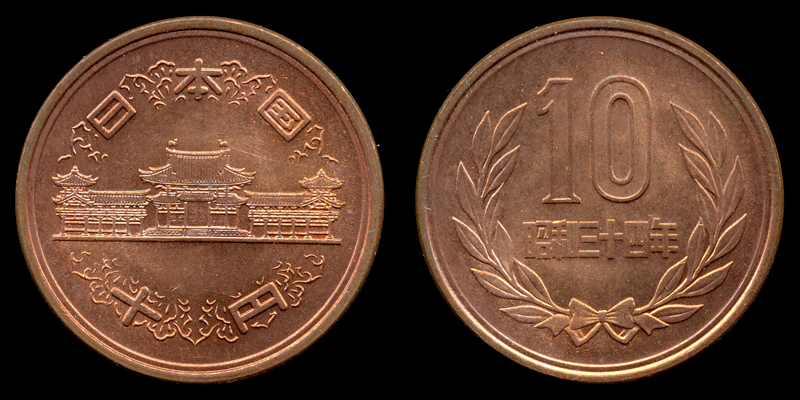
The following are circulation dates which cover Emperor Hirohito's reign. The dates below correspond with the 26th to the 64th year (last) of his reign. All ten yen coins that were made before 1959 have reeded edges, this has since changed to the present day smooth edge. Coins for this period will all begin with the Japanese symbol 昭和 (Shōwa).
- Japanese coins are read with a left to right format: :"Emperors name" → "Number representing year of reign" → "Year" (Ex: 昭和 → 三十四 → 年).
| Year of reign | Japanese date | Gregorian date | url=https://www.mint.go.jp/media/2025/02/nenmeibetsu_r6.pdf | title=年銘別貨幣製造枚数【令和6年銘】 | publisher=Japan Mint | language=ja | accessdate=February 5, 2025}} |
|---|---|---|---|---|---|---|---|
| 26th | 二十六 | 1951 | 101,068,000 | ||||
| 27th | 二十七 | 1952 | 486,632,000 | ||||
| 28th | 二十八 | 1953 | 466,300,000 | ||||
| 29th | 二十九 | 1954 | 520,900,000 | ||||
| 30th | 三十 | 1955 | 123,100,000 | ||||
| 32nd | 三十二 | 1957 | 50,000,000 | ||||
| 33rd | 三十三 | 1958 (Reeded) | 25,000,000 | ||||
| 34th | 三十四 | 1959 (Smooth) | 62,400,000 | ||||
| 35th | 三十五 | 1960 | 225,900,000 | ||||
| 36th | 三十六 | 1961 | 229,900,000 | ||||
| 37th | 三十七 | 1962 | 284,200,000 | ||||
| 38th | 三十八 | 1963 | 411,300,000 | ||||
| 39th | 三十九 | 1964 | 479,200,000 | ||||
| 40th | 四十 | 1965 | 387,600,000 | ||||
| 41st | 四十一 | 1966 | 395,900,000 | ||||
| 42nd | 四十二 | 1967 | 158,900,000 | ||||
| 43rd | 四十三 | 1968 | 363,600,000 | ||||
| 44th | 四十四 | 1969 | 414,800,000 | ||||
| 45th | 四十五 | 1970 | 382,700,000 | ||||
| 46th | 四十六 | 1971 | 610,050,000 | ||||
| 47th | 四十七 | 1972 | 634,950,000 | ||||
| 48th | 四十八 | 1973 | 1345 1,345,000,000 | ||||
| 49th | 四十九 | 1974 | 1780 1,780,000,000 | ||||
| 50th | 五十 | 1975 | 1280 1,280,260,000 | ||||
| 51st | 五十一 | 1976 | 1369 1,369,740,000 | ||||
| 52nd | 五十二 | 1977 | 1467 1,467,000,000 | ||||
| 53rd | 五十三 | 1978 | 1435 1,435,000,000 | ||||
| 54th | 五十四 | 1979 | 1207 1,207,000,000 | ||||
| 55th | 五十五 | 1980 | 1127 1,127,000,000 | ||||
| 56th | 五十六 | 1981 | 1369 1,369,000,000 | ||||
| 57th | 五十七 | 1982 | 890,000,000 | ||||
| 58th | 五十八 | 1983 | 870,000,000 | ||||
| 59th | 五十九 | 1984 | 533,850,000 | ||||
| 60th | 六十 | 1985 | 335,150,000 | ||||
| 61st | 六十一 | 1986 | 68,960,000 | ||||
| 62nd | 六十二 | 1987 | 165,775,000 | ||||
| 63rd | 六十三 | 1988 | 618,112,000 | ||||
| 64th | 六十四 | 1989 | 74,692,000 |
Heisei

The following are circulation dates during the reign of Emperor Akihito. who was crowned in 1989. The dates below correspond with the 1st to the 31st year (last) of his reign. First year of reign coins are marked with a 元 symbol (first) as a one-year type. Coins for this period all begin with the Japanese symbol 平成 (Heisei).
- Japanese coins are read with a left to right format: :"Emperors name" → "Number representing year of reign" → "Year" (Ex: 平成 → 十 → 年).
| Year of reign | Japanese date | Gregorian date | name=mintage}} |
|---|---|---|---|
| 01 1st | 元 | 1989 | 666,308,000 |
| 02 2nd | 二 | 1990 | 754,953,000 |
| 03 3rd | 三 | 1991 | 632,120,000 |
| 04 4th | 四 | 1992 | 538,130,000 |
| 05 5th | 五 | 1993 | 249,240,000 |
| 06 6th | 六 | 1994 | 190,767,000 |
| 07 7th | 七 | 1995 | 248,874,000 |
| 08 8th | 八 | 1996 | 546,213,000 |
| 09 9th | 九 | 1997 | 491,086,000 |
| 10th | 十 | 1998 | 410,612,000 |
| 11th | 十一 | 1999 | 359,120,000 |
| 12th | 十二 | 2000 | 315,026,000 |
| 13th | 十三 | 2001 | 542,024,000 |
| 14th | 十四 | 2002 | 455,667,000 |
| 15th | 十五 | 2003 | 551,406,000 |
| 16th | 十六 | 2004 | 592,903,000 |
| 17th | 十七 | 2005 | 504,029,000 |
| 18th | 十八 | 2006 | 440,594,000 |
| 19th | 十九 | 2007 | 388,904,000 |
| 20th | 二十 | 2008 | 362,811,000 |
| 21st | 二十一 | 2009 | 338,003,000 |
| 22nd | 二十二 | 2010 | 328,905,000 |
| 23rd | 二十三 | 2011 | 255,936,000 |
| 24th | 二十四 | 2012 | 279,211,000 |
| 25th | 二十五 | 2013 | 100,892,000 |
| 26th | 二十六 | 2014 | 171,013,000 |
| 27th | 二十七 | 2015 | 203,004,000 |
| 28th | 二十八 | 2016 | 198,064,000 |
| 29th | 二十九 | 2017 | 124,927,000 |
| 30th | 三十 | 2018 | 178,960,000 |
| 31st | 三十一 | 2019 | 197,594,000 |
Reiwa
The following are circulation dates in the reign of the current Emperor. Naruhito's accession to the Chrysanthemum Throne took place on May 1, 2019, and he was formally enthroned on October 22, 2019. Coins for this period all begin with the Japanese symbol 令和 (Reiwa). The inaugural year coin (2019) was marked 元 (first) and debuted during the summer of that year.
- Japanese coins are read with a left to right format: :"Emperors name" → "Number representing year of reign" → "Year" (Ex: 令和 → 二 → 年).
| Year of reign | Japanese date | Gregorian date | name=mintage}} |
|---|---|---|---|
| 1st | 元 | 2019 | 137,026,000 |
| 2nd | 二 | 2020 | 276,428,000 |
| 3rd | 三 | 2021 | 139,133,000 |
| 4th | 四 | 2022 | 129,874,000 |
| 5th | 五 | 2023 | 27,927,000 |
| 6th | 六 | 2024 | 109,027,000 |
| 7th | 七 | 2025 | TBD |
Collecting
The value of any given coin is determined by survivability rate and condition as collectors in general prefer uncleaned appealing coins. The first ten yen coins were made from 1871 to 1892 with coins dated 1871, 1876, 1877, 1880, and 1892 using a dragon design. All of these dates outside of those from 1871 (year 4) are now rarely found for sale as they are highly valued. Coins with the latter of these two dates were never intended for circulation as coins dated 1880 (year 13) were part of presentation sets. It's now estimated that only four to five known "year 13" coins have survived with an example selling at auction for $276,000 (USD) in 2011. No surviving examples are known for coins dated 1892 (year 25) which had been exhibited at the World's Columbian Exposition.
The second smaller design used for this denomination was minted from 1897 to 1910 after Japan officially adopted the gold standard. These are generally valued in lesser amounts than their predecessors, though rarer key dates in this group include coins dated 1904, 1907, and 1910. As a whole, the series dated from 1870 to 1910 can also be found on the market inside "Ministry of Finance" labeled plastic holders. These came from a hoard of 30,000 gold coins that were found to have been held by the Ministry of Finance. The Japanese government held a series of auctions from 2005 through 2007 which included previously unreported rare coins in denominations of 5, 10 and 20 Yen.
Modern ten yen coins date back to 1951 (year 26 of Shōwa) when the coins were struck for circulation using a bronze alloy. There is a misconception among the Japanese public that Giza 10 (yen made between 1951 and 1958) are worth a lot of money because of their reeds. On average these coins are worth only 3 to 4 times their face value, or in some cases just their face value. Ten yen coins from this period are only valued highly in uncirculated grades. Modifications to the ten yen coin were made in 1986 which show slight differences in the appearance of Byodoin Phoenix Hall. Those made in the latter half of 1986 with these temple changes were reported to be worth over $1,000 (USD) by TV Tokyo in 2019.
Notes
References
References
- "10 yen coin". Bank of Japan.
- Juichi Soyeda. (2013). "A History of Banking in Japan". Routledge.
- (1964). "Information Bulletin". Ministry of Foreign Affairs.
- Edouard Frossard. (1878). "The Coin Collector's Journal". Scott and Company.
- A. Piatt Andrew, ''Quarterly Journal of Economics'', "The End of the Mexican Dollar", 18:3:321–356, 1904, p. 345
- United States. Bureau of the Mint. (1898). "Annual Report of the Director of the Mint". Department of the Treasury.
- Hisamitsu Shigehira. (1976). "Monogatari Monogatari". Mainichi Shimbun.
- (1898). "Monetary Changes in Japan". Harvard University.
- (1918). "帝国現代縱横史". Period Research Group.
- "Japan: Meiji Proof gold 10 Yen Year 13 (1880)".
- Jeff Starck. (September 29, 2011). "Jacobs Collection stuns, nets $6.8 million". [[Coin World]].
- "Japan: Meiji gold Proof 10 Yen Year 4 (1871) PR66 Cameo".
- (1897). "The Coinage Law of Japan, Enacted in 1897".
- "Japan 10 Yen Y# 33". Numismatic Guaranty Corporation.
- Katsuji Inahara. (1939). "The Japan Year Book". Foreign Affairs Association of Japan.
- G Droppers. (1898). "(1897)". Quarterly Journal of Economics.
- Japanese Numismatic Dealers Assn. (2014). "The Catalog of Japanese Coins and Banknotes". JNDA.
- Friedberg, Arthur L. and Ira S. Friedberg. (2003). "Gold Coins of the World, From Ancient Times to the Present". Coin and Currency Institute.
- (2015). "Auction 3042, featuring the Read and Bob Bennett Collections". Heritage World Coin Auction.
- Office of the Chief of Naval Operations. (1944). "Taiwan (Formosa)--Economic Supplement". Navy Department (US).
- (1943). "Civil Affairs Handbook". United States. Army Service Forces.
- (1950). "Official Gazette. English Edition".
- (1950). "Annual Report of the Director of the Mint". United States. Bureau of the Mint.
- (1951). "Annual Report of the Director of the Mint". United States. Bureau of the Mint.
- (1955). "The Numismatic Scrapbook Magazine". Hewitt Bros.
- Mint Bureau. (1974). "Mint Bureau 100 Year History (Document)". Ministry of Finance.
- "(1950 (S25) P10 Yen KM-Pn83) (Special Strike)". PCGS.
- "((1951) S26 P10 Yen KM-Pn85) (Special Strike)". PCGS.
- (1953). "The Numismatic Scrapbook Magazine". Hewitt Bros.
- (April 18, 2019). "目指せ、億万長者! 「ギザ10」を売ってリッチになれるのか試してみた". [[TV Tokyo]].
- "How to Pray at Shrines". Experience Suginami Tokyo.
- "Japan 10 Yen Y# 12". [[Numismatic Guaranty Corporation]].
- "Japan 10 Yen Y# 12a". Numismatic Guaranty Corporation.
- "10円青銅貨". www.buntetsu.net.
- "年銘別貨幣製造枚数【令和6年銘】". [[Japan Mint]].
- "Reiwa coins to debut summer 2019".
- "明治4年〜明治25年 10円(十圓)金貨の価値". japan.antique-coin.inf.
- "旧10円金貨の買取価格一覧リスト". Kosen Kaitori.
- "Japan Ministry of Finance Holder". NGC.
- "ギザ10の価値は最大で約6万円!その条件と高く売る方法をご紹介". Kosen Kaitori.
This article was imported from Wikipedia and is available under the Creative Commons Attribution-ShareAlike 4.0 License. Content has been adapted to SurfDoc format. Original contributors can be found on the article history page.
Ask Mako anything about 10 yen coin — get instant answers, deeper analysis, and related topics.
Research with MakoFree with your Surf account
Create a free account to save articles, ask Mako questions, and organize your research.
Sign up freeThis content may have been generated or modified by AI. CloudSurf Software LLC is not responsible for the accuracy, completeness, or reliability of AI-generated content. Always verify important information from primary sources.
Report