From Surf Wiki (app.surf) — the open knowledge base
1,1,1,2-Tetrafluoroethane
HFC, hydrofluoroalkane refrigerant

HFC, hydrofluoroalkane refrigerant
HFC-134a R-134a Norflurane | NFPA-H = 1 | NFPA-F = 0 | NFPA-R = 1 Pentafluoroethane 1,1,1-Trichloroethane
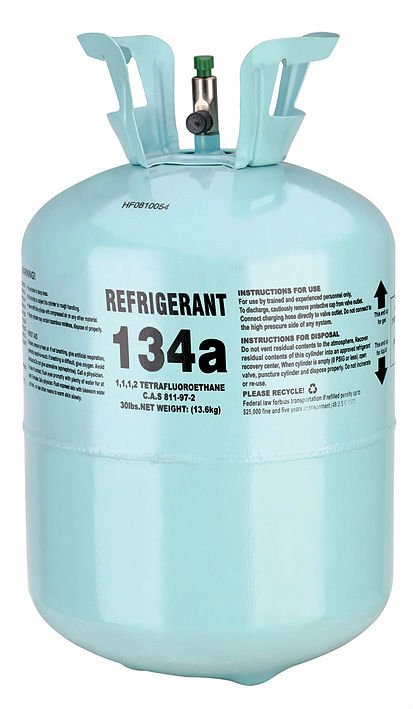
1,1,1,2-Tetrafluoroethane (also known as norflurane (INN), R-134a, Klea 134a, Freon 134a, Forane 134a, Genetron 134a, Green Gas, Florasol 134a, Suva 134a, HFA-134a, or HFC-134a) is a hydrofluorocarbon (HFC) and haloalkane refrigerant with thermodynamic properties similar to R-12 (dichlorodifluoromethane) but with insignificant ozone depletion potential and a lower 100-year global warming potential (1,430, compared to R-12's GWP of 10,900). It has the formula CFCHF and a boiling point of −26.3 °C (−15.34 °F) at atmospheric pressure. R-134a cylinders are colored light blue. A phaseout and transition to HFO-1234yf and other refrigerants, with GWPs similar to CO2, began in 2012 within the automotive market.
Uses
1,1,1,2-Tetrafluoroethane is a non-flammable gas used primarily as a "high-temperature" refrigerant for domestic refrigeration and automobile air conditioners. These devices began using 1,1,1,2-tetrafluoroethane in the early 1990s as a replacement for the more environmentally harmful R-12. Retrofit kits are available to convert units that were originally R-12-equipped.
Other common uses include plastic foam blowing, as a cleaning solvent, a propellant for the delivery of pharmaceuticals (e.g., inhaler canisters such as for bronchodilators), wine cork removers, gas dusters ("canned air"), and in air driers for removing the moisture from compressed air. 1,1,1,2-Tetrafluoroethane has also been used to cool computers in some overclocking attempts. It is the refrigerant used in plumbing pipe freeze kits. It is also commonly used as a propellant for airsoft airguns. The gas is often mixed with a silicone-based lubricant.
Aspirational and niche applications
1,1,1,2-Tetrafluoroethane is also being considered as an organic solvent, both as a liquid and a supercritical fluid.
It is used in the resistive plate chamber particle detectors in the Large Hadron Collider. It is also used for other types of particle detectors, e.g. some cryogenic particle detectors. It can be used as an alternative to sulfur hexafluoride in magnesium smelting as a shielding gas.
History and environmental impacts
1,1,1,2-Tetrafluoroethane was introduced in the early 1990s as a replacement for dichlorodifluoromethane (R-12), which has massive ozone depleting properties. Even though 1,1,1,2-Tetrafluoroethane has insignificant ozone depletion potential (ozone layer) and negligible acidification potential (acid rain), it has a 100-year global warming potential (GWP) of 1430 and an approximate atmospheric lifetime of 14 years. Its concentration in the atmosphere and contribution to radiative forcing have been growing since its introduction. Thus it was included in the IPCC list of greenhouse gases.{{cite book | chapter-url =http://www.ipcc.ch/pdf/assessment-report/ar4/wg1/ar4-wg1-chapter2.pdf | author =Forster, P.
_concentration.png)
R-134a began being phased out from use in the European Union, starting in the mid 2010s, by a directive of 2006, recommending the replacement of gases in air conditioning systems with a GWP above 100.
1,1,1,2-tetrafluoroethane is subject to use restrictions in the US and other countries as well. The Society of Automotive Engineers (SAE) has proposed that it be best replaced by a new fluorochemical refrigerant HFO-1234yf (CFCF=CH) in automobile air-conditioning systems. As of model year 2021, newly manufactured light-duty vehicles in the United States no longer use R-134a.
California may also prohibit the sale of canned R-134a to individuals to avoid non-professional recharge of air conditioners. A ban had been in place in Wisconsin since October 1994 under ATCP 136 prohibiting sales of container sizes holding less than 15 lbs of 1,1,1,2-tetrafluoroethane, but this restriction applied only when the chemical was intended to be a refrigerant. However, the ban was lifted in Wisconsin in 2012. During the time that it was active, this Wisconsin-specific ban contained loopholes. For example, it was legal for a person to purchase gas duster containers with any amount of the chemical because in that instance the chemical is neither intended to be a refrigerant nor is HFC-134a included in the § 7671a listing of class I and class II substances.
Production and reactions
Tetrafluoroethane is typically made by reacting trichloroethylene with hydrogen fluoride: :CHCl=CCl + 4 HF → CFCHF + 3 HCl
It reacts with butyllithium to give trifluorovinyl lithium: :CFCHF + 2 BuLi → CF=CFLi + LiF + 2 BuH
Safety

Mixtures with air of the gas 1,1,1,2-tetrafluoroethane are not flammable at atmospheric pressure and temperatures up to 100 °C (212 °F). However, mixtures with high concentrations of air at elevated pressure and/or temperature can be ignited. Contact of 1,1,1,2-tetrafluoroethane with flames or hot surfaces in excess of 250 °C (482 °F) may cause vapor decomposition and the emission of toxic gases including hydrogen fluoride and carbonyl fluoride, however the decomposition temperature has been reported as above 370 °C. 1,1,1,2-Tetrafluoroethane itself has an of 1,500 g/m in rats, making it relatively non-toxic, apart from the dangers inherent to inhalant abuse. Its gaseous form will displace air in the lungs. This can result in asphyxiation if excessively inhaled. This contributes to most deaths by inhalant abuse.
Aerosol cans containing 1,1,1,2-tetrafluoroethane, when inverted, become effective freeze sprays. Under pressure, 1,1,1,2-tetrafluoroethane is compressed into a liquid, which upon vaporization absorbs a significant amount of thermal energy. As a result, it will greatly lower the temperature of any object it contacts as it evaporates.
.jpg)
Medical use
For its medical uses, 1,1,1,2-tetrafluoroethane has the generic name norflurane. It is used as propellant for some metered dose inhalers. It is considered safe for this use. In combination with pentafluoropropane, it is used as a topical vapocoolant spray for numbing boils before curettage. It has also been studied as a potential inhalational anesthetic, but it is nonanaesthetic at doses used in inhalers.
References
References
- "Table 2.14 (Errata). Lifetimes, radiative efficiencies and direct (except for CH4) GWPs relative to CO2.".
- "Example image of a 30 lbs R134a bottle".
- (6 August 2015). "Refrigerant Transition & Environmental Impacts". U.S. Environmental Protection Agency.
- (2005). "Natural Flavors and Fragrances".
- (2005). "Solubility of unsaturated carboxylic acids in supercritical 1,1,1,2-tetrafluoroethane (HFC 134a) and a methodology for the separation of ternary mixtures". Green Chemistry.
- (2005). "Hydrogenation in supercritical 1,1,1,2 tetrafluoroethane (HFC 134a)". Green Chemistry.
- Anushree Ghosh [http://www.hecr.tifr.res.in/~bsn/INO/rpc-anushree.pdf STUDY OF GLASS RESISTIVE PLATE CHAMBERS (RPC) AND CALCULATION OF EFFICIENCY] {{Webarchive. link. (7 August 2011 . INO Graduate Training Programme DHEP, TIFR, Mumbai.)
- M. Capeans, I. Glushkov, R. Guida, F. Hahn, S. Haider (CERN, Switzerland) [https://web.archive.org/web/20101116193636/http://project-wp7.web.cern.ch/PROJECT%2DWP7/Documents/Roberto_IEEE2009%20v2.pdf RPC operation at the LHC experiments in an optimized closed loop gas system]. Medical Imaging Conference. 25–31 October 2009.
- (2006). "Rad Hard Active Media For Calorimeters". AIP Conference Proceedings.
- [https://pubs.usgs.gov/of/2001/of01-166/of01-166.pdf Magnesium recycling in the United States in 1998]. (PDF). USGS. Retrieved 21 August 2011.
- Franklin J. (1993). "The Atmospheric Degradation and Impact of 1,1,1,2-Tetrafluorethane (Hydrofluorocarbon 134a)". Chemosphere.
- {{CELEX
- [http://refrigerants.dupont.com/Suva/en_US/pdf/DP_HW_2nd_European_Workshop_MAC.pdf HFO-1234yf A Low GWP Refrigerant For MAC] {{webarchive. link. (27 February 2009. Refrigerants.dupont.com (17 August 2011). Retrieved 21 August 2011.)
- [http://www.r744.com/articles/494/california_restricts_use_of_hfc-134a_in_cars California restricts use of HFC-134a in cars]. 27 June 2007. R744.com. Retrieved 21 August 2011.
- [http://www.legis.state.wi.us/rsb/code/atcp/atcp136.pdf Chapter ATCP 136. MOBILE AIR CONDITIONERS; RECLAIMING OR RECYCLING REFRIGERANT]. State.wi.us. (PDF). Retrieved 21 August 2011.
- [https://web.archive.org/web/20080118120230/http://www.epa.gov/ozone/science/ods/classone.html Class I Ozone-depleting Substances]. EPA.gov. Retrieved 21 August 2011.
- "Solvay in North America {{pipe".
- (1996). "The hydrofluorocarbon 1,1,1,2-tetrafluoroethane (HFC-134a) as a ready source of trifluorovinyllithium". Chemical Communications.
- DuPont. (2004). "DuPont HFC-134a— Properties, Uses, Storage, and Handling".
- Honeywell International. (December 2005). "MSDS # GTRN-0047 For Genetron 134aUV".
- "SAFETY DATA SHEET according to Regulation (EU) 2015/8301/7 Harp 134a".
- (1995). "An overview of the toxicology of HFA-134a (1,1,1,2-tetrafluoroethane)". Hum. Exp. Toxicol..
- (1972). "Kinetic analysis of the shock wave decomposition of 1,1,1,2-tetrafluoroethane". The Journal of Physical Chemistry.
- (2017). "Asthma pressurised metered dose inhaler performance: Propellant effect studies in delivery systems". Allergy, Asthma & Clinical Immunology.
- (2015). "Anaesthetic in the garb of a propellant". Indian Journal of Anaesthesia.
- (2000). "Comparison of the safety of drug delivery via HFA- and CFC-metered dose inhalers in CAO". The European Respiratory Journal.
- "1,1,1,2-Tetrafluoroethane". [[Occupational Safety & Health Administration]].
- "Norflurane". DrugBank.
- "Norflurane-Pentafluoropropane Aerosol, Spray". [[WebMD]].
- (1967). "1,1,1,2-tetrafluoroethane: an inhalational agent of intermediate potency". Anesthesia and Analgesia.
This article was imported from Wikipedia and is available under the Creative Commons Attribution-ShareAlike 4.0 License. Content has been adapted to SurfDoc format. Original contributors can be found on the article history page.
Ask Mako anything about 1,1,1,2-Tetrafluoroethane — get instant answers, deeper analysis, and related topics.
Research with MakoFree with your Surf account
Create a free account to save articles, ask Mako questions, and organize your research.
Sign up freeThis content may have been generated or modified by AI. CloudSurf Software LLC is not responsible for the accuracy, completeness, or reliability of AI-generated content. Always verify important information from primary sources.
Report