From Surf Wiki (app.surf) — the open knowledge base
1,000,000
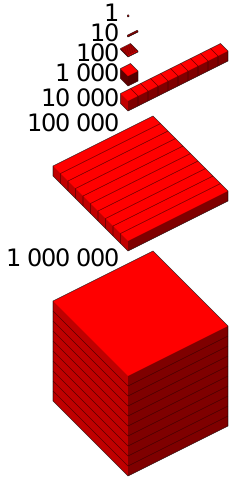
| Field | Value | |
|---|---|---|
| number | 1000000 | |
| lang1 | Egyptian hieroglyph | lang1 symbol=𓁨 |
1,000,000 (one million), or one thousand thousand, is the natural number following 999,999 and preceding 1,000,001. The word is derived from the early Italian millione (milione in modern Italian), from mille, "thousand", plus the augmentative suffix -one.
It is commonly abbreviated:
- in British English as m (not to be confused with the metric prefix "m" milli, for , or with metre),
- M,
- MM ("thousand thousands", from Latin "Mille"; not to be confused with the Roman numeral = 2,000),
- mm (not to be confused with millimetre), or
- mn, mln, or mio can be found in financial contexts.
In scientific notation, it is written as or 106. Physical quantities can also be expressed using the SI prefix mega (M), when dealing with SI units; for example, 1 megawatt (1 MW) equals 1,000,000 watts.
The meaning of the word "million" is common to the short scale and long scale numbering systems, unlike the larger numbers, which have different names in the two systems.
The million is sometimes used in the English language as a metaphor for a very large number, as in "Not in a million years" and "You're one in a million", or a hyperbole, as in "I've walked a million miles" and "You've asked a million-dollar question".
1,000,000 is also the square of 1000 and the cube of 100.
Visualizing one million
Even though it is often stressed that counting to precisely a million would be an exceedingly tedious task due to the time and concentration required, there are many ways to bring the number "down to size" in approximate quantities, ignoring irregularities or packing effects.
- Information: Not counting spaces, the text printed on 136 pages of an Encyclopædia Britannica, or 600 pages of pulp paperback fiction contains approximately one million characters.
- Length: There are one million millimetres in a kilometre, and roughly a million sixteenths of an inch in a mile (1 sixteenth = 0.0625). A typical car tire might rotate a million times in a 1200 mi trip, while the engine would do several times that number of revolutions.
- Fingers: If the width of a human finger is 22 mm, then a million fingers lined up would cover a distance of 22 km. If a person walks at a speed of 4 km/h, it would take them approximately five and a half hours to reach the end of the fingers.
- Area: A square a thousand objects or units on a side contains a million such objects or square units, so a million holes might be found in less than three square yards of window screen, or similarly, in about one half square foot (400–500 cm2) of bed sheet cloth. A city lot 70 by 100 feet is about a million square inches.
- Volume: The cube root of one million is one hundred, so a million objects or cubic units is contained in a cube a hundred objects or linear units on a side. A million grains of table salt or granulated sugar occupies about 64 mL, the volume of a cube one hundred grains on a side. One million cubic inches would be the volume of a small room feet long by feet wide by feet high.
- Mass: A million cubic millimetres (small droplets) of water would have a volume of one litre and a mass of one kilogram. A million millilitres or cubic centimetres (one cubic metre) of water has a mass of a million grams or one tonne.
- Weight: A million 80 mg honey bees would weigh the same as an 80 kg person.
- Landscape: A pyramidal hill 600 ft wide at the base and 100 ft high would weigh about a million short tons.
- Computer: A display resolution of 1,280 by 800 pixels contains 1,024,000 pixels.
- Money: A U.S. dollar bill of any denomination has a mass of 1 g. One million dollar bills have a mass of 1 Mg or 1 tonne (just over 1 short ton).
- Time: A million seconds, 1 megasecond, is 11.57 days.
In Indian English and Pakistani English, it is also expressed as 10 lakh. Lakh is derived from sa for 100,000 in Sanskrit.
Selected 7-digit numbers (1,000,001–9,999,999)
1,000,001 to 1,999,999
- 1,000,003 = Smallest 7-digit prime number
- 1,000,405 = Smallest triangular number with 7 digits and the 1,414th triangular number
- 1,002,001 = 10012, palindromic square
- 1,006,301 = First number of the first pair of prime quadruplets occurring thirty apart ({1006301, 1006303, 1006307, 1006309} and {1006331, 1006333, 1006337, 1006339})
- 1,024,000 = Sometimes, the number of bytes in a megabyte
- 1,030,301 = 1013, palindromic cube
- 1,037,718 = Large Schröder number
- 1,048,576 = 10242 = 324 = 165 = 410 = 220, the number of bytes in a mebibyte (previously called a megabyte)
- 1,048,976 = smallest 7 digit Leyland number
- 1,058,576 = Leyland number
- 1,058,841 = 76 x 32
- 1,077,871 = the amount of prime numbers between 0 and 16777216(2^24)
- 1,081,080 = 39th highly composite number
- 1,084,051 = fifth Keith prime
- 1,089,270 = harmonic divisor number
- 1,111,111 = repunit
- 1,112,083 = logarithmic number
- 1,129,30832 + 1 is prime
- 1,136,689 = Pell number, Markov number
- 1,174,281 = Fine number
- 1,185,921 = 10892 = 334
- 1,200,304 = 17 + 27 + 37 + 47 + 57 + 67 + 77
- 1,203,623 = smallest unprimeable number ending in 3
- 1,234,321 = 11112, palindromic square
- **1,246,863 ** = Number of 27-bead necklaces (turning over is allowed) where complements are equivalent
- 1,256,070 = number of reduced trees with 29 nodes
- 1,262,180 = number of triangle-free graphs on 12 vertices
- 1,278,818 = Markov number
- 1,290,872 = number of 26-bead binary necklaces with beads of 2 colors where the colors may be swapped but turning over is not allowed
- 1,296,000 = number of primitive polynomials of degree 25 over GF(2)
- 1,299,709 = 100,000th prime number
- 1,336,336 = 11562 = 344
- 1,346,269 = Fibonacci number, Markov number
- 1,367,631 = 1113, palindromic cube
- 1,388,705 = number of prime knots with 16 crossings
- 1,413,721 = square triangular number
- 1,419,857 = 175
- 1,421,280 = harmonic divisor number
- 1,441,440 = 11th colossally abundant number, 11th superior highly composite number, 40th highly composite number
- 1,441,889 = Markov number
- 1,500,625 = 12252 = 354
- 1,539,720 = harmonic divisor number
- 1,563,372 = Wedderburn-Etherington number
- 1,594,323 = 313
- 1,596,520 = Leyland number
- 1,606,137 = number of ways to partition {1,2,3,4,5,6,7,8,9} and then partition each cell (block) into subcells.
- 1,607,521/1,136,689 ≈ √2
- 1,647,086 = Leyland number
- 1,671,800 = Initial number of first century xx00 to xx99 consisting entirely of composite numbers
- 1,679,616 = 12962 = 364 = 68
- 1,686,049 = Markov prime
- 1,687,989 = number of square (0,1)-matrices without zero rows and with exactly 7 entries equal to 1
- 1,719,900 = number of primitive polynomials of degree 26 over GF(2)
- 1,730,787 = Riordan number
- 1,741,725 = equal to the sum of the seventh power of its digits
- 1,771,561 = 13312 = 1213 = 116, also, Commander Spock's estimate for the tribble population in the Star Trek episode "The Trouble with Tribbles"
- 1,864,637 = k such that the sum of the squares of the first k primes is divisible by k.
- 1,874,161 = 13692 = 374
- 1,889,568 = 185
- 1,928,934 = 2 x 39 x 72
- 1,941,760 = Leyland number
- 1,953,125 = 1253 = 59
- 1,978,405 = 16 + 26 + 36 + 46 + 56 + 66 + 76 + 86 + 96 + 106
2,000,000 to 2,999,999
- 2,000,002 = number of surface-points of a tetrahedron with edge-length 1000
- 2,000,376 = 1263
- 2,012,174 = Leyland number
- 2,012,674 = Markov number
- 2,027,025 = double factorial of 15
- 2,085,136 = 14442 = 384
- 2,097,152 = 1283 = 87 = 221
- 2,097,593 = Leyland prime using 2 & 21 (221 + 212)
- 2,118,107 = largest integer n\le10^{10} such that \sum_{k=0}^{22}\omega(n+k)\le57, where \omega(n) is the prime omega function for distinct prime factors. The corresponding sum for 2118107 is indeed 57.
- 2,124,679 = largest known Wolstenholme prime
- 2,144,505 = number of trees with 21 unlabeled nodes
- 2,162,160 = 41st highly composite number, 2079th triangular number
- 2,177,399 = smallest pandigital number in base 8.
- 2,178,309 = Fibonacci number
- 2,222,222 = repdigit
- 2,266,502 = number of signed trees with 13 nodes
- 2,274,205 = number of different ways of expressing 1,000,000,000 as the sum of two prime numbers
- 2,313,441 = 15212 = 394
- 2,356,779 = Motzkin number
- **2,405,236 ** = Number of 28-bead necklaces (turning over is allowed) where complements are equivalent
- 2,423,525 = Markov number
- 2,476,099 = 195
- 2,485,534 = number of 27-bead binary necklaces with beads of 2 colors where the colors may be swapped but turning over is not allowed
- 2,515,169 = number of reduced trees with 30 nodes
- 2,560,000 = 16002 = 404
- 2,567,284 = number of partially ordered set with 10 unlabelled elements
- 2,598,560 = chances of getting a royal flush in a hand of poker (52!/5!47!) (n choose r)
- 2,646,723 = little Schroeder number
- 2,674,440 = Catalan number
- 2,692,537 = Leonardo prime
- 2,704,900 = initial number of fourth century xx00 to xx99 containing seventeen prime numbers {2,704,901, 2,704,903, 2,704,907, 2,704,909, 2,704,927, 2,704,931, 2,704,937, 2,704,939, 2,704,943, 2,704,957, 2,704,963, 2,704,969, 2,704,979, 2,704,981, 2,704,987, 2,704,993, 2,704,997}
- 2,744,210 = Pell number
- 2,796,203 = Wagstaff prime, Jacobsthal prime
- 2,825,761 = 16812 = 414
- 2,890,625 = 1-automorphic number
- 2,922,509 = Markov prime
- 2,985,984 = 17282 = 1443 = 126 = 1,000,00012 AKA a great-great-gross
3,000,000 to 3,999,999
- 3,111,696 = 17642 = 424
- 3,200,000 = 205
- 3,263,443 = sixth term of Sylvester's sequence
- 3,276,509 = Markov prime
- 3,294,172 = 22×77
- 3,301,819 = alternating factorial
- 3,333,333 = repdigit
- 3,360,633 = palindromic in 3 consecutive bases: 62818269 = 336063310 = 199599111
- 3,418,801 = 18492 = 434
- 3,426,576 = number of free 15-ominoes
- 3,524,578 = Fibonacci number, Markov number
- 3,554,688 = 2-automorphic number
- 3,626,149 = Wedderburn–Etherington prime
- 3,628,800 = 10!
- 3,748,096 = 19362 = 444
- 3,880,899/2,744,210 ≈ √2
4,000,000 to 4,999,999
- 4,008,004 = 20022, palindromic square
- 4,037,913 = sum of the first ten factorials
- 4,084,101 = 215
- 4,100,625 = 20252 = 454
- 4,194,304 = 20482 = 411 = 222
- 4,194,788 = Leyland number
- 4,202,496 = number of primitive polynomials of degree 27 over GF(2)
- 4,208,945 = Leyland number
- 4,210,818 = equal to the sum of the seventh powers of its digits
- 4,213,597 = Bell number
- 4,260,282 = Fine number
- 4,297,512 = 12-th derivative of xx at x=1
- 4,324,320 = 12th colossally abundant number, 12th superior highly composite number, pronic number
- 4,400,489 = Markov number
- 4,444,444 = repdigit
- 4,477,456 = 21162 = 464
- **4,636,390 ** = Number of 29-bead necklaces (turning over is allowed) where complements are equivalent
- 4,741,632 = number of primitive polynomials of degree 28 over GF(2)
- 4,782,969 = 21872 = 97 = 314
- 4,782,974 = n such that n | (3n + 5)
- 4,785,713 = Leyland number
- 4,794,088 = number of 28-bead binary necklaces with beads of 2 colors where the colors may be swapped but turning over is not allowed
- 4,805,595 = Riordan number
- 4,826,809 = 21972 = 1693 = 136
- 4,879,681 = 22092 = 474
- 4,913,000 = 1703
- 4,937,284 = 22222
5,000,000 to 5,999,999
- 5,049,816 = number of reduced trees with 31 nodes
- 5,096,876 = number of prime numbers having eight digits
- 5,134,240 = the largest number that cannot be expressed as the sum of distinct fourth powers
- 5,153,632 = 225
- 5,195,977 = smallest number n such that the sum of reciprocals of primes up to n exceeds 3
- 5,221,225 = 22852, palindromic square
- 5,293,446 = Large Schröder number
- 5,308,416 = 23042 = 484
- 5,496,925 = first cyclic number in base 6
- 5,555,555 = repdigit
- 5,623,756 = number of trees with 22 unlabeled nodes
- 5,702,887 = Fibonacci number
- 5,761,455 = the number of primes under 100,000,000
- 5,764,801 = 24012 = 494 = 78
- 5,882,353 = 5882 + 23532
6,000,000 to 6,999,999
- 6,250,000 = 25002 = 504
- 6,436,343 = 235
- 6,536,382 = Motzkin number
- 6,625,109 = Pell number, Markov number
- 6,666,666 = repdigit
- 6,765,201 = 26012 = 514
- 6,948,496 = 26362, palindromic square
7,000,000 to 7,999,999
- 7,109,376 = 1-automorphic number
- 7,311,616 = 27042 = 524
- 7,453,378 = Markov number
- 7,529,536 = 27442 = 1963 = 146
- 7,652,413 = Largest n-digit pandigital prime
- 7,777,777 = repdigit
- 7,779,311 = A hit song written by Prince and released in 1982 by The Time
- 7,861,953 = Leyland number
- 7,890,481 = 28092 = 534
- 7,906,276 = pentagonal triangular number
- 7,913,837 = Keith number
- 7,962,624 = 245
8,000,000 to 8,999,999
- 8,000,000 = 2003, Used to represent infinity in Japanese mythology
- 8,053,393 = number of prime knots with 17 crossings
- 8,108,731 = repunit prime in base 14
- 8,388,607 = second composite Mersenne number with a prime exponent
- 8,388,608 = 223
- 8,389,137 = Leyland number
- 8,399,329 = Markov number
- 8,436,379 = Wedderburn-Etherington number
- 8,503,056 = 29162 = 544
- 8,675,309 = A hit song for Tommy Tutone (also a twin prime with 8,675,311)
- 8,675,311 = Twin prime with 8,675,309
- 8,877,691 = number of nonnegative integers with distinct decimal digits
- 8,888,888 = repdigit
- 8,946,176 = self-descriptive number in base 8
- **8,964,800 ** = Number of 30-bead necklaces (turning over is allowed) where complements are equivalent
9,000,000 to 9,999,999
- 9,000,000 = 30002
- 9,069,229 = 13 × 293 × 2,381, Strong pseudoprime to base two, first strong pseudoprime to have a multiplicative order above 100,000 (104,244)
- 9,150,625 = 30252 = 554
- 9,227,465 = Fibonacci number, Markov number
- 9,256,396 = number of 29-bead binary necklaces with beads of 2 colors where the colors may be swapped but turning over is not allowed
- 9,261,000 = 2103
- 9,369,319 = Newman–Shanks–Williams prime
- 9,647,009 = Markov number
- 9,653,449 = square Stella octangula number
- 9,581,014 = n such that n | (3n + 5)
- 9,663,500 = Initial number of first century xx00 to xx99 that possesses an identical prime pattern to any century with four or fewer digits: its prime pattern of {9663503, 9663523, 9663527, 9663539, 9663553, 9663581, 9663587} is identical to {5903, 5923, 5927, 5939, 5953, 5981, 5987}
- 9,694,845 = Catalan number
- 9,699,690 = eighth primorial
- 9,765,625 = 31252 = 255 = 510
- 9,800,817 = equal to the sum of the seventh powers of its digits
- 9,834,496 = 31362 = 564
- 9,865,625 = Leyland number
- 9,926,315 = equal to the sum of the seventh powers of its digits
- 9,938,375 = 2153, the largest 7-digit cube
- 9,997,156 = largest triangular number with 7 digits and the 4,471st triangular number
- 9,998,244 = 31622, the largest 7-digit square
- 9,999,991 = Largest 7-digit prime number
- 9,999,999 = repdigit
Prime numbers
There are 78,498 primes less than 106, where 999,983 is the largest prime number smaller than 1,000,000.
Increments of 106 from 1 million through a 10 million have the following prime counts:
- 70,435 primes between 1,000,000 and 2,000,000.
- 67,883 primes between 2,000,000 and 3,000,000.
- 66,330 primes between 3,000,000 and 4,000,000.
- 65,367 primes between 4,000,000 and 5,000,000.
- 64,336 primes between 5,000,000 and 6,000,000.
- 63,799 primes between 6,000,000 and 7,000,000.
- 63,129 primes between 7,000,000 and 8,000,000.
- 62,712 primes between 8,000,000 and 9,000,000.
- 62,090 primes between 9,000,000 and 10,000,000. In total, there are 586,081 prime numbers between 1,000,000 and 10,000,000.
Notes
References
References
- "million". Random House, Inc..
- "m". Oxford University Press.
- (2015). "The Economist Style Guide". The Economist.
- (26 February 2019). "English Style Guide. A handbook for authors and translators in the European Commission".
- "m". Merriam-Webster Inc..
- "Definition of 'M'". HarperCollins Publishers.
- "Q&A: What Does M and MM Stand For?". AccountingCoach, LLC.
- (4 February 2022). "FT makes change to style guide to benefit text-to-speech software". The Financial Times Ltd..
- David Wells. (1987). "[[The Penguin Dictionary of Curious and Interesting Numbers]]". Penguin Group.
- {{Cite OEIS. A059925. Initial members of two prime quadruples (A007530) with the smallest possible difference of 30
- [http://www.computernostalgia.net/articles/HistoryoftheFloppyDisk.htm Tracing the History of the Computer - History of the Floppy Disk]
- "A002182 - OEIS".
- {{Cite OEIS. A007629. Repfigit (REPetitive FIbonacci-like diGIT) numbers (or Keith numbers)
- {{Cite OEIS. A001599. Harmonic or Ore numbers
- {{cite OEIS. A002104. Logarithmic numbers
- {{cite OEIS. A006315. Numbers n such that n^32 + 1 is prime
- {{Cite OEIS. A000129. Pell numbers
- {{Cite OEIS. A002559
- {{cite OEIS. A000957. Fine's sequence (or Fine numbers): number of relations of valence > 0 on an n-set; also number of ordered rooted trees with n edges having root of even degree
- {{cite OEIS. A031971. Sum_{1..n} k^n
- Collins, Julia. (2019). "Numbers in Minutes". Quercus.
- {{Cite OEIS. A143641. Odd prime-proof numbers not ending in 5
- {{cite OEIS. A000011. Number of n-bead necklaces (turning over is allowed) where complements are equivalent
- {{cite OEIS. A000014. Number of series-reduced trees with n nodes
- {{cite OEIS. A006785. Number of triangle-free graphs on n vertices
- {{cite OEIS. A000013. Definition (1): Number of n-bead binary necklaces with beads of 2 colors where the colors may be swapped but turning over is not allowed
- {{cite OEIS. A011260. Number of primitive polynomials of degree n over GF(2)
- {{Cite OEIS. A000045. Fibonacci numbers
- {{Cite OEIS. A001110. Square triangular numbers
- {{Cite OEIS. A004490. Colossally abundant numbers
- {{Cite OEIS. A002201. Superior highly composite numbers
- {{Cite OEIS. A001190. Wedderburn-Etherington numbers
- {{cite OEIS. A000258. Expansion of e.g.f. exp(exp(exp(x)-1)-1)
- {{Cite OEIS. A181098. Primefree centuries
- {{cite OEIS. A122400. Number of square (0,1)-matrices without zero rows and with exactly n entries equal to 1
- {{cite OEIS. A111441. Numbers k such that the sum of the squares of the first k primes is divisible by k
- {{cite OEIS. A000540. Sum of 6th powers: 0^6 + 1^6 + 2^6 + ... + n^6.
- {{cite OEIS. A005893. Number of points on surface of tetrahedron
- {{Cite OEIS. A094133. Leyland prime numbers
- {{Cite OEIS. A088164. Wolstenholme primes
- {{cite OEIS. A000055. Number of trees with n unlabeled nodes
- {{cite OEIS. A049363
- {{cite OEIS. A000060. Number of signed trees with n nodes
- {{Cite OEIS. A065577. Number of Goldbach partitions of 10^n
- {{Cite OEIS. A001006. Motzkin numbers
- {{cite OEIS. A000112. Number of partially ordered sets (posets) with n unlabeled elements
- {{Cite OEIS. A000108. Catalan numbers
- {{Cite OEIS. A186509. Centuries containing 17 primes
- {{Cite OEIS. A186311. Least century 100k to 100k+99 with exactly ''n'' primes
- {{cite OEIS. A186408. Centuries containing 16 primes
- {{Cite OEIS. A000979. Wagstaff primes
- {{Cite OEIS. A003226. Automorphic numbers
- {{Cite OEIS. A000058. Sylvester's sequence
- {{cite OEIS. A048102. Numbers k such that if k equals Product p_i^e_i then p_i equals e_i for all i
- {{Cite OEIS. A005165. Alternating factorials
- {{Cite OEIS. A030984. 2-automorphic numbers
- {{Cite OEIS. A000110. Bell or exponential numbers
- {{cite OEIS. A005727. n-th derivative of x^x at 1. Also called Lehmer-Comtet numbers
- {{cite OEIS. A277288. Positive integers n such that n divides (3^n + 5)
- {{Cite OEIS. A006879. Number of primes with n digits.
- {{Cite OEIS. A016088
- {{cite OEIS. A344389. a(n) is the number of nonnegative numbers < 10^n with all digits distinct.
- {{Cite OEIS. A088165. NSW primes
- {{Cite OEIS. A164987. First pair of primes (p1, p2) that begin centuries of primes having the same prime configuration, ordered by increasing p2. Each configuration is allowed only once.
- {{cite OEIS. A258275. Smallest number k > n such that the interval k100 to k100+99 has exactly the same prime pattern as the interval n100 to n100+99
- "The Nth Prime Page".
This article was imported from Wikipedia and is available under the Creative Commons Attribution-ShareAlike 4.0 License. Content has been adapted to SurfDoc format. Original contributors can be found on the article history page.
Ask Mako anything about 1,000,000 — get instant answers, deeper analysis, and related topics.
Research with MakoFree with your Surf account
Create a free account to save articles, ask Mako questions, and organize your research.
Sign up freeThis content may have been generated or modified by AI. CloudSurf Software LLC is not responsible for the accuracy, completeness, or reliability of AI-generated content. Always verify important information from primary sources.
Report