Mu Geminorum
Star in the constellation Gemini
title: "Mu Geminorum" type: doc version: 1 created: 2026-02-28 author: "Wikipedia contributors" status: active scope: public tags: ["m-type-giants", "asymptotic-giant-branch-stars", "slow-irregular-variables", "gemini-(constellation)", "bayer-objects", "durchmusterung-objects", "flamsteed-objects", "henry-draper-catalogue-objects", "hipparcos-objects", "bright-star-catalogue-objects", "stars-with-proper-names"] description: "Star in the constellation Gemini" topic_path: "science/astronomy" source: "https://en.wikipedia.org/wiki/Mu_Geminorum" license: "CC BY-SA 4.0" wikipedia_page_id: 0 wikipedia_revision_id: 0
::summary Star in the constellation Gemini ::
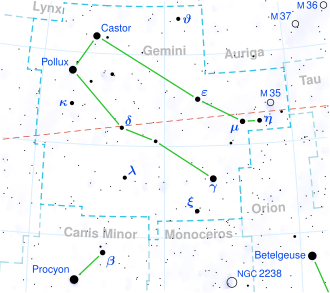
| name = μ Geminorum | image= | image=Gemini constellation map.svg | alt= | float=center | width=280 | label= | position=right | mark=Red circle.svg | mark_width=10 | mark_link=μ Gem | x%=73.5 | y%=41.6 |caption=Location of μ Geminorum (circled) | constell = Gemini | epoch = J2000.0 (ICRS) | ra = | dec = | appmag_v = 2.75 - 3.02 | type = AGB | class = M3 III | b-v = +1.643 | u-b = +1.924 | variable = LB | radial_v = | prop_mo_ra = +56.39 | prop_mo_dec = −110.03 | parallax = 14.08 | p_error = 0.71 | parallax_footnote = | absmag_v = −1.42 | mass = | radius = 107.7 | luminosity = 1,692 | temperature = 3,643 | gravity = | metal_fe = | rotational_velocity = 8.4 | age_gyr = | names = | Simbad = mu+Gem
Mu Geminorum or μ Geminorum, formally named Tejat (), is a single star in the northern constellation of Gemini. From parallax measurements obtained during the Hipparcos mission, it is roughly 230 ly distant from the Sun. The position of the star near the ecliptic means that it is subject to lunar occultations.
Mu Geminorum forms the primary or 'A' component of a double star system designated WDS J06230+2231 along with UCAC2 39641417 (also designated WDS J06230+2231BC), itself a binary pair.
Nomenclature
::figure[src="https://upload.wikimedia.org/wikipedia/commons/1/14/Ic443_wide.jpg" caption="η Gem]]."] ::
μ Geminorum (Latinised to Mu Geminorum) is the star's Bayer designation. WDS J06230+2231 is the star's designation in the Washington Double Star Catalog. The designations of the double star's components as WDS J06230+2231A and BC derive from the convention used by the Washington Multiplicity Catalog (WMC) for multiple star systems, and adopted by the International Astronomical Union (IAU). Further faint companions D, E, and F are also listed, all distant background objects.
Mu Geminorum bore the traditional name of Tejat (or more precisely, Tejat Posterior), from an old southern Arabic word of unknown meaning, tiḥyāt. The name Tejat Posterior was formerly applied to an asterism consisting of this star, along with Gamma Geminorum (Alhena), Nu Geminorum, Eta Geminorum (Propus), and Xi Geminorum (Alzirr). In 2016, the International Astronomical Union organized a Working Group on Star Names (WGSN) to catalogue and standardize proper names for stars. The WGSN decided to attribute proper names to individual stars rather than entire multiple systems. It approved the name Tejat for the component WDS J06230+2231A (i.e. Mu Geminorum) on February 1, 2017 and it is now so included in the List of IAU-approved Star Names.
The names Calx (Latin, meaning 'heel'), Pish Pai (from the Persian پیشپای ('pīshpāy', meaning 'foreleg'), and Nuhatai (from Arabic 'Al Nuḥātai', the dual form of 'Al Nuḥāt', 'a Camel's Hump') have also been applied to Mu Geminorum.
In Chinese, 井宿 (Jǐng Su), meaning Well (asterism), refers to an asterism consisting of Mu Geminorum, Gamma Geminorum, Nu Geminorum, Xi Geminorum, Epsilon Geminorum, 36 Geminorum, Zeta Geminorum and Lambda Geminorum. Consequently, Mu Geminorum itself is known as 井宿一 (Jǐng Su yī, ).
Properties
::figure[src="https://upload.wikimedia.org/wikipedia/commons/2/2d/MuGemLightCurve.png" caption="Visual band]] [[light curve]]s for Mu Geminorum, adapted from Percy ''et al.'' (2001). The 27 day periodicity is visible in the lower plot."] ::
Mu Geminorum has an average apparent visual magnitude of about 2.9, which makes it the fourth-brightest member of Gemini. It is 0.8 degrees south of the ecliptic, so it is subject to occultations by the Moon and, rarely, by planets. Seen from Earth, its brightness is reduced by 0.07 magnitudes by extinction from intervening gas and dust.
It is a slow irregular variable of type LB. Its brightness varies between magnitude +2.75 and +3.02 over a 72-day period, along with a 2,000-day period of long term variation. It is a red giant at a stellar classification of M3 III, with a surface temperature of , meaning it is considerably cooler than the Sun. Despite being cooler than the Sun, it is over 1,500 times as luminous as it has expanded to more than 100 times the size of the Sun.
Mu Geminorum is currently on the asymptotic giant branch and is generating energy through the nuclear fusion of hydrogen and helium along concentric shells surrounding an inert core of carbon and oxygen.
References
| last1=Percy |first1=John R. |last2=Wilson |first2=Joseph B. | last3=Henry |first3=Gregory W. | title=Long-Term VRI Photometry of Small-Amplitude Red Variables. I. Light Curves and Periods | journal=Publications of the Astronomical Society of the Pacific |date=August 2001 | volume=113 |issue=786 |pages=983–996 |doi=10.1086/322153| jstor=10.1086/322153 |bibcode=2000AAS...197.4614P | s2cid=14609175 |doi-access=free }}
| title=Angular Diameter Measurements of Evolved Variables by Lunar Occultations at 2.2 and 3.8 Microns | last1=Mondal | first1=Soumen | last2=Chandrasekhar | first2=T. | journal=The Astronomical Journal | volume=130 | issue=2 | pages=842–852 | date=August 2005 | doi=10.1086/430457 | arxiv=astro-ph/0504326 | bibcode=2005AJ....130..842M | s2cid=14802944 | postscript=. }}
| title=Population Synthesis in the Blue. IV. Accurate Model Predictions for Lick Indices and UBV Colors in Single Stellar Populations | last1=Schiavon | first1=Ricardo P. | journal=The Astrophysical Journal Supplement Series | volume=171 | issue=1 | pages=146–205 | date=July 2007 | doi=10.1086/511753 | bibcode=2007ApJS..171..146S | arxiv=astro-ph/0611464 | s2cid=13946698 | postscript=. }}
| title=A Catalog of Stellar Angular Diameters Measured by Lunar Occultation | last1=White | first1=Nathaniel M. | last2=Feierman | first2=Barry H. | journal=Astronomical Journal | postscript=. | volume=94 | page=751 | date=September 1987 | doi=10.1086/114513 | bibcode=1987AJ.....94..751W }}
|last1=Kunitzsch |first1=Paul |last2=Smart |first2=Tim |date = 2006 |edition = 2nd rev. |title = A Dictionary of Modern star Names: A Short Guide to 254 Star Names and Their Derivations |publisher = Sky Pub |location = Cambridge, Massachusetts |isbn = 978-1-931559-44-7
References
- {{in lang. zh ''中國星座神話'', written by 陳久金. Published by 台灣書房出版有限公司, 2005, {{ISBN. 978-986-7332-25-7.
- {{in lang. zh [http://www.lcsd.gov.hk/CE/Museum/Space/Research/StarName/c_research_chinengstars_t_z.htm 香港太空館 - 研究資源 - 亮星中英對照表] {{webarchive. link. (2010-08-19 , Hong Kong Space Museum. Accessed on line November 23, 2010.)
- {{cite Gaia DR3
- (2001). "The 2001 US Naval Observatory Double Star CD-ROM. I. The Washington Double Star Catalog". The Astronomical Journal.
- (October 2023). "Long-period radial velocity variations of nine M red giants: The detection of sub-stellar companions around HD 6860 and HD 112300". [[Astronomy & Astrophysics]].
- (2011-01-01). "Coudé-feed stellar spectral library - atmospheric parameters". Astronomy and Astrophysics.
- (2016-09-23). "Hubble Space Telescope Constraints on the Winds and Astrospheres of Red Giant Stars". [[The Astrophysical Journal]].
- (2015-08-01). "Exploring masses and CNO surface abundances of red giant stars". Monthly Notices of the Royal Astronomical Society.
- (November 2007). "Validation of the new Hipparcos reduction". Astronomy and Astrophysics.
- (December 1999). "Lithium abundance and mass". Astronomy and Astrophysics.
- "mu. Gem".
- [https://vizier.cds.unistra.fr/viz-bin/VizieR-5?-ref=VIZ62f11e91198ed5&-out.add=.&-source=B/gcvs/gcvs_cat&recno=22328 mu Gem], entry in the [https://vizier.cds.unistra.fr/viz-bin/VizieR?-source=B/gcvs Combined General Catalog of Variable Stars (GCVS 5.1)], N. N. Samus, O. V. Durlevich, et al., database identifier B/gcvs at the [[Centre de Données astronomiques de Strasbourg]].
- (2007). "Isotopic abundances of Carbon and Oxygen in Oxygen-rich giant stars". Convection in Astrophysics.
- (January 2008). "BRITE stars on the AGB". Communications in Asteroseismology.
- (January 2005). "Local kinematics of K and M giants from CORAVEL/Hipparcos/Tycho-2 data. Revisiting the concept of superclusters". Astronomy and Astrophysics.
- (January 2008). "Rotational and Radial Velocities for a Sample of 761 HIPPARCOS Giants and the Role of Binarity". The Astronomical Journal.
- (1966). "A System of photometric standards". Publicaciones Universidad de Chile, Department de Astronomy.
- (1899). "Star-names and Their Meanings". G. E. Stechert.
- "Tejat". Jim Kaler's STARS.
- (1973). "Spectral Classification". Annual Review of Astronomy and Astrophysics.
- (2010). "Coudé-feed stellar spectral library – atmospheric parameters". Astronomy & Astrophysics.
- "Naming Stars". IAU.org.
- "UCAC2 39641417 -- Double or multiple star". [[Centre de Données astronomiques de Strasbourg]].
- (2010). "On the naming convention used for multiple star systems and extrasolar planets".
- "International Astronomical Union {{!}} IAU".
- "WG Triennial Report (2015-2018) - Star Names".
::callout[type=info title="Wikipedia Source"] This article was imported from Wikipedia and is available under the Creative Commons Attribution-ShareAlike 4.0 License. Content has been adapted to SurfDoc format. Original contributors can be found on the article history page. ::