Gamma Geminorum
Star in the constellation Gemini
title: "Gamma Geminorum" type: doc version: 1 created: 2026-02-28 author: "Wikipedia contributors" status: active scope: public tags: ["bayer-objects", "flamsteed-objects", "gemini-(constellation)", "a-type-subgiants", "spectroscopic-binaries", "stars-with-proper-names", "bright-star-catalogue-objects", "henry-draper-catalogue-objects", "hipparcos-objects", "durchmusterung-objects"] description: "Star in the constellation Gemini" topic_path: "science/astronomy" source: "https://en.wikipedia.org/wiki/Gamma_Geminorum" license: "CC BY-SA 4.0" wikipedia_page_id: 0 wikipedia_revision_id: 0
::summary Star in the constellation Gemini ::
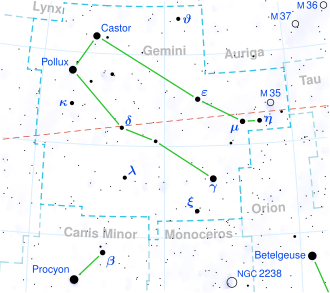
| name = γ Geminorum | image= |image=Gemini constellation map.svg|alt=|float=center|width=260 |label=|position=right |mark=Red circle.svg|mark_width=10|mark_link=γ Gem |x=645|y=542 |caption=Location of γ Geminorum (circled) | epoch = J2000 | ra = | dec = | appmag_v = 1.915 | constell = Gemini | type = subgiant | class = A1IV + G | b-v = +0.005 | u-b = +0.137 | variable = | radial_v = −12.5 | prop_mo_ra = +13.81 | prop_mo_dec = −54.96 | parallax = 29.84 | p_error = 2.23 | parallax_footnote = | absmag_v = −0.68 | reference = | primary = | name = | period_unitless = 4,614.51 days | axis = | axis_unitless = | eccentricity = | inclination = | node = | periastron = | periarg = | periarg_primary = | k1 = | k2 = | component1 = γ Gem A | mass = 2.81 | radius = | gravity = | luminosity = | temperature = | metal_fe = −0.12 | rotational_velocity = | age_gyr = | component2 = γ Gem B | mass2 = 1.07 | names = Alhena, 24 Geminorum, BD+16°1223, FK5 251, GCTP1539.00, HIP 31681, HD 47105, HR 2421, SAO 95912 | Simbad = gamma+Gem
Gamma Geminorum (γ Geminorum, abbreviated Gamma Gem, γ Gem), formally named Alhena , is the third-brightest object in the constellation of Gemini. It has an apparent visual magnitude of 1.9, making it easily visible to the naked eye even in urban regions. Based upon parallax measurements with the Hipparcos satellite, it is located at a distance of roughly 109 ly.
Properties
Alhena is an evolving star that is exhausting the supply of hydrogen at its core and has entered the subgiant stage. The spectrum matches a stellar classification of A0 IV. Compared to the Sun it has 2.8 times the mass and six times the radius. It is radiating around 200 times the luminosity of the Sun from its outer envelope at an effective temperature of 9,190 K. This gives it a white hue typical of an A-class star.
Alhena is a spectroscopic binary system with a period of 12.6 years (4,614.51 days) in a highly eccentric Keplerian orbit. The secondary, with 1.07 times the mass of the Sun, is likely a G-type main-sequence star.
Etymology
γ Geminorum (Latinised to Gamma Geminorum) is the star's Bayer designation. The traditional name Alhena is derived from the Arabic الهنعة Al Han'ah, 'the brand' (on the neck of the camel), whilst the alternate name Almeisan is from the Arabic المیسان Al Maisan, 'the shining one.' Al Hanʽah was the name of star association consisting of this star, along with Mu Geminorum (Tejat Posterior), Nu Geminorum, Eta Geminorum (Tejat Prior) and Xi Geminorum (Alzirr). They also were associated in Al Nuḥātai, the dual form of Al Nuḥāt, 'a Camel's Hump'. In 2016, the International Astronomical Union organized a Working Group on Star Names (WGSN) to catalog and standardize proper names for stars. The WGSN's first bulletin of July 2016 included a table of the first two batches of names approved by the WGSN; which included Alhena for this star.
In the catalogue of stars in the Calendarium of Al Achsasi Al Mouakket, this star was designated Nir al Henat, which was translated into Latin as Prima του al Henat, meaning 'the brightest of Al Henat'.
In Chinese, 井宿 (Jǐng Su), meaning Well (asterism), refers to an asterism consisting of γ Geminorum, ε Geminorum, ζ Geminorum, λ Geminorum, μ Geminorum, ν Geminorum, ξ Geminorum and 36 Geminorum. Consequently, γ Geminorum itself is known as 井宿三 (Jǐng Su sān, .)
Conjunctions
Gamma Geminorum is 6° south of the ecliptic, far enough so that the Moon never occults it. Similarly, planets in conjunction with this star almost always pass several degrees to the north, but Venus will have a series of close conjunctions with Gamma Geminorum starting in August 2143, and continuing every eight years after over the remainder of that century.
The Sun passes Gamma Geminorum on or around June 30 every year.
In culture
Alhena was the name of a Dutch ship that rescued many people from an Italian cruise liner, the SS Principessa Mafalda, in October 1927. In addition, the American attack cargo ship was named after the star.
References
References
- {{in lang. zh ''中國星座神話'', written by 陳久金. Published by 台灣書房出版有限公司, 2005, {{ISBN. 978-986-7332-25-7.
- {{in lang. zh [http://www.lcsd.gov.hk/CE/Museum/Space/Research/StarName/c_research_chinengstars_ala_alz.htm 香港太空館 – 研究資源 – 亮星中英對照表] {{webarchive. link. (October 25, 2008 , Hong Kong Space Museum. Accessed on line November 23, 2010.)
- "IAU Catalog of Star Names".
- "Bulletin of the IAU Working Group on Star Names, No. 1".
- "IAU Working Group on Star Names (WGSN)".
- (2004). "The angular sizes of dwarf stars and subgiants. Surface brightness relations calibrated by interferometry". Astronomy and Astrophysics.
- "Italian account of the Principessa Malfeda".
- (1993). "The Spectroscopic Orbit of Gamma Geminorum and a Search for its Secondary". Astronomical Journal.
- (2023-12-11). "Non-LTE abundance analysis of A-B stars with low rotational velocities – II. Do A-B stars with normal abundances exist?". Monthly Notices of the Royal Astronomical Society.
- "Interactive Sky Chart".
- van Leeuwen, F.. (November 2007). "Validation of the new Hipparcos reduction". Astronomy and Astrophysics.
- (January 2011). "Very Wide Binaries and Other Comoving Stellar Companions: A Bayesian Analysis of the Hipparcos Catalogue". The Astrophysical Journal Supplement.
- Allen, R. H.. (1963). "Star Names: Their Lore and Meaning". Dover Publications Inc.
- Knobel, E. B.. (June 1895). "Al Achsasi Al Mouakket, on a catalogue of stars in the Calendarium of Mohammad Al Achsasi Al Mouakket". [[Monthly Notices of the Royal Astronomical Society]].
- (December 1994). "Elemental abundances of the B and A stars. 2: Gamma Geminorum, HD 60825, 7 Sextantis, HR 4817, and HR 5780". Publications of the Astronomical Society of the Pacific.
- (April 1969). "A study of the bright A stars. I. A catalogue of spectral classifications". Astronomical Journal.
- (June 20–24, 1966). "Determination of Radial Velocities and their Applications, Proceedings from IAU Symposium no. 30". [[International Astronomical Union]].
- (1966). "A System of photometric standards". Publicaciones Universidad de Chile, Department de Astronomy.
- "ALHENA – Spectroscopic binary". [[Centre de Données astronomiques de Strasbourg]].
- (December 21, 2004). "The Colour of Stars". [[Commonwealth Scientific and Industrial Research Organisation]].
- (February 2002). "The spectroscopic binaries 21 Her and gamma Gem". Astronomy and Astrophysics.
::callout[type=info title="Wikipedia Source"] This article was imported from Wikipedia and is available under the Creative Commons Attribution-ShareAlike 4.0 License. Content has been adapted to SurfDoc format. Original contributors can be found on the article history page. ::