Kadamba script
Historic abugida of South India
title: "Kadamba script" type: doc version: 1 created: 2026-02-28 author: "Wikipedia contributors" status: active scope: public tags: ["kannada-literature", "brahmic-scripts", "alphabets", "linguistic-history-of-india"] description: "Historic abugida of South India" topic_path: "arts" source: "https://en.wikipedia.org/wiki/Kadamba_script" license: "CC BY-SA 4.0" wikipedia_page_id: 0 wikipedia_revision_id: 0
::summary Historic abugida of South India ::
::data[format=table title="Infobox Writing system"]
| Field | Value |
|---|---|
| name | Kadamba script |
| type | Abugida |
| sample | Sri-manarashi.jpg |
| imagesize | 300 |
| time | 4–7th century CE |
| languages | Old Kannada |
| Old Telugu | |
| Sanskrit | |
| Konkani | |
| fam1 | Egyptian hieroglyphs |
| fam2 | Proto-Sinaitic |
| fam3 | Phoenician |
| fam4 | Aramaic |
| fam5 | Brahmi |
| children | Kannada-Telugu alphabet, Goykanadi, Pyu script |
| :: |
| name = Kadamba script | type = Abugida | sample = Sri-manarashi.jpg | imagesize = 300 | time = 4–7th century CE | languages = Old Kannada Old Telugu Sanskrit Konkani | fam1 = Egyptian hieroglyphs | fam2 = Proto-Sinaitic | fam3 = Phoenician | fam4 = Aramaic | fam5 = Brahmi | children = Kannada-Telugu alphabet, Goykanadi, Pyu script The Kadamba script is the first writing system devised specifically for writing Kannada, and later adopted to write Telugu language. The Kadamba script is also known as Pre-Old-Kannada script.
The Kadamba script is one of the oldest scripts of the southern group of writing systems that developed from the ancient Brahmi script. By the 5th century CE it became distinct from other Brahmi variants and was used in what are now the South Indian states of Karnataka, Telangana and Andhra Pradesh. It evolved into the Kannada-Telugu script by the 10th century CE and was used to write the Kannada and Telugu languages.{{cite news |url=https://bangaloremirror.indiatimes.com/news/india/scripts-fading-away-with-time/articleshow/21534740.cms |title=Scripts fading away with time |access-date=2013-08-28
History
| align = right | direction =horizontal | header=Kadamba coinage | image1 = Coin of Kadamba king Sri Manarashi.jpg | caption1 = Coin of Kadamba king Sri Manarashi, name written in Kadamba script | image2 = Sri-manarashi.jpg | caption2 = Sri manarashi written in Kadamba script on Kadamba coin | image3 = Coin of Kadamba king Sri Dosharashi.jpg | caption3 = Coin of the Kadambas written in Kadamba script as sri dosharashi and other side Shri shashankaha | image4 = Kannada legend of Sri-dosharashi.jpg | caption4 = Sri dosharashi written in Kadamba script on Kadamba coin | footer= During the rule of Kadamba dynasty (325-550), major change in the Brahmi script resulted in the Kadamba Kannada script, letters were shorter and round in shape. During (325 to 1000 AD) the rule of the Western Ganga dynasty in the southern parts of Karnataka the Kannada script used differently (also known as Ganga script) in rock edicts and copper plate inscriptions. During 6th to 10th century, the Telugu-Kannada alphabet stabilized during the rule of the Chalukyas of Badami from 500-1000 and Rastrakutas.
Inscriptions in Kadamba script
::figure[src="https://upload.wikimedia.org/wikipedia/commons/b/b5/Copper_plates_NMND-9.JPG" caption="Sanskrit language written in Kannada-Telugu script of [[Eastern Chalukyas]] in 10th century AD"] ::
::figure[src="https://upload.wikimedia.org/wikipedia/commons/1/15/Kadamba_inscription_from_Kerala.jpg" caption="Prakrit Grantha inscription of Kadamba ruler [[Vishnuvarman]] (c. 5th-6th century CE) from [[Edakkal]] (northern Kerala)"] ::
- Gudnapur Inscription on 20-foot-long stone pillar written in Kadamba script
- Copper plate inscriptions in Kadamba (Pre - Chalukya) script, Kadamba-Pallava script, Kannada-Telugu script are available at Chennai museum
- Halmidi inscription
- Talagunda pillar inscription
Similarity with other scripts
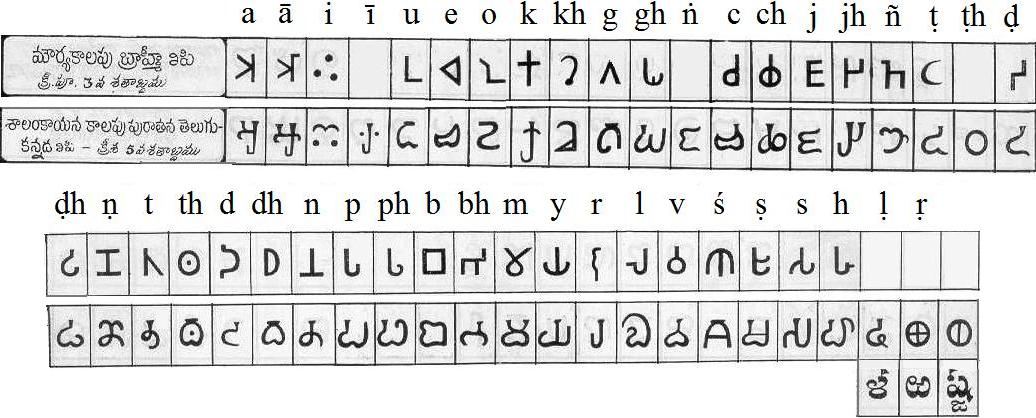
The Kadamba script shares similarities with scripts of certain languages belonging to the alphasyllabary or abugida family, including Goykanadi, Bhattiprolu script, Salankayana script, Pallava script, Gupta script, as well as the Tulu script. ::figure[src="https://upload.wikimedia.org/wikipedia/commons/6/6a/Kadamba_Script.jpg" caption="Latin symbols corresponding to Kadamba script."] ::
References
References
- (1948). "Alphabet a key to the history of mankind".
- "Goykanadi script".
- Aung-Thwin, Michael. (2005). "The mists of Rāmañña: The Legend that was Lower Burma". University of Hawai'i Press.
- (1948). "Alphabet a key to the history of mankind".
- Jayarajan, Paul M. (1 January 1976). ''History of the Evolution of the Sinhala Alphabet''. Colombo Apothecaries' Company, Limited.
- Kipfer, Barbara Ann. (2000). "Encyclopedic Dictionary of Archaeology". Springer Science & Business Media.
- Rajiv Ajjibal. (2011-12-16). "Monuments crying for attention". The Hindu.
- "Government Museum Chennai". Chennaimuseum.org.
- (12 January 2017). "Kannada inscription at Talagunda may replace Halmidi as oldest".
- "Comparison of Brahmi and Pallava scripts". SkyKnowledge.com.
- "Gupta". Ancient Scripts.
- "Comparison of scripts (Tulu/Kadamba)". Quora.
::callout[type=info title="Wikipedia Source"] This article was imported from Wikipedia and is available under the Creative Commons Attribution-ShareAlike 4.0 License. Content has been adapted to SurfDoc format. Original contributors can be found on the article history page. ::