GM High Feature engine

title: "GM High Feature engine" type: doc version: 1 created: 2026-02-28 author: "Wikipedia contributors" status: active scope: public tags: ["general-motors-engines", "v6-engines", "gasoline-engines-by-model"] topic_path: "general/general-motors-engines" source: "https://en.wikipedia.org/wiki/GM_High_Feature_engine" license: "CC BY-SA 4.0" wikipedia_page_id: 0 wikipedia_revision_id: 0
::data[format=table title="Infobox automobile engine"]
| Field | Value |
|---|---|
| name | GM High Feature V6 |
| image | Alloytec V6 (LPG) engine of a 2006-2008 Holden VE Commodore 1.jpg |
| caption | Alloytec LPG V6 engine in a 2006-2008 Holden VE Commodore |
| manufacturer | General Motors |
| aka | Alloytec V6 |
| production | 2004–present |
| predecessor | |
| configuration | 60° V6 |
| block | Aluminum |
| head | Aluminum |
| valvetrain | DOHC 4 valves × cyl. with VVT |
| fuelsystem | Sequential multi-port fuel injection |
| Direct injection | |
| fueltype | Gasoline, E85, LPG |
| oilsystem | Wet sump |
| coolingsystem | Water-cooled |
| turbocharger | Twin-turbo (in some models) |
| compression | 9.5:1, 10.0:1, 10.2:1, 10.3:1, 11.3:1, 11.5:1, 11.7:1, 12.2:1 |
| displacement | |
| bore | |
| stroke | |
| redline | 6500–7200 |
| emissions level | Euro 6 |
| power | 201-464 hp |
| torque | 182-445 lbft |
| :: |
| name = GM High Feature V6 | image = Alloytec V6 (LPG) engine of a 2006-2008 Holden VE Commodore 1.jpg | caption = Alloytec LPG V6 engine in a 2006-2008 Holden VE Commodore | manufacturer = General Motors | aka = Alloytec V6 | production = 2004–present | predecessor = | configuration = 60° V6 | block = Aluminum | head = Aluminum | valvetrain = DOHC 4 valves × cyl. with VVT | fuelsystem = Sequential multi-port fuel injection Direct injection | fueltype = Gasoline, E85, LPG | oilsystem = Wet sump | coolingsystem = Water-cooled | turbocharger = Twin-turbo (in some models) Single-turbo (in the 2.8L LP9 and LAU) | compression = 9.5:1, 10.0:1, 10.2:1, 10.3:1, 11.3:1, 11.5:1, 11.7:1, 12.2:1 | displacement = | bore = | stroke = | redline = 6500–7200 | emissions level = Euro 6 | power = 201-464 hp | torque = 182-445 lbft
The GM High Feature engine (also known as the HFV6, and including the 3600 LY7 and derivative LP1) is a family of modern DOHC V6 engines produced by General Motors. The series was introduced in 2004 with the Cadillac CTS and the Holden VZ Commodore.
It is a 60° 24-valve design with aluminum block and heads and sequential multi-port fuel injection. Most versions feature continuously variable cam phasing on both intake and exhaust valves and electronic throttle control. Other features include piston oil-jet capability, forged and fillet rolled crankshaft, sinter forged connecting rods, a variable-length intake manifold, twin knock control sensors and coil-on-plug ignition. It was developed by the same international team responsible for the Ecotec, including the Opel engineers responsible for the 54° V6, with involvement with design and development engineering from Ricardo plc.
GM's Australian auto division Holden produced a HFV6 engine under the name "Alloytec."
History
The HFV6 was designed, tested, and produced in a joint program by Holden and Cadillac. A majority of designs into the new alloy construction, transmission pairing, and first use in production were all undertaken in Detroit (and manufactured in St. Catharines, Ontario). Holden was charged with developing smaller engines (Holden 3.2 LP1 and Saab 2.8 Turbo LP9) as well as their own Holden 3.6 and 3.0 HFV6 (called the Alloytec V6) for local models.
Cadillac and Holden both tested variations of these engines in the United States and Australia.
2.8
LP1
A 2792 cc LP1 variant was introduced in the 2005 Cadillac CTS. It was also used on the Chinese 2008 CTS. It has a 89x74.8 mm bore and stroke, sequential multi-port fuel injection and a 10.0:1 compression ratio. The LP1 was built in St. Catharines, Ontario.
Applications: ::data[format=table]
| Year(s) | Model | Power | Torque |
|---|---|---|---|
| 2004–2006 | Buick Royaum (China) | 208 hp @ 6500 rpm | 184 lbft @ 3200 rpm |
| 2007–2009 | Buick Park Avenue (China) | 201 hp @ 6500 rpm | 195 lbft @ 2600 rpm |
| 2005–2007 | Cadillac CTS | 210 hp @ 6500 rpm | 194 lbft @ 3300 rpm |
| 2008-2010 | Cadillac CTS | 210 hp @ 6800 rpm | 182 lbft @ 3600 rpm |
| 2007–2009 | Cadillac SLS (China) | 209 hp @ 6500 rpm | 194 lbft @ 3300 rpm |
| :: |
LP9 {{Anchor|A28NET|Z28NET|B284}}
::figure[src="https://upload.wikimedia.org/wikipedia/commons/e/e8/2006_Saab_9-3_SportCombi_engine.jpg" caption="2.8 L turbo V6 in a 2006 [[Saab 9-3"] ::
This engine is also known as a A28NET, Z28NET, Z28NEL or B284.
The LP9 is a 2.8L turbocharged version used for the Saab 9-3, Saab 9-5, and other GM vehicles. It has the same bore and stroke as the naturally aspirated LP1, however the compression ratio is reduced to 9.5:1. The engine is manufactured at Holden's Fishermans Bend engine factory in Port Melbourne, Australia, while GM Powertrain Sweden (formerly Saab Automobile Powertrain) is responsible for turbocharging the engine. Global versions of this engine use the same horsepower rating for both metric and imperial markets – mechanical horsepower – while the Europe-only versions are rated in metric horsepower.
Applications: ::data[format=table]
| Year(s) | Model | Power | Torque |
|---|---|---|---|
| 2005–2008 | Opel/Vauxhall Vectra | 227 hp @ 5500 rpm | 330 Nm @ 1900-4500 rpm |
| 2005–2008 | Opel/Vauxhall Signum | 227 hp @ 5500 rpm | 330 Nm @ 1900-4500 rpm |
| 2006–2008 | 247 hp @ 5500 rpm | 350 Nm @ 1900-4500 rpm | |
| 2005 | Opel/Vauxhall Vectra OPC/VXR | 247 hp @ 5500 rpm | 350 Nm @ 1900-4500 rpm |
| 2006–2008 | 276 hp @ 5500 rpm | 350 Nm @ 1900-4500 rpm | |
| 2006–2009 | Cadillac BLS | 247 hp @ 5500 rpm | 350 Nm @ 1900-4500 rpm |
| 2006–2008 | Saab 9-3 Aero | 247 hp @ 5500 rpm | 350 Nm @ 1900-4500 rpm |
| 2009 | 276 hp @ 5500 rpm | 400 Nm @ 1900-4500 rpm | |
| 2008 | Saab 9-3 Turbo X | 276 hp @ 5500 rpm | 400 Nm @ 1900-4500 rpm |
| 2008 | Saab 9-3 Aero Convertible | 252 hp @ 5500 rpm | 350 Nm @ 1900-4500 rpm |
| 2009 | 276 hp @ 5500 rpm | 370 Nm @ 1900-4500 rpm | |
| :: |
LAU
The LAU is GM's new code for the LP9 Turbo engine, its usage starting with the 2010 Cadillac SRX. In 2011, production of the Cadillac SRX with the LAU engine ceased, but the engine remained in use in the Saab 9-4X until 2012, when production of that model came to an end.
Applications: ::data[format=table]
| Year(s) | Model | Power | Torque |
|---|---|---|---|
| 2010–2011 | Cadillac SRX | 300 hp at 5500 rpm | 295 lbft at 2000 rpm |
| 2011–2012 | Saab 9-4X | 300 hp at 5500 rpm | 295 lbft at 2000 rpm |
| 2009–2013 | Opel/Vauxhall Insignia V6 4x4 | 256 hp @ 5500 rpm | 350 Nm @ 1900–4500 rpm |
| 2009–2013 | Opel/Vauxhall Insignia OPC/VXR | 321 hp @ 5250 rpm | 435 Nm @ 1900–4500 rpm |
| 2010–2012 | Saab 9-5 Turbo6 XWD /Aero | 296 hp @ 5500 rpm | 400 Nm @ 2000 rpm |
| :: |
3.0
LF1
The LF1 is a 2994 cc version with a bore and stroke of 89x80.3 mm produced between 2010 and 2014, equipped with spark ignition direct injection (SIDI) and a 11.7:1 compression ratio.
Applications: ::data[format=table]
| Year(s) | Model | Power | Torque |
|---|---|---|---|
| 2010 | Buick LaCrosse | 255 hp @ 6950 rpm | 217 lbft @ 5600 rpm |
| 2010–2012 | Buick Park Avenue (China) | 251 hp @ 6700 rpm | 218 lbft @ 2900 rpm |
| 2010–2011 | Cadillac CTS | 270 hp @ 7000 rpm | 223 lbft @ 5700 rpm |
| 2011–2013 | Cadillac SLS (China) | 268 hp @ 7000 rpm | 221 ftlb @ 5600 rpm |
| 2010–2011 | first=Sam | last=Abuelsamid | title=Detroit Preview: 2010 Cadillac SRX reborn |
| 2010–2012 | Chevrolet Equinox | 264 hp @ 6950 rpm | 222 lbft @ 5100 rpm |
| 2010–2012 | GMC Terrain | 264 hp @ 6950 rpm | 222 lbft @ 5100 rpm |
| 2010 | Holden VE Commodore | 255 hp @ 6700 rpm | 214 lbft @ 2900 rpm |
| 2011 | Saab 9-4X | 265 hp @ 6950 rpm | 223 lbft @ 5100 rpm |
| 2011 | Chevrolet Captiva | 255 hp @ 6900 rpm | 212 lbft @ 5800 rpm |
| 2012 | Chevrolet Malibu (Middle East) | 260 hp @ 6900 rpm | 214 lbft @ 5600 rpm |
| :: |
LFW
The LFW is a flexible fuel version of the LF1, capable of running on E85, gasoline, or any mixture of the two. Output is identical to the LF1.
Applications: ::data[format=table]
| Year(s) | Model | Power | Torque |
|---|---|---|---|
| 2011-2017 | Buick GL8 (China only) | 254 hp @ 6800 rpm | 214 lbft @ 5200 rpm |
| 2011–2012 | Chevrolet Equinox | 264 hp @ 6950 rpm | 222 lbft @ 5100 rpm |
| 2011–2012 | GMC Terrain | 264 hp @ 6950 rpm | 222 lbft @ 5100 rpm |
| 2012–2013 | Cadillac CTS | 270 hp @ 7000 rpm | 223 lbft @ 5700 rpm |
| 2012–2013 | Chevrolet Captiva Sport | 264 hp @ 6950 rpm | 222 lbft @ 5100 rpm |
| 2010–2017 | Holden VE Commodore and Holden VF Commodore | 254 hp @ 6800 rpm | 214 lbft @ 5200 rpm |
| :: |
3.2 {{Anchor|N32A}}
Holden has built its own 3195 cc version of the High Feature engine in Australia produced between 2005 and 2010 with a bore and stroke of 89x85.6 mm. Branded with the Alloytec name like the 3.6L version, this version produces 227 hp at 6600 rpm and 297 Nm at 3200 rpm. It has a 10.3:1 compression ratio. Its fuel economy is 4–6 km/L in city, and 7–9 km/L on highway.. Holden also produced the 3.2L engines that were used by Alfa Romeo as the basis of its JTS V6 engine.
Applications:
- 2006-2010 Daewoo Winstorm / Chevrolet Captiva / Holden Captiva
- 2006-2010 Opel Antara / Daewoo Winstorm MaXX / Holden Captiva MaXX
- 2008-2012 Suzuki Grand Vitara
3.6
| name = 3.6 | image = Alloytec V6 engine of a 2006 Holden VZ Commodore SVZ 01.jpg | caption = 3.6L engine in a Holden VZ Commodore | production = 2004–present | bore = 94 mm | stroke = 85.6 mm | displacement = 3564 cc | compression = 10.2:1, 11.3:1, 11.5:1 | fuelsystem = | fueltype = Gasoline, Autogas (LPG), E85 | weight = 168 kg (3.6L V6 High Feature engine)
{{anchor|LY7|Suzuki|N36A}} LY7
The 3564 cc LY7 engine was developed primarily by Holden and introduced in the 2004 Holden VZ Commodore and 2004 Cadillac CTS sedan. It has a 10.2:1 compression ratio, Sequential multi-port fuel injection, and a bore and stroke of 94x85.6 mm. Lower-powered versions only have variable cam phasing on the inlet cam (LE0). Selected models also include variable exhaust. The engine weighs 370 lb as installed.
This engine is produced in several locations: St. Catharines (Ontario), Flint Engine South (Michigan), Melbourne (Australia), Ramos Arizpe (Mexico), and Sagara (Japan) by Suzuki.
Suzuki's engine designation is N36A.
The dual-fuel 235 hp LW2 version was able to run on petrol and autogas. The LW2 engine was based on the low-output LE0 V6. It featured a factory-fitted dual-fuel system developed by IMPCO, different valves, and hardened titanium valve seats. This motor was available exclusively in Holden vehicles from 2005–2012.
Applications: ::data[format=table]
| Year(s) | Model | Power | Torque |
|---|---|---|---|
| 2004–2007 | Buick Rendezvous CXL/Ultra | 242 hp @ 6000 rpm | 232 lbft @ 3500 rpm |
| 2004–2007 | Cadillac CTS | 255 hp @ 6200 rpm | 252 lbft @ 2800 rpm |
| 2008–2009 | Cadillac CTS | 263 hp @ 6200 rpm | 253 lbft @ 3100 rpm |
| 2004–2009 | Cadillac SRX | 255 hp @ 6500 rpm | 254 lbft @ 2800 rpm |
| 2004–2005 | Holden VZ Commodore | 235 hp @ 6000 rpm | 236 lbft @ 2800 rpm |
| 2006–2007 | 231 hp @ 6000 rpm | 236 lbft @ 2800 rpm | |
| 2004–2006 | Holden VZ Commodore | 255 hp @ 6500 rpm | 251 lbft @ 3200 rpm |
| 2006–2007 | 255 hp @ 6500 rpm | 247 lbft @ 3200 rpm | |
| 2005–2008 | Buick LaCrosse CXS | 240 hp @ 6000 rpm | 225 lbft @ 2000 rpm |
| 2005–2007 | Cadillac STS | 255 hp @ 6500 rpm | 252 lbft @ 3200 rpm |
| 2006–2007 | Holden VE Commodore Omega | 240 hp @ 6000 rpm | 243 lbft @ 2600 rpm |
| 2008–2009 | 235 hp @ 6500 rpm | 240 lbft @ 2400 rpm | |
| 2006–2009 | Holden WM Statesman/Caprice | 262 hp @ 6500 rpm | 250 lbft @ 2600 rpm |
| 2007–2009 | Buick Park Avenue (China) | 255 hp @ 6600 rpm | 250 lbft @ 2800 rpm |
| 2007–2009 | Cadillac SLS (China) | 251 hp @ 6500 rpm | 252 lbft @ 3200 rpm |
| 2006–2011 | Holden Rodeo/Colorado | 211 hp @ 6500 rpm | 231 lbft @ 2600 rpm |
| 2007–2008 | GMC Acadia | 275 hp @ 6600 rpm | 251 lbft @ 3200 rpm |
| 2007 | Pontiac G6 GTP | 252 hp @ 6300 rpm | 251 lbft @ 3200 rpm |
| 2007–2009 | Saturn Aura XR | 252 hp @ 6300 rpm | 251 lbft @ 3200 rpm |
| 2007–2008 | Saturn Outlook XE single exhaust | 270 hp @ 6600 rpm | 248 lbft @ 3200 rpm |
| 2007–2008 | Saturn Outlook XR dual exhaust | 275 hp @ 6600 rpm | 251 lbft @ 3200 rpm |
| 2008 | Buick Enclave | 275 hp @ 6600 rpm | 251 lbft @ 3200 rpm |
| 2007–2013 {{Cite web | title=2013 Chevrolet Caprice – Prices & Specs in KSA | url=https://www.drivearabia.com/carprices/ksa/chevrolet/chevrolet-caprice/2013/ | website=Drive Arabia |
| 2008–2012 | Chevrolet Malibu | 252 hp @ 6300 rpm | 251 lbft @ 3200 rpm |
| 2008–2009 | Chevrolet Equinox Sport | 264 hp @ 6500 rpm | 250 lbft @ 2300 rpm |
| 2008–2009 | Pontiac G6 GXP | 252 hp @ 6300 rpm | 251 lbft @ 3200 rpm |
| 2008–2009 | Pontiac G8 | 256 hp @ 6300 rpm | 248 lbft @ 2100 rpm |
| 2008–2009 | Pontiac Torrent GXP | 264 hp @ 6500 rpm | 250 lbft @ 2300 rpm |
| 2008–2009 | Saturn Vue XR / Red Line | 257 hp @ 6500 rpm | 248 lbft @ 2100 rpm |
| 2007–2009 | Suzuki XL-7 | 252 hp @ 6500 rpm | 243 lbft @ 2300 rpm |
| :: |
LLT
The 3564 cc LLT is a direct injected version based on the earlier LY7 engine. It was first unveiled in May 2006, and the DI version was claimed to have 15% greater power, 8% greater torque, and 3% better fuel economy than its port-injected counterpart. The LLT engine has a compression ratio of 11.3:1, and has been certified by the SAE to produce 302 hp at 6300 rpm and 272 lbft of torque at 5200 rpm on regular unleaded (87 octane) gasoline. This engine debuted on the 2008 Cadillac STS and CTS. GM used an LLT in all 2009–2017 Lambda-derived crossover SUVs to allow class-leading fuel economy in light of the new Corporate Average Fuel Economy (CAFE) standards. In these crossovers, the LLT engine produced up to 288 hp and 270 lbft of torque.
Applications: ::data[format=table]
| Year(s) | Model | Power | Torque |
|---|---|---|---|
| 2008–2011 | Cadillac CTS | 304 hp @ 6400 rpm | 273 lbft @ 5200 rpm |
| 2008–2011 | Cadillac STS | 302 hp @ 6300 rpm | 272 lbft @ 5200 rpm |
| 2009–2017 | Buick Enclave | 288 hp @ 6300 rpm | 270 lbft @ 3400 rpm |
| 2009–2017 | Chevrolet Traverse single exhaust | 281 hp @ 6300 rpm | 266 lbft @ 3400 rpm |
| 2009–2017 | Chevrolet Traverse dual exhaust | 288 hp @ 6300 rpm | 270 lbft @ 3400 rpm |
| 2009–2016 | GMC Acadia | 288 hp @ 6300 rpm | 270 lbft @ 3400 rpm |
| 2009 | Saturn Outlook single exhaust | 281 hp @ 6300 rpm | 266 lbft @ 3400 rpm |
| 2009 | Saturn Outlook dual exhaust | 288 hp @ 6300 rpm | 270 lbft @ 3400 rpm |
| 2009–2011 | Daewoo Veritas | ||
| 2009–2011 | Holden VE Commodore SV6 | 281 hp @ 6400 rpm | 258 lbft @ 2900 rpm |
| 2009–2011 | Holden WM Statesman/Caprice | 281 hp @ 6400 rpm | 258 lbft @ 2900 rpm |
| 2010–2011 | Buick LaCrosse CXS | 280 hp @ 6400 rpm | 259 lbft @ 5200 rpm |
| 2010–2011 | Chevrolet Camaro | 312 hp @ 6400 rpm | 278 lbft @ 5200 rpm |
| 2010–2011 | Cadillac SLS (China) | 307 hp @ 6400 rpm | 276 lbft @ 5200 rpm |
| :: |
LFX
The LFX is an enhanced version of the LLT engine developed jointly by Holden and Cadillac. Introduced in the MY 2012 Holden VE Commodore SV6 and the MY2012 Chevrolet Camaro LS/LT, it is 20.5 lbs lighter than the LLT, thanks to a redesigned cylinder head, integrated exhaust manifold, and composite intake manifold. Other components like the timing chains, fuel injectors, intake valves, and fuel pump have also been updated. They also updated the cam phasing and variable valve timing system compared to the LLT. Power and torque are up slightly from the LLT. The compression ratio is 11.5:1. The LFX also features E85 flex-fuel capability.
Applications: ::data[format=table]
| Year(s) | Model | Power | Torque | Dyno chart |
|---|---|---|---|---|
| 2012–2016 | Buick LaCrosse | 303 hp @ 6800 rpm | 264 lbft @ 5300 rpm | link |
| 2013–2015 | Cadillac ATS | 321 hp @ 6800 rpm | 274 lbft @ 4800 rpm | link |
| 2012–2014 | Cadillac CTS | |||
| (2014 Wagon & Coupe only) | 318 hp @ 6800 rpm | 275 lbft @ 4900 rpm | link | |
| 2012–2015 | Cadillac CTS | |||
| (2012 - 2013 Sedan Performance Trim only) | 321 hp @ 6800 rpm | 275 lbft @ 4900 rpm | link | |
| 2012–2016 | Cadillac SRX | 308 hp @ 6800 rpm | 265 lbft @ 2400 rpm | link |
| 2013–2019 | Cadillac XTS | 304 hp @ 6800 rpm | 264 lbft @ 5200 rpm | link |
| 2012–2015 | Chevrolet Camaro | 323 hp @ 6800 rpm | 278 lbft @ 4800 rpm | link |
| 2012–2017 | Chevrolet Caprice PPV | 301 hp @ 6700 rpm | 265 lbft @ 4800 rpm | link |
| 2015–2016 | Chevrolet Colorado | 305 hp @ 6800 rpm | 269 lbft @ 4000 rpm | link |
| GMC Canyon | link | |||
| 2013–2017 | Chevrolet Equinox | 301 hp @ 6500 rpm | 272 lbft @ 4800 rpm | link |
| 2012–2016 | Chevrolet Impala/Impala Limited | 302 hp @ 6500 rpm | 262 lbft @ 5300 rpm | |
| 2014–2020 | Chevrolet Impala | 305 hp @ 6500 rpm | 262 lbft @ 5300 rpm | link |
| 2013–2017 | GMC Terrain | 301 hp @ 6500 rpm | 272 lbft @ 4800 rpm | link |
| 2011–2015 | Holden WM II/WN Caprice | 281 hp @ 6700 rpm | 258 lbft @ 2800 rpm | |
| 2011–2013 | Holden VE II Commodore (MY 2012) | 281 hp @ 6700 rpm | 258 lbft @ 2800 rpm | |
| 2013–2017 | Holden VF Commodore | 281 hp @ 6700 rpm | 258 lbft @ 2800 rpm | |
| :: |


_CHECol020915.jpg)
_GMCCan_020915.jpg)


LWR
The LWR is dedicated LPG 3.6-liter engine. Introduced in the MY 2012 Holden VE Commodore, Based on the 3.6-litre LY7 engine, the LWR had a vapour injection system. The vapour injection system injected gas directly into the air intake runner, thereby preventing excess gas from circulating through the air intake system. Although liquid LPG injection generally produces more power, Holden justified vapour injection on the grounds of lower fuel consumption, lower emissions, reduced pumping and parasitic losses, and start-up reliability in hot weather.
The dedicated LPG LWR engine produced peak power and torque of 180 kW at 6000 rpm and 320 Nm at 2000 rpm. The LWR engine was mated to GM's six-speed 6L45 automatic transmission and, over the combined ADR 81/02 test cycle, the Commodore Omega achieved fuel consumption of 11.8 L/100 km – an improvement of 1.6 L/100 km compared to its dual-fuel LW2 predecessor. Furthermore, the LWR engine exceeded Euro 6 emissions standards.
- Specially hardened valves and valve seats.
- A redesigned cylinder head and manifold for improved air flow.
- Variable exhaust valve timing (the LW2 engine only had variable intake valve timing)
- Specially-developed fuel injectors.
- New pistons with pentroof-style centre-domes and valve eyelets for a higher compression ratio of 12.2:1 (compared to 10.2:1 for the dual fuel engine).
- A new fuel rail and a new LPG fuel filter. Applications: ::data[format=table] | Year(s) | Model | Power | Torque | |---|---|---|---| | 2012–2013 | Holden VE II Commodore (MY 2012) | 241 hp @ 6000 rpm | 236 lbft @ 2000 rpm | | 2013–2015 | Holden VF Commodore | 241 hp @ 6000 rpm | 236 lbft @ 2000 rpm | | 2012–2015 | Holden WM II/WN Caprice | 241 hp @ 6000 rpm | 236 lbft @ 2000 rpm | ::
LCS
The 3564 cc LCS was derived from the direct-injected LLT for use in hybrids, using the two-mode system. Differences from the LLT included a slightly lower compression ratio, 11.3:1, and lower power and torque peaks. It was to debut in the 2009 Saturn Vue Hybrid, where it would have made 262 hp at 6100 rpm and 250 lbft of torque at 4800 rpm. Fuel economy ratings would have been 6–8 km/L in city, and 9–11 km/L on highway. However, GM cancelled its plans for the Saturn Vue Hybrid.
LF3
The 3.6L twin-turbocharged version for the 2014 Cadillac CTS and XTS was announced at the 2013 NYAS.
The engine is rated at 420 hp of power at 5750 rpm and 430 lbft of torque at 3500–4500 rpm (with 90% of torque being available at 2500–5500 rpm) and helps the CTS achieve 0-60 mph time of 4.6 seconds with an 8-speed automatic transmission.
In essence, the twin-turbo 3.6L V6 is the forced-induction variant of the popular LFX V6 found in the Cadillac ATS, XTS, and SRX, among many other GM models, with several important upgrades, including:
- All-new cylinder block casting
- All-new cylinder head castings
- Strengthened connecting rods
- Forged steel crankshaft
- Continuously variable valve timing
- Large 38.3 mm intake valves and 30.6 mm sodium-filled exhaust valves
- Machined, domed aluminum pistons with top steel ring carrier for greater strength
- 10.2:1 compression ratio
- Patented, integrated charge air cooler system with low-volume air ducts
- Twin turbochargers produce more than 12 psi
- Vacuum-actuated wastegates with electronic control valves
- All-new direct injection fuel system
- Tuned air inlet and outlet resonators, aluminum cam covers, and other features that contribute to exceptional quietness and smoothness
Applications: ::data[format=table]
| Year(s) | Model | Power | Torque | Dyno chart |
|---|---|---|---|---|
| 2014–2019 | Cadillac XTS | 404 hp @ 6000 rpm | 369 lbft @ 1900–5600 rpm | link |
| 2014–2019 | Cadillac CTS | 420 hp @ 5750 rpm | 430 lbft @ 3500–4500 rpm | link |
| :: |


LF4
The LF4 is a higher-performance variant of the LF3 for use in the Cadillac ATS-V and Cadillac CT4-V Blackwing. Changes to the LF3 include:
- Turbochargers with low-inertia titanium-aluminide turbines and vacuum-actuated wastegates for more responsive torque production
- Compressors matched for peak efficiency at peak power levels, for optimal track performance
- Patent-pending low-volume charge-cooling system that optimizes packaging efficiency and maximizes boost pressure
- To compliment the quick spooling turbochargers, lightweight titanium connecting rods that reduce inertia of the rotating assembly were used on all ATS-V models, while only manual transmission CT4-V Blackwing models featured titanium connecting rods. 10-speed automatic CT4-V Blackwing models featured steel connecting rods.
- Peak boost increased to 18 psi, from 12 psi
- Higher-flow fuel injectors
- Oil pan baffling for better oil flow at high cornering speeds
Applications: ::data[format=table]
| Year(s) | Model | Power | Torque | Dyno chart |
|---|---|---|---|---|
| 2016–2019 | Cadillac ATS-V, Cadillac ATS-V Coupe | 464 hp @ 5850 RPM | 445 lbft @ 3500 RPM | 2016 link |
| 2022–present | Cadillac CT4-V Blackwing | 472 hp | 445 lbft | |
| :: |
_ATSV_052015.jpg)
LFR
The LFR is a bi-fuel variant of the LFX, although multi-point fuel injection is used for both the gasoline and CNG instead of direct-injection.
Applications: ::data[format=table]
| Year(s) | Model | Power | Torque | Dyno chart |
|---|---|---|---|---|
| 2015–2017 | Chevrolet Impala Bi-Fuel | CNG 232 hp @ 6000 RPM | CNG 218 lbft @ 5200 RPM | 2016 CNG link |
| Gasoline 258 hp @ 5900 RPM | Gasoline 244 lbft @ 4800 RPM | 2016 Gas link | ||
| :: |


LFY
The LFY is similar to the LFX, but adds stop-start technology and has improved airflow.
Applications: ::data[format=table]
| Year(s) | Model | Power | Torque |
|---|---|---|---|
| 2018–2024 | Buick Enclave | 310 hp @ 6800 rpm | 266 lbft @ 2800 rpm |
| 2018–2023 | Chevrolet Traverse | 310 hp @ 6800 rpm | 266 lbft @ 2800 rpm |
| :: |
Fourth generation
Starting with the 2016 Cadillac models, a new generation of High Feature V6s were developed. These new engines have redesigned block architectures with bore centers increased from 103 mm on prior HFV6 engines to 106 mm and a redesigned cooling system to target the hottest areas while also facilitating faster warm-up. They also incorporate engine start-stop technology, cylinder-deactivation, 2-stage oil pumps, and updated variable valve timing featuring intermediate park technology for late-intake valve closure. Both engines debuted in the 2016 Cadillac CT6.
3.0 L
LGW
Bore and stroke of 86x85.8 mm are used, along with a 9.8:1 compression ratio and twin turbos with titanium-aluminide turbine wheels. Maximum engine speed is 6500 RPM. Premium unleaded fuel is required.
Applications: ::data[format=table]
| Year(s) | Model | Power | Torque | Dyno chart |
|---|---|---|---|---|
| 2016–2019 | Cadillac CT6 | 404 hp @ 5700 RPM | 400 lbft @ 2500-5100 RPM | dyno chart |
| :: |

LGY
Bore and stroke of 86x85.8 mm are used, along with a 9.8:1 compression ratio and twin turbos with titanium-aluminide turbine wheels. Maximum engine speed is 6500 RPM. Premium unleaded fuel is required.
Applications: ::data[format=table]
| Year(s) | Model | Power | Torque | Dyno chart |
|---|---|---|---|---|
| 2020–present | Cadillac CT5 | 335 hp @ 5600 RPM | 405 lbft @ 2400-4400 RPM | |
| V: 360 hp @ 5600 RPM | V: 405 lbft @ 2400-4400 RPM | |||
| :: |
3.6 L
LGX
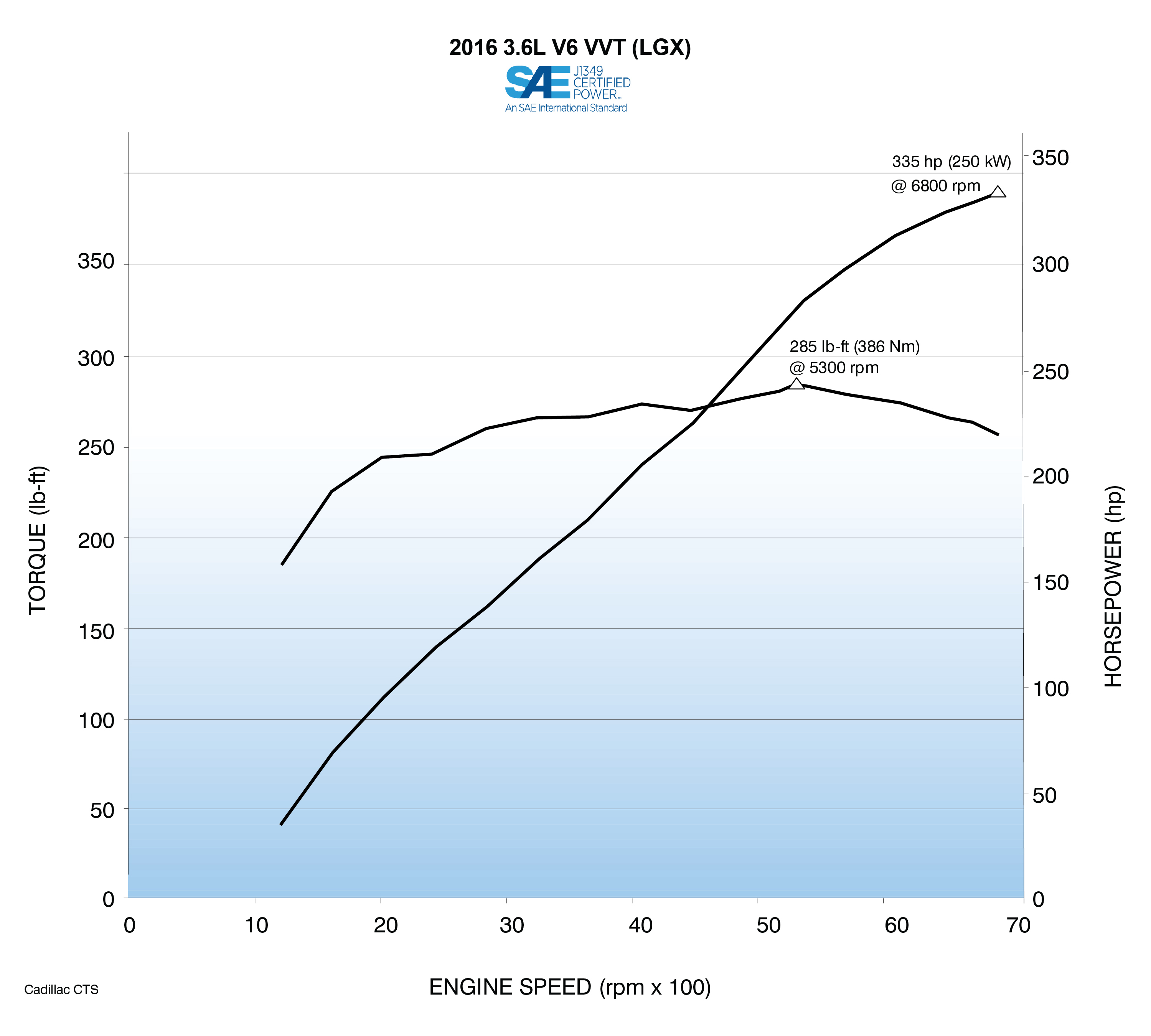
Along with the increased bore spacing, the new 3.6 L DI V6 has larger bores than before, growing from 94 mm to 95 mm with the same 85.8 mm stroke as the 3.0L LGW, for a displacement of 3649 cc. Intake and exhaust valves are also increased in size along with other changes to the cylinder head. The only part shared with the prior generation is the hydraulic lash adjusters in the valvetrain. The LGX was benchmarked against the 3.7L VQ37VHR of the 2015 Infiniti Q40. Compression ratio is 11.5:1 and maximum engine speed is 7200 RPM.
Compared to GM's LFX/LFY 3.6 L engine, the LGX features active fuel management, NVH enhancements and slightly more torque.
The LGX was on Ward's 10 Best Engines for 2016.
Applications: ::data[format=table]
| Year(s) | Model | Power | Torque | Dyno chart |
|---|---|---|---|---|
| 2016–2019 | Cadillac ATS | 335 hp @ 6800 RPM | 285 lbft @ 5300 RPM | 2016 link |
| 2016–2019 | Cadillac CT6 | 335 hp @ 6800 RPM | 284 lbft @ 5300 RPM | 2016 link |
| 2016–2019 | Cadillac CTS | 335 hp @ 6800 RPM | 285 lbft @ 5300 RPM | 2016 link |
| 2016–2024 | Chevrolet Camaro | 335 hp @ 6800 RPM | 284 lbft @ 5300 RPM | 2016 link |
| 2017–2019 | Buick LaCrosse | 310 hp @ 6800 RPM | 282 lbft @ 5200 RPM | |
| 2018–2020 | Buick Regal GS | 310 hp @ 6800 RPM | 282 lbft @ 5200 RPM | |
| 2018–2020 | Holden ZB Commodore | 315 hp @ 6800 RPM | 281 lbft @ 5200 RPM | |
| 2017–present | Cadillac XT5 | 310 hp @ 6600 RPM | 271 lbft @ 5000 RPM | |
| 2017–2023 | GMC Acadia | 310 hp @ 6600 RPM | 271 lbft @ 5000 RPM | |
| 2019–present | Chevrolet Blazer | 308 hp @ 6600 RPM | 269 lbft @ 5000 RPM | |
| 2020–2025 | Cadillac XT6 | 310 hp @ 6600 RPM | 271 lbft @ 5000 RPM | |
| :: |



LGZ
The LGZ is a variant of the LGX designed for use in the Chevrolet Colorado and GMC Canyon.
Applications: ::data[format=table]
| Year(s) | Model | Power | Torque |
|---|---|---|---|
| 2017–2022 | GMC Canyon | 308 hp @ 6800 RPM | 275 lbft @ 4000 RPM |
| Chevrolet Colorado | |||
| :: |
7.2L V12
On March 21, 2007, AutoWeek reported that GM was planning to develop a 60-degree V12 based on this engine family to power the top version of Cadillac's upcoming flagship sedan. This Cadillac would essentially have had two 3.6L High Feature V6s attached crankshaft-to-crankshaft and would have featured high-end technologies including direct injection and cylinder deactivation. If this engine were developed, it would have displaced 7.2 liters, and produced approximately 600 hp and 540 lbft of torque. Development of the engine was reportedly being conducted in Australia by Holden, with a potential HSV or Statesman application.
In August 2008, GM announced that development of the V12 had been cancelled.
Timing chain issues
Earlier production 2.8L, 3.0L, 3.2L, and 3.6L engines with the three chain design suffered from premature timing chain failures because of a faulty PCV system and extended oil change intervals. Most of the problems occurred on pre-LFX engines.
Holden High Feature engine
Holden sold a HFV6 engine under the name Alloytec. The High Feature moniker on the Holden produced engine is reserved for the twin cam phasing high output version. The block was designed to be expandable from 2.8 L to 4.0 L. High Feature V6 engines were previously produced in Fishermans Bend, Port Melbourne, Australia, and remain in production at the following four manufacturing locations: St. Catharines Engine Plant, St. Catharines, Canada; Flint Engine South in Flint, Michigan, United States; Romulus Engine Plant in Romulus, Michigan; and Ramos Arizpe, Coahuila, Mexico. The assembly lines for the St. Catharines and Flint facilities were manufactured by Hirata Corporation at its powertrain facility in Kumamoto, Japan. Most of the designs of this motor happened in Flint. They were first produced for the Cadillac range. The engine block and cylinder heads are cast at Defiance Foundry in Defiance, Ohio.
References
References
- "GM Media Online: GM Canada English". Archives.media.gm.com.
- "Cadillac SRX Turbo Model Axed". GM Inside News.
- (September 2017). "New Saab 9-4X: Powertrain". Saab Media Online.
- Abuelsamid, Sam. (2009-01-04). "Detroit Preview: 2010 Cadillac SRX reborn". autoblog.com.
- "Press Kits". Media.gm.com.
- "Holden's new Alloytec engine may chew as much fuel as the engine it replaces". goauto.com.au.
- (2010-11-01). "GM News - United States - News". Media.gm.com.
- Hellwig, Ed. (2007-01-08). "Detroit Auto Show: 2008 Cadillac CTS". edmunds.com.
- Brennan, Reilly. (2007-05-08). "Cadillac Ups STS Horsepower Rating To 302". nextautos.com.
- "Engine - Power Curve". Eogld.ecomm.gm.com.
- "Engine - Power Curve". Eogld.ecomm.gm.com.
- "Engine - Power Curve". Eogld.ecomm.gm.com.
- "Model Information - Online Ordering Guide". Eogld.ecomm.gm.com.
- http://media.gm.com/us/powertrain/en/product_services/2009a/HPT%20Library/HFV6/2009%2036L%20Hybrid_SAE.pdf {{dead link. (November 2010)
- (2013-03-18). "Cadillac Twin-Turbo Debuts in All-New 2014 CTS Sedan". Media.gm.com.
- (April 2021). "Only Some Cadillac CT4-V Blackwing Engines Have Titanium Rods". GM.
- (18 November 2014). "2016 Cadillac ATS-V Coupe and Sedan: 455 M3-Baiting Horsepower!".
- (19 April 2017). "GM 3.6 Liter V6 LFY Engine".
- (20 March 2015). "All-New, Advanced 3.6L V-6 to Drive Cadillac CT6".
- (20 March 2015). "Cadillac Next-Gen V-6 Engines Led by 3.0L Twin Turbo". GM.
- (20 March 2015). "All-New, Advanced 3.6L V-6 to Drive Cadillac CT6".
- (9 November 2015). "GM Powertrain Shows Love for 6-Pack".
- (11 September 2018). "Buyers Don't Seem To Care That New Buick Enclave Uses Last-Gen Engine".
- "Electrics Charge up 10 Best Engines List | Engines content from WardsAuto".
- (January 2019). "2017 GM VIN Card}}{{Dead link".
- (2016-08-26). "Chevrolet Colorado Resets the Bar for Midsize Segment". Media.chevrolet.com.
- (2007-03-21). "AutoWeek Breaks Major Cadillac News in March 26 Issue". prnewswire.com.
- (2008-08-21). "Cadillac cancels plans for V12 XLKS flagship sedan". autospies.com.
- "MOTOR".
::callout[type=info title="Wikipedia Source"] This article was imported from Wikipedia and is available under the Creative Commons Attribution-ShareAlike 4.0 License. Content has been adapted to SurfDoc format. Original contributors can be found on the article history page. ::