Beta Delphini
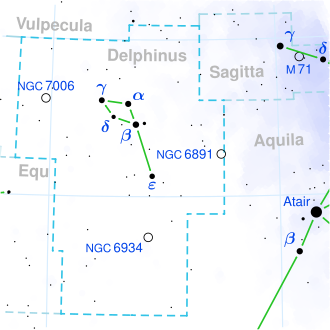
Binary star in the constellation of Delphinus
title: "Beta Delphini" type: doc version: 1 created: 2026-02-28 author: "Wikipedia contributors" status: active scope: public tags: ["delphinus", "f-type-subgiants", "f-type-giants", "binary-stars", "bayer-objects", "flamsteed-objects", "henry-draper-catalogue-objects", "hipparcos-objects", "stars-with-proper-names", "durchmusterung-objects", "bright-star-catalogue-objects", "lucidae"] description: "Binary star in the constellation of Delphinus" topic_path: "science/astronomy" source: "https://en.wikipedia.org/wiki/Beta_Delphini" license: "CC BY-SA 4.0" wikipedia_page_id: 0 wikipedia_revision_id: 0
::summary Binary star in the constellation of Delphinus ::
| name = β Delphini | image= |image=Delphinus constellation map.svg|alt=|float=center|width=240 |label=|position=right |mark=Red circle.svg|mark_width=10|mark_link=β Delphini |x=411|y=375 |caption=Location of β Delphini (circled) | epoch = J2000 | equinox = J2000 | ra = | dec = | appmag_v = (4.11 + 5.01) | constell = Delphinus | class = F5 III + F5 IV | b-v = A: B: | u-b = | variable = | component1 = Beta Delphini A | radial_v = | prop_mo_ra = +118.09 | prop_mo_dec = -48.06 | parallax = 32.33 | p_error = 0.47 | parallax_footnote = | absmag_v = | component2 = Beta Delphini B | absmag_v2 = | reference = | period = 26.660 | axis = 0.440 | eccentricity = 0.36 | inclination = 61 | node = 177 | periastron = | periarg = 349 | k1 = 7.6 | component1 = Beta Delphini A | mass = | radius = | gravity = 3.50 | luminosity = 24 | temperature = | metal_fe = –0.05 | rotational_velocity = 49.8 | age_gyr = | component2 = Beta Delphini B | mass2 = | luminosity2 = 8 | names = Rotanev, Rotanen, Venator, β Del, Beta Delphini, Beta Del, 6 Delphini, 6 Del, BD+14 4369, HD 196524, HIP 101769, HR 7882, SAO 106316, WDS 20375+1436AB |Simbad=bet+Del Beta Delphini (β Delphini, abbreviated Beta Del, β Del) is a binary star in the constellation of Delphinus. It is the brightest star in Delphinus.
The two components of the system are designated Beta Delphini A (officially named Rotanev , which is historically the name of the system){{cite book |last1=Kunitzsch |first1=Paul |last2=Smart |first2=Tim |date = 2006 |edition = 2nd rev. |title = A Dictionary of Modern star Names: A Short Guide to 254 Star Names and Their Derivations |publisher = Sky Pub |location = Cambridge, Massachusetts |isbn = 978-1-931559-44-7
Nomenclature
β Delphini (Latinised to Beta Delphini) is the binary's Bayer designation. The designations of the two components as Beta Delphini A and B derive from the convention used by the Washington Multiplicity Catalog (WMC) for multiple star systems, and adopted by the International Astronomical Union (IAU).
Beta Delphini bore an historical name, Rotanev, which arose as follows: Niccolò Cacciatore was the assistant to Giuseppe Piazzi, and later his successor as Director of the Palermo Observatory. The name first appeared in Piazzi's Palermo Star Catalogue. When the Catalogue was published in 1814, the unfamiliar names Sualocin and Rotanev were attached to Alpha and Beta Delphini, respectively. Eventually the Reverend Thomas Webb, a British astronomer, puzzled out the explanation. Cacciatore's name, Nicholas Hunter in English translation, would be Latinized to Nicolaus Venator. Reversing the letters of this construction produces the two names. They have endured, the result of Cacciatore's little practical joke of naming the two after himself. How Webb arrived at this explanation 45 years after the publication of the catalogue is still a mystery.
In 2016, the International Astronomical Union organized a Working Group on Star Names (WGSN){{citation | url=https://www.iau.org/science/scientific_bodies/working_groups/280/ | title=IAU Working Group on Star Names (WGSN) | publisher=International Astronomical Union | access-date=22 May 2016 | postscript=. | archive-date=10 June 2016 | archive-url=https://web.archive.org/web/20160610172014/https://www.iau.org/science/scientific_bodies/working_groups/280/ | url-status=dead
In Chinese, 瓠瓜 (Hù Guā), meaning Good Gourd, refers to an asterism consisting of Beta Delphini, Alpha Delphini, Gamma2 Delphini, Delta Delphini, and Zeta Delphini.
Properties
Beta Delphini was found to be a binary star system in 1873 by the American astronomer S. W. Burnham. The system consists of a pair of F-type stars that orbit each other with a period of 26.66 years and an eccentricity of 0.36. The plane of the orbit is inclined by an angle of 61° to the line of sight from the Earth. The two stars have an angular separation of about 0.44 arcseconds, making them a challenge to resolve with a telescope. The larger member of the pair is a giant star with 1.75 times the mass and 24 times the luminosity of the Sun, while the secondary component is a subgiant star that has 1.47 times the Sun's mass and around 8 times the Sun's luminosity. The system is around 1.8 billion years old.
References
References
- "Naming Stars". IAU.org.
- (2010). "On the naming convention used for multiple star systems and extrasolar planets".
- (1859). "Celestial Objects for Common Telescopes". [[Longmans, Green and Co.]].
- "Secrets of the 1814 Palermo Star Catalogue". Mark Hurn, Institute of Astronomy Library, Univ. of Cambridge.
- "WG Triennial Report (2015-2018) - Star Names".
- {{in lang. zh ''中國星座神話'', written by 陳久金. Published by 台灣書房出版有限公司, 2005, {{ISBN. 978-986-7332-25-7.
- van Leeuwen, F.. (November 2007). "Validation of the new Hipparcos reduction". Astronomy and Astrophysics.
- (November 2009). "A Photometric Analysis of Seventeen Binary Stars Using Speckle Imaging". The Astronomical Journal.
- (1978). "Burnham's celestial handbook: an observer's guide to the universe beyond the Solar System". [[Courier Dover Publications]].
- (September 2004). "SB9: The ninth catalogue of spectroscopic binary orbits". Astronomy and Astrophysics.
- (October 2003). "Lithium and rotation in F and G dwarfs and subgiants". Astronomy and Astrophysics.
- (January 1999). "Visual binary orbits and masses post Hipparcos". Astronomy and Astrophysics.
- (April 1976). "MK classification for visual binary components". Astronomical Journal.
- link. (2022-01-27 , database entry, The Bright Star Catalogue, 5th Revised Ed. (Preliminary Version), D. Hoffleit and W. H. Warren, Jr., [[Centre de Données astronomiques de Strasbourg). CDS]] ID [http://vizier.u-strasbg.fr/viz-bin/Cat?V/50 V/50]. Accessed on line October 1, 2008.
- [http://www.astro.uiuc.edu/~kaler/sow/rotanev.html Rotanev] {{webarchive. link. (November 21, 2008 , ''Stars'', Jim Kaler. Accessed on line October 1, 2008.)
- {{SIMBAD link. beta+del. HD 196524 -- Spectroscopic binary, database entry, [[SIMBAD]]. Accessed on line October 1, 2008.
- Entry 20375+1436, [http://ad.usno.navy.mil/wds/wdsnewframe4.html The Washington Double Star Catalog] {{webarchive. link. (September 8, 2008 , [[United States Naval Observatory]]. Accessed on line October 1, 2008.)
::callout[type=info title="Wikipedia Source"] This article was imported from Wikipedia and is available under the Creative Commons Attribution-ShareAlike 4.0 License. Content has been adapted to SurfDoc format. Original contributors can be found on the article history page. ::