Alpha Delphini
Multiple star system in the constellation Delphinus
title: "Alpha Delphini" type: doc version: 1 created: 2026-02-28 author: "Wikipedia contributors" status: active scope: public tags: ["bayer-objects", "flamsteed-objects", "delphinus", "binary-stars", "multiple-stars", "b-type-subgiants", "stars-with-proper-names", "hipparcos-objects", "bright-star-catalogue-objects", "durchmusterung-objects", "henry-draper-catalogue-objects"] description: "Multiple star system in the constellation Delphinus" topic_path: "science/astronomy" source: "https://en.wikipedia.org/wiki/Alpha_Delphini" license: "CC BY-SA 4.0" wikipedia_page_id: 0 wikipedia_revision_id: 0
::summary Multiple star system in the constellation Delphinus ::
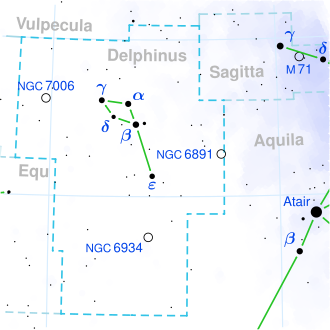
| name = α Delphini A | image= |image=Delphinus constellation map.svg|alt=|float=center|width=240 |label=|position=right |mark=Red circle.svg|mark_width=10|mark_link=α Del |x=387|y=315 |caption=Location of α Delphini (circled) | epoch = J2000.0 | constell = Delphinus | ra = | dec = | appmag_v = +3.777 (3.86 + 6.43) | class = B9 IV | b-v = −0.061 | u-b = −0.205 | variable = | radial_v = −3.40 | prop_mo_ra = 53.82 ± 0.43 | prop_mo_dec = 8.47 ± 0.31 | parallax = 12.85 | p_error = 0.44 | parallax_footnote = | dist_pc = | absmag_v = −0.4 | reference = | primary = Aa (A) | name = Ab (B) | period_unitless = | periastron = JD57988.7 | axis = | axis_unitless = | eccentricity = | inclination = | node = | periarg = | primary = Ab1 (Ba) | name = Ab2 (Bb) | period_unitless = | periastron = JD58762.84 | axis = | axis_unitless = | eccentricity = | inclination = | node = | periarg = | k2 = | component1 = Aa (A) | mass = | radius = 3.92 | luminosity = | temperature = 11,643 | metallicity_fe = −0.49 | gravity = 3.93 | rotational_velocity = 144 | age_myr = 227 | component1 = Ab1 (Ba) | mass = | component2 = Ab2 (Bb) | mass2 = | names = α Del, 9 Delphini, BD+15 4222, HD 196867, HIP 101958, HR 7906, SAO 106357, CCDM J20396+1555, WDS J20396+1555 | Simbad = alpha+Delphini Alpha Delphini (α Delphini, abbreviated Alpha Del, α Del) is a multiple star system in the constellation of Delphinus.
It consists of a triple star, designated Alpha Delphini A, together with five faint, probably optical companions, designated Alpha Delphini B, C, D, E and F. A's two components are themselves designated Alpha Delphini Aa (officially named Sualocin , the historical name for the entire system){{cite book |last1=Kunitzsch |first1=Paul |last2=Smart |first2=Tim |date = 2006 |edition = 2nd rev. |title = A Dictionary of Modern star Names: A Short Guide to 254 Star Names and Their Derivations |publisher = Sky Pub |location = Cambridge, Massachusetts |isbn = 978-1-931559-44-7
Nomenclature
α Delphini (Latinised to Alpha Delphini) is the system's Bayer designation. The designations of the six constituents as Alpha Delphini A to F, and those of A's components - Alpha Delphini Aa and Ab - derive from the convention used by the Washington Multiplicity Catalog (WMC) for multiple star systems, and adopted by the International Astronomical Union (IAU). The primary star's components Aa, Ab1, and Ab2 are also sometimes referred to as A, Ba, and Bb respectively, given that the outer pair have been resolved.
The system bore an historical name, Sualocin, which arose as follows: Niccolò Cacciatore was the assistant to Giuseppe Piazzi, and later his successor as Director of the Palermo Observatory. The name first appeared in Piazzi's Palermo Star Catalogue. When the Catalogue was published in 1814, the unfamiliar names Sualocin and Rotanev were attached to Alpha and Beta Delphini, respectively. Eventually the Reverend Thomas Webb, a British astronomer, puzzled out the explanation. Cacciatore's name, Nicholas Hunter in English translation, would be Latinised to Nicolaus Venator. Reversing the letters of this construction produces the two-star names. They have endured, the result of Cacciatore's little practical joke of naming the two stars after himself.
In 2016, the International Astronomical Union organized a Working Group on Star Names (WGSN) to catalogue and standardize proper names for stars. The WGSN decided to attribute proper names to individual stars rather than entire multiple systems. It approved the name Sualocin for the component Alpha Delphini Aa on 12 September 2016, and it is now so included in the List of IAU-approved Star Names.
In Chinese, 瓠瓜 (Hù Guā), meaning Good Gourd, refers to an asterism consisting of Alpha Delphini, Gamma2 Delphini, Delta Delphini, Beta Delphini and Zeta Delphini. Consequently, the Chinese name for Alpha Delphini itself is 瓠瓜一 (Hù Guā yī, ).
In Hindu astronomy, the star corresponded to one of the nakshatras named Dhanishta.
Properties
Alpha Delphini A is a spectroscopic binary star which has now been resolved using speckle interferometry. The components are separated by and have a 17-year orbit. Alpha Delphini Aa has a spectral type of B9IV. It is a subgiant that has begun to evolve away from the main sequence, is about 3.8 times as massive as the sun and about twice as hot.
The spectral type of the secondary star cannot be determined as it is too close and too faint compared to the primary, but it has been shown to itself be a binary star with an orbit of 30 days. Spectral lines showing 30-day radial velocity changes are likely to belong to the faintest component, expected from its mass to be an F-type star. Then the more massive star of the inner pair is likely to be an A-type dwarf, possibly not detected in the spectral because rapid rotation blurs its absorption lines.
The five faint companions have visual magnitudes around 11th to 13th magnitude and separations of 35" to 72". They all show motion relative to Alpha Delphini A, and have much smaller parallaxes.
References
References
- "Naming Stars". IAU.org.
- (2010). "On the naming convention used for multiple star systems and extrasolar planets".
- "WG Triennial Report (2015-2018) - Star Names".
- {{cite Gaia DR3
- (2021). "ARMADA. I. Triple Companions Detected in B-type Binaries α del and ν Gem". The Astronomical Journal.
- (2015). "The Ages of Early-type Stars: Strömgren Photometric Methods Calibrated, Validated, Tested, and Applied to Hosts and Prospective Hosts of Directly Imaged Exoplanets". The Astrophysical Journal.
- 陳久金. (2005). "中國星座神話". 五南圖書出版股份有限公司.
- "IAU Working Group on Star Names (WGSN)". [[International Astronomical Union]].
- (2007). "Validation of the new Hipparcos reduction". Astronomy and Astrophysics.
- (1859). "Celestial Objects for Common Telescopes". [[Longmans, Green and Co.]].
- "Secrets of the 1814 Palermo Star Catalogue". Mark Hurn, Institute of Astronomy Library, Univ. of Cambridge.
- link. Hong Kong Space Museum.
- (1991). "UBV photometry of stars whose positions are accurately known. VI". Astronomy and Astrophysics Supplement Series.
- (1973). "Spectral Classification". Annual Review of Astronomy and Astrophysics.
- (2007). "Astrophysical supplements to the ASCC-2.5: Ia. Radial velocities of ˜55000 stars and mean radial velocities of 516 Galactic open clusters and associations". Astronomische Nachrichten.
- (2012). "Dynamical masses of a selected sample of orbital binaries". Astronomy & Astrophysics.
- (2005). "Determining the Physical Properties of the B Stars. II. Calibration of Synthetic Photometry". The Astronomical Journal.
- (1998). "The absolute magnitude of the early type MK standards from HIPPARCOS parallaxes". Astronomy and Astrophysics.
- (2001). "The 2001 US Naval Observatory Double Star CD-ROM. I. The Washington Double Star Catalog". The Astronomical Journal.
- (1994). "Catalogue des composantes d'etoiles doubles et multiples (CCDM) premiere edition - Catalogue of the components of double and multiple stars (CCDM) first edition". Communications de l'Observatoire Royal de Belgique.
::callout[type=info title="Wikipedia Source"] This article was imported from Wikipedia and is available under the Creative Commons Attribution-ShareAlike 4.0 License. Content has been adapted to SurfDoc format. Original contributors can be found on the article history page. ::