From Surf Wiki (app.surf) — the open knowledge base
Zedekiah's Cave
Underground quarry in Jerusalem

Underground quarry in Jerusalem
| Field | Value |
|---|---|
| name | |
| alternate_name | Solomon's Quarries |
| image | File:Zedekiah's Cave in summer 2011 (3).JPG |
| mapframe | |
| altitude_m | |
| type | Quarry |
| epochs | |
| public_access | Yes |
| website |
Zedekiah's Cave, also known as Solomon's Quarries, is a 5 acre underground meleke limestone quarry under the Muslim Quarter of the Old City of Jerusalem that runs the length of five city blocks, named after King Zedekiah (Tzidkiyahu; a Judean king of the 6th century BC). It was carved over a period of several thousand years and is a remnant of the largest quarry in Jerusalem.
Names
In addition to Zedekiah's Cave and Solomon's Quarries, this site has been called Zedekiah's Grotto, Suleiman's Cave, the Royal Caverns (or Royal Caves or Royal Quarries), and Korah's Cave. The Arabic name Migharat al-Kitan (or "Cotton Cave") has also been used; the cavern is thought to have been once used as a storage place for cotton.
Geography
The entrance to Zedekiah's Cave is just beneath the Old City wall, between the Damascus and Herod Gates, about 500 ft east of the former. Beyond the narrow entrance, the cave slopes down into a vast 300-foot-long auditorium-like chamber. Drops of water, known as "Zedekiah's tears", trickle through the ceiling.
Beyond the "auditorium" are a series of artificial galleries hewn by ancient stonecutters into chaotic, sometimes bizarre, patterns and formations. Paths give access to every corner of the quarry system, which takes at least 30 minutes to explore thoroughly. Chisel marks are visible in many sections and in some galleries huge, nearly finished building blocks destined for some long-ago structure are locked into the rock where the stonecutters left them centuries ago. In a few places the stones are marked in Arabic, Latin, Greek, Armenian and English by means of charcoal and engraved etchings (e.g., "W. E. Blackstone Jan. 1889"). Several plaques explaining some of the myriad legends associated with the site have been mounted on the cave walls.
From entrance to the farthest point, the cave extends about 650 ft. Its maximum width is about 330 ft and its depth is generally about 30 ft below the street level of the Muslim Quarter, although there are several lower levels and blocked tunnels too.
History
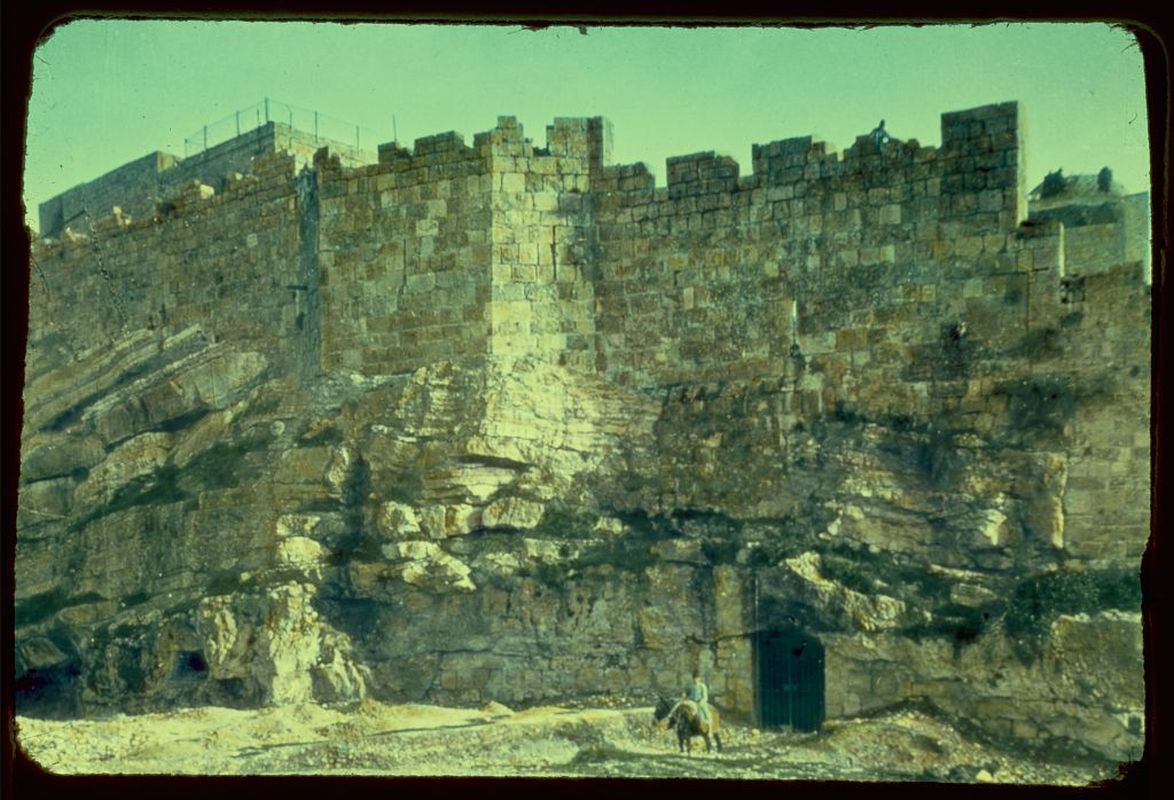
Only the mouth of the cave is natural. The interior was carved over a period of several thousand years.
Herod the Great used the main quarry at Zedekiah's Cave for building blocks in the renovation of the Temple and its retaining walls, including what is known today as the Western (Wailing) Wall. Stone from the quarry may also have been used for the building projects of Herod Agrippa I. The subterranean quarry would have been usable in all seasons and any weather. which may have been a reference to Zedekiah's Cave.
The medieval midrash Numbers Rabbah mentions the cave: "One who observed the Sabbath in a cave, even though it be like the cave of Zedekiah, which was eighteen miles long, may walk through the whole of it".
Suleiman the Magnificent (1494–1566), the Ottoman sultan who built the present walls around the Old City, also apparently mined the quarry, ultimately sealing it up around 1540 because of security concerns.
In 1854 the American missionary James Turner Barclay followed rumors of a cavern near the Damascus Gate, and, apparently with the help of his dog, discovered the entrance. Barclay and his two sons returned secretly at night and explored the cave.
In 1873, French archeologist Charles Clermont-Ganneau uncovered a crude carving of a winged creature in a small niche in the cave. It had two long narrow wings that opened like a pair of scissors, a curled tail and a bearded human head under a conical headdress. The site is now marked by a plaque.
In the mid-1880s, the cave was occupied by a German religious sect that was eventually evacuated by the German Consul in Jerusalem after many of the group fell ill from living in the damp, unsanitary conditions.
Some minor quarrying occurred in 1907 when stone was obtained to be used in the Ottoman clock tower over the Jaffa Gate. Otherwise, the site was not frequented again until the 1920s, when it began to be something of a tourist attraction.

In 1968, a resident of East Jerusalem contacted the Israeli Ministry of Finance with a claim that, during the Ottoman period, his grandfather had buried three cases of gold in Zedekiah's Cave. He claimed he could show officials where the treasure was buried in return for 25% of the gold. The Ministry agreed, but, according to The Jerusalem Post, after digging a deep hole no gold was found.
In the mid-1980s, The Jerusalem Foundation built paths and installed lights throughout the cavern, facilitating tourist access. In the late 20th century, the East Jerusalem Development Corporation carried out restorations of the cave.
The cave reopened to the public in 2023 after three years of renovation and the installation of an audiovisual show.
Archaeology
Excavations were conducted in 2000 and 2002 for the purpose of determining the periods of use. The wall generally attributed to the Ottoman period was found to have been constructed earlier, in the 13th century, i.e. during the Mamluk period.

Biblical associations
According to local lore, the cave served as a quarry for the First Temple of Israel; King Solomon's Temple. The meleke limestone of the quarry – which is strong, well suited to carving, and resistant to erosion – is thought to have been used for royal buildings. The name meleke is derived from Hebrew and Arabic words meaning "kingly" or "royal".
In the 10th century, Muslim geographer and writer Al-Mukaddasi wrote: "There is at Jerusalem, outside the city, a huge cavern. According to what I have heard from learned men, and also have read in books, it leads into the place where lie the people slain by Moses. But there is no surety in this, for apparently it is but a stone quarry, with passages leading therefrom, along which one may go with torches." The "people slain by Moses" refers to a story that appears in both the Bible and the Quran about a man named Korah (Arabic, Karun) who mounted a revolt against Moses and his brother Aaron, maintaining that they had led the children of Israel out of Egypt under false pretenses. According to the Old Testament, Korah and his fellow rebels were swallowed up by the earth.
The cave was also said to be the hiding place of King Zedekiah (Tzidkiyahu; a Judean king of the 6th century BC), with the Biblical commentator Rashi writing that Zedekiah hid here to escape the soldiers of Babylonian king Nebuchadnezzar I during the siege of Jerusalem in 597 BC. According to Rashi, "(t)here was a cave from the palace of Zedekiah to the plain of Jericho and he fled through the cave." He added that God sent a buck running along the surface on top of the cave as Zedekiah was walking down below. The soldiers chased the buck and arrived at the exit of the cave just as Zedekiah was coming out, enabling them to capture and blind him. Thus was born the legend and name of "Zedekiah's Cave". The Radak repeats this story.
Freemasons
Masonic ceremonies have been held at the cave since the 1860s. According to Masonic ritual, King Solomon was their first grand master. The first Masonic lodge in the Holy Land, known as the Royal Solomon Mother Lodge No. 293, met in the cave on May 7, 1873.
The Freemasons of Israel consider it one of the most revered sites in Masonic history. On May 10, 2015, a Masonic initiation was held in the cave on the occasion of a visit of Masons from the Grand Lodge of California to the Grand Lodge of Israel.
References
References
- For King Zedekiah, see ''[[II Kings]]'' XXV, 4; ''[[Book of Jeremiah. Jeremiah]]'' XXXIX, 4–5 and LII, 7–8.
- Friedman, Thomas L.. (1 December 1985). "Quarrying History in Jerusalem". [[The New York Times]].
- Har-El, Menashe (2004), ''Golden Jerusalem'', Jerusalem: [[Gefen Publishing House]]
- (2013-09-10). "Underground Jerusalem: The excavation of tunnels, channels, and underground spaces in the Historic Basin". Emek Shaveh.
- [[History of the Jews in the Roman Empire. The Roman-Jewish]] historian [[Flavius Josephus]] writes about the "Royal Caverns" of the Old City,Flavius Josephus, ''[[The Jewish War]]'', V:4 and 147
- ''Numbers Rabbah'' II
- Barclay, J[ames] T[urner]. (1858). "The City of the Great King: or, Jerusalem as it Was, as it Is, and as it Is To Be". James Callen and Sons.
- [[Thomas Friedman
- Vester, Bertha Stafford (1950), ''Our Jerusalem: An American Family in the Holy City, 1881–1949'', Doubleday & Company, Inc.
- "Jerusalem Clock Tower". Madain Project.
- "Zedekiah's Cave: One of Israel's oldest quarries reopened".
- Zelinger, Yehiel. (2007). "Jerusalem, 'Zedekiah's Cave'". Israeli Antiquities Authority.
- Zelinger, Yehiel. (October 2025}}{{cite journal). "Jerusalem, Zedekiah's Cave, final report". Israeli Antiquities Authority.
- For King Zedekiah, see ''[[II Kings]]'' XXV, 4; ''[[Book of Jeremiah. Jeremiah]]'' XXXIX, 4–5 and LII, 7–8.
- [http://www.freemasonry.org.il/ The Grand Lodge of the State of Israel]
This article was imported from Wikipedia and is available under the Creative Commons Attribution-ShareAlike 4.0 License. Content has been adapted to SurfDoc format. Original contributors can be found on the article history page.
Ask Mako anything about Zedekiah's Cave — get instant answers, deeper analysis, and related topics.
Research with MakoFree with your Surf account
Create a free account to save articles, ask Mako questions, and organize your research.
Sign up freeThis content may have been generated or modified by AI. CloudSurf Software LLC is not responsible for the accuracy, completeness, or reliability of AI-generated content. Always verify important information from primary sources.
Report