From Surf Wiki (app.surf) — the open knowledge base
Wood's metal
Alloy of bismuth, lead, tin and cadmium

Alloy of bismuth, lead, tin and cadmium
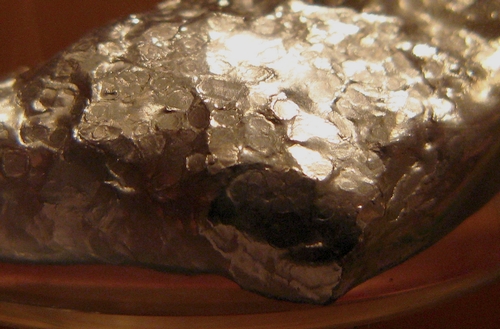
Wood's metal, also known as Lipowitz's alloy or by the commercial names Cerrobend, Bendalloy, Pewtalloy and MCP 158, is a fusible metal alloy (having a low melting point) that is useful for soldering and making custom metal parts.{{cite book | archive-url= | archive-date=
Applications
As suggested by the trade names, Wood's metal is used to fill thin-walled tube so that it can be bent to a radius without kinking or collapsing. The filling is easily melted and run out of the tube after bending is completed. The low melting point and lack of contraction on freezing make Wood's metal suitable for this purpose.
Wood's Metal is also used for making fusible links in the sprinkler heads of commercial building automatic fire sprinkler systems. Due to the fire, ambient temperature increases enough to melt the link, releasing the water. A similar use is fusible plugs in boilers.
Uses also include making custom-shaped apertures and blocks (for example, electron-beam cutouts and lung blocks) for medical radiation treatment, and making casts of keys that are hard to otherwise duplicate.
Like other fusible alloys, e.g. Rose's metal, Wood's metal can be used as a heat-transfer medium in hot baths. Hot baths with Rose's and Wood's metals are not used routinely but are employed at temperatures above 220 °C.
At room temperature, Wood's metal has a modulus of elasticity of 12.7 GPa and a yield strength of 26.2 MPa.
Toxicity
Wood's metal is toxic because it contains lead and cadmium, and contamination of bare skin is considered harmful. Vapour from cadmium-containing alloys is also known to pose a danger to humans. Cadmium poisoning carries the risk of cancer, anosmia (loss of sense of smell), and damage to the liver, kidneys, nerves, bones, and respiratory system. Field's metal is a non-toxic alternative.
The dust may form flammable mixtures with air.
References
Bibliography
- Birchon's Dictionary of Metallurgy, London, 1965
- Experimental techniques in low-temperature physics, G. K. White, Oxford University Press, Third Edition
References
- Jensen, William B.. (2010). "The Origin of the Name "Onion's Fusible Alloy"". [[Journal of Chemical Education]].
- "Collection: Barnabas Wood Papers".
- Khan F. M., Gibbons J. P.. "The Physics of Radiation Therapy, 5th ed.". [[Wolters Kluwer]].
- DeviantOllam. (2019-05-01). "Copying Keys via a Mold and Cast Attack".
- The Modern Rogue. (2019-10-04). "Duplicating a Key Using Molten Metal (with LockPickingLawyer)".
- (2007). "Pharmaceutical Engineering". New Age International.
- (February 2006). "Evaluation of Filler Materials Used for Uniform Load Distribution at Boundaries During Structural Biomechanical Testing of Whole Vertebrae". Journal of Biomechanical Engineering.
- Genchi, Giuseppe. (May 26, 2020). "The Effects of Cadmium Toxicity". International Journal of Environmental Research and Public Health.
- "Wood's Metal Safety Data Sheet".
This article was imported from Wikipedia and is available under the Creative Commons Attribution-ShareAlike 4.0 License. Content has been adapted to SurfDoc format. Original contributors can be found on the article history page.
Ask Mako anything about Wood's metal — get instant answers, deeper analysis, and related topics.
Research with MakoFree with your Surf account
Create a free account to save articles, ask Mako questions, and organize your research.
Sign up freeThis content may have been generated or modified by AI. CloudSurf Software LLC is not responsible for the accuracy, completeness, or reliability of AI-generated content. Always verify important information from primary sources.
Report