From Surf Wiki (app.surf) — the open knowledge base
Women's Auxiliary Air Force
British military service in World War II
British military service in World War II
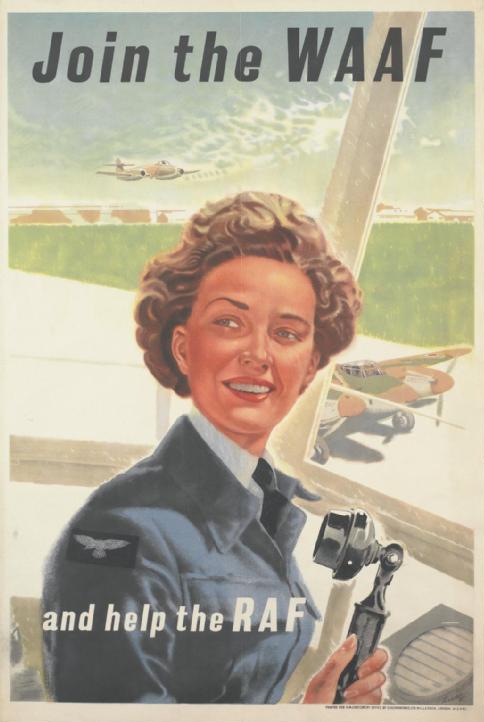
The Women's Auxiliary Air Force (WAAF), whose members were referred to as WAAFs (), was the female auxiliary of the British Royal Air Force during the Second World War. Established in 1939, WAAF numbers exceeded 181,000 at its peak strength in 1943, (15.7% of the RAF) with over 2,000 women enlisting per week.
History
A Women's Royal Air Force had existed from 1918 to 1920 but had been disbanded in the wake of the end of the First World War, alongside the Women's Army Auxiliary Corp (1917–1921) and the first iteration of the Women's Royal Naval Service (1917–1919).
Second World War
The Women's Auxiliary Air Force was created on 28 June 1939, absorbing the forty-eight RAF companies of the Auxiliary Territorial Service which had existed since 1938, following the Munich Agreement. Conscription of women did not begin until after December 1941 when the UK Government passed the National Service Act (No. 2), which was issued by Royal Proclamation on 10 January 1942. It only applied to those between 20 and 30 years of age and they had the choice of the military auxiliary services, the civilian Women's Land Army or factory work in support of the war effort.
Training
Women recruited into the WAAF were given basic training at one of five sites, though not all of the sites ran training simultaneously. The five sites were at West Drayton, Harrogate, Bridgnorth, Innsworth and Wilmslow. All WAAF basic recruit training was located at Wilmslow from 1943.
Roles in the WAAF

WAAFs did not serve as aircrew. (The use of women pilots was limited to the Air Transport Auxiliary, which was civilian, but 30 WAAFs did transfer to serve as pilots in the ATA). Although WAAFs did not participate in active combat, they were exposed to the same dangers as any on the "home front" working at military installations. They were active in parachute packing and the crewing of barrage balloons in addition to performing catering, meteorology, radar, aircraft maintenance, transport, policing, communications duties including wireless telephonic and telegraphic operation. They worked with codes and ciphers, analysed reconnaissance photographs, and performed intelligence operations. WAAFs were a vital presence in the control of aircraft, both in radar stations and iconically as plotters in operation rooms, most notably during the Battle of Britain. These operation rooms directed fighter aircraft against the Luftwaffe, mapping both home and enemy aircraft positions.
While the official terminology for the WAAF at barrage balloon sites was barrage balloon operator, they were often referred to in the press as the balloon girls.
Air Force nurses belonged to Princess Mary's Royal Air Force Nursing Service instead. Female medical and dental officers were commissioned into the Royal Air Force and held RAF ranks.
WAAFs were paid two-thirds of the pay of male counterparts in RAF ranks.
By the end of the Second World War, WAAF enrolment had declined and the effect of demobilisation was to take the vast majority out of the service. The remainder, now only several hundred strong, was renamed the Women's Royal Air Force on 1 February 1949.
Flying Nightingales
Nursing Orderlies of the WAAF flew on RAF transport planes to evacuate the wounded from the Normandy battlefields. They were dubbed the Flying Nightingales by the press. The RAF Air Ambulance Unit flew under 46 Group Transport Command from RAF Down Ampney, RAF Broadwell, and RAF Blakehill Farm. RAF Dakota aircraft carried military supplies and ammunition so could not display the Red Cross.
Training for air ambulance nursing duties included instruction in the use of oxygen, injections, learning how to deal with certain types of injuries such as broken bones, missing limb cases, head injuries, burns and colostomies; and to learn the effects of air travel and altitude. Although supplied with parachutes, they were instructed not to use them if the plane was shot down on its return from Europe and instead stay with the wounded soldiers onboard and provide medical support should anyone survive the crash.
The first three Flying Nightingales to arrive in France, a week after D-Day, were Corporal Lydia Alford, LACW Myra Roberts and LACW Edna Birkbeck.
In October 2008 the seven known nurses still living were presented with lifetime achievement awards by the Duchess of Cornwall.
Directors

On 1 July 1939, Jane Trefusis Forbes was made Director of WAAF, with the rank of Senior Controller, later, Air Commandant. On 1 January 1943 she was appointed to the rank of Air Chief Commandant with its creation. On 4 October 1943, while Forbes toured Canada, assessing the Royal Canadian Air Force Women's Division, she was relieved by Princess Alice, Duchess of Gloucester, who had been head of the WAAF since 1939, again with the rank of Senior Controller, then, Air Commandant, being gazetted to Air Chief Commandant on 22 March 1943. Forbes retired in August 1944, and the post of director was given to Mary Welsh, who was appointed Air Chief Commandant. After the war, the rank of Air Chief Commandant was suspended and in December 1946, the final director of WAAF, Felicity Hanbury, was appointed.
- Air Chief Commandant Dame Jane Trefusis Forbes, June 1939 – 4 October 1943
- Air Chief Commandant Princess Alice, Duchess of Gloucester, 4 October 1943 – August 1944
- Air Chief Commandant Dame Mary Welsh, August 1944 – November 1946
- Air Commandant Dame Felicity Hanbury, December 1946 – January 1949
Ranks
Initially, the WAAF used the ATS ranking system, although the director held the rank of senior controller (equivalent to brigadier in the British Army and air commodore in the RAF) instead of chief controller (equivalent to major-general or air vice-marshal) as in the ATS. However, in December 1939 the title was changed to air commandant, when the ranks were renamed and reorganised. Other ranks now held identical ranks to male RAF personnel, but officers continued to have a separate rank system, although now different from that of the ATS. From February 1940 it was no longer possible to enter directly as an officer; from that time all officers were appointed from the other ranks. From July 1941 WAAF officers held full commissions. On 1 January 1943, the rank of air chief commandant (equivalent to air vice-marshal) was created with the director's appointment to that rank.
Officers
| Air officers | Field officers | Junior officers |
|---|
Other ranks
| Rank group | Senior NCOs | Junior NCOs | Enlisted | United Kingdom Royal Air Force | ||||
|---|---|---|---|---|---|---|---|---|
| (1939–1950) | ||||||||
| [[File:OR9 RAF Warrant Officer.svg | 50px]] | [[File:OR7 RAF Flight Sergeant.svg | 50px]] | [[File:OR5n6a RAF Sergeant.svg | 50px]] | [[File:OR4 RAF Corporal.svg | 50px]] | |
| Warrant officer | Flight sergeant | Sergeant | Corporal | Leading Aircraftman |
WAAFs serving with SOE
Several members of the WAAF served with the Special Operations Executive during the Second World War.
- Assistant Section Officer Noor Inayat Khan (9901), posthumously Mentioned in Dispatches and awarded the French Croix de Guerre with Gold Star and the George Cross, Britain's highest award for gallantry not in the face of the enemy.
- Section Officer Yvonne Baseden
- Section Officer Yolande Beekman, posthumously awarded the French Croix de Guerre.
- Assistant Section Officer Sonya Butt (9910)
- Section Officer Muriel Byck
- Flight Officer Yvonne Cormeau, awarded the MBE, the Légion d'honneur, Croix de Guerre and Médaille combattant volontaire de la Résistance.
- Flight Officer Alix D'Unienville
- Flight Officer Krystyna Skarbek (aka Christine Granville), awarded the OBE, George Medal and Croix de Guerre.
- Section Officer Mary Katherine Herbert
- Section Officer Phyllis Latour
- Section Officer Cecily Lefort, posthumously awarded the French Croix de Guerre.
- Section Officer Patricia O'Sullivan
- Sergeant Haviva Reik (aka Ada Robinson)
- Assistant Section Officer Lilian Rolfe, posthumously awarded the MBE and the Croix de Guerre.
- Section Officer Diana Rowden, posthumously awarded the MBE and the Croix de Guerre.
- Section Officer Anne-Marie Walters, awarded the MBE.
Other notable WAAFs
- Section Leader Constance Babington Smith, imagery intelligence specialist, first to identify launch ramps for V-1 flying bomb. Awarded MBE.
- Sarah Churchill, photographic interpreter.
Gallery
File:The Operations Room at RAF Fighter Command's No. 10 Group Headquarters, Rudloe Manor (RAF Box), Wiltshire, showing WAAF plotters and duty officers at work, 1943. CH11887.jpg|The Operations Room at RAF Fighter Command's No. 10 Group Headquarters, Rudloe Manor (RAF Box), Wiltshire, showing WAAF plotters and duty officers at work, 1943 File:Noor_Inayat_Khan.jpeg|Noor Inayat Khan File:Waafsspeakgerman large.jpg|WAAF Operation Corona Radio Operators File:HRH Princess Alice Commandant of the WAAF.jpg|Princess Alice, Duchess of Gloucester Commandant of the WAAF File:Barrage ballons.jpg|WAAF Barrage Balloon crews at RAF Cardington. File:Members of the Womens Auxiliary Air Force (WAAF) repair and pack parachutes for use by airborne troops during the Normandy invasion, 31 May 1944. TR1783.jpg|Members of the WAAF repair and pack parachutes for use by airborne troops during the Normandy invasion, 31 May 1944. File:WAAF grave, Clonmacnoise.jpg|Grave of an Irish WAAF, Clonmacnoise. Cpl Bridget White was serving with the No3 (Pilots) Advanced Flying Unit based at RAF South Cerney when she died in a road accident. File:W.A.A.F.s at Ultimo Technical College, Sydney, 1943.jpg|WAAFs working on an aircraft fuselage at Ultimo Technical College, Sydney, 1943
Notes
References
References
- MILLER, SARAH-LOUISE. (2023). "WOMEN BEHIND THE FEW : the women's auxiliary air force and british intelligence during the... second world war.". BITEBACK PUBLISHING.
- Narracot, A.H.. (1941). "How The R A F Works". Frederick Muller Limited.
- (1989). "Women in air force blue : the story of women in the Royal Air Force from 1918 to the present day". Patrick Stephens Ltd..
- (2008). "The Royal Air Force day by day". Sutton.
- [https://www.iwm.org.uk/collections/item/object/205450170 "Ex-London Police Woman Trains W.A.A.F. Police", Imperial War Museum]
- [https://www.iwm.org.uk/collections/item/object/205450185 "Ex-London Police Woman Trains W.A.A.F. Police", Imperial War Museum]
- Eileen Younghusband. ''One Woman's War''. Cardiff. Candy Jar Books. 2011. {{ISBN. 978-0-9566826-2-8
- (2004-03-10). "girl handles one of the barrage balloons used as a deterrent against...".
- (September 2010). "The Flying Nightingales". RAF Broadwell website.
- (12 May 2024). "The forgotten story of the Nightingales – the first British women flown into a 1944 war zone". [[The Daily Telegraph.
- (12 May 2024). "Flying Nightingales: Women who flew into WW2 battles celebrated". [[BBC News]].
- "The Flying Nightingales". Hampshire the County Magazine.
- (28 October 2017). "Margaret Wilson: Flying Nightingale, 95, seeks fellow nurse's family". [[BBC]].
- (13 June 2024). "Flying Nightingales celebrated 80 years after first flight". [[BBC News]].
- (24 October 2015). "Lilian West: The last of the Flying Nightingales". [[BBC News]].
- {{London Gazette. (5 April 1949)
- "WWII RAF Casualties buried in Ireland".
This article was imported from Wikipedia and is available under the Creative Commons Attribution-ShareAlike 4.0 License. Content has been adapted to SurfDoc format. Original contributors can be found on the article history page.
Ask Mako anything about Women's Auxiliary Air Force — get instant answers, deeper analysis, and related topics.
Research with MakoFree with your Surf account
Create a free account to save articles, ask Mako questions, and organize your research.
Sign up freeThis content may have been generated or modified by AI. CloudSurf Software LLC is not responsible for the accuracy, completeness, or reliability of AI-generated content. Always verify important information from primary sources.
Report