From Surf Wiki (app.surf) — the open knowledge base
Weißwurst
Traditional Bavarian sausage

Traditional Bavarian sausage
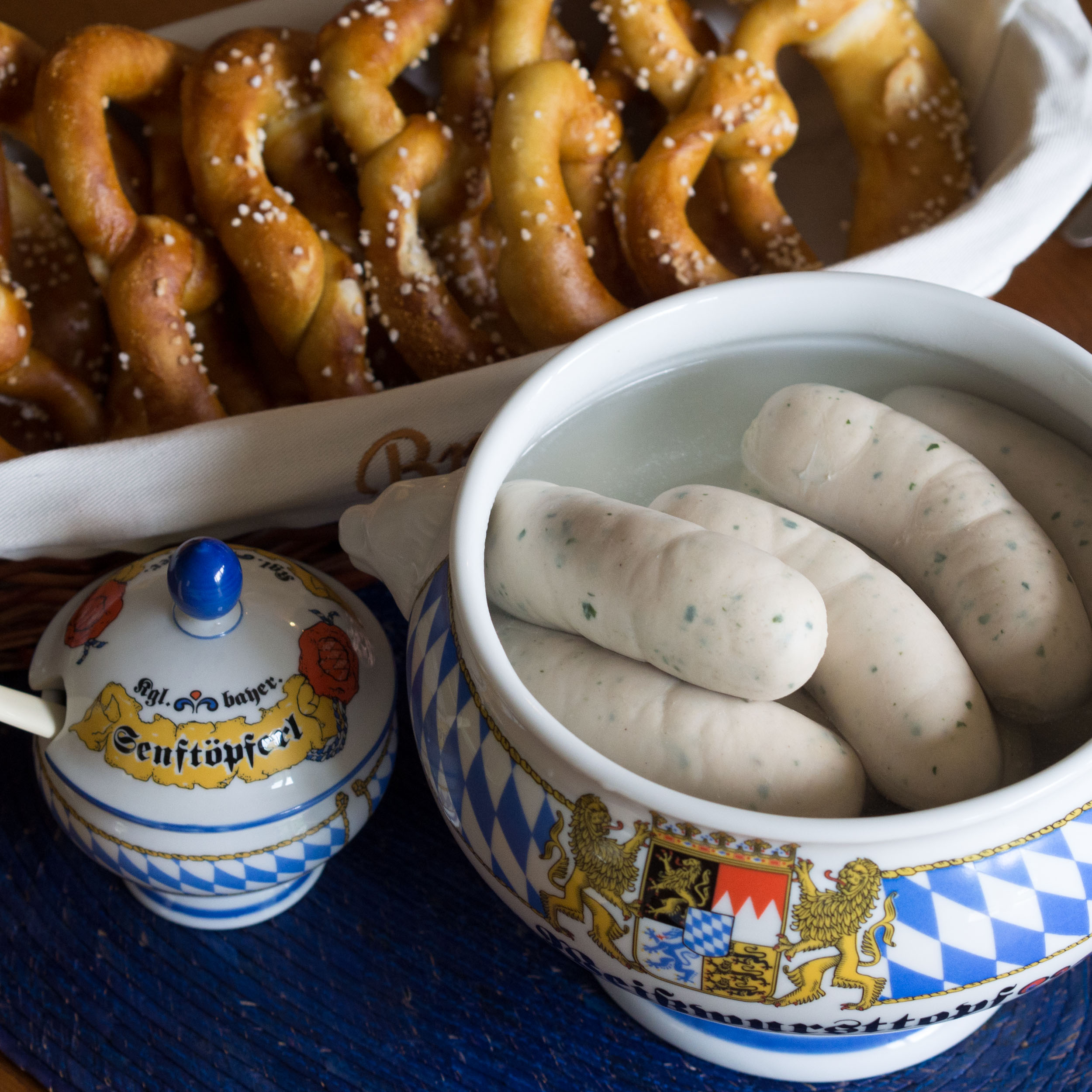
Weißwurst (, literally 'white sausage'; ; plural Weißwürste) is a traditional Bavarian sausage made from minced veal and pork fatback. It is usually flavored with parsley, lemon, mace, onions, ginger and cardamom, although there are some variations. Then the mixture is stuffed into pork casings and separated into individual sausages measuring about 10 to(-) in length and 3 - in diameter.
As they are not smoked or otherwise preserved they are very perishable. Weißwürste were traditionally manufactured early in the morning and prepared and eaten as a snack between breakfast and lunch. There is a saying that the sausages should not be allowed to hear the noon chime of the church bells. Even today, most Bavarians never eat Weißwürste after lunchtime (though it is perfectly acceptable to have a lunch consisting of Weißwürste).
The sausages are heated in water—well short of boiling—for about ten minutes, which will turn them greyish-white because no colour-preserving nitrite is used in Weißwurst preparation.
Weißwürste are brought to the table in a big bowl together with the hot water used for preparation (so they do not cool down too much), then eaten without their skins. Ways of eating Weißwurst include the traditional way, called zuzeln (Bavarian for sucking), in which each end of the sausage is cut or bitten open, after which the meat is sucked out from the skin. Alternatively, the more popular and more discreet ways of consuming it are by cutting the sausage lengthwise and then "rolling out" the meat from the skin with a fork, or also to open it on one end and consume it very much like a banana, ever opening the peel further and dipping the sausage into the mustard.
Weißwurst is commonly served with a Bavarian sweet mustard (Süßer Senf) and accompanied by Brezn (Bavarian pretzel—often spelled Brezeln outside Bavaria) and .
Weißwurst, whose consumption traditionally is associated with Bavaria, helped in the coining of a humorous term, (literally, 'white-sausage-equator'), that delineates a cultural boundary separating other linguistic and cultural areas from Southern Germany.
References
References
- "How To Eat Weisswurst".
- (2023-11-23). "Weisswurst German Sausage - Bish Bash Bangers".
- Dietz, Christie. (2015-05-05). "The Ultimate Guide to German Sausages #2: Weisswurst".
- "How to eat {{lang". World Hum.
- "{{lang". Perob.com.
- "{{lang".
This article was imported from Wikipedia and is available under the Creative Commons Attribution-ShareAlike 4.0 License. Content has been adapted to SurfDoc format. Original contributors can be found on the article history page.
Ask Mako anything about Weißwurst — get instant answers, deeper analysis, and related topics.
Research with MakoFree with your Surf account
Create a free account to save articles, ask Mako questions, and organize your research.
Sign up freeThis content may have been generated or modified by AI. CloudSurf Software LLC is not responsible for the accuracy, completeness, or reliability of AI-generated content. Always verify important information from primary sources.
Report