From Surf Wiki (app.surf) — the open knowledge base
Vitslav II, Prince of Rügen
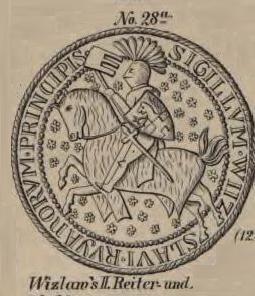
| Field | Value |
|---|---|
| name | Vitslav II |
| succession | Prince of Rügen |
| reign | 20 August 1260 29 December 1302 |
| predecessor | Jaromar II |
| successor | Vitslav III |
| house | House of Wizlaw |
| father | Jaromar II, Prince of Rügen |
| mother | Euphemia of Pomerellia |
| spouse | Agnes of Braunschweig-Lüneburg |
| issue | Vitslav III, Prince of Rügen |
| Jaromar, Bishop of Cammin | |
| Euphemia of Rügen | |
| full name | |
| birth_date | 1240 |
| death_date |
Jaromar, Bishop of Cammin Euphemia of Rügen
Vitslav II (c. 1240 – 1302), variously called Vislav, Vizlav, Wislaw, Wizlaw and Witslaw in English sources () was a prince of Rügen.
Life
Vitslav was probably born between 1240 and 1245 as the son of Prince Jaromar II of Rügen and Euphemia, a daughter of Duke Swantopolk II of East Pomerania. After his father, who had taken part on the side of the church in battles in Denmark between the Danish royal house and the Archbishopric of Lund. When his father was stabbed to death by a woman in 1260 out of revenge, Vitslav became the reigning Prince of Rügen.
From the beginning of his reign Vitslav II maintained good relations with the Hanseatic town of Lübeck, whose merchants he exempted from customs duties within his principality and with whom, in 1266, he renewed the existing trade agreements. In 1269, he supported the town of Stralsund, located within his territory, by withdrawing rights from the Schadegard, built in the immediate vicinity of Stralsund, and gave up the town founded in order to compete with Stralsund.
Probably over claims to the dowry of his mother, a daughter of Prince Swietopelk of East Pomerania, he succeeded in 1270 in gaining possession of the enfeoffment of Schlawe. Possibly in the same year, but no later than 1271, he founded Rügenwalde, but sold his enfeoffments in 1277, after he had been driven out of the area in 1275 by Mestwin II. The territory of Schlawe (Schlawer Land) with its town and Rügenwalde went to Margrave John II, Otto IV and Conrad of Brandenburg.
In 1282, he joined the Livonian Crusade, leaving his brother Jaromar III behind as regent.
On 13 June 1283, the Treaty of Rostock alliance (Rostocker Landfriedensbündnis) was agreed between the cities and towns of Lübeck, Wismar Rostock, Stralsund, Greifswald, Stettin, Demmin and Anklam with Duke John I of Saxe-Lauenburg, the Mecklenburg prince, Bogislaw IV of Pomerania and Vitslav II of Rügen. This alliance was clearly directed against Brandenburg.
In 1283, Vitslav II was given his territory as German fiefdom by the German king, Rudolf I of Habsburg, although the document probably referred only to the mainland element. The Rügen-Danish fief relationship continued, as the regular participation of Vitslav II at the Danish court and his nomination as a witness in Danish royal charters indicates. Among other things, he was present at the investigation of the murder of the King of Denmark Erik Klipping.
In 1285, he granted town rights to Tribsees. In 1290 the town of Stralsund was given the right of herring fishing on the Wittow and commercial monopoly on the island of Rügen, which severely hampered, the development of trade and commerce, including the grain trade, in the next few centuries. In 1288 Greifswald was given the Greifswald Saltworks and, in 1297, the right to build a port in Wieck by the mouth of the Ryck. He extended the possessions of the monasteries located in the principality: Eldena and Neuenkamp Abbeys.
In einem Vertrag vom 12. März 1289 (oder 1292) mit den Markgrafen von Brandenburg verfolgte er das Ziel nach dem erwarteten Tode des kinderlosen Herzogs Mestwin II. Pommerellen zwischen Brandenburg und Rügen zu teilen. Das Vorhaben scheiterte wegen der Hinwendung Mestwins II. zu seinen großpolnischen Nachbarn.
Wizlaw II. war am 29. September 1302 beim Treffen des norwegischen Königs Håkon V. mit dem schwedischen König Birger, dessen Bruder, Herzog Erik, und dem dänischen Grafen Jacob von Halland anwesend. Das Treffen fand in Solberga, nördlich des heutigen Göteborg statt. Im selben Jahr, möglicherweise unmittelbar nach dem Treffen reiste Wizlaw II. nach Norwegen, wo er in Oslo mit seiner--
Gebeine Wizlaws II.
Die Grablege Wizlaws II. befand sich in der Osloer Marienkirche. Diese wurde im 16. Jahrhundert durch Brand und Plünderung zerstört. Erst 1868 wurden die Reste des Gebäudes wiederentdeckt. Bei archäologischen Ausgrabungen wurden im Bereich des Chorers drei Gräber entdeckt. In einem befand sich das Skelett eines älteren Mannes, den man wegen eines Fingerrings für einen Geistlichen hielt. Es wurde als der Prälat in die anthropologische Sammlung des Anatomischen Instituts der Universität Christiania eingereiht. Heute wird davon ausgegangen, dass es sich mit großer Wahrscheinlichkeit um die Gebeine Wizlaws II. handelt, denn dieser war der einzige in Norwegen begrabene ausländische Fürst.
Aus Messungen der Röhrenknochenlängen wurde eine Körpergröße von 183 cm abgeleitet, zu Wizlaws II. Lebenszeit ungewöhnlich groß. Die Person war sehr muskulös, insbesondere die zum Laufen benötigte Muskulatur war wahrscheinlich stark entwickelt. Weitere Merkmale, wie Kalkablagerungen, legen die Vermutung nahe, das Wizlaw sich vor allem zu Fuß fortbewegte und nur wenig geritten ist. Spuren zweier Entzündungen an den Beinknochen sind wahrscheinlich auf stumpfe Schläge zurückzuführen, scheinen die Person jedoch kaum beeinträchtigt zu haben. Harris-Linien, die bei Röntgenaufnahmen der Schienbeine entdeckt wurden, deuten auf zwei Krankheitsperioden mit Immobilität im 15. und 16. Lebensjahr hin, über die nichts weiteres bekannt ist.
Bei den Ausgrabungen 1868 wurden außerdem Reste einer Grabplatte aus Messing gefunden, auf der noch das Gesicht eines Mannes mit Vollbart und lockigem Haar erkennbar ist. Auffallend ist die Ähnlichkeit mit einer in der Nikolaikirche in Stralsund für Albrecht Hövener angebrachten Grabplatte aus dem Jahr 1357. Ein Stück der Grabplatte zeigt die Abbildung einer Kettenrüstung, die zu dieser Zeit nur von Fürsten und Adeligen getragen wurden.
Wizlaw (* um 1240; † 29. Dezember 1302 in Oslo)
Descendants
Vitslav II married between 1263 and 1269 Agnes of Brunswick-Lüneburg, the daughter of Duke Otto I, the Child of Brunswick and Matilda of Brandenburg. The names of four sons and four daughters are known from the Vitslav's testament dated 27 December 1302:
- Vitslav III of Rügen, co-regent from 1286
- Jaromar (born around 1267 – died 1294), rector at Stralsund St. Nicholas', later Bishop of Cammin from 1288 to 1294
- Euphemia (born around 1280 – died 1321), married King Hakon V of Norway
- Sambor (born around 1267 – died 4 June 1304), from 1302 co-regent with Vitslav III, probably died in battles in Farther Pomerania (Hinterpommern)
- Margaret (born around 1270/71 – died 1318), married 1284 Duke Bogislaw IV of Pomerania-Wolgast
- Swantepolk (born around 1273 – died after 1285)
- Helena (born around 1271 – died 9 August 1315), married:
- 1288 Prince John III of Mecklenburg,
- 1299 Prince Bernard II of Anhalt-Bernburg
- Sophia (born around 1281 – died after 1302), only mentioned in the testament, lived with Euphemia in Norway
References
References
- Vitslav is the most common variant and also the closest in sound to the German ''Wizlaw''.
- Die Annahme, Euphemia sei eine Tochter des Grafen Günther von Arnstein-Lindow-Ruppin beruht laut Ursula Scheil auf einer Verwechslung und wurde von ihr in der ''Genealogie der Fürsten von Rügen '';(1164 - 1325), Greifswald 1945 widerlegt, ist aber heute noch weit verbreitet.
This article was imported from Wikipedia and is available under the Creative Commons Attribution-ShareAlike 4.0 License. Content has been adapted to SurfDoc format. Original contributors can be found on the article history page.
Ask Mako anything about Vitslav II, Prince of Rügen — get instant answers, deeper analysis, and related topics.
Research with MakoFree with your Surf account
Create a free account to save articles, ask Mako questions, and organize your research.
Sign up freeThis content may have been generated or modified by AI. CloudSurf Software LLC is not responsible for the accuracy, completeness, or reliability of AI-generated content. Always verify important information from primary sources.
Report