From Surf Wiki (app.surf) — the open knowledge base
Tiger's eye
Chatoyant gemstone from the quartz family
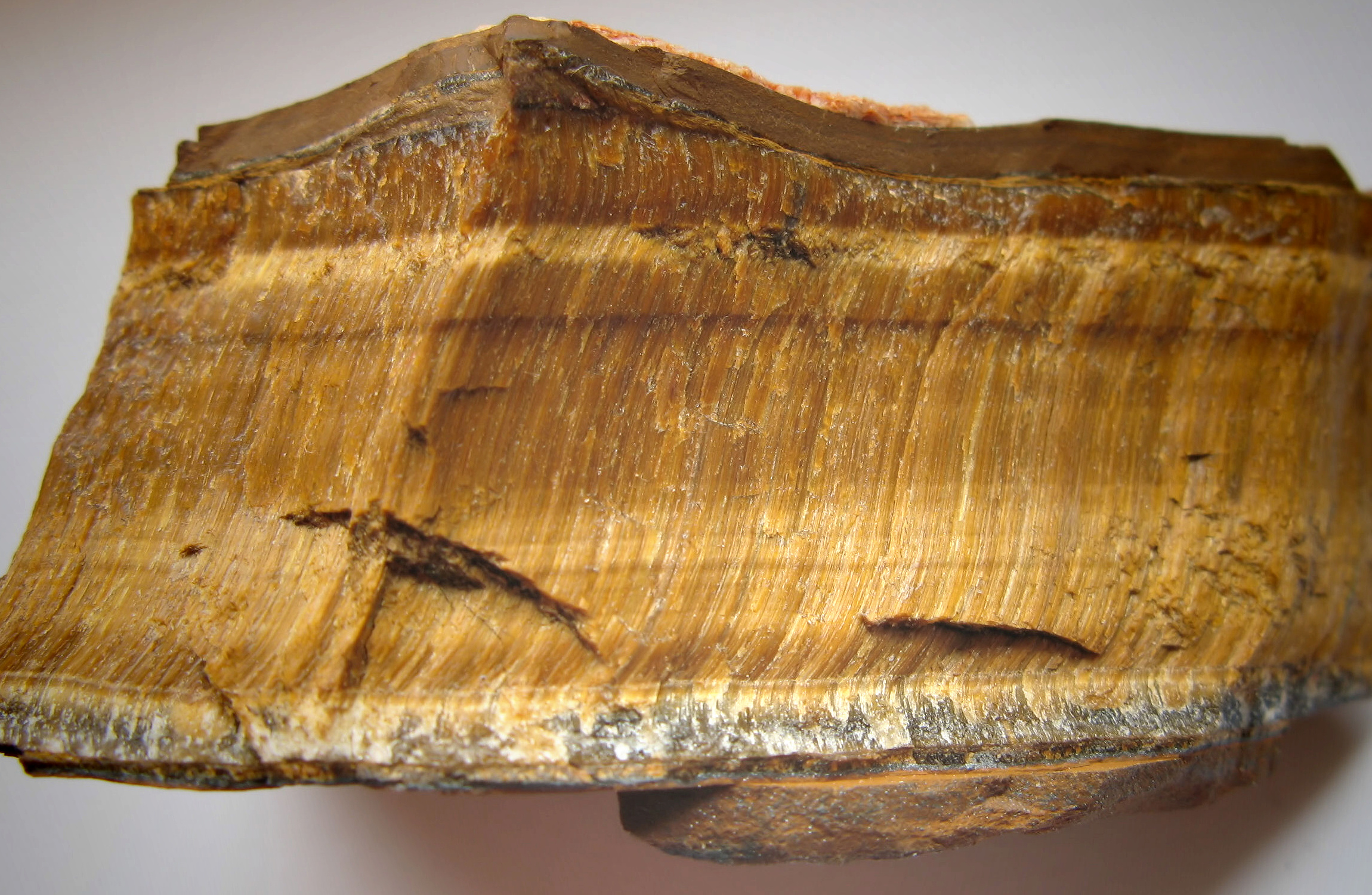
Chatoyant gemstone from the quartz family
| Field | Value |
|---|---|
| name | Tiger's eye |
| image | Tiger's eye.jpg |
| boxbgcolor | #914b16 |
| boxtextcolor | #FFFFFF |
| imagesize | 260px |
| alt | A polished reddish brown stone which is bisected by a band containing golden fibers |
| formula | Silica () |
| colour | golden to red-brown |
| mohs | 6.5–7 |
| luster | Silky |
| gravity | 2.64–2.71 |
Tiger's eye (also called tiger eye) is a chatoyant gemstone that is usually a metamorphic rock with a golden to red-brown colour and a silky lustre. As members of the quartz group, tiger's eye and the related blue-coloured mineral hawk's eye gain their silky, lustrous appearance from the parallel intergrowth of quartz crystals and altered amphibole fibres that have mostly turned into limonite.
Other forms of tiger's eye
Tiger iron is an altered rock composed chiefly of tiger's eye, red jasper and black hematite. The undulating, contrasting bands of colour and lustre make for an attractive motif and it is mainly used for jewellery-making and ornamentation. Tiger iron is a popular ornamental material used in a variety of applications, from beads to knife hilts.
Tiger iron is mined primarily in South Africa and Western Australia. Tiger's eye is composed chiefly of silicon dioxide () and is coloured mainly by iron oxide. The specific gravity ranges from 2.64 to 2.71. It is formed by the alteration of crocidolite.
Serpentine deposits in the US states of Arizona and California can have chatoyant bands of chrysotile, a form of asbestos, fibres. These have been cut and sold as "Arizona tiger-eye" and "California tiger's eye" gemstones. The trade name 'pietersite' is used for a fractured or brecciated chalcedony containing amphibole fibers and promoted as tiger's eye from Namibia and China.
Sources
Common sources of tiger's eye include Australia, Burma, India, Namibia, South Africa, the United States, Brazil, Canada, China, Korea and Spain.
Cultural associations
In some parts of the world, the stone is believed to ward off the evil eye.The Encyclopedia of Superstitions By Richard Webster, p.257
Roman soldiers wore engraved tigers eye to protect them in battle.
Cut, treatment and imitation
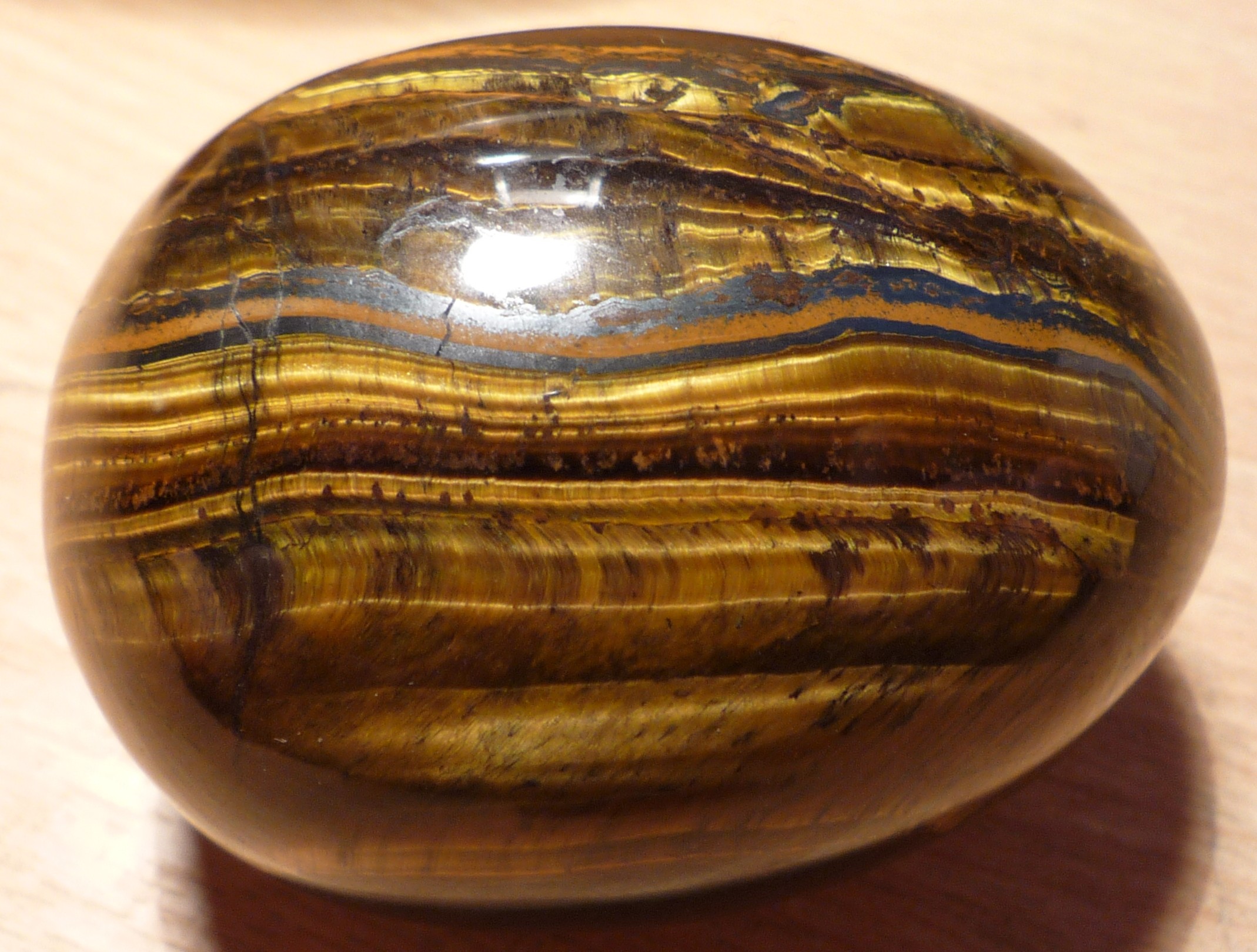
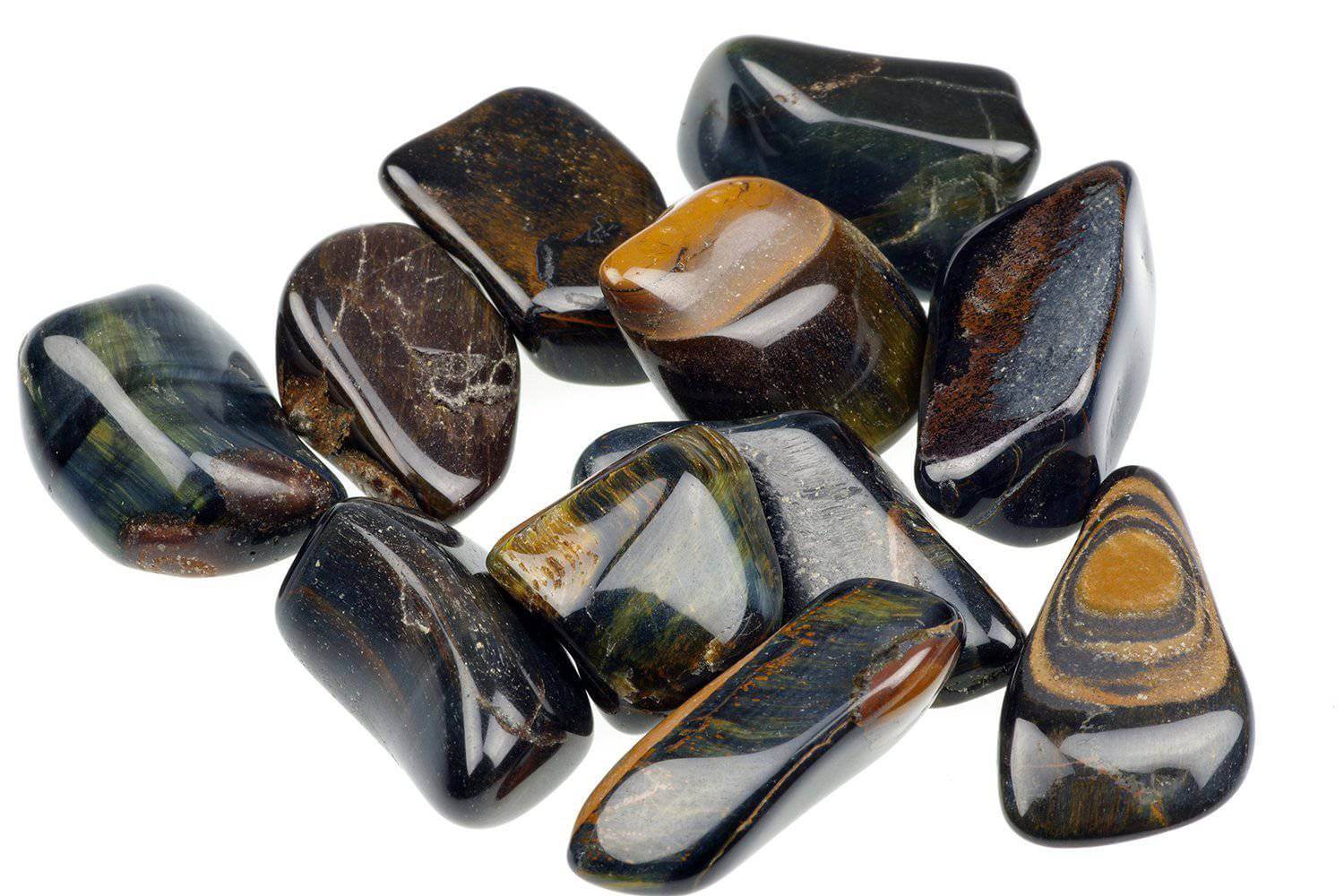
Gems are usually given a cabochon cut to best display their chatoyance. Red stones are developed by gentle heat treatments. Dark stones are artificially lightened to improve colour using a nitric acid treatment.
Honey-coloured stones have been used to imitate the more valued cat's eye chrysoberyl, cymophane, but the overall effect is often unconvincing. Artificial fibre optic glass is a common imitation of tiger's eye, and is produced in a wide range of colours.
References
References
- "Tiger's Eye".
- (April 2003). "New interpretation of the origin of tiger's-eye". Geology.
- [http://ist-socrates.berkeley.edu/~eps2/wisc/sg.html Listing of SG of gems and gem simulants] {{Webarchive. link. (2006-09-04 , Berkeley.edu)
- Flagg, Arthur Leonard. (1958). "Mineralogical Journeys in Arizona". F.H. Bitner.
- USGS. (1908–1909). "Cat's Eye or Tiger-Eye". US Government Printing Office.
- [http://www.mindat.org/min-27262.html Pietersite on Mindat.org]
- Schumann, Walter. (2009). "Gemstones of the World". Sterling Publishing.
- O'Donoghue, Michael. (1997). "Synthetic, Imitation, and Treated Gemstones". Butterworth-Heinemann.
This article was imported from Wikipedia and is available under the Creative Commons Attribution-ShareAlike 4.0 License. Content has been adapted to SurfDoc format. Original contributors can be found on the article history page.
Ask Mako anything about Tiger's eye — get instant answers, deeper analysis, and related topics.
Research with MakoFree with your Surf account
Create a free account to save articles, ask Mako questions, and organize your research.
Sign up freeThis content may have been generated or modified by AI. CloudSurf Software LLC is not responsible for the accuracy, completeness, or reliability of AI-generated content. Always verify important information from primary sources.
Report