From Surf Wiki (app.surf) — the open knowledge base
Tantō
Japanese dagger
Japanese dagger
| Field | Value |
|---|---|
| name | ja |
| image | Tanto Kunimitsu.jpg |
| image_size | 165 |
| caption | ja with signature (ja) of Shintōgo Kunimitsu. Complete ja-style ja (mountings) and bare blade. Kamakura Period, 14th century. Important Cultural Property. |
| type | Japanese sword |
| is_bladed | yes |
| production_date | Heian period (794–1185) to present |
| part_length | approx. 15 – |
| blade_type | Double or single edged, straight bladed or curved bladed |
A is a traditionally made Japanese knife (ja) that was worn by the samurai class of feudal Japan. The ja dates to the Heian period, when it was mainly used as a weapon but evolved in design over the years to become more ornate. ja were used in traditional martial arts (ja) and in the seppuku suicide ritual. The term has seen a resurgence in the West since the 1980s as referring to a point style of modern tactical knives, designed for piercing or stabbing, though the style is not present on any traditional tantō.
A Tanto knife may refer to an American style of blade based on the Japanese ja, usually with a squared rather than curved tip.
Description
The ja is a single or double edged dagger with a length between 6 and (1 Japanese ja). The ja was designed primarily as a stabbing weapon, but the edge can be used for slashing as well. ja are generally forged in the style (without a ridgeline), meaning that their sides have no ridge line and are nearly flat, unlike the structure of a katana. Some ja have particularly thick cross-sections for armor-piercing duty, and are called ja.
ja were mostly carried by samurai; commoners did not generally wear them. Women sometimes carried a small ja called a ja in their ja, primarily for self-defense. ja were sometimes worn as the in place of a ja in a ja, especially on the battlefield. Before the advent of the ja combination, it was common for a samurai to carry a ja and a ja as opposed to a katana and a ja.
It has been noted that the ja would be paired with a ja and later the katana would be paired with another shorter katana. With the advent of the katana, the ja was eventually chosen by samurai as the short sword of choice over the ja. Kanzan Satō, in his book The Japanese Sword, notes that there did not seem to be any particular need for the ja, and suggests that the ja may have become more popular than the ja due to the ja being more suited for indoor fighting. He mentions the custom of leaving the katana at the door of a castle or palace when entering while continuing to wear the ja inside.
History of {{transliteration|ja|tantō}} in Japan
The production of swords in Japan is divided into specific time periods:
- Jōkotō (ancient swords, until around 900 AD)
- Kotō (old swords from around 900–1596)
- Shintō (new swords 1596–1780)
- Shinshintō (new new swords 1781–1876)
- Gendaitō (modern swords 1876–1945)
- Shinsakutō (newly made swords 1953–present)
Heian to Muromachi periods
The ja was invented partway through the Heian period. With the beginning of the Kamakura period, ja were forged to be more aesthetically pleasing, and ja and ja became the most popular styles. Near the middle of the Kamakura period, more ja artisans were seen, increasing the abundance of the weapon, and the ja style became prevalent in the cities of Kyoto and Yamato. Because of the style introduced by the ja in the late Kamakura period, ja began to be forged longer and wider. The introduction of the Hachiman faith became visible in the carvings in the hilts around this time. The ja (line of temper) is similar to that of the ja, except for the absence of ja, which is ja and ja. ja and ja are found to have taken its place.
During the era of the Northern and Southern Courts, the ja were forged to be up to 40 cm in length, as opposed to the normal one ja (about 30 cm) length. The blades became thinner between the ja and the ja, and wider between the ja and ja. At this point in time, two styles of ja were prevalent: the older style, which was subtle and artistic, and the newer, more popular style. With the beginning of the Muromachi period, constant fighting caused the mass production of blades, meaning that with higher demand, lower-quality blades were manufactured. Blades that were custom-forged still were of exceptional quality, but the average blade suffered greatly. As the end of the period neared, the average blade narrowed and the curvature shallowed.
Katana originate from , a kind of ja used by lower-ranking samurai who fought on foot in the Kamakura period. Their main weapon was a long ja, with the ja as a spare weapon. In the Nanboku-chō period, which corresponds to the early Muromachi period, long weapons such as ja were popular, and along with this, the ja lengthened, taking its form as the katana.
Momoyama to the early Edo period

Approximately 250 years of peace accompanied the unification of Japan, in which there was little need for blades. In this period, both the katana and ja were invented, taking the place of the ja and ja as the most-used pair of weapons, and the number of ja forged was severely decreased. Since this period, ja have often been carved with splendid decorations. Of the ja and ja forged during this period, three masterpieces are called the .
Late Edo period
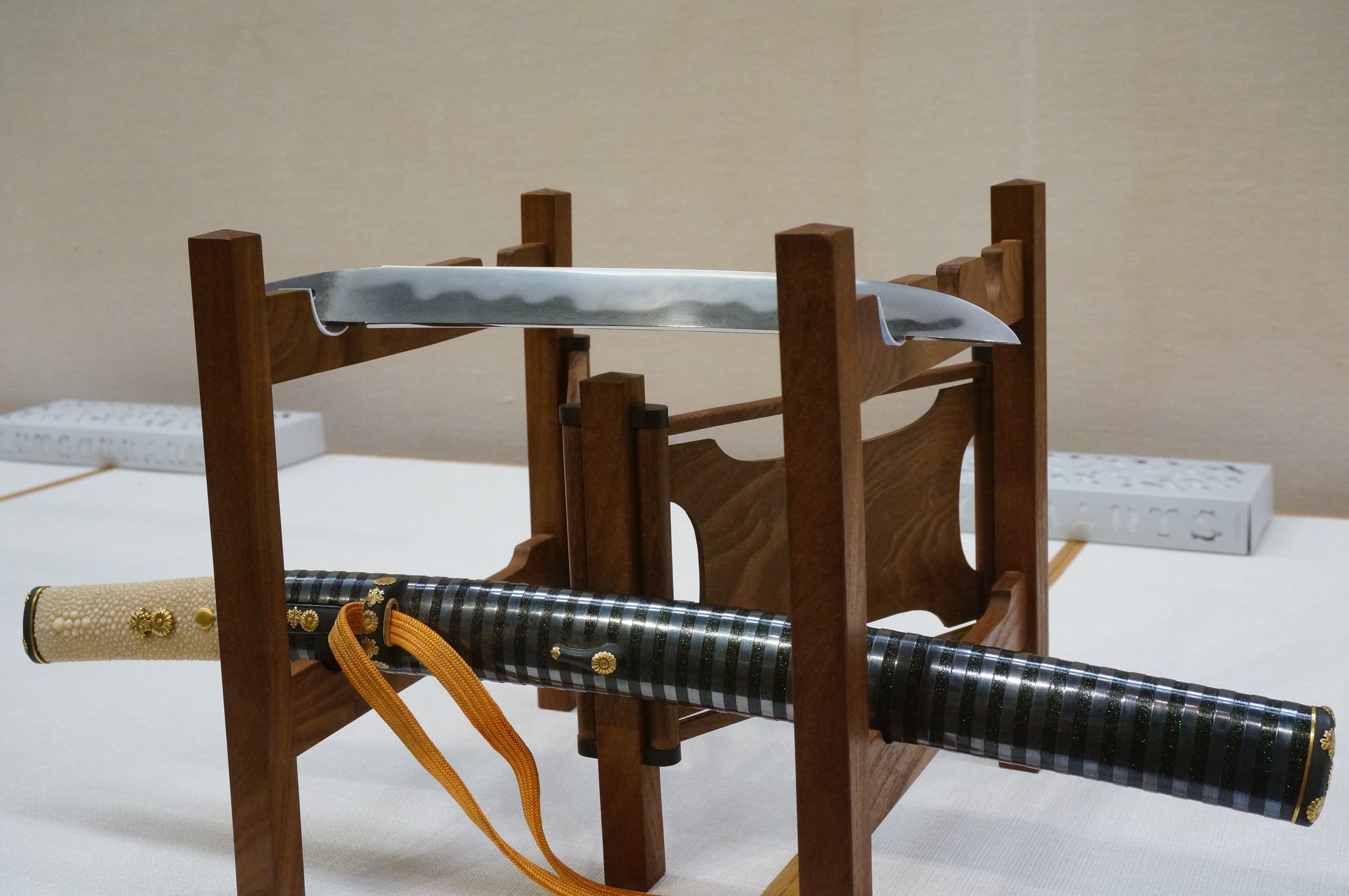
There were still a few ja being forged during the late Edo period, and the ones that were forged reflected the work of the Kamakura, Nambokucho, or Muromachi eras. Suishinshi Masahide was a main contributor towards the forging of ja during this age. There were now only ja predating the Edo period being used in combat; ja forged during the late Edo period were not combative weapons.
Meiji to present
Many ja were forged before World War II, due to the restoration of the Emperor to power. Members of the Imperial Court began wearing the set of ja and ja once more, and the number of ja in existence increased dramatically. After World War II, a restriction on sword forging caused ja manufacture to fall drastically.
ja remained in use among twentieth century yakuza (gangsters) since they could be carried as a concealed weapon more easily than a katana. A ja is also traditionally used in the yubitsume ritual (cutting off part of a finger as an act of submission or atonement).
American and European interest in Japanese martial arts since the war created a demand for the ja outside Japan from the 1960s through the present time.
Types of {{transliteration|ja|tantō}}
Blade types
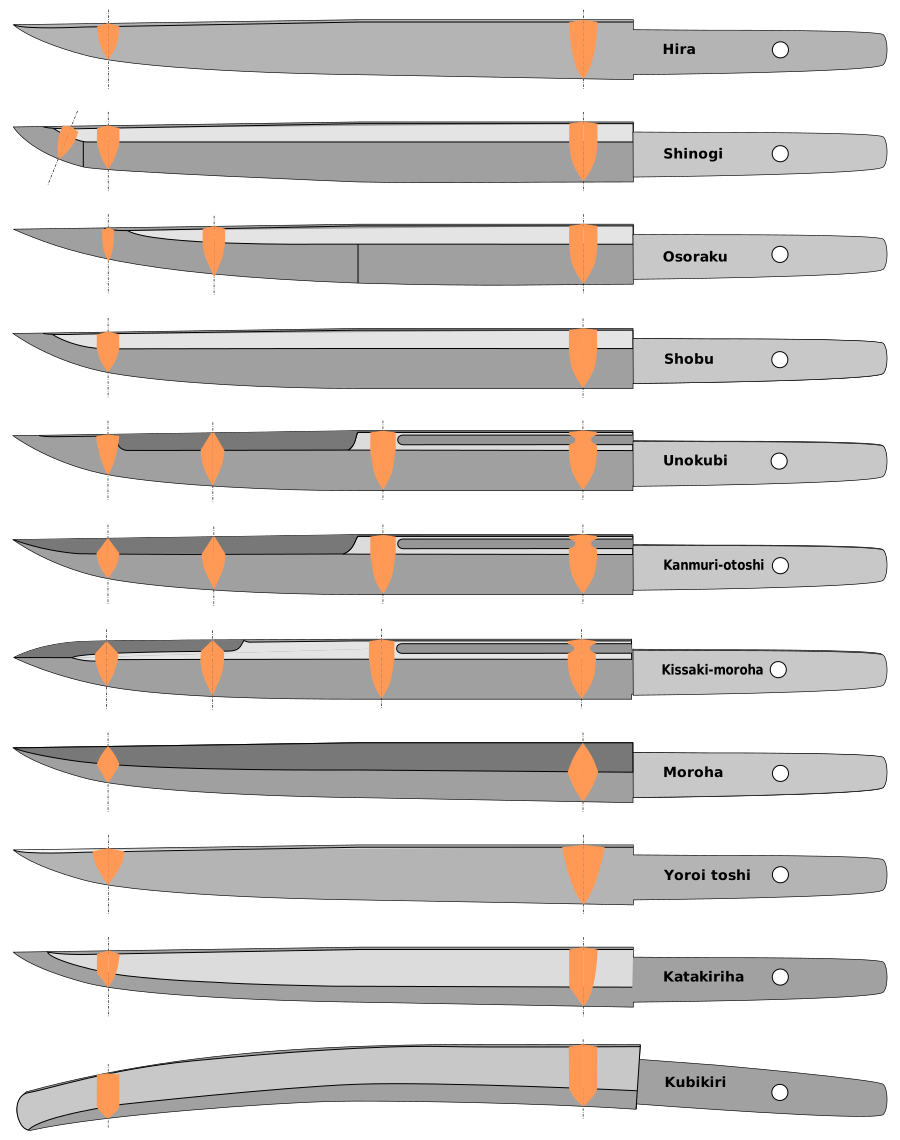
- : A very common ja form with no ja, the edge bevels reaching all the way from the edge (ja) to the back (ja) with no separate flats in between, creating an almost triangular cross-section (the back is ridged, as on most other blade forms, so the cross-section is actually an extremely asymmetrical diamond shape; on ja blades it is hexagonal). It is extremely common due to the simplicity of its design.
- : This is the most common type of blade geometry for long swords, but ja made in this form are very rare, usually created from cut-down blades when a longer sword has been broken. ja means the central ridge that runs along the length of the blade between the edge bevels and the body of the blade.
- ja: ja feature an extremely long ja type point, over half the blade's length.
- : A common blade type that is very similar to the ja, except that it lacks a ja, the distinct angle between the long cutting edge and the point section, and instead the edge curves smoothly and uninterrupted into the point.
- : An uncommon ja style akin to the ja, with a back that grows abruptly thinner around the middle of the blade; however, the ja regains its thickness just before the point. There is normally a short, wide groove extending to the midway point on the blade.
- ja: These ja were shaped in the ja or ja style, but from about halfway to the tip the back edge was sharpened though this second edge was not particularly sharp. They had a groove running halfway up the blade and were similar to the ja-style ja.
- : A rare blade type with a double-edged point. Unlike the later ja the tip had a distinct shape unlike any other ja: the back edge would curve slightly downwards so that the point was lower than the back of the blade whereas other ja had the point in line with the back of the blade. Often they had a wide groove in the base half. The most well known historical blade of this type is the ja Kogarasu Maru, "Little Crow", one of the National Treasures of Japan.
- : A rare, double-edged ja type that has a diamond-shaped cross-section. The blade tapers to a point and contains a ja that runs to the point.
- : ja that have particularly thick cross-sections for armor-piercing duty.
- : An asymmetric ja form, sharpened only on one side to create a chisel-shaped cross-section.
- : A very rare type; the sharpened blade is on the inside curve rather than the outside. It has no sharpened point, making it difficult to use in battle and enshrouding the weapon in mystery. ja means . According to one myth, they were carried by attendants of samurai for cutting off the heads of fallen enemies. There are other speculations existing about the ja's possible uses. Perhaps they were used by doctors or carried by high-ranking officials as a badge is worn today. They could also have been used for cutting charcoal or incense, or used as an artistic tool for pruning bonsai trees.
- : A ja form that is commonly described as a short, wide, ja. The ja () was one of the blade type that the legendary swordsmith Masamune favored.
Mountings ({{transliteration|ja|koshirae}})
- : The ja is a ja where the ja is flush with the mouth of the sheath. There is no handguard. ja normally have plain wooden hilts, and many forms of ja have ja that are made from animal horns.
- ja: The ja is a ja that features a small handguard.
Western Tanto
A popular style of blade, known simply as a Tanto in the US and Europe, is similar in style to the Tantō except that the tip is squared at a shearing angle instead of curved.
The shearing angle may facilitate the stabbing effectiveness of the blade, and make the process of sharpening simpler.

This style of blade is commercially popular, and was used by CIA field agents in the wake of 9/11.
The Bundeswehr is among the few militaries (if not the only) that issues a "tantō"-style military knife in significant numbers. It is designated as the KM2000.
Other {{transliteration|ja|tantō}}

- ja: The ja (also ja or ja) is a generally short ja that is commonly carried in ja or ja mounts. It was useful for self-defense indoors where the long katana and intermediate ja were inconvenient. Women carried them in the obi for self-defense and rarely for ja (ritual suicide). A woman received a ja as part of her wedding gifts.
- Fan ja: The fan ja is a common ja with a blade entirely concealed within a fan-shaped scabbard. The blade was usually low quality, as this ja was not designed to be a display piece, but rather a concealed weapon for self-defense.
- ja: Japanese spearheads were often altered so that it became possible to mount them as ja. Unlike most blades, ja had triangular cross-sections. The primary purpose of the ja was to pierce ja (chain mail).
- ja: This is also not truly a ja, though it is often used and thought of as one. ja were straight, double-edged blades often used for Buddhist rituals, and could be made from spearheads that were broken or cut shorter. They were often given as offerings from sword smiths when they visited a temple. The hilt of the ja may be found made with a vajra (double thunderbolt related to Buddhism).
- Modern ja: Modern tactical knives have been made by knife makers Bob Lum, Phill Hartsfield, Ernest Emerson, Allen Elishewitz, Bob Terzuola, Strider Knives, Harold J. "Kit" Carson, Benchmade, Camillus Cutlery Company, Spyderco, Severtech, Ka-Bar, SOG Knives, Columbia River Knife & Tool, and Cold Steel. These "American ja" designs which are often folding knives, feature a thick spine on the blade that goes from the tang to the tip for increased tip strength. The handle shape may be altered slightly to provide better ergonomics.
Use in martial arts
ja with blunt wooden or blunt plastic blades are used to practice martial arts. Versions with a blunt metal blade are used in more advanced training and in demonstrations. Martial arts that employ the ja include:
- Aikido
- Aikijutsu
- Jujutsu
- Wadō-ryū (both ja and katana)
- Koryu bujutsu
- Ninjutsu
- Shorinji Kempo
- Modern Arnis (taking place of dagger)
Popular culture
- ja can be seen in many jidaigeki and chanbara films, especially those depicting seppuku, such as Harakiri (1962).
- ja also appear in many yakuza films, where they are used in fights and stabbings among yakuza, and in the yubitsume (finger-cutting) ritual. Examples include Kinji Fukasaku's many yakuza films of the 1970s, and the Hollywood film The Yakuza (1974).
- Teenage Mutant Ninja Turtles features ja knives used by April O'Neil, Leonardo, and Splinter in the 2012 version, and also by the Shredder in the 1990 version and Karai in the 2003 version.
- ja appear in many video games set in Japan, such as the 2020 samurai themed game Ghost of Tsushima, in which the protagonist uses a ja for stealth kills.
- The 2012 video game Hitman: Absolution enables players to pick up and use a weapon called the 'Agency Tanto Knife' on levels where Agent 47 fights a rogue sect of his employers, the International Contract Agency
- In the light novel series, Is It Wrong to Try to Pick Up Girls in a Dungeon?, the Greek deity Hephaestus crafted the Hestia Knife, divine knife designed after a Tanto which became Bell Cranel's signature weapon.
- A tanto is a possible weapon of Fujibayashi Naoe in Assassin's Creed Shadows.
Gallery
|Image:Tanto - Yoshimitsu.jpg|ja, by Awataguchi Yoshimitsu. 13th century, Kamakura period. National Treasure. Tokyo National Museum |File:Tantō Minamoto Kiyomaro.jpg|A ja forged by Minamoto Kiyomaro (left), ja mounting (right). Late Edo period. |File:Hilt of tantō.jpg|Hilt (ja) and handguard (ja) of ja. Late Edo period. |File:Mounting for a tantō.jpg|ja mounting. Edo or Meiji period. The Metropolitan Museum of Art. |Image:Yari tanto.JPG|Edo period ja (spear) ja in ja. A spearhead converted to use as a ja. |Image:Yari tanto 1.JPG|Edo period ja. A ja (spear) converted to use as a ja. |Image:Fan tanto.JPG|A ja disguised as a fan |Image:Ken tanto.JPG|ja, a double-edged straight sword in wooden mounts ja|Image:Aikuchi tanto.JPG|Edo period ja with an ja mounting}}
References
References
- [https://books.google.com/books?id=I__jerUaPkMC&pg=PA47 ''The Samurai Sword: A Handbook'', John M. Yumoto, Tuttle Publishing, 1989 p .47]
- [https://books.google.com/books?id=i0ni1NmbYe0C&pg=PA161 ''Handbook to life in medieval and early modern Japan'', William E. Deal, Oxford University Press US, 2007 P.161]
- 3-03911-711-4. 978-3-03911-711-6 p.150
- 1-59257-764-4. 978-1-59257-764-4 P.144
- [http://www.ksky.ne.jp/~sumie99/styles.html Styles in the Shape of Blades]
- [http://www.ksky.ne.jp/~sumie99/kaiken.html Kaiken]
- [https://books.google.com/books?id=vFS2iT8QjqEC&dq=daisho+tanto&pg=PA68 ''The Japanese Sword'', Kanzan Satō, Kodansha International, 1983 P.68]
- [https://books.google.com/books?id=BGxQeTMnPzQC&dq=samurai+daisho&pg=PA106 ''Shotokan's Secret: The Hidden Truth Behind Karate's Fighting Origins'', Bruce D. Clayton, Black Belt Communications, 2004 P106]
- [https://books.google.com/books?id=vFS2iT8QjqEC&dq=daisho&pg=PA68 ''The Japanese Sword'', Kanzan Satō, Kodansha International, 1983 P.68]
- Clive Sinclaire. (1 November 2004). "Samurai: The Weapons and Spirit of the Japanese Warrior". Lyons Press.
- トム岸田. (24 September 2004). "靖国刀". Kodansha International.
- Satō, Kanzan. (1983). "The Japanese Sword; Volume 12 of Japanese arts library". Kodansha International.
- ''歴史人'' September 2020. p40. {{ASIN. B08DGRWN98
- [https://web.archive.org/web/20201117093425/https://www.touken-world.jp/word/word/page/4/ List of terms related to Japanese swords "Sasuga".] Nagoya Japanese Sword Museum Touken World.
- Satō (1983) p. 68
- [https://web.archive.org/web/20201110031603/https://bijutsutecho.com/exhibitions/6771 崇高なる造形-日本刀 名刀と名作から識る武士の美学-.] Bijutsu techō
- Sinclaire, Clive. (2004). "Samurai: The Weapons and Spirit of the Japanese Warrior". Globe Pequot.
- "Unusual tantō".
- "Operation JAWBREAKER Knife - CIA".
- Moeller, Jason. (2007-05-01). "Soldiers Without Uniforms: CIA Paramilitary Operations in Afghanistan". MSU Graduate Theses.
- Pacella, Gerard. (2002). "100 Legendary Knives". Krause Publications.
- "American Tanto - Blade Geometry Knife FAQ". faq.customtacticals.com.
- Steele, David. (1981). "Japanese Daggers". Black Belt, Inc..
This article was imported from Wikipedia and is available under the Creative Commons Attribution-ShareAlike 4.0 License. Content has been adapted to SurfDoc format. Original contributors can be found on the article history page.
Ask Mako anything about Tantō — get instant answers, deeper analysis, and related topics.
Research with MakoFree with your Surf account
Create a free account to save articles, ask Mako questions, and organize your research.
Sign up freeThis content may have been generated or modified by AI. CloudSurf Software LLC is not responsible for the accuracy, completeness, or reliability of AI-generated content. Always verify important information from primary sources.
Report