From Surf Wiki (app.surf) — the open knowledge base
Surya
Solar deity in Hinduism
Solar deity in Hinduism
| Field | Value | |||||
|---|---|---|---|---|---|---|
| type | Hindu | |||||
| image | File:Surya with Adityas and attendants.jpg | |||||
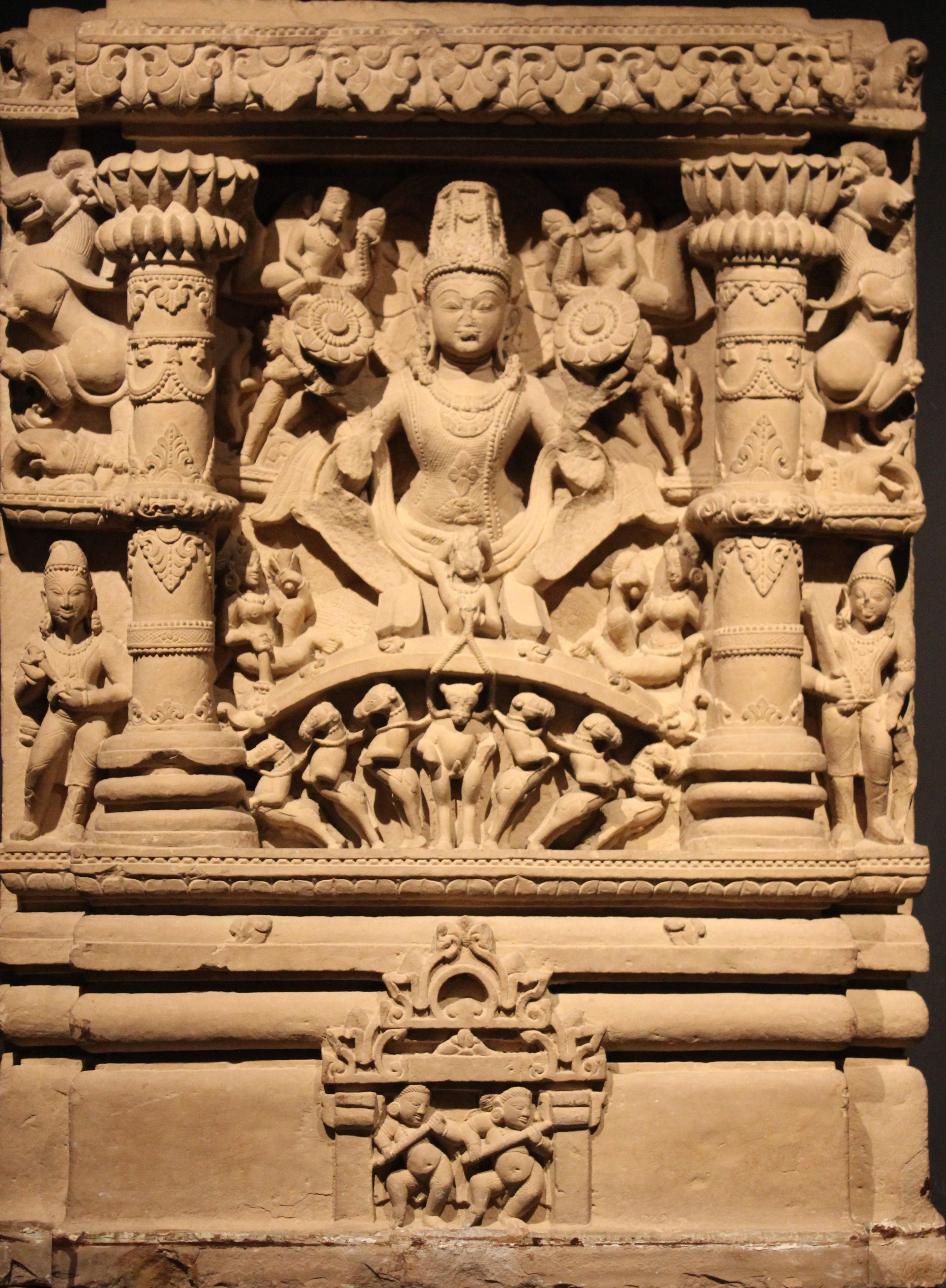
| caption | Sculpture of Surya with attendants, c. 11th century | |||||
| affiliation | Deva, Adityas, Navagraha | |||||
| other_names | ||||||
| god_of | God of the Sun | |||||
| Ruler of the Planets | ||||||
| Para Brahman, the Supreme Being (Saura) | ||||||
| mount | Chariot drawn by seven horses | |||||
| **Charioteer**: Aruṇa | ||||||
| {{cite book | last | Jansen | first=Eva Rudy | year= | title=The Book of Hindu Imagery: Gods, manifestations, and their meaning | page=65}} |
| children | ||||||
| siblings | Adityas including | |||||
| consorts | Sanjna and Chhaya | |||||
| father | Kashyapa | |||||
| mother | Aditi | |||||
| abode | Suryaloka | |||||
| planet | Sun | |||||
| day | Sunday | |||||
| festivals | Pongal, Sankranti, Chhath, | |||||
| number | 1 | |||||
| weapon | Suryastra, Astras, Wand, Trisula, Chakra, Gada and Shankha | |||||
| mantra | *Gayatri Mantra | |||||
| member_of | Navagraha |
Ruler of the Planets Para Brahman, the Supreme Being (Saura) Charioteer: Aruṇa Samba Dashami
- Oṃ ādityāya namo namaḥ
- Oṃ sūryadevāya namaḥ Surya ( ; , ) is the Sun as well as the solar deity in Hinduism. He is traditionally one of the major five deities in the Smarta tradition, all of whom are considered as equivalent deities in the Panchayatana puja and a means to realise Brahman. Throughout Indian literature, Surya has been given multiple epitaphs such as Ravi, Vaivasvat, Bhāskara, etc. Furthermore, Surya has been described through aspects of itself which are identified as the Ādityas; including Savitr, Pushan, Mārtanda, Bhaga, etc.
The iconography of Surya is often depicted riding a chariot harnessed by horses, often seven in number During the medieval period, Surya was worshipped in tandem with Brahma during the day, Shiva at noon, and Vishnu in the evening. In some ancient texts and art, Surya is presented syncretically with Indra, Ganesha, and others.
Surya is depicted with a Chakra, also interpreted as Dharmachakra. Surya is the lord of Simha (Leo), one of the twelve constellations in the zodiac system of Hindu astrology. Surya or Ravi is the basis of Ravivara, or Sunday, in the Hindu calendar. Major festivals and pilgrimages in reverence for Surya include Makar Sankranti, Pongal, Samba Dashami, Ratha Saptami, Chath puja, and Kumbha Mela.
He is particularly venerated in the Saura and Smarta traditions found in Indian states such as Rajasthan, Gujarat, Madhya Pradesh, Bihar, Maharashtra, Uttar Pradesh, Jharkhand, and Odisha.
Having survived as a primary deity in Hinduism longer than most of the original Vedic deities, the worship of Surya declined greatly around the 13th century, perhaps as a result of the Muslim destruction of Sun temples in North India. New Sun temples virtually ceased to be built, and some were later repurposed to a different deity. A number of important Surya temples remain, but most are no longer in worship. In certain aspects, Surya has tended to be merged with the prominent deities of Vishnu or Shiva, or seen as subsidiary to them.
Texts and history
Vedic
The Sun causes day and night on the earth, because of revolution, when there is night here, it is day on the other side, the sun does not really rise or sink. The oldest surviving Vedic hymns, such as the hymn 1.115 of the Rigveda, mention Sūrya with particular reverence for the "rising sun" and its symbolism as dispeller of darkness, one who empowers knowledge, the good and all life. However, the usage is context specific. In some hymns, the word Surya simply means Sun as an inanimate object, a stone or a gem in the sky (Rigvedic hymns 5.47, 6.51 and 7.63); while in others it refers to a personified deity. |orig-year=1897–1898 |year=1996 Surya is prominently associated with the dawn goddess Ushas and sometimes, he is mentioned as her son or her husband.
Surya's origin differs heavily in the Rigveda, with him being stated to have been born, risen, or established by a number of deities, including the Ādityas, Aditi, Dyaush, Mitra-Varuna, Agni, Indra, Soma, Indra-Soma, Indra-Varuna, Indra-Vishnu, Purusha, Dhatri, the Angirases, and the gods in general. The Atharvaveda also mentions that Surya originated from Vritra.
The Vedas assert Sun (Surya) to be the creator of the material universe (Prakriti). In the layers of Vedic texts, Surya is one of the several trinities along with Agni and either Vayu or Indra, which are presented as an equivalent icon and aspect of the Hindu metaphysical concept called the Brahman.
In the Brahmanas layer of Vedic literature, Surya appears with Agni (fire god) in the same hymns. Surya is revered for the day, while Agni for its role during the night. The idea evolves, states Kapila Vatsyayan, where Surya is stated to be Agni as the first principle and the seed of the universe. It is in the Brahmanas layer of the Vedas, and the Upanishads that Surya is explicitly linked to the power of sight, to visual perception and knowledge. He is then interiorized to be the eye as ancient Hindu sages suggested abandonment of external rituals to gods in favor of internal reflections and meditation of gods within, in one's journey to realize the Atman (soul, self) within, in texts such as the Brihadaranyaka Upanishad, Chandogya Upanishad, Kaushitaki Upanishad and others.
Conflation with other solar deities
Surya in Indian literature is referred to by various names, which typically represent different aspects or phenomenological characteristics of the Sun. The figure of Surya as we know him today is an amalgamation of various different Rigvedic deities. Thus, Savitr refers to one that rises and sets, Aditya means one with splendor, Mitra refers to Sun as "the great luminous friend of all mankind", while Pushan refers to Sun as illuminator that helped the Devas win over Asuras who use darkness. Arka, Mitra, Vivasvat, Aditya, Tapan, Ravi and Surya have different characteristics in early mythologies, but by the time of the epics they are synonymous.
The term "Arka" is found more commonly in temple names of north India and in the eastern parts of India. The 11th century Konark Temple in Odisha is named after a composite word "Kona and Arka", or "Arka in the corner". Other Surya temples named after Arka include Devarka (Deva teertha) and Ularka (Ulaar) in Bihar, Uttararka and Lolarka in Uttar Pradesh, and Balarka in Rajasthan. Another 10th-century sun temple ruin is in Bahraich, Uttar Pradesh named Balarka Surya Mandir, which was destroyed in the 14th century during the Turkish invasions.
Vivasvat, also known as Vivasvant, is also one such of these deities. His wife is Saranyu, daughter of Tvashtar. His sons include the Ashvins, Yama, and Manu. Through Manu, Vivasvat is considered an ancestor of humanity. Vivasvat is affiliated with Agni and Matarishvan, with Agni being stated to have been first revealed to those two. Vivasvat is also variously related to Indra, Soma, and Varuna. Vivasvant is also used as an adjective of Agni and Ushas to mean "brilliant". Already by the time of his earliest appearance (the Rigveda), Vivasvat had declined in importance. He was likely a solar deity, but scholars debate his specific role as one. In the Rigveda, Indra drinks Soma alongside Manu Vivasvat and Trita. In post-Vedic literature, Vivasvat further declines in importance, and is merely another name for the sun. He is cognate to the Avestan Vivanhvant, who is the father of Yima (cognate to Yama) and Manu. Taittiriya Aranyaka, in Prapataka (section) 6, provides the methods of meditating on Surya.
Epics
As per the Ramayana's Yuddha Kanda, Rama was taught the Ādityahṛdayam stotra before his war against Ravana, the king of the rakshasas. The stotra was composed in Anushtup Chanda in praise of Surya, who is described as the embodiment of all gods and the origin of everything in the universe.
The Mahabharata epic opens its chapter on Surya that reverentially calls him as the "eye of the universe, soul of all existence, origin of all life, goal of the Samkhyas and Yogis, and symbolism for freedom and spiritual emancipation.
In the Mahabharata, Karna is the son of Surya and unmarried princess Kunti. The epic describes Kunti's trauma as an unmarried mother, then abandonment of Karna, followed by her lifelong grief. Baby Karna is found and adopted by a charioteer but he grows up to become the greatest warrior and one of the central heroes of the great war of Kurukshetra.
Iconography
Buddhism and Jainism
Earliest representations of Surya riding a chariot occur in the Buddhist railings of the Mahabodhi temple in Bodhgaya (2nd century BCE), in the Bhaja Caves (1st century BCE), and the Jain cave of Ananta Gumpha in Khandagiri (1st century CE). They follow similar depiction of the chariot-riding god Helios of Hellenistic mythology, as appearing for example on the coinage of Greco-Bactrian kings, such as Plato I.
The iconography of Surya has varied over time. In some ancient arts, particularly from the early centuries of the common era, his iconography is similar to those found in Persia and Greece suggesting likely adoption of Greek, Iranian and Scythian influences. After the Greek and Kushan influences arrived in ancient India, some Surya icons of the period that followed show him wearing a cloak and high boots. In some Buddhist artwork, his chariot is shown as being pulled by four horses. The doors of Buddhist monasteries of Nepal show him, along with the Chandra (moon god), symbolically with Surya depicted as a red circle with rays.
Hinduism
In Hindu context, the sun-god only appears at a later period, as in the Virūpākṣa temple in Paṭṭadakal (8th century CE). The iconography of Surya in Hinduism varies with its texts. He is typically shown as a resplendent standing person holding a lotus flower in both hands, riding a chariot pulled by one or more horses typically seven. The seven horses are named after the seven meters of Sanskrit prosody: Gayatri, Brihati, Ushnih, Jagati, Trishtubha, Anushtubha and Pankti.
The Brihat Samhita of Varaha Mihira (), a Hindu text that describes architecture, iconography and design guidelines, states that Surya should be shown with two hands and wearing a crown. It specifically describes his dress to be Northern (i.e. Central Asian, with boots). Brihat Samhita, Chap. LVIII, 46–48 In contrast, the Vishnudharmottara, another Hindu text on architecture, states Surya iconography should show him with four hands, with flowers in two hands, a staff in third, and in fourth he should be shown to be holding writing equipment (Kundi palm leaf and pen symbolizing knowledge). In other representations, these goddesses are Surya's two wives, Samjna and Chhaya. He had two other wives according to some texts, Rajni and Prabha.
Aniconic symbols of Surya include the Swastika and the ring-stone. In various texts including Mahabharata, Suryasataka, or Prasasti of Vatsabhatti, Surya is depicted as being worshipped by a host of semi-divine beings. These beings, namely Siddhas, Charanas, Gandharvas, Yaksas, Guhyakas, and the Nagas, desirous of obtaining boons, follow the course of Surya's chariot through the sky.
Astronomy
Surya as an important heavenly body appears in various Indian astronomical texts in Sanskrit, such as the 5th century Aryabhatiya by Aryabhata, the 6th century Romaka by Latadeva and Panca Siddhantika by Varahamihira, the 7th century Khandakhadyaka by Brahmagupta and the 8th century Sisyadhivrddida by Lalla. These texts present Surya and various planets and estimate the characteristics of the respective planetary motion. Other texts such as Surya Siddhanta dated to have been complete sometime between the 5th century and 10th century present their chapters on various planets with deity mythologies.
The manuscripts of these texts exist in slightly different versions, present Surya- and planets-based calculation and its relative motion to earth. These vary in their data, suggesting that the text were open and revised over their lives. For example, the 10th century BCE Hindu scholars had estimated the sidereal length of a year as follows, from their astronomical studies, with slightly different results: |access-date=26 September 2016
| *Siddhanta Shiromani* | 365 days, 6 hours, 12 minutes, 9 seconds |
|---|
The oldest of these is likely to be the Surya Siddhanta, while the most accurate is the Siddhanta Shiromani.
Zodiac and astrology
Surya's synonym Ravi is the root of the word 'Ravivara' or Sunday in the Hindu calendar. In both Indian and Greek-Roman nomenclature for days of the week, the Sunday is dedicated to the Sun.
Surya is a part of the Navagraha in Hindu zodiac system. The role and importance of the Navagraha developed over time with various influences. Deifying the sun and its astrological significance occurred as early as the Vedic period and was recorded in the Vedas. The earliest work of astrology recorded in India is the Vedanga Jyotisha which began to be compiled in the 14th century BCE. It was possibly based on works from the Indus Valley Civilization as well as various foreign influences. Babylonian astrology was the first to develop astrology and the calendar, and was adopted by multiple civilizations including India.
The Navagraha developed from early works of astrology over time. The Sun and various classical planets were referenced in the Atharvaveda around 1000 BCE. The Navagraha was furthered by additional contributions from Western Asia, including Zoroastrian and Hellenistic influences. The Yavanajataka, or 'Science of the Yavanas', was written by the Indo-Greek named "Yavanesvara" ("Lord of the Greeks") under the rule of the Western Kshatrapa king Rudrakarman I. The Yavanajataka written in 120 BCE is often attributed to standardizing Indian astrology. The Navagraha would further develop and culminate in the Shaka era with the Saka, or Scythian, people.
Additionally the contributions by the Saka people would be the basis of the Indian national calendar, which is also called the Saka calendar.
The Hindu calendar is a Lunisolar calendar which records both lunar and solar cycles. Like the Navagraha, it was developed with the successive contributions of various works.
Temples and worship
Surya temples are found in many parts of India. More common than Surya temples are artwork related to Surya, which are found in all types of temples of various traditions within Hinduism, such as the Hindu temples related to Shiva, Vishnu, Ganesha, and Shakti.{{refn| name=Meister-1986-p243| Meister (1986) pp 243 (with notes [35] and [36]), 252-254, 239-241 Reliefs on temple walls, forts and artwork above doorways of many Hindu monasteries feature Surya.

Many of the temples that contain Surya icons and artwork are dated to the second half of the 1st millennium BCE and early centuries of the 2nd millennium. The 11th-century Vaishnava temple at Kadwaha in Madhya Pradesh, for example, features a Surya artwork along with many other gods and goddesses at its doorway. The 8th and 9th century goddess (Shaktism) temples of central India, similarly engrave Surya along with other Hindu gods within the temple. The six century Shiva temple at Gangadhar in Rajasthan includes Surya.{{refn| name=Meister-1986-pp233-262| Meister (1986) pp 233–262 Similar mentions are found in stone inscriptions found near Hindu temples, such as the 5th century Mandasor inscription. These temples, states Michael Meister, do not glorify one god or goddess over the other, but present them independently and with equal emphasis in a complex iconography.
Cave temples of India, similarly, dedicated to different gods and goddesses feature Surya. For example, the 6th century carvings in the Ellora Caves in Maharashtra as well as the 8th and 9th century artworks there, such as Cave 25, the Kailasha Temple (Cave 16) and others feature complete iconography of Surya.
Hindu temples predominantly have their primary entrance facing east, and their square principle based architecture is reverentially aligned the direction of the rising Surya. This alignment towards the sunrise is also found in most Buddhist and Jaina temples in and outside of India.
Dedicated temples
A prominent temple dedicated to Surya can be found in Arasavalli, which is in the Srikakulam district of Andhra Pradesh, India. The coastal district temple is peculiar with its latitude aligned to the minor lunar standstill. Also the transition from lunar calendar of north India to solar calendar of south India can be seen in the local culture. This is probably the eastern most coastal sun temple in the peninsular India, where prayers are offered until date. The place, Chicacole, has a significance in the Kalinga (historical region) kingdom with their port at Kalingapatnam, making it to Megasthenes dairy (Calingae). The diaspora is spread in the present day south east Asia at historical Kalinga (province), Kalingga Kingdom etc. [[File:Sun-temple DEO Aurangabad Bihar,India.jpg|thumb|[[Deo Surya Mandir]]]] Other most worshiped Surya temple is the Deo Surya Mandir. Sun Temple of Deo is one of the most remarkable, major crowd-puller and notable temple and religious place in Deo, Bihar, India for chhath puja. Deo Sun Temple Built in during the 8th century. Similarly in the Mithila region of Bihar, there is Kandaha Surya Mandir also known as Markandeyark Surya Mandir at Kandaha village in the Saharsa district dedicated to Lord Suryanarayana. It is believed to be built by Samba, the son of Krishna. In the Sitamarhi district of the Mithila region, there are two major Surya temples. They are Surya Mandir at Punauradham and Navagraha Surya Mandir at Mangaldham. In the Madhubani district, there is an ancient Surya temple known as Kamlark Surya Mandir at the campus of the Kamaladitya Sthan.
In Tamil Nadu, Navagraha temples are world famous. Suryanar kovil situated in Tanjore district of Tamil Nadu is one among the Navagraha temples and it is dedicated to Surya. Here lord Surya is called as Sivasurya Perumal. It is the first among the Navagraha temples of Tamil Nadu. |access-date=3 November 2019 |archive-date=11 October 2020 |archive-url=https://web.archive.org/web/20201011215216/https://timesofindia.indiatimes.com/travel/destinations/Deo-Sun-Temple/ps52430772.cms |url-status=live
The most famous Surya temple is the Konark Sun Temple, a World Heritage Site in Orissa. Constructed in the 13th century by the Eastern Ganga dynasty, on a pre-existing pilgrimage site for Surya god, the temple architecture mimics a grand chariot with twelve wheels pulled by seven horses. The temple features Surya in three representations, with the main large Surya destroyed and the temple damaged over the course of repeated Muslim invasions. |access-date=26 September 2016 |url-status=live |archive-url=https://web.archive.org/web/20190809073150/https://books.google.com/books?id=aJBNAAAAYAAJ |archive-date=9 August 2019 Besides Konark, there are two other sun temples in Orissa called Biranchi Narayan Sun Temple.
There are sun temples in many parts of India, such as Modhera, Gujarat. It was sponsored by King Bhimdev of the Chaulukya dynasty. Other major Surya temples are found in Kanakaditya Temple in Kasheli (Dist ratnagiri) – Maharashtra, near the famous Galtaji's temple in Jaipur, Rajasthan and Assam.
Adithyapuram Sun Temple is a Hindu temple located in Iravimangalam near Kaduthuruthy in Kottayam district in the Indian state of Kerala dedicated to Surya. It is noted as the only Surya shrine in the Kerala state. |access-date=8 December 2016 |url-status=live |archive-url=https://web.archive.org/web/20161220113325/https://www.keralatourism.org/destination/surya-temple-adityapuram/489 |archive-date=20 December 2016 |access-date=8 December 2016 |url-status=live |archive-date=20 December 2016 |archive-url=https://web.archive.org/web/20161220193322/http://english.mathrubhumi.com/mobile/travel/hot-spots/adityapuram-surya-temple-1.33587
The Martand Sun Temple in Jammu and Kashmir was destroyed by Islamic armies. A surviving Surya temple in northern India is Kattarmal Surya mandir in Almora District, Uttarakhand created by King Kattarmal in the 12th century.
The Indian rulers were essentially worshipers of the sun and some of the sun temples were erected by them during the medieval period. The sun temple known as Jayaditya was constructed by king of Nandipuri, Jayabhatta II. This temple is situated at Kotipura near Kapika in the Bharukachha district. The Surya temple of Bhinmal known as Jagaswami Surya temple was also erected during this period.
Surya temples outside India
The Sun Temple of Multan (in modern-day Pakistan) contained a revered statue of Surya. It was one of the focal points of Hindu-Muslim religious conflicts. After 871 BCE, Multan (Panjab) was under the rule by Arab princes, who kept the Surya temple hostage and desecrated it, in order to threaten its destruction if the Indian Hindu rulers attacked them. The early Muslim rulers taxed Hindu pilgrims for the privilege to visit the Surya temple, and this provided these rulers an important source of revenue. The Surya temple was destroyed by Ismaili Shia rulers in the late 10th century, who built a mosque atop the site, abandoning the Sunni congregational mosque in Multan. This Ismaili Shia mosque atop the Sun Temple's ruins was then destroyed by the Sunni ruler Mahmud of Ghazni, the Surya temple was not rebuilt and an empty space left in place, actions that helped re-establish the importance of the Sunni mosque in Multan.
While Shiva and Vishnu are more common in 1st millennium southeast Asian artwork such as those found in Cambodia and Thailand, archaeological evidence suggest god Surya were among the pantheon of ideas adopted early in these regions and retained after Buddhism became the dominant tradition.

In Nepal, many Surya temples and artworks trace to the medieval era, such as the 11th-century Thapahiti and Saugal-tol, and 12th century Naksal stone sculptures.
Artifacts discovered at the Sanxingdui culture founded , about 40 km from present day Chengdu, capital city of Sichuan province China reveal an ancient worship of sun-deity, similar to Surya. The artifacts include a gold sheet with design of four birds flying around the sun deity, and a bronze sculpture of the surya-chakra. Chung Tan (2015) Himalaya Calling – The origins of China and India pp. 13–15 Source link (accessed: Wed 7 Sept. 2016)
In cultures, arts and other religions
Festivals

Various festivals mark deity Surya and these vary regionally in India. Pongal or Makara Sankaranti is the most widely celebrated Hindu festival dedicated to the Sun God. These celebrate a good harvest. Other festivals that focus on Surya include Chhath of Bihar, eastern Uttar Pradesh and the neighboring regions, Samba Dashami and Ratha Saptami are also major festivals celebrated in honour of Surya; Chhath is celebrated immediately after Diwali with fasting for three days followed by bathing in river or tank with remembrance of Sun. Similarly Aytar Puja is celebrated in Goa. |access-date=14 August 2014 |url-status=live |archive-url=https://web.archive.org/web/20150926085346/http://timesofindia.indiatimes.com/city/goa/Seeking-the-suns-blessings/articleshow/6454309.cms |archive-date=26 September 2015 The latter is known as Aditya Ranubai in Maharashtra.
The second day of the Pongal harvest festival is dedicated to Surya in Tamil Nadu, and is called the "Surya Pongal". Another festival named Kartik Puja marks Surya, along with Shiva, Vishnu, Lakshmi, Radha, Krishna and Tulsi. It is observed by Hindu women, typically with visit to rivers such as the Ganges, socialization and group singing.
Dances
The repertoire of classical Indian dances such as the Bharatanatyam include poses that signify rays of light beaming towards all of the universe, as a form of homage to Surya. Katherine C. Zubko (2006) Embodying "Bhakti Rasa" in Bharata Natyam: An Indian-Christian Interpretation of "Gayatri" Mantra through Dance Journal of Hindu-Christian Studies volume 19, article 10, pages 38–39
Yoga
The nomenclature refers to the symbolism of Sun as the soul and the source of all life. It is relatively a modern practice that developed in the 20th century. A yogi may develop a personalized yoga warm up routine as surya-namaskar to precede his or her asana practice.
The Gayatri Mantra is associated with Surya (Savitr). The mantra's earliest appearance is in the hymn 3.62.10 of the Rigveda.
:Might we make our own that desirable effulgence :of god Savitar, who will rouse forth our insights.
Ask Mako anything about Surya — get instant answers, deeper analysis, and related topics.
Research with MakoFree with your Surf account
Create a free account to save articles, ask Mako questions, and organize your research.
Sign up freeThis content may have been generated or modified by AI. CloudSurf Software LLC is not responsible for the accuracy, completeness, or reliability of AI-generated content. Always verify important information from primary sources.
Report