From Surf Wiki (app.surf) — the open knowledge base
Saint Basil's Cathedral
1561 Orthodox church in Moscow, Russia
1561 Orthodox church in Moscow, Russia
| Field | Value |
|---|---|
| name | Cathedral of the Intercession of Most Holy Theotokos on the Moat |
| native_name | ru |
| image | Saint Basil's Cathedral in Moscow.jpg |
| alt | Saint Basil's Cathedral, Moscow, Russia |
| caption | Saint Basil's Cathedral as viewed from Red Square |
| map_type | Russia Moscow Central |
| location | Red Square, Moscow, Russia |
| geo | |
| religious_affiliation | Russian Orthodox Church |
| status | State Historical Museum with church services restored since 1991 |
| functional_status | Active |
| heritage_designation | 1990 |
| website | |
| architecture | yes |
| architect | Ivan Barma and Postnik Yakovlev |
| architecture_type | Church |
| architecture_style | Disputed (see #Architectural style) |
| groundbreaking | |
| consecration_year | |
| specifications | yes |
| height_max | 47.5 m |
| dome_quantity | 10 |
| spire_quantity | 2 |
| materials | {{Infobox designation list |
| embed | yes |
| designation1_partof | Kremlin and Red Square, Moscow |
| designation1_type | Cultural |
| designation1_criteria | i, ii, iv, vi |
| designation1 | WHS |
| designation1_date | 1990 (14th session) |
| designation1_number | [545](https://whc.unesco.org/en/list/545) |
| designation1_free1name | Region |
| designation1_free1value | Europe |
The Cathedral of Vasily the Blessed (), commonly known as Saint Basil's Cathedral, is a Russian Orthodox church in Red Square of Moscow. It is one of the most popular cultural symbols of Russia. The building, now a museum, is officially known as the Cathedral of the Intercession of the Most Holy Theotokos on the Moat, or Pokrovsky Cathedral. It was built from 1555 to 1561 on orders from Ivan the Terrible and commemorates the capture of Kazan and Astrakhan. It was completed, with its colours, in 1683.
The original building, known as Trinity Church and later Trinity Cathedral, contained eight chapels arranged around a ninth, central chapel dedicated to the Intercession; a tenth chapel was erected in 1588 over the grave of the venerated local saint Vasily (Basil). In the 16th and 17th centuries, it was perceived as the earthly symbol of the Heavenly City. Like all churches in Byzantine Christianity, the church was popularly known as the "Jerusalem" and served as an allegory of the Jerusalem Temple in the annual Palm Sunday parade attended by the patriarch of Moscow and the tsar of all Russia.
The cathedral has nine onion domes (each one corresponding to a different church) and is shaped like the flame of a bonfire rising into the sky. Russian historian Dmitry Shvidkovsky, in his book Russian Architecture and the West, states that "it is like no other Russian building. Nothing similar can be found in the entire millennium of Byzantine tradition from the fifth to the fifteenth century [...] a strangeness that astonishes by its unexpectedness, complexity and dazzling interleaving of the manifold details of its design." The cathedral foreshadowed the climax of Russian national architecture in the 17th century, and it is considered as a prime example of Russian Renaissance architecture.
As part of the program of state atheism, the church was confiscated from the Russian Orthodox community as part of the Soviet Union's antireligious campaigns and has operated as a division of the State Historical Museum since 1928. Following the dissolution of the Soviet Union in 1991, weekly liturgical celebration and prayers to St. Basil have been restored since 1997.
History
Construction under Ivan IV
The site of the church had historically been a busy marketplace between the St. Frol's (later Saviour's) Gate of the Moscow Kremlin and the outlying posad. The centre of the marketplace was marked by the Trinity Church, built of the same white stone as the Kremlin of Dmitry Donskoy (1366–68) and its cathedrals. Tsar Ivan IV marked every victory of the Russo-Kazan War by erecting a wooden memorial church next to the walls of Trinity Church; by the end of his Astrakhan campaign, it was shrouded within a cluster of seven wooden churches. According to the report in Nikon's Chronicle, in the autumn of 1554 Ivan ordered the construction of the wooden Church of Intercession on the same site, "on the moat".
Contemporary commentators clearly identified the new building as Trinity Church, after its easternmost sanctuary; the status of "katholikon" (собор, ru, large assembly church) had not been bestowed on it yet:
The identity of the architect is unknown. Tradition held that the church was built by two architects, Barma and Postnik: Researchers proposed that both names refer to the same person, Postnik Yakovlev Many historians are convinced that it is a myth, as the architect later participated in the construction of the Cathedral of the Annunciation in Moscow as well as in building the walls and towers of the Kazan Kremlin. Postnik Yakovlev remained active at least throughout the 1560s. This myth likely originated with Jerome Horsey's account of Ivan III of Moscow having blinded the architect of the fortress of Ivangorod.
There is evidence that construction involved stonemasons from Pskov and German lands.
Development
1583–1596
The original Trinity Church burnt down in 1583 and was refitted by 1593. The ninth sanctuary, dedicated to Basil Fool for Christ (the 1460s–1552), was added in 1588 next to the north-eastern sanctuary of the Three Patriarchs. Another local fool, Ivan the Blessed, was buried on the church grounds in 1589; a sanctuary in his memory was established in 1672 inside the south-eastern arcade.
The vault of the Saint Basil Sanctuary serves as a reference point in evaluating the quality of Muscovite stonemasonry and engineering. As one of the first vaults of its type, it represents the average of engineering craft that peaked a decade later in the church of the Trinity in Khoroshovo (completed 1596).
1680–1683
The second, and most significant, round of refitting and expansion took place in 1680–1683. What once was a group of nine independent churches on a common platform became a monolithic temple.
The formerly open ground-floor arcades were filled with brick walls; the new space housed altars from thirteen former wooden churches erected on the site of Ivan's executions in Red Square. Wooden shelters above the first-floor platform and stairs (the cause of frequent fires) were rebuilt in brick, creating the present-day wrap-around galleries with tented roofs above the porches and vestibules.
The old detached belfry was demolished; its square basement was reused for a new belltower. The effect is most pronounced on the southern and eastern facades (as viewed from Zaryadye), although the belltower is large enough to be seen from the west.
The first ornamental murals in the cathedral appeared in the same period, starting with floral ornaments inside the new galleries; the towers retained their original brickwork pattern. Finally, in 1683, the church was adorned with a tiled cornice in yellow and blue, featuring a written history of the church in Old Slavic typeface.
1737–1784
In 1737, the church was damaged by a massive fire and later restored by Ivan Michurin. The inscriptions made in 1683 were removed during the repairs of 1761–1784. The church received its first figurative murals inside the churches; all exterior and interior walls of the first two floors were covered with floral ornamentation. The belltower was connected with the church through a ground-floor annex; the last remaining open arches of the former ground-floor arcade were filled during the same period, erasing the last hint of what was once an open platform carrying the nine churches of Ivan's Jerusalem.
1800–1848
Paintings of Red Square by Fyodor Alekseyev, made in 1800–1802, show that by this time the church was enclosed in an apparently chaotic cluster of commercial buildings; rows of shops "transformed Red Square into an oblong and closed yard." In 1800 the space between the Kremlin wall and the church was still occupied by a moat that predated the church itself. The moat was filled in preparation for the coronation of Alexander I in 1801. The French troops who occupied Moscow in 1812 used the church for stables and looted anything worth taking.
The fate of the immediate environment of the church has been a subject of dispute between city planners since 1813. Scotsman William Hastie proposed clearing the space around all sides of the church and all the way down to the Moskva River; the official commission led by Fyodor Rostopchin and Mikhail Tsitsianov agreed to clear only the space between the church and Lobnoye Mesto.
Nevertheless, actual redevelopment by Joseph Bove resulted in clearing the rubble and creating Vasilyevskaya (St. Basil's) Square between the church and Kremlin wall by shaving off the crest of the Kremlin Hill between the church and the Moskva River. Bove built the stone terrace wall separating the church from the pavement of Moskvoretskaya Street; the southern side of the terrace was completed in 1834. Minor repairs continued until 1848, when the domes acquired their present-day colours.
1890–1914
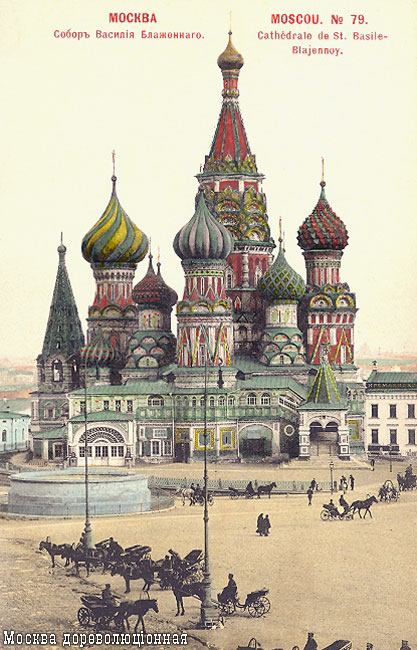
Preservationist societies monitored the state of the church and called for a proper restoration throughout the 1880s and 1890s, but it was regularly delayed for lack of funds. The church did not have a congregation of its own and could only rely on donations raised through public campaigning; In 1899 Nicholas II reluctantly admitted that this expense was necessary, to 1909; in total, preservationists managed to raise around 100,000 roubles.
Restoration began with replacing the roofing of the domes. Restorers agreed that the paintwork of the 19th century must be replaced with a "truthful recreation" of historic patterns, but these had to be reconstructed and deduced based on medieval miniatures. In the end, Solovyov and his advisers chose a combination of deep red with deep green that is retained to the present.
_(14572290017).jpg)
In 1908 the church received its first warm air heating system, which did not work well because of heat losses in long air ducts, heating only the eastern and northern sanctuaries. In 1913 it was complemented with a pumped water heating system serving the rest of the church.
1918–1941
During World War I, the church was headed by protoiereus Ioann Vostorgov, a nationalist preacher and a leader of the Black-Hundredist Union of the Russian People. Vostorgov was arrested by Bolsheviks in 1918 on a pretext of embezzling nationalized church properties and was executed in 1919. The church briefly enjoyed Vladimir Lenin's "personal interest"; in 1923 it became a public museum, though religious services continued until 1929.
Bolshevik planners entertained ideas of demolishing the church after Lenin's funeral (January 1924). In the first half of the 1930s, the church became an obstacle for Joseph Stalin's urbanist plans, carried out by Moscow party boss Lazar Kaganovich, "the moving spirit behind the reconstruction of the capital". The conflict between preservationists, notably Pyotr Baranovsky, and the administration continued at least until 1936 and spawned urban legends. In particular, a frequently-told story is that Kaganovich picked up a model of the church in the process of envisioning Red Square without it, and Stalin sharply responded "Lazar, put it back!" Similarly, Stalin's master planner, architect Vladimir Semyonov, reputedly dared to "grab Stalin's elbow when the leader picked up a model of the church to see how Red Square would look without it" and was replaced by pure functionary Sergey Chernyshov.
In the autumn of 1933, the church was struck from the heritage register. Baranovsky was summoned to perform a last-minute survey of the church slated for demolition, and was then arrested for his objections. While he served his term in the Gulag, attitudes changed and by 1937 even hard-line Bolshevik planners admitted that the church should be spared. In the spring of 1939, the church was locked, probably because demolition was again on the agenda; however, the 1941 publication of Dmitry Sukhov's detailed book on the survey of the church in 1939–1940 speaks against this assumption.
1947 to present
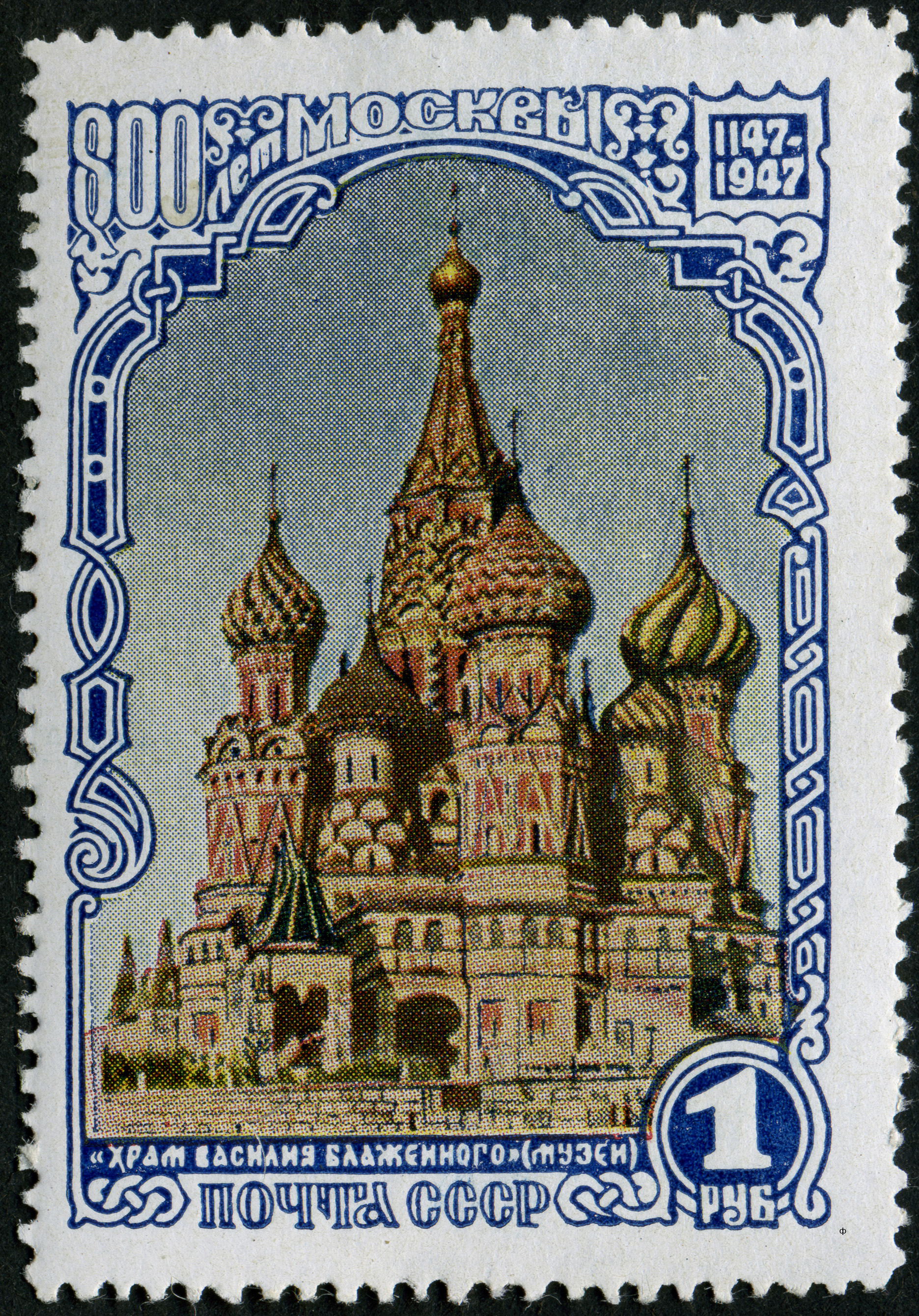
In the first years after World War II, renovators restored the historical ground-floor arcades and pillars that supported the first-floor platform, cleared up vaulted and caissoned ceilings in the galleries, and removed "unhistoric" 19th-century oil paint murals inside the churches.
The last round of renovation was completed in September 2008 with the opening of the restored sanctuary of St. Alexander Svirsky. The building is still partly in use today as a museum and, since 1991, is occasionally used for services by the Russian Orthodox Church. Since 1997, Orthodox Christian services have been held regularly. Nowadays, every Sunday at Saint Basil's church, there is a divine liturgy at 10a.m. with an Akathist to Saint Basil.
Architectural style
Because the church has no analog—in the preceding, contemporary, or later architecture of Muscovy and Byzantine cultural tradition, in general,—the sources that inspired Barma and Postnik are disputed. Eugène Viollet-le-Duc rejected European roots for the cathedral, opining that its corbel arches were Byzantine and ultimately Asian. A modern "Asian" hypothesis considers the cathedral a recreation of Qolşärif Mosque, which was destroyed by Russian troops after the Siege of Kazan.
Nineteenth-century Russian writers, starting with Ivan Zabelin, David Watkin also wrote of a blend of Russian and Byzantine roots, calling the cathedral "the climax" of Russian vernacular wooden architecture.
The church combines the staggered layered design of the earliest (1505–1508) part of the Ivan the Great Bell Tower, the central tent of the Church of Ascension in Kolomenskoye (1530s), and the cylindric shape of the Church of Beheading of John the Baptist in Dyakovo (1547); although mainstream history has not yet accepted his opinion. Andrey Batalov revised the year of completion of Dyakovo church from 1547 to the 1560s–70s, and noted that Trinity Church could have had no tangible predecessors at all.
Andrey Batalov wrote that judging by the number of novel elements introduced with Trinity Church, it was most likely built by German craftsmen.
The 1983 academic edition of Monuments of Architecture in Moscow takes the middle ground: the church is, most likely, a product of the complex interaction of distinct Russian traditions of wooden and stone architecture, with some elements borrowed from the works of Italians in Moscow. Specifically, the style of brickwork in the vaults is Italian.
Layout
Instead of following the original ad hoc layout (seven churches around the central core), Ivan's architects opted for a more symmetrical floor plan with eight side churches around the core, producing "a thoroughly coherent, logical plan" despite the erroneous latter "notion of a structure devoid of restraint or reason" The larger churches stand on massive foundations, while the smaller ones were each placed on a raised platform as if hovering above ground.
Although the side churches are arranged in perfect symmetry, the cathedral as a whole is not. The larger central church was deliberately offset to the west from the geometric centre of the side churches, to accommodate its larger apse on the eastern side. As a result of this subtle calculated asymmetry, viewing from the north and the south presents a complex multi-axial shape, while the western façade, facing the Kremlin, appears properly symmetrical and monolithic. The latter perception is reinforced by the fortress-style machicolation and corbeled cornice of the western Church of Entry into Jerusalem, mirroring the real fortifications of the Kremlin.
Inside the composite church is a labyrinth of narrow vaulted corridors and vertical cylinders of the churches. Today the cathedral consists of nine individual chapels. The largest, central one, the Church of the Intercession, is 46 m tall internally but has a floor area of only 64 m2. Nevertheless, it is wider and airier than the church in Kolomenskoye with its exceptionally thick walls. The corridors functioned as internal parvises; the western corridor, adorned with a unique flat caissoned ceiling, doubled as the narthex.
The detached belfry of the original Trinity Church stood southwest or south of the main structure. Late 16th- and early 17th-century plans depict a simple structure with three roof tents, most likely covered with sheet metal. August von Meyenberg's panorama (1661) presents a different building, with a cluster of small onion domes.
Structure

The foundations, as was traditional in medieval Moscow, were built of white stone, while the churches themselves were built of red brick (28 by), then a relatively new material Surveys of the structure show that the basement level is perfectly aligned, indicating use of professional drawing and measurement, but each subsequent level becomes less and less regular. Restorers who replaced parts of the brickwork in 1954–1955 discovered that the massive brick walls conceal an internal wooden frame running the entire height of the church.
The builders, fascinated by the flexibility of the new technology, used red bricks as a decorative medium both inside and out, leaving as much brickwork open as possible; when location required the use of stone walls, it was decorated with a brickwork pattern painted over stucco. Sculpture and sacred symbols employed by earlier Russian architecture are completely missing; floral ornaments are a later addition. Instead, the church boasts a diversity of three-dimensional architectural elements executed in brick.
Colour
The church acquired its present-day vivid colours in several stages from the 1680s The original colour scheme, missing these innovations, was far less challenging. It followed the depiction of the Heavenly City in the Book of Revelation:
| And he that sat was to look upon like a jasper and a sardine stone: and there was a rainbow round about the throne, in sight like unto an emerald. And round about the throne were four and twenty seats: and upon the seats, I saw four and twenty elders sitting, clothed in white raiment; and they had on their heads crowns of gold. | Revelation, 4:3–4 (KJV)

The 25 seats from the biblical reference are alluded to in the building's structure, with the addition of eight small onion domes around the central tent, four around the western side church and four elsewhere. This arrangement survived through most of the 17th century. The walls of the church mixed bare red brickwork or painted imitation of bricks with white ornaments, in roughly equal proportion. The domes, covered with tin, were uniformly gilded, creating an overall bright but fairly traditional combination of white, red and golden colours. Moderate use of green and blue ceramic inserts provided a touch of rainbow as prescribed by the Bible.
While historians agree on the colour of the 16th-century domes, their shape is disputed. Boris Eding wrote that they most likely were of the same onion shape as the present-day domes. However, both Kolomenskoye and Dyakovo churches have flattened hemispherical domes, and the same type could have been used by Barma and Postnik.
Naming
The building, originally known as "Trinity Church", "Trinity", according to tradition, refers to the easternmost sanctuary of the Holy Trinity, while the central sanctuary of the church is dedicated to the Intercession of Mary. Together with the westernmost sanctuary of the Entry into Jerusalem, these sanctuaries form the main east–west axis (Christ, Mary, Holy Trinity), while other sanctuaries are dedicated to individual saints.
| Compass point | Type | Dedicated to | Commemorates |
|---|---|---|---|
| Central core | Tented church | Intercession of Most Holy Theotokos | Beginning of the final assault of Kazan, 1 October 1552 |
| West | Column | Entry of Christ into Jerusalem | Triumph of the Muscovite troops |
| North-west | Groin vault | Saint Gregory the Illuminator of Armenia | Capture of Ars Tower of Kazan Kremlin, 30 September 1552 |
| North | Column | Saint Martyrs Cyprian and Justinia (since 1786 Saint Adrian and Natalia of Nicomedia) | Complete capture of Kazan Kremlin, 2 October 1552 |
| North-east | Groin vault | Three Patriarchs of Alexandria (since 1680 Saint John the Merciful) | Defeat of Yepancha's cavalry on 30 August 1552 |
| East | Column | Life-giving Holy Trinity | Historical Trinity Church on the same site |
| South-east | Groin vault | Saint Alexander Svirsky | Defeat of Yepancha's cavalry on 30 August 1552 |
| South | Column | The icon of Saint Nicholas from the Velikaya River (Nikola Velikoretsky) | The icon was brought to Moscow in 1555. |
| South-west | Groin vault | Saint Barlaam of Khutyn | May have been built to commemorate Vasili III of Russia |
| North-eastern annex (1588) | Groin vault | Basil the Blessed | Grave of venerated local saint |
| South-eastern annex (1672) | Groin vault | Laying the Veil (since 1680: Nativity of Theotokos, since 1916: Saint John the Blessed of Moscow) | Grave of venerated local saint |
The name "Intercession Church" came into use later, coexisting with Trinity Church. From the end of the 16th century to the end of the 17th century the cathedral was also popularly called Jerusalem, with reference to its church of Entry into Jerusalem as well as to its sacral role in religious rituals. Finally, the name of Vasily (Basil) the Blessed, who died during construction and was buried on-site, was attached to the church at the beginning of the 17th century.
Current Russian tradition accepts two coexisting names of the church: the official the latter name, being informal, is always mentioned second.
The common Western translations "Cathedral of Basil the Blessed" and "Saint Basil's Cathedral" incorrectly bestow the status of cathedral on the church of Basil, but are nevertheless widely used even in academic literature.
Sacral and social role
Miraculous find
On the day of its consecration the church itself became part of Orthodox thaumaturgy. According to the legend, its "missing" ninth church (more precisely a sanctuary) was "miraculously found" during a ceremony attended by Tsar Ivan IV, Metropolitan Makarius with the divine intervention of Saint Tikhon. Piskaryov's Chronist wrote in the second quarter of the 17th century:
| Piskaryov Chronicle, 1560 (7068 per Byzantine calendar)}}
Allegory of Jerusalem
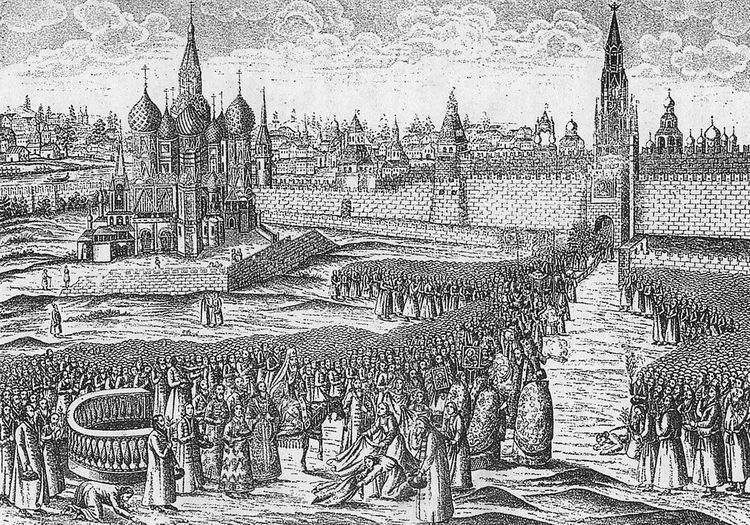
Construction of wrap-around ground-floor arcades in the 1680s visually united the nine churches of the original cathedral into a single building. At a distance, separate churches towering over their base resembled the towers and churches of a distant citadel rising above the defensive wall. The abstract allegory was reinforced by real-life religious rituals where the church played the role of the biblical Temple in Jerusalem:
| Peter Petreius| History of the Great Duchy of Moscow, 1620}}
| Legend of Peter's map of Moscow, 1597, as reproduced in the Bleau Atlas}}
The last donkey walk (хождение на осляти) took place in 1693. noted that all cross processions of the period began, as described by Petreius, from the Dormition Church, passed through St. Frol's (Saviour's) Gate and ended at Trinity Cathedral. For these processions the Kremlin itself became an open-air temple, properly oriented from its "narthex" (Cathedral Square) in the west, through the "royal doors" (Saviour's Gate), to the "sanctuary" (Trinity Cathedral) in the east.
Urban hub
Tradition calls the Kremlin the centre of Moscow, but the geometric centre of the Garden Ring, first established as the Skorodom defensive wall in the 1590s, lies outside the Kremlin wall, coincident with the cathedral. despite Alexander Chayanov's earlier suggestion that the system was not strictly concentric at all.
In the 1960s Gennady Mokeev (born 1932) formulated a different concept of the historical growth of Moscow. According to Mokeev, medieval Moscow, constrained by the natural boundaries of the Moskva and Neglinnaya Rivers, grew primarily in a north-easterly direction into the posad of Kitai-gorod and beyond. The main road connecting the Kremlin to Kitai-gorod passed through St. Frol's (Saviour's) Gate and immediately afterwards fanned out into at least two radial streets (present-day Ilyinka and Varvarka), forming the central market square. In the 14th century the city was largely contained within two balancing halves, Kremlin and Kitai-gorod, separated by a marketplace, but by the end of the century it extended further along the north-eastern axis. Two secondary hubs in the west and south spawned their own street networks, but their development lagged behind until the Time of Troubles.
Tsar Ivan's decision to build the church next to St. Frol's Gate established the dominance of the eastern hub with a major vertical accent, The cathedral was the main church of the posad, and at the same time it was perceived as a part of the Kremlin thrust into the posad, a personal messenger of the Tsar reaching the masses without the mediation of the boyars and clergy. It was complemented by the nearby Lobnoye mesto, a rostrum for the Tsar's public announcements first mentioned in chronicles in 1547
Replicas
A scale model of Saint Basil's Cathedral has been built in Jalainur in Inner Mongolia, near China's border with Russia. The building houses a science museum.{{citation|url=http://www.newyorker.com/culture/photo-booth/invisible-bridges-life-along-the-chinese-russian-border
Gallery
File:030524-StBasil'sCathedral-Moscow-IMG 9808-2.jpg|alt= File:030524-StBasil'sCathedral-Moscow-IMG 9813-2.jpg|alt= File:030524-StBasil'sCathedral-Moscow-IMG 9797-2.jpg|Monument to Minin and Pozharsky File:030524-Moscow-IMG 9807-2.jpg|alt= File:030524-Moscow-IMG 9858-2.jpg|alt= File:030524-Moscow-IMG 9844-2.jpg|alt= File:030530-Moscow-IMG 0902-2.jpg|alt=
References
Sources
- (second edition; first edition: 1991)
- (Original book written in 1615 and printed in Leipzig, in German language, in 1620; translated to Russian in 1847 by Mikhail Shemyakin).
References
- "Cathedral of the Protecting Veil of the Mother of God". www.SaintBasil.ru.
- (12 July 2011). "Cathedral of the Protection of Most Holy Theotokos on the Moat". Moscow Patriarchy.
- Brunov, p. 39
- A concise English history of the evolution of the church's names is provided in Shvidkovsky 2007 p. 126
- Brunov, p. 100
- Shvidkovsky 2007, p. 126
- Shvidkovsky 2007, p. 140
- "Итальянская Москва: Об архитектуре храма Василия Блаженного".
- "Kremlin and Red Square, Moscow (WHS card)". [[UNESCO]].
- "St. Basil's Cathedral". [[Dotdash]].
- "Московский Кремль: собор Покрова Пресвятой Богородицы на Рву (храм Василия Блаженного) / Организации / Патриархия.ru".
- One year later, Ivan ordered the construction of a new stone cathedral on the site of Trinity Church to commemorate his campaigns. Dedication of a church to a military victory was "a major innovation" for Muscovy. The placement of the church outside the Kremlin walls was a political statement in favour of [[posad]] commoners and against hereditary [[boyars]].Brunov, p. 41
- Kudryavtsev, p. 72
- (1978). "Piskaryov Chronicle, part 3". [[Full Collection of Russian Chronicles]].
- Shvidkovsky 2007, p. 139
- (1 June 2009). "List of federally protected landmarks". Ministry of Culture.
- or, alternatively, Ivan Yakovlevich Barma (Varfolomey). Legend held that Ivan blinded the architect so that he could not re-create the masterpiece elsewhere.Perrie, pp. 96–97
- Watkin, p. 103
- Olsen, Brad. "Sacred Places Europe: 108 Destinations". CCC publishing.
- RBTH, special to. (2016-07-12). "8 facts about Russia's best-known church – St. Basil's Cathedral".
- (2016-07-06). "Saint Basil's Cathedral, Moscow 2018 ✮ Church on Red Square". MOSCOVERY.COM.
- List of federally protected buildings, cited above, names Postnik Yakovlev and Ivan Shiryay the builders of the new [[Kazan Kremlin]], 1555–1568.
- The Gentleman's Magazine Volume 265
- Brumfield, p. 94
- The craft was lost in the [[Time of Troubles]]; buildings from the first half of the 17th century lack the refinement of the late 16th century, compensating for poor construction skill with thicker walls and heavier vaults.Buseva-Davudova, p. 29
- The nine churches themselves retained their appearance, but additions to the ground-floor arcade and the first-floor platform were so profound that Nikolay Brunov rebuilt a composite church from an "old" building and an independent work that incorporated the "new" Trinity Church.Brunov, supplementary volume, p. 121
- Komech, Pluzhnikov p. 403
- Schmidt, p. 146
- The moat, fed with waters of the [[Neglinnaya River]], was built in 1508–16 – Komech, Pluzhnikov p. 268
- Schenkov et al., p. 57
- The church was spared by the [[Fire of Moscow (1812)]] that razed [[Kitai-gorod]], and by the troops' failure to blow it up according to [[Napoleon]]'s order. The interiors were repaired in 1813 and the exterior in 1816. Instead of replacing missing ceramic tiles of the main tent, the Church preferred to simply cover it with a tin roof.Schenkov et al., p. 72
- Schmidt, p. 130
- Schmidt, p. 1,32
- Schmidt, p. 129
- Hastie's plan could have radically transformed the city, but he lost to the opposition, whose plans were finally endorsed by Alexander I in December 1817 (the specific decision on clearing the rubble around the church was issued in 1816).Schenkov et al., p. 70
- Red Square was opened to the river, and "St. Basil thus crowned the decapitated [[hillock]]."Schmidt, p. 149
- Schenkov et al., pp. 181–183
- Schenkov et al., p. 396
- national authorities in [[Saint Petersburg]] and local in Moscow prevented financing from state and municipal budgets.Schenkov et al., p. 359
- but again all the involved state and municipal offices, including the [[Holy Synod]], denied financing. Restoration, headed by Andrey Pavlinov (died 1898) and Sergey Solovyov, dragged on from 1896Schenkov et al., p. 318
- Schenkov et al., p. 361
- Solovyov removed the tin roofing of the main tent installed in the 1810s and found many original tiles missing and others discoloured; after a protracted debate the whole set of tiles on the tented roof was replaced with new ones. Another dubious decision allowed the use of standard bricks that were smaller than the original 16th-century ones.Schenkov et al., pp. 396–397
- Schenkov et al., p. 397
- Schenkov et al., p. 473
- Colton, p. 111
- Colton, p. 220
- Akinsha et al., p. 121
- Colton, p. 277
- Colton, p. 269
- "St. Basil's was returned to state list in the mid-1930s" – Colton, p. 269
- See, for instance, [[Arkady Mordvinov]]'s entry for the second phase of [[Narkomtiazhprom]] contest (1936), with the church in place.
- Colton, p. 837
- (1941). "Pokrovsky sobor (Покровский собор)". Soviet Academy of Architecture.
- (25 September 2008). "Pridel Hrama Vasilia Blazhennogo otkryvaetsa posle restavratsii (Придел Храма Василия Блаженного открывается после реставрации)". [[RIA Novosti]].
- https://www.efe.com/efe/english/life/small-russian-church-from-st-basil-complex-re-opens-after-renovations/50000263-3822413 Reopen for services
- and the Dyakovo church (centre)Artwork distorts perspective and placement of two churches. In real life, they are about 400 meters from each other and are separated by hills and a deep ravine.
- Cracraft, Rowland p. 95
- (29 June 2006). "Sobor Vasilia Blazhennogo – machete (Собор Василия Блаженного – зашифрованный образ погибшей мечети)". [[RIA Novosti]].
- Watkin, pp. 102–103
- Brunov, pp. 71, 73, 75
- Batalov, p. 16
- Shvidkovsky 2007, p. 7
- These two groups, according to Shvidkovsky, helped Moscow rulers in forging the [[doctrine]] of [[Third Rome]], which in turn promoted [[Cultural assimilation
- Shvidkovsky 2007, pp. 128–129
- Brunov, p. 62
- Brunov, p. 44
- Batalov and Shvidkovsky noted that during Ivan's reign, [[Germans]] and [[English people. Englishmen]] replaced Italians, although German influence peaked later during the reign of [[Mikhail I of Russia
- Komech, Pluzhnikov p. 401
- Komech, Pluzhnikov p. 399
- Brumfield, p. 95
- Shvidkovsky 2007, p. 128: "regular, not to say "rationalist" plan."
- influenced by the memory of Ivan's irrational atrocities. The central core and the four larger churches placed on the four major [[points of the compass|compass points]] are [[octagon]]al; the four [[diagonal]]ly placed smaller churches are [[cuboid]], although their shape is hardly visible through later additions.Brumfield, p. 96
- Brunov, p. 109
- Brunon, pp. 53, 55
- Brumfield, p. 100
- Brunov, p. 114
- Underwood, Alice E.M.. "Five Wild Facts about St. Basil's Cathedral".
- Komech, Pluzhnikov p. 400
- Brunov, p. 43
- No buildings of this type survive to date, although it was then common and used in all of the pass-through towers of Skorodom.Kudryavtsev, p. 104
- Komech, Pluzhnikov p. 389
- Brunov, p. 45
- Brunov, p. 47
- Komech, Pluzhnikov p. 49
- A major novelty introduced by the church was the use of strictly "architectural" means of exterior decoration.Shvidkovsky 2007, p. 129
- to 1848. Russian attitude towards colour in the 17th century changed in favour of bright colours; [[icon]]ographic and [[mural]] art experienced an explosive growth in the number of available paints, dyes and their combinations.Buseva-Davydova, p. 58
- Kudryavtsev, pp. 72, 74
- Kudryavtsev, p. 74
- Brunov, pp. 65, 67
- Brunov, p. 67
- sobor]]'' (similar to an [[Basilica#Ecclesiastical basilicas. ecclesiastical basilica]] in the [[Catholic Church]], but usually and incorrectly translated as "cathedral").A "sobor" in Orthodox tradition is any significant church that is prepared to and allowed by the Patriarch to host [[Divine Liturgy]] delivered by a [[bishop]] or a higher-level cleric. It is not necessarily ''the'' seat of a bishop; seat of the bishop, strictly correlating to Catholic [[cathedral]], is "kafedralny sobor".
- Brunov, p. 113
- Names (patron saints) of the sanctuaries start with the earliest known consecration, as in: Brunov, supplemental tables, pp. 6–10
- Shortly before his death Grand Prince Vasily, father of Ivan, accepted [[tonsure]] of a monk under the name of Varlaam. Connection between this event and the Church of St. Varlaam has not been confirmed by hard evidence.
- Ritchie, Leitch. (1836). "A Journey to St. Petersburg and Moscow". [[Longman]].
- Abbott, Capt. James. (1843). "Narrative of a Journey from Heraut to Khiva, Moscow, and St. Petersburgh". W.H. Allen and Co..
- . (20 January 1855). ["Sketches of Moscow"](https://archive.org/details/ballouspictorial0708ball/page/36/mode/2up). *[[Maturin Murray Ballou*.
- Sutherland, Edwards. (1861). "Russians At Home". W.H. Allen and Co..
- Gautier, Théophile. (1874). "A Winter in Russia". [[Henry Holt and Company]].
- von Reber, Franz. (1887). "History of Mediæval Art". [[Harper (publisher).
- Pelham-Clinton, Charles S.. (January–June 1896). "The City of the Tsars: A Visit to Moscow and the Kremlin". [[Ward, Lock & Co..
- (1978). "Piskaryov Chronicle, part 3". [[Full Collection of Russian Chronicles]].
- The style of [[Grand Prince of Moscow]], used by Petreius, has been in disuse for nearly seventy years, replaced by the style of [[Tsar]].
- {{lang. ru. Эта столица Москва разделяется на три части, первая из них называется Китай-город и обнесена толстой и крепкой стеной. В этой части города находится чрезвычайно красивой постройки церковь, крытая светлыми блестящими камнями и называемая Иерусалимом. К этой церкви ежегодно, в Вербное Воскресенье, великий князь должен водить осла, на котором из крепости едет патриарх, от церкви Девы Марии до церкви Иерусалима, стоящей перед крепостью. Тут же живут самые знатные княжеские, дворянские и купеческие семейства... – Petreius, pp. 159–160. Petreius visited Moscow in 1601–1605 and described the city as it existed before the [[Time of Troubles]].
- Komech, Pluzhnikov, graphic supplement.
- Bushkovitch, p. 181
- Kudryavtsev, p. 85
- Kudryavtsev, p. 11
- Pyotr Goldenberg (1902–71), who popularized this notion in 1947, still regarded the Kremlin as the starting seed of Moscow's radial-concentric system,For a graphic introduction of L. M. Tverskoy's concept of concentric Moscow (1950s), see Schmidt, p. 11 and related annotations.
- Mokeev, G. Ya.. (September 1969). "Moskva – pamyatnik drevnerusskogo gradostroitelstva (Москва – памятник древнерусского градостроительства)". [[Nauka i Zhizn]].
- Kudryavtsev, p. 14
- Brunov, p. 31
- Kudryavtsev, p. 15
- and inserted a pivot point between the nearly equal Kremlin and Kitai-gorod into the once amorphous marketplace.Brunov, p. 37
- Brunov, p. 49
- Conrad Bussow. (1961). "Chronicon Moscovitum ab a. 1584 AD ann. 1612".
This article was imported from Wikipedia and is available under the Creative Commons Attribution-ShareAlike 4.0 License. Content has been adapted to SurfDoc format. Original contributors can be found on the article history page.
Ask Mako anything about Saint Basil's Cathedral — get instant answers, deeper analysis, and related topics.
Research with MakoFree with your Surf account
Create a free account to save articles, ask Mako questions, and organize your research.
Sign up freeThis content may have been generated or modified by AI. CloudSurf Software LLC is not responsible for the accuracy, completeness, or reliability of AI-generated content. Always verify important information from primary sources.
Report