From Surf Wiki (app.surf) — the open knowledge base
Rubik's Clock
Rubik's puzzle
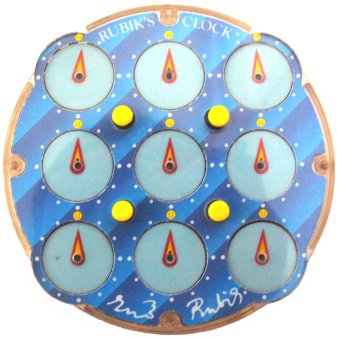
Rubik's puzzle
The Rubik's Clock is a mechanical puzzle invented and patented by Christopher C. Wiggs and Christopher J. Taylor. The Hungarian sculptor and professor of architecture Ernő Rubik bought the patent from them to market the product under his name. It was first marketed in 1988.
The Rubik's Clock is a two-sided puzzle, each side presenting nine clocks to the puzzler. There are four dials, one at each corner of the puzzle, each allowing the corresponding corner clock to be rotated directly. (The corner clocks, unlike the other clocks, rotate on both sides of the puzzle simultaneously and can never be operated independently. Thus, the puzzle contains only 14 independent clocks.)
There are also four pins which span both sides of the puzzle; each pin arranged such that if it is "in" on one side, it is "out" on the other. The state of each pin (in or out) determines whether the adjacent corner clock is mechanically connected to the three other adjacent clocks on the front side or on the back side: thus the configuration of the pins determines which sets of clocks can be turned simultaneously by rotating a suitable dial.
The aim of the puzzle is to set all nine clocks to 12 o'clock (straight up) on both sides of the puzzle simultaneously. A method to do so is to start by constructing a cross on both sides (at 12 o’clock) and then solving the corner clocks individually.
The Rubik's Clock is listed as one of the 17 WCA events, with records for fastest time to solve one puzzle, and the fastest average time to solve 5 puzzles (discarding the slowest and fastest times). Viable speedsolving methods have been devised that always solve it in 14 moves or less. An example is "7-Simul", which involves performing seven pairs of moves on the front and back of the clock simultaneously and requires mental calculation from the puzzle's initial position to determine some moves. God's number for Clock is 12.
Combinations
Since there are 14 independent clocks, with 12 settings each, there are a total of 12^{14}=1,283,918,464,548,864 possible combinations for the clock faces. This does not count for the number of pin positions.
Including pin positions, the total combinations is 1214*16 =20,542,695,432,781,824 (approximately 20.5 quadrillion) combinations.
Notation
The puzzle is oriented with 12 o'clock on top, and either side in front. The following moves can be made:
Pin movements
- UR (top-right): Move the top-right pin up.
- DR (bottom-right): Move the bottom-right pin up.
- DL (bottom-left): Move the bottom-left pin up.
- UL (top-left): Move the top-left pin up.
- U (both top): Move both top pins up.
- R (both right): Move both right pins up.
- D (both bottom): Move both bottom pins up.
- L (both left): Move both left pins up.
- ALL (all): Move all pins up.
Wheel movements
- X+ (X clockwise turns): Turn a dial next to an up-position pin clockwise X times, then move all pins down.
- X− (X counter-clockwise turns): Turn a dial next to an up-position pin counter-clockwise X times, then move all pins down.
Puzzle rotation
- y2: Flip the puzzle, then move all pins down.
Records
The world record for single solve is held by Lachlan Gibson of New Zealand with a time of 1.53 seconds, set at Hasty Hastings 2025 in Hastings, New Zealand.
The world record for Olympic average of five solves is held by Brendyn Dunagan of The United States with an average of 2.24 seconds, set at Temecula Valley Winter 2025 in Murrieta, California with times of 2.02, (3.27), (1.93), 2.27, and 2.43 seconds.
Top 10 solvers by single solve
| Rank | Name | Result | Competition |
|---|---|---|---|
| 1 | NZL Lachlan Gibson | 1.53s | NZL Hasty Hastings 2025 |
| 2 | USA Brendyn Dunagan | 1.60s | USA Agoura Winter 2026 |
| 3 | AUS Kyle Jones | 1.61s | AUS Melbourne Summer 2026 |
| 4 | USA Volodymyr Kapustianskyi | 1.64s | USA Moorhead Madness 2025 |
| 5 | USA Alessandro Diomampo | 1.85s | USA Agoura Winter 2026 |
| 6 | RUS Anatolii Turenko | 1.87s | CZE Back to Kostelec 2025 |
| 7 | POL Eryk Kasperek | 1.90s | POL Polish Championship 2025 |
| 8 | PHI Karl Abarquez | 1.91s | PHI Makati Heroes Speedcubing 2025 |
| 10 | NDL Mick Boekema | 2.00s | NDL Lente in Lent 2025 |
| GBR Caleb Wolf Dunn | GBR Wiltshire Winter 2025 |
Top 10 solvers by [[Olympic average]] of 5 solves
| Rank | Name | Result | Competition | Times |
|---|---|---|---|---|
| 1 | USA Brendyn Dunagan | 2.24s | USA Temecula Valley Winter 2025 | 2.02, (3.27), (1.93), 2.27, 2.43 |
| 2 | NZL Lachlan Gibson | 2.26s | NZL 2x2 in Tāmaki Makaurau 2025 | 2.27, (1.82), (3.01), 2.26, 2.24 |
| 3 | USA Volodymyr Kapustianskyi | 2.31s | USA Moorhead Madness 2025 | 2.35, 2.40, 2.18, (3.71), (1.64) |
| 4 | AUS Kyle Jones | 2.41s | AUS Melbourne Summer 2026 | 2.65, (3.70), 2.30, (1.61), 2.32 |
| 5 | POL Eryk Kasperek | 2.52s | POL Cube4fun Lublin on WEII 2024 | 2.44, (3.36), 2.59, (2.40), 2.52 |
| 6 | PHI Karl Abarquez | 2.58s | PHI Rizal Raise a Silence 2025 | 2.48, (2.35), 2.57, 2.68, (2.85) |
| 7 | USA Alessandro Diomampo | 2.65s | USA Benicia Open 2025 | 2.35, (3.09), 2.55, (2.24), 3.06 |
| 8 | USA Ivan ThanhDanh Duong | 2.66s | USA Minnesota Championship 2025 | (2.54), 2.56, 2.66, 2.77, (5.19) |
| 9 | UK Caleb Wolf Dunn | 2.68s | USA Rubik's WCA World Championship 2025 | (4.44), 2.71, 2.70, (2.56), 2.63 |
| 10 | USA Fiona Bao | 2.73s | USA Ephrata Fall 2025 | 2.70, 2.88, 2.61, (2.36), 2.93 |
Top 10 single solves
| Rank | Name | Result | Competition |
|---|---|---|---|
| 1 | NZL Lachlan Gibson | 1.53s | NZL Hasty Hastings 2025 |
| 2 | USA Brendyn Dunagan | 1.60s | USA Agoura Winter 2026 |
| 3 | AUS Kyle Jones | 1.61s | AUS Melbourne Summer 2026 |
| 4 | USA Volodymyr Kapustianskyi | 1.64s | USA Moorhead Madness 2025 |
| 5 | USA Brendyn Dunagan | 1.70s | USA Georgia Championship 2026 |
| 6 | NZL Lachlan Gibson | 1.74s | NZL New Zealand Cubing Decathlon 2025 |
| 7 | USA Brendyn Dunagan | 1.77s | USA Agoura Winter 2026 |
| 8 | NZL Lachlan Gibson | 1.82s | NZL 2x2 in Tāmaki Makaurau 2025 |
| NZL Puzzling Papatoetoe 2025 | |||
| 10 | USA Brendyn Dunagan | 1.84s | USA Mission Viejo Fall 2025 |
Top 10 [[Olympic average|Olympic averages]] of 5 solves
| Rank | Name | Result | Competition | Times |
|---|---|---|---|---|
| 1 | USA Brendyn Dunagan | 2.24s | USA Temecula Valley Winter 2025 | 2.02, (3.27), (1.93), 2.27, 2.43 |
| 2 | NZL Lachlan Gibson | 2.26s | NZL 2x2 in Tāmaki Makaurau 2025 | 2.27, (1.82), (3.01), 2.26, 2.24 |
| 3 | USA Brendyn Dunagan | 2.27s | USA Agoura Winter 2026 | 2.07, 1.97, (1.60), (DNF), 2.77 |
| 4 | NZL Lachlan Gibson | 2.28s | NZL Puzzling Papatoetoe 2025 | (2.20), 2.22, 2.26, 2.36, (2.65) |
| 5 | 2.29s | NZL Milford Winter Warm Up 2025 | (4.34), 2.57, 2.08, (1.87), 2.21 | |
| 6 | 2.30s | NZL New Zealand Cubing Decathlon 2025 | 1.98, 2.16, 2.77, (2.93), (1.74) | |
| 7 | USA Volodymyr Kapustianskyi | 2.31s | USA Moorhead Madness 2025 | 2.35, 2.40, 2.18, (3.71), (1.64) |
| 8 | NZL Lachlan Gibson | 2.36s | NZL New Zealand Cubing Decathlon 2025 | 2.38, 2.04, (4.31), (1.98), 2.67 |
| 9 | 2.38s | NZL Auckland Autumn 2025 | 2.14, (6.07), 2.57, 2.43, (2.10) | |
| 10 | UKR Volodymyr Kapustianskyi | 2.39s | USA Grand Forks 2024 | (2.96), 2.46, (2.24), 2.29, 2.43 |
| USA Volodymyr Kapustianskyi | USA South Dakota Playhouse 2025 | 2.32, 2.34, (1.91), (3.76), 2.51 |
Non-human solving
On Nov 21, 2024, a robot developed by Erez Borenshtein achieved a Guinness World Record by solving a Rubik's Clock in 0.443 seconds. This accomplishment was officially recognized by Guinness World Record as the fastest time for a robot to solve a Rubik's Clock. The record is documented on the Guinness World Records website.
References
References
- Patents [http://v3.espacenet.com/origdoc?DB=EPODOC&IDX=EP0322085&F=0&QPN=EP0322085 EP0322085] (1989-06-28), [http://v3.espacenet.com/origdoc?DB=EPODOC&IDX=JP1171588&F=0&QPN=JP1171588 JP1171588] (1989-07-06), [http://v3.espacenet.com/origdoc?DB=EPODOC&IDX=GB2213739&F=0&QPN=GB2213739 GB2213739] (1989-08-23), [http://v3.espacenet.com/origdoc?DB=EPODOC&IDX=US4869506&F=0&QPN=US4869506 US4869506] (1989-09-26)
- (March 4, 2025). "Rubik's Clock has now been solved!".
- (February 1, 2023). "WCA Regulations {{!}} World Cube Association".
- [[World Cube Association]] [https://www.worldcubeassociation.org/results/records - Records]
- [[World Cube Association]] [https://www.worldcubeassociation.org/results/rankings/clock/single Official Clock Rankings - Single]
- [[World Cube Association]] [https://www.worldcubeassociation.org/results/rankings/clock/average Official Clock Rankings - Average]
- [[World Cube Association]] [https://www.worldcubeassociation.org/results/rankings/clock/single?show=100+results Official Clock Rankings - Single]
- [[World Cube Association]] [https://www.worldcubeassociation.org/results/rankings/clock/average?show=100+results Official Clock Rankings - Single]
This article was imported from Wikipedia and is available under the Creative Commons Attribution-ShareAlike 4.0 License. Content has been adapted to SurfDoc format. Original contributors can be found on the article history page.
Ask Mako anything about Rubik's Clock — get instant answers, deeper analysis, and related topics.
Research with MakoFree with your Surf account
Create a free account to save articles, ask Mako questions, and organize your research.
Sign up freeThis content may have been generated or modified by AI. CloudSurf Software LLC is not responsible for the accuracy, completeness, or reliability of AI-generated content. Always verify important information from primary sources.
Report