From Surf Wiki (app.surf) — the open knowledge base
Révay family
- Kingdom of Croatia
- Turóc County
- Baron and Count Révay de Szklabina et Blatnicza The Révay family was a Hungarian noble lineage that held extensive estates in Turóc County of the Kingdom of Hungary (present-day Turiec region in Slovakia) until the early 20th century.
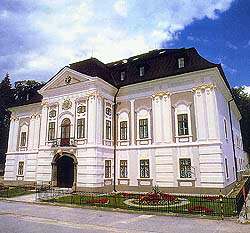
Their holdings included, among others, the Rococo-Classical manor house in Mošovce, the so-called Old Manor House (demolished in the mid-20th century), the Noblemen’s Mansion and park in Mošovce, a castle in Blatnica, estates and a castle in Sklabiňa, as well as a manor house with a park in Turčianska Štiavnička.
Family history
The Révay family has been known since the 13th century. The first known ancestor of the family was called Comes Jakab (Count Jakab) in the early 13th century. The main estates of the family were situated in the region of Syrmia until the Ottoman occupation of southern Hungary. In 1556 and 1635 the family was promoted to Barons and on 17 June 1723 to Counts. The coat of arms of the Masters de Reva, which can be seen at the façade of their manor house, is composed of a wolf Tenné growing from a crown of Or, holding three roses. Mošovce became the property of the Révay family in 1534, six years after the donation of the King of Hungary, Ferdinand I, Holy Roman Emperor. The last member of the family, who resided in Mošovce, was count Ferenc Révay. Today the descendants of the family live in Trnava, Bratislava, Graz as well as in Hungary. The last letter of the name is sometimes "i" instead of "y" in some printed versions or as an affair of modernization in the late 19th century Kingdom of Hungary.
After World War II, the property of the Révay family in Turiec was nationalized. In 1993, the niece of Ladislav Révay, the last of the counts, filed a request for the restitution of their property. The request ended up in court as the Révay family and the state had differing opinions as to the extent of their claim. In 2001 the restitution claim of the Révays was rejected by the Constitutional Court of the Slovak Republic. 5 years later, however, the European Court of Human Rights in Strasbourg issued a ruling allowing the matter to proceed, thus opening a possibility for a reconciliation of both parties. This resulted in a financial compensation of the state for the husband and of Ladislav Révay's niece (who died in 1995) in the amount of SKK 150 million (just under 5 million EUR).{{cite web |url=http://www.sme.sk/c/4088574/stat-odskodni-slachticov.html |title=Štát odškodní šľachticov |access-date=2008-09-23 |date=2008-09-23 |author=Monika Tódová
In Sweden, the family is considered part of the unintroduced nobility.
Gallery
Image:František Révay.jpg|Count Ferenc Révay, the last member of the Révay family, who lived in Mošovce. Picture approx. from 1910. Image:Baronov hrob.jpg|The grave of Count Ferenc Révay in the woods of Mošovce Image:Révay - CoA.jpg|Coat of arms of the Révay (left) and Szunyogh families Image:Révay-Gate.jpg|Initials of Count Ferenc Révay in the gate of the manor-house in Mošovce
References
References
- Hamish M, Scott. (1995). "The European Nobilities in the Seventeenth and Eighteenth Centuries: Northern, Central and Eastern Europe". Longman.
- "Révay - Lexikon ::".
This article was imported from Wikipedia and is available under the Creative Commons Attribution-ShareAlike 4.0 License. Content has been adapted to SurfDoc format. Original contributors can be found on the article history page.
Ask Mako anything about Révay family — get instant answers, deeper analysis, and related topics.
Research with MakoFree with your Surf account
Create a free account to save articles, ask Mako questions, and organize your research.
Sign up freeThis content may have been generated or modified by AI. CloudSurf Software LLC is not responsible for the accuracy, completeness, or reliability of AI-generated content. Always verify important information from primary sources.
Report