From Surf Wiki (app.surf) — the open knowledge base
Rába (company)
Truck and automotive component manufacturer

Truck and automotive component manufacturer
| Field | Value |
|---|---|
| name | RÁBA Automotive Group |
| type | Public |
| traded_as | |
| *BUX Component* | |
| foundation | 1896 |
| location | Győr, Hungary |
| key_people | István Pintér (CEO&Chairman ) |
| industry | Automotive industry |
| products | Military trucks, trucks, rail cars, trains, bridges steel structure |
| revenue | HUF 47.9 billion |
| operating_income | HUF 1.9 billion |
| num_employees | 1,990 |
| homepage |
BUX Component
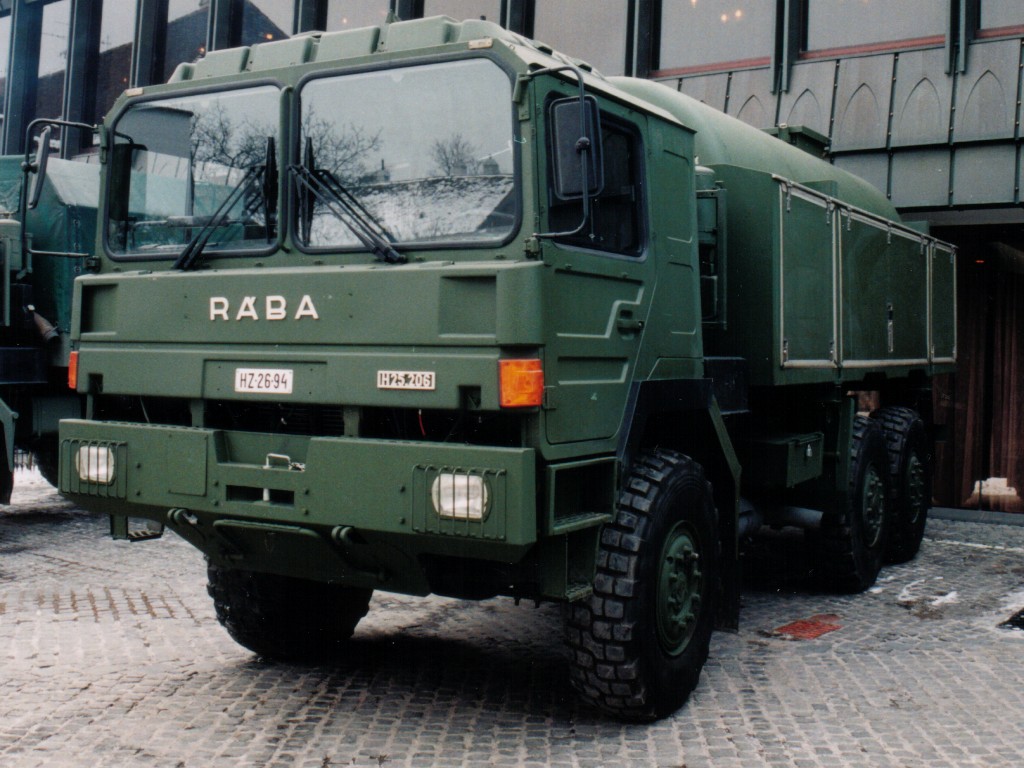
The RÁBA Automotive Group (), commonly known as Rába, is a Hungarian public limited company, listed on the Budapest Stock Exchange. Rába engineers, manufactures and customizes automotive components, specialty vehicles and axles for commercial vehicles, agri-machinery and earth-movers. The Rába has been building axles as well as complete vehicles since 1902. The company has three strategic business units. The company is headquartered in Győr, employing more than 2000 people.
History
The company was founded by local investor groups in Győr in 1896.
In 1899, the Rába had started to export to foreign countries: it supplied railway passenger carriages to Egypt, the East Indies, Southern Africa, city tramcars to Amsterdam and Antwerp. The carriages of the London underground railway were constructed and manufactured in the Rába company. The London Underground Railway ordered 30 multiple-unit trains, 66 passenger cars for multiple-unit trains and bogies. In 1904, the production of the first petrol engine powered trucks started. In 1914, the company started to produce its first passenger automobiles: The RÁBA Alpha. The steward's office ordered a special RÁBA Grand for the personal use of Emperor Charles I of Austria.
Rába's trucks originally used cabins supplied by West German MAN, but from 1980 on DAF's F241 cabin was used. A few Roman cabs (of MAN origins) were also supplied from Romania in return for engines. Rába's engine mainstay was itself of MAN origins, with the old D21 inline-six diesel massaged up to 300 PS with the help of turbocharging and intercooling.
In the 1980s, Rába built no more than about 2,000 trucks per year, although it was Hungary's third biggest employer. Being an important provider to Hungarocamion, a publicly operated international trucking firm, helped raise their international profile. In 1985, Rába's business mostly consisted of engine and axle manufacturing, with only 15% of turnover being represented by trucks. Of these trucks, however, nearly 90 per cent were exported, with most going to Yugoslavia. In 1986, Rába introduced a more powerful, 370 PS diesel engine (D11TLL) in order to help their trucks compete internationally and to meet Hungarocamion's needs. The new engine range was loosely based on the earlier MAN units, but were now of 11.05 litres, and were developed together with the Linz Institute of Graz, Austria.
Models
- Rába U26
References
References
- (16 April 2015). "Rába közgyűlés: stabil eredményeket hozott a 2014-es év". Rába Nyrt..
- "Our Profile". raba.hu.
- "the History of Rába".
- Bennett, George. (December 1986). "Eastern Block". FF Publishing Ltd.
- [[#truck1286. Bennett (''Eastern Block'')]], p. 58
This article was imported from Wikipedia and is available under the Creative Commons Attribution-ShareAlike 4.0 License. Content has been adapted to SurfDoc format. Original contributors can be found on the article history page.
Ask Mako anything about Rába (company) — get instant answers, deeper analysis, and related topics.
Research with MakoFree with your Surf account
Create a free account to save articles, ask Mako questions, and organize your research.
Sign up freeThis content may have been generated or modified by AI. CloudSurf Software LLC is not responsible for the accuracy, completeness, or reliability of AI-generated content. Always verify important information from primary sources.
Report