From Surf Wiki (app.surf) — the open knowledge base
Prüfer group
Mathematical term in group theory
Mathematical term in group theory
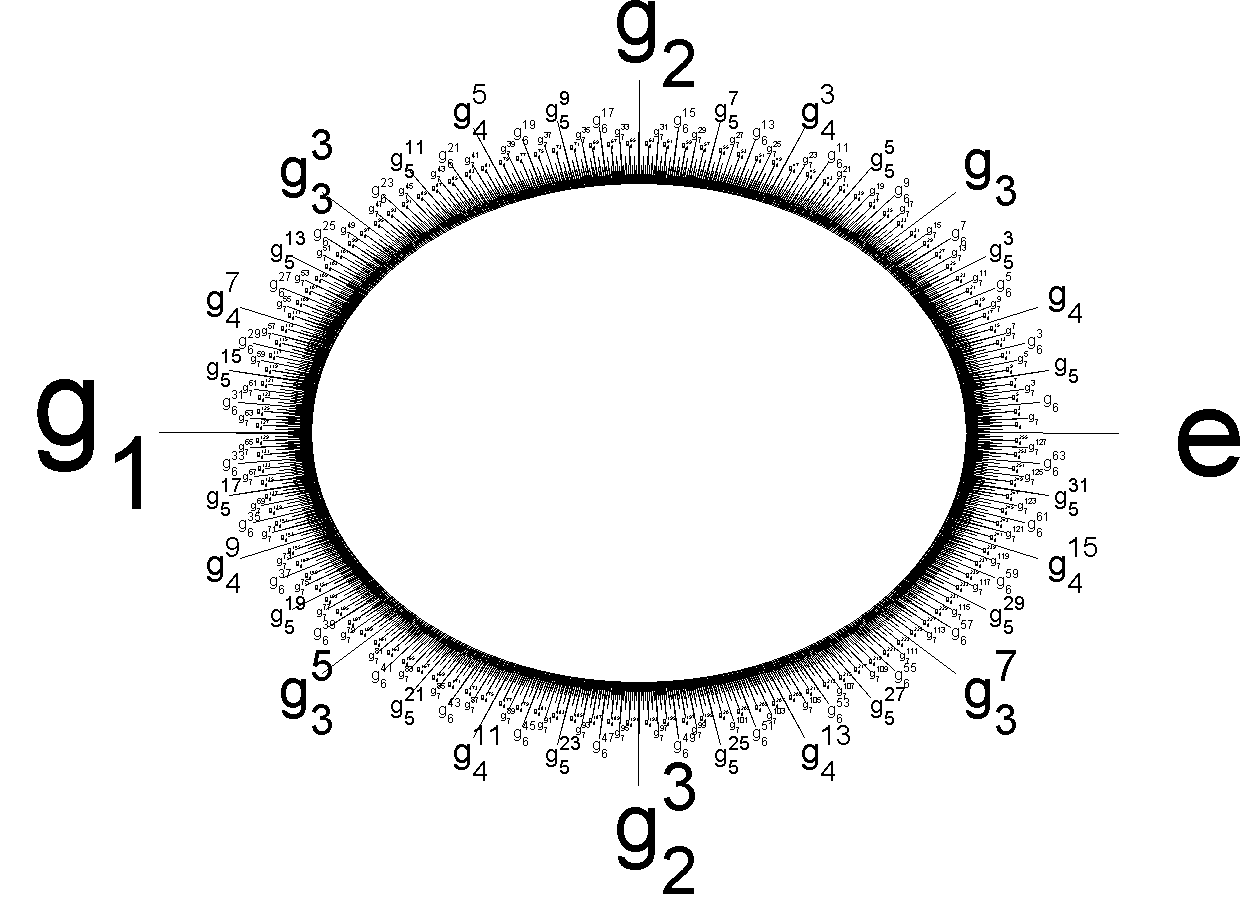
In mathematics, specifically in group theory, the Prüfer p-group or the p-quasicyclic group or p^\infty-group, \mathbb Z(p^\infty), for a prime number p is the unique p-group in which every element has p different p-th roots.
The Prüfer p-groups are countable abelian groups that are important in the classification of infinite abelian groups: they (along with the group of rational numbers) form the smallest building blocks of all divisible groups.
The groups are named after Heinz Prüfer, a German mathematician of the early 20th century.
Constructions
The Prüfer p-group may be identified with the subgroup of the circle group, \operatorname{U}(1), consisting of all p**n-th roots of unity as n ranges over all non-negative integers: :\mathbb{Z}(p^\infty)={\exp(2\pi i m/p^n) \mid 0 \leq m The group operation here is the multiplication of complex numbers.
There is a presentation :\mathbb{Z}(p^\infty) = \langle, g_1, g_2, g_3, \ldots \mid g_1^p = 1, g_2^p = g_1, g_3^p = g_2, \dots,\rangle. Here, the group operation in \mathbb{Z}(p^\infty) is written as multiplication.
Alternatively and equivalently, the Prüfer p-group may be defined as the Sylow p-subgroup of the quotient group \mathbb{Q}/\mathbb{Z}, consisting of those elements whose order is a power of p: :\mathbb{Z}(p^\infty) = \mathbb{Z}[1/p]/\mathbb{Z} (where \mathbb{Z}[1/p] denotes the group of all rational numbers whose denominator is a power of p, using addition of rational numbers as group operation).
For each natural number n, consider the quotient group \mathbb{Z}/p^n \mathbb{Z} and the embedding \mathbb{Z}/p^n \mathbb{Z}\to\mathbb{Z}/p^{n+1} \mathbb{Z} induced by multiplication by p. The direct limit of this system is \mathbb{Z}(p^\infty): :\mathbb{Z}(p^\infty) = \varinjlim \mathbb{Z}/p^n \mathbb{Z} .
If we perform the direct limit in the category of topological groups, then we need to impose a topology on each of the \mathbb{Z}/p^n \mathbb{Z}, and take the final topology on \mathbb{Z}(p^\infty). If we wish for \mathbb{Z}(p^\infty) to be Hausdorff, we must impose the discrete topology on each of the \mathbb{Z}/p^n \mathbb{Z}, resulting in \mathbb{Z}(p^\infty) to have the discrete topology.
We can also write :\mathbb{Z}(p^\infty)=\mathbb{Q}_p/\mathbb{Z}_p where \mathbb{Q}_p denotes the additive group of p-adic numbers and \mathbb{Z}_p is the subgroup of p-adic integers.
Properties
The complete list of subgroups of the Prüfer p-group \mathbb{Z}(p^\infty) is: :0 \subsetneq \left({1 \over p}\mathbb{Z}\right)/\mathbb{Z} \subsetneq \left({1 \over p^2}\mathbb{Z}\right)/\mathbb{Z} \subsetneq \left({1 \over p^3}\mathbb{Z}\right)/\mathbb{Z} \subsetneq \cdots \subsetneq \mathbb{Z}(p^\infty) Here, each \left({1 \over p^n}\mathbb{Z}\right)/\mathbb{Z} is a cyclic subgroup of \mathbb{Z}(p^\infty) with p**n elements; it contains precisely those elements of \mathbb{Z}(p^\infty) whose order divides p**n and corresponds to the set of pn-th roots of unity.
The Prüfer p-groups are the only infinite groups whose subgroups are totally ordered by inclusion. This sequence of inclusions expresses the Prüfer p-group as the direct limit of its finite subgroups. As there is no maximal subgroup of a Prüfer p-group, it is its own Frattini subgroup.
Given this list of subgroups, it is clear that the Prüfer p-groups are indecomposable (cannot be written as a direct sum of proper subgroups). More is true: the Prüfer p-groups are subdirectly irreducible. An abelian group is subdirectly irreducible if and only if it is isomorphic to a finite cyclic p-group or to a Prüfer group.
The Prüfer p-group is the unique infinite p-group that is locally cyclic (every finite set of elements generates a cyclic group). As seen above, all proper subgroups of \mathbb{Z}(p^\infty) are finite. The Prüfer p-groups are the only infinite abelian groups with this property.
The Prüfer p-groups are divisible. They play an important role in the classification of divisible groups; along with the rational numbers they are the simplest divisible groups. More precisely: an abelian group is divisible if and only if it is the direct sum of a (possibly infinite) number of copies of \mathbb{Q} and (possibly infinite) numbers of copies of \mathbb{Z}(p^\infty) for every prime p. The (cardinal) numbers of copies of \mathbb{Q} and \mathbb{Z}(p^\infty) that are used in this direct sum determine the divisible group up to isomorphism.
As an abelian group (that is, as a Z-module), \mathbb{Z}(p^\infty) is Artinian but not Noetherian. It can thus be used as a counterexample against the idea that every Artinian module is Noetherian (whereas every Artinian ring is Noetherian).
The endomorphism ring of \mathbb{Z}(p^\infty) is isomorphic to the ring of p-adic integers \mathbb{Z}_p.
In the theory of locally compact topological groups the Prüfer p-group (endowed with the discrete topology) is the Pontryagin dual of the compact group of p-adic integers, and the group of p-adic integers is the Pontryagin dual of the Prüfer p-group.
Notes
References
References
- See Vil'yams (2001)
- See Kaplansky (1965)
- See also Jacobson (2009), p. 102, ex. 2.
- See Vil'yams (2001)
- D. L. Armacost and W. L. Armacost,"[http://projecteuclid.org/euclid.pjm/1102968274 On ''p''-thetic groups]", ''Pacific J. Math.'', '''41''', no. 2 (1972), 295–301
This article was imported from Wikipedia and is available under the Creative Commons Attribution-ShareAlike 4.0 License. Content has been adapted to SurfDoc format. Original contributors can be found on the article history page.
Ask Mako anything about Prüfer group — get instant answers, deeper analysis, and related topics.
Research with MakoFree with your Surf account
Create a free account to save articles, ask Mako questions, and organize your research.
Sign up freeThis content may have been generated or modified by AI. CloudSurf Software LLC is not responsible for the accuracy, completeness, or reliability of AI-generated content. Always verify important information from primary sources.
Report