From Surf Wiki (app.surf) — the open knowledge base
Presidency of Raúl Leoni
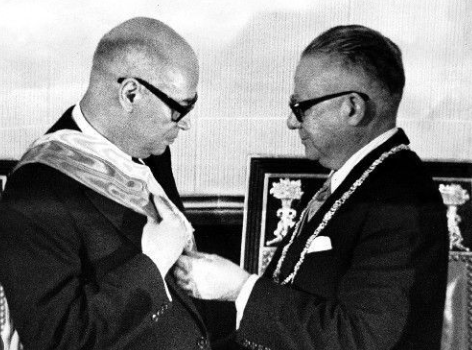
Raúl Leoni served as President of Venezuela from March 13, 1964 to March 11, 1969.
Background
In the elections of 1963 the Democratic Action (AD) candidate Raúl Leoni, a long-time ally of Rómulo Betancourt (President from 1959 to 1964) from the times of dictator Juan Vicente Gómez, won handily. Rafael Caldera of COPEI came second. The Wolfgang Larrazábal political phenomenon was eclipsed and Jóvito Villalba on his own came just behind Caldera. AD was still the pardo party by excellence, but Caracas was definitely lost.
Cabinet
| Ministries |
|---|
| OFFICE |
| President |
| Home Affairs |
| Reinaldo Leandro Mora |
| Outer Relations |
| Finance |
| Eddy Morales Crespo |
| Benito Raúl Losada |
| Francisco Mendoza |
| Defense |
| Development |
| Aura Celina Casanova |
| Public Works |
| Education |
| Labor |
| Hens Silva Torres |
| Simón Antoni Paván |
| Raúl Valera |
| Communications |
| J. J. González Gorrondona |
| Héctor Santaella |
| Juan Manuel Domínguez Chacín |
| Lorenzo Azpúrua Marturet |
| Agriculture |
| Juan José Palacios |
| Pedro Segnini La Cruz |
| Alejandro Osorio |
| Health and Social Assistance |
| Domingo Guzmán Lander |
| Alfonso Araujo Belloso |
| Armando Soto Rivera |
| Justice |
| José S. Núñez Aristimuño |
| Mines and Hydrocarbons |
| José Antonio Mayobre |
| Secretary of Presidency |
Presidency
Judicial policy
The Law on Commutation of Sentences by Pardon or Banishment from National Territory (Ley de conmutación de penas por indulto o extrañamiento del territorio nacional) was enacted in Venezuela, decreed on 15 December 1964 by President Raúl Leoni and published in the Official Gazette No. 27,619.
On 7 August 1968, the government ordered the release of 67 political prisoners and the exile of Simón Sáez Mérida.
Economy
.jpg)
The administration implemented significant fiscal reforms, including a reduction in public spending coupled with an increase in the nation's international reserves. In 1967, his government enacted a comprehensive reform through a new Income Tax Law.
Energy
During this period, Venezuela broke its annual oil export record, reaching an average of 3.6 million barrels per day by 1968.
Education
During Raúl Leoni's presidency, two police raids were conducted at the Central University of Venezuela (UCV): the first on 15 May 1964 and the second on 14 December 1966.
Agriculture
During Leoni’s presidency, rice production increased by 107%, while corn production rose by 39.5%. By the end of his term, nearly 85% of the nation's food consumption was domestically sourced.
Infrastructure
Raúl Leoni's presidency saw the construction of the Guri Dam, a power station with a combined installed capacity of 1750 megawatts (MW) that created a reservoir which is the largest fresh water body of water in Venezuela and one of the largest man-made blackwater lakes ever created.
Environment
In 1967, the Caño Mánamo (a distributary of the Orinoco River) was closed as part of an infrastructure project by the Venezuelan Corporation of Guayana (CVG). According to Monsonyi and Jackson (1990), this led to the "complete ecological destruction of the western Delta: water stagnation and salinization, the decline of local flora and fauna, the disintegration of numerous agricultural communities (both Creole and Indigenous)", and the "death by hunger, thirst, and disease of thousands (possibly around 3,000) Warao Indigenous people".
Human Rights
During the counterinsurgency campaign against guerrilla movements, numerous arrests were made of insurgents, civilians, and politicians accused of collaboration. Reports emerged of procedural delays and modifications to the Penal Code to increase penalties for sedition-related crimes. Several media outlets faced censorship, including the newspapers El Clarín and La Extra, the magazine Venezuela Gráfica, and outlets linked to the Cadena Capriles.
Enforced disappearances
According to Revista SIC, Venezuela experienced "the highest number of enforced disappearances by police or military forces in the continent during the 1960s."
Under Raúl Leoni's presidency, the parliamentary group Vanguardia Popular Nacionalista (VPN), including deputies José Vicente Rangel, Luis Miquilena and José Herrera Oropeza, denounced extrajudicial executions and clandestine detention centers where detainees were allegedly tortured, killed, and their remains concealed.
A prominent case was that of , general secretary of the Communist Party (PCV), who was abducted in public in 1965 and his weighted body dumped at sea, though it later washed ashore near Lechería. Following these revelations, Congress formed an investigative commission, and the Attorney General launched an inquiry. The congressional investigations also examined the disappearances of sociologist Víctor Soto Rojas (allegedly thrown from a helicopter in El Bachiller, Miranda state) and Humberto Barrios*.*
On 29 August 1965, the General Amnesty Council, comprising trade unions and professional associations, met at Caracas' Casa del Periodista and published a report condemning state-sponsored human rights violations, including documented disappearances.
Foreign policy
Leoni maintained the foreign policy framework established by Rómulo Betancourt, known as the Betancourt Doctrine. In 1966, Venezuela joined the Latin American Free Trade Association (ALALC) and later that year, Leoni signed the Cartagena Agreement in Bogotá (a precursor to the Andean Community), a trade bloc comprising Venezuela, Chile, Colombia, Peru, and Ecuador.
Opposition
Guerrillas
Leoni's government was unexceptional, but it was Leoni who had to liquidate the remnants of the communist insurrection, for which he put the army in charge of the country with carte blanche to be as ruthless as it had to. But in fact it was the communist guerrilleros themselves who brought about their own liquidation. They had no rural support whatsoever. Unlike guerrillas all over the world, they did not control villages and lived from hand to mouth. They knew they were no match for the army and avoided confrontations. Castro had been hoping that Venezuela would be the second act of the Latin American revolution, and he tried to supply the Venezuelan guerrillas. This was in keeping with the theory of what could be called the "permanent agrarian revolution", which the French intellectual Régis Debray had expressed in the widely circulated book Revolution Inside the Revolution and Ernesto "Che" Guevara had been trying to carry out first in Africa and later, fatally for him, in Bolivia. Castro sent a trusted officer, Manuel Ochoa, to assess the Venezuelan guerrillas, and the report that he brought was negative, which effectively ended Cuba's intervention in Venezuelan affairs. By then the Venezuelan leftists had given up on violence and were seeking legalization, but Leoni did not offer it. Ochoa was later tried and executed by Castro on an unlikely charge of drug-smuggling.
References
References
- Ministerio de Relaciones Exteriores de Venezuela (1965). Oficina de Información, Prensa y Publicaciones. "El Presidente y su Gabinete."
- "1964 - Cronología de historia de Venezuela". Fundación Empresas Polar.
- "Gaceta Oficial de la República de Venezuela Número 27.619". Gaceta Oficial de Venezuela.
- Montes de Oca, Rodolfo. (2022). "Sospechosos habituales. Diez aproximaciones a los antecedentes históricos del movimiento por los derechos humanos en Venezuela (1936-1999)". Edición del Programa Venezolano de Educación-Acción en Derechos Humanos (PROVEA).
- Rojas, Indira. (2018-10-07). "Gracias, Dr. Leoni".
- "1967 - Cronología de historia de Venezuela".
- Pérez, Amado Moreno. "Sesenta años del Decreto Ley de Universidades (1958). Autonomía universitaria plena: origen, desarrollo, transformación y transfiguración (1958-2018)". Universidad de Los Andes.
- (2011). "Guri Dam". Encyclopædia Britannica, Inc..
- (1994). "Archiv Für Hydrobiologie". E. Schweizerbart'sche Verlagsbuchhandlung (Nägele u. Obermiller).
- Esteban E. Mosonyi y Gisela Jackson. (1990). "Violencia antiindígena en la Venezuela contemporánea". Nueva Sociedad.
- Díaz Rangel, Eleazar. (2007). "La prensa venezolana en el siglo XX". Ediciones B Venezuela.
- "1965 - Cronología de historia de Venezuela".
- Alvarado Betancourt, Marino. (2015-05-04). "La desaparición forzada en Venezuela".
- Grand Henríquez, María Emma. (2016). "Noel, desaparición forzada".
- [[Empresas Polar. "1965 - Cronología de historia de Venezuela".
- "1966 - Cronología de historia de Venezuela".
- Prieto, Carolina. "Firma del Acuerdo de Cartagena - 26 de mayo".
- Zago, Angela, ''Aqui no ha pasado nada'', 1972
- Szulc, Tad, ''Castro: a Critical Portrait'', 1986
This article was imported from Wikipedia and is available under the Creative Commons Attribution-ShareAlike 4.0 License. Content has been adapted to SurfDoc format. Original contributors can be found on the article history page.
Ask Mako anything about Presidency of Raúl Leoni — get instant answers, deeper analysis, and related topics.
Research with MakoFree with your Surf account
Create a free account to save articles, ask Mako questions, and organize your research.
Sign up freeThis content may have been generated or modified by AI. CloudSurf Software LLC is not responsible for the accuracy, completeness, or reliability of AI-generated content. Always verify important information from primary sources.
Report