From Surf Wiki (app.surf) — the open knowledge base
Pomeranz–Fritsch reaction
Chemical reaction

Chemical reaction
Paul Fritsch The Pomeranz–Fritsch reaction, also named Pomeranz–Fritsch cyclization, is a named reaction in organic chemistry. It is named after Paul Fritsch (1859–1913) and Cäsar Pomeranz (1860–1926). In general it is a synthesis of isoquinoline.
General reaction scheme
The reaction below shows the acid-promoted synthesis of isoquinoline from benzaldehyde and a 2,2-dialkoxyethylamine.
Various alkyl groups, e.g. methyl and ethyl groups, can be used as substituent R.
In the archetypical reaction sulfuric acid was used as proton donor, but Lewis acids such as trifluoroacetic anhydride and lanthanide triflates have been used occasionally. Later, a wide range of diverse isoquinolines were successfully prepared.
Reaction mechanism
A possible mechanism is depicted below:

First the benzalaminoacetal 1 is built by the condensation of benzaldehyde and a 2,2-dialkoxyethylamine. After the condensation a hydrogen-atom is added to one of the alkoxy groups. Subsequently, an alcohol is removed. Next, the compound 2 is built. After that a second hydrogen-atom is added to the compound. In the last step a second alcohol is removed and the bicyclic system becomes aromatic.
Applications
The Pomeranz–Fritsch reaction has general application in the preparation of isoquinoline derivatives.
Isoquinolines find many applications, including:
- topical anesthetics such as dimethisoquin: :[[File:Quinisocaine.svg|200x200px]]
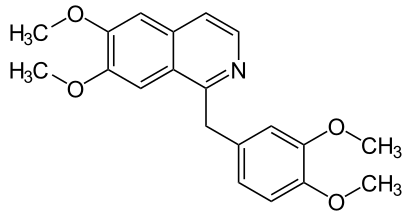
- vasodilators, a well-known example, papaverine, shown below.
References
References
- (December 1893). "Uber eine neue Isochinolinsynthese". Monatshefte für Chemie.
- (January 1893). "Synthesen in der Isocumarin- und Isochinolinreihe". Berichte der Deutschen Chemischen Gesellschaft.
- (2009). "Comprehensive organic name reactions and reagents". John Wiley.
- (2007). "Strategic applications of named reactions in organic synthesis : background and detailed mechanisms ; 250 named reactions". Elsevier Academic Press.
- (2006). "Name reactions : a collection of detailed reaction mechanisms ; [more than 300 reactions]". Springer.
This article was imported from Wikipedia and is available under the Creative Commons Attribution-ShareAlike 4.0 License. Content has been adapted to SurfDoc format. Original contributors can be found on the article history page.
Ask Mako anything about Pomeranz–Fritsch reaction — get instant answers, deeper analysis, and related topics.
Research with MakoFree with your Surf account
Create a free account to save articles, ask Mako questions, and organize your research.
Sign up freeThis content may have been generated or modified by AI. CloudSurf Software LLC is not responsible for the accuracy, completeness, or reliability of AI-generated content. Always verify important information from primary sources.
Report