From Surf Wiki (app.surf) — the open knowledge base
Padrón pepper
Variety of pepper from Padrón, Spain
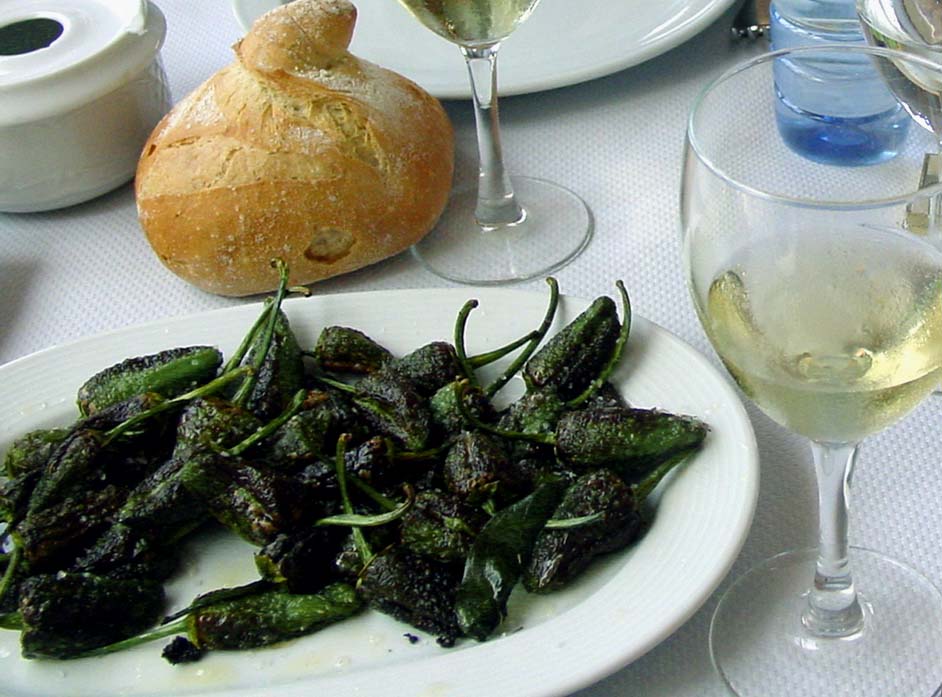
Variety of pepper from Padrón, Spain
| Field | Value |
|---|---|
| name | Padrón |
| image | Pementos de Padron.jpg |
| image_caption | Unripe Padrón peppers |
| origin | Galicia, Spain |
| species | *Capsicum annuum* |
| module | {{Infobox pepper |
| embed | yes |
| scoville | 500 to 2,500 |
Padrón pepper, also called Herbón pepper, is a landrace variety of pepper (Capsicum annuum) from the municipality of Padrón in northwestern Spain (mainly in the valley of the parish of Herbón).
Characteristics
Padrón peppers are small, about 2 in long and have an elongated shape. They are often picked, sold and eaten unripe, when they are still green. The taste is mild, but some exemplars can be quite hot. This property has given rise to the popular Galician aphorism "Os pementos de Padrón, uns pican e outros non" ("Padrón peppers, some are hot, some are not"). Drought-stressed plants tend to produce hotter peppers. Like several other peppers, Padrón peppers become spicier as they mature. Their ripe colour is red.
Cultivation
The species Capsicum annuum is native to southern North America, the Caribbean, and northern South America where it was domesticated. The Padrón pepper variety originates from the municipality of Padrón in the province of A Coruña, Galicia, northwestern Spain. European Union law has protected the name pemento de Herbón as a protected designation of origin since 2010. Padrón peppers are now also grown elsewhere in the Mediterranean and in the United States.
Padrón peppers are picked when immature and green.
Culinary preparation
Padrón peppers are customarily fried in olive oil until the skin starts to blister and the pepper collapses.
In and around the town of Padrón, the stems are removed before frying. Removing the stems is recommended by major Galician pepper producers and the head of the Galician tourism association on the grounds that they cause bitterness in fried peppers. Elsewhere, the stems are generally left on the peppers, and the stems are used to hold the peppers while eating.
Fried Padrón peppers are typically served hot with a dusting of coarse salt, sometimes accompanied by chunks of bread, as tapas.
References
References
- (2018). "The Devil's Dinner: A Gastronomic and Cultural History of Chili Peppers". St. Martin's.
- (2000). "Gourmetour: Food, Wine & Travel Quarterly Magazine". INFE.
- (2016-05-12). "Assessing genetic and phenotypic diversity in pepper (Capsicum annuum L.) landraces from North-West Spain". Scientia Horticulturae.
- Davis, Kat. (2018). "The Camino Portugues: From Lisbon and Porto to Santiago – Central, Coastal and Spiritual caminos". Cicerone Press Limited.
- Baró, Gonzalo. (2018). "Vegan Recipes from Spain". Grub Street Cookery.
- (1999-10-11). "Pungency level in fruits of the Padrón pepper with different water supply". Scientia Horticulturae.
- (2019). "Joy of Cooking". Simon and Schuster.
- (1997). "Evolution of capsaicinoids in Capsicum annuum L. var. annuum cv. Padrón fruit at different growth stages after flowering". Capsicum & Eggplant Newsletter.
- (1998). "Capsicum & Eggplant Newsletter". Plant Breeding and Seed Production, University of Turin.
- {{GRIN
- "D.O.P. Pemento de Herbón". [[Ministry of Agriculture (Spain).
- (September 2020). "Antioxidant Profile of Pepper (Capsicum annuum L.) Fruits Containing Diverse Levels of Capsaicinoids". Antioxidants.
- Winston, Steve. (2009). "The Spanish Table: Traditional Recipes and Wine Pairings from Spain and Portugal". Gibbs Smith.
- (2014). "Bar Tartine: Techniques & Recipes". Chronicle Books.
- Rockridge Press. (2014). "Hot Sauce Cookbook: The Book of Fiery Salsa and Hot Sauce Recipes". Callisto Media.
- (2019-07-14). "En Padrón no hay debate: los pimientos se fríen sin tallo".
- Torrado, C. B.. (August 24, 2019). "Los pimientos, ¿con o sin rabo?". [[La Voz de Galicia]].
- DK Publishing. (15 February 2010). "Back Roads Spain". DK Publishing.
This article was imported from Wikipedia and is available under the Creative Commons Attribution-ShareAlike 4.0 License. Content has been adapted to SurfDoc format. Original contributors can be found on the article history page.
Ask Mako anything about Padrón pepper — get instant answers, deeper analysis, and related topics.
Research with MakoFree with your Surf account
Create a free account to save articles, ask Mako questions, and organize your research.
Sign up freeThis content may have been generated or modified by AI. CloudSurf Software LLC is not responsible for the accuracy, completeness, or reliability of AI-generated content. Always verify important information from primary sources.
Report