From Surf Wiki (app.surf) — the open knowledge base
Nuclear reactor
Device for controlled nuclear reactions
Device for controlled nuclear reactions
nuclear fission reactors
- Chicago Pile-1, the first artificial nuclear reactor
- Shippingport Atomic Power Station, the first peacetime reactor
- HTR-10, a prototype to the first Generation IV reactor, HTR-PM
- The Convair NB-36H, the first aircraft to test an onboard reactor
- Operation Sea Orbit, the first nuclear-powered surface vessel circumnavigation
- The Chernobyl sarcophagus, built to contain the effects of the 1986 disaster A nuclear reactor is a device used to sustain a controlled fission nuclear chain reaction. They are used for commercial electricity, marine propulsion, weapons production and research. Fissile nuclei (primarily uranium-235 or plutonium-239) absorb single neutrons and split, releasing energy and multiple neutrons, which can induce further fission. Reactors stabilize this, regulating neutron absorbers and moderators in the core. Fuel efficiency is exceptionally high; low-enriched uranium is 120,000 times more energy-dense than coal.
Heat from nuclear fission is passed to a working fluid coolant. In commercial reactors, this drives turbines and electrical generator shafts. Some reactors are used for district heating, and isotope production for medical and industrial use.
After the discovery of fission in 1938, many countries launched military nuclear research programs. Early subcritical experiments probed neutronics. In 1942, the first artificial critical nuclear reactor, Chicago Pile-1, was built by the Metallurgical Laboratory. From 1944, for weapons production, the first large-scale reactors were operated at the Hanford Site. The pressurized water reactor design, used in about 70% of commercial reactors, was developed for US Navy submarine propulsion, beginning with S1W in 1953. In 1954, small-scale nuclear electricity production began with the Soviet Obninsk plant. The first commercial nuclear power station was Calder Hall at Sellafield, England, which started operation in 1956.
Spent fuel can be reprocessed, potentially reducing nuclear waste and recovering reactor-usable fuel. This also poses a nuclear proliferation risk via production of plutonium for nuclear weapons.
Reactor accidents have been caused by combinations of design and operator failure. The 1979 Three Mile Island accident, at INES Level 5, and the 1986 Chernobyl disaster and 2011 Fukushima disaster, both at Level 7, all had major effects on the nuclear industry and anti-nuclear movement.
, there are 417 commercial reactors, 226 research reactors, and over 200 marine propulsion reactors in operation globally. Commercial reactors provide 9% of the global electricity supply, compared to 30% from renewables, together comprising low-carbon electricity. Almost 90% of this comes from pressurized and boiling water reactors. Other designs include gas-cooled, fast-spectrum, breeder, heavy-water, molten-salt, and small modular, each of which improves safety, efficiency, cost, fuel type, enrichment, or burnup, and the now-obsolete Light water graphite reactor.
Terminology
During early 1940s nuclear research, the phrase "atomic pile" was used for any assembly involving uranium and attempts at neutron multiplication, including the majority which were subcritical. After Chicago Pile-1 demonstrated a self-sustaining chain reaction, the "reactor" terminology became more common. The phrases "nuclear pile" and "atomic reactor" were also common.
Critical mass experiments, while being far simpler, are sometimes referred to as research reactors, such as the Godiva device.
"Nuclear reactor" is predominantly used to refer to the nuclear fission reactor. It can also refer to a nuclear fusion reactor, of which only net negative power systems have been constructed. Radioisotope thermoelectric generators and radioisotope heater units, while deriving power from nuclear decay reactions, are not referred to as nuclear reactors as they do not induce reactions.
Operation
Main article: Nuclear reactor physics
Just as conventional thermal power stations generate electricity by harnessing the thermal energy released from burning fossil fuels, nuclear reactors convert the energy released by controlled nuclear fission into thermal energy for further conversion to mechanical or electrical forms.
Fission
Main article: Nuclear fission
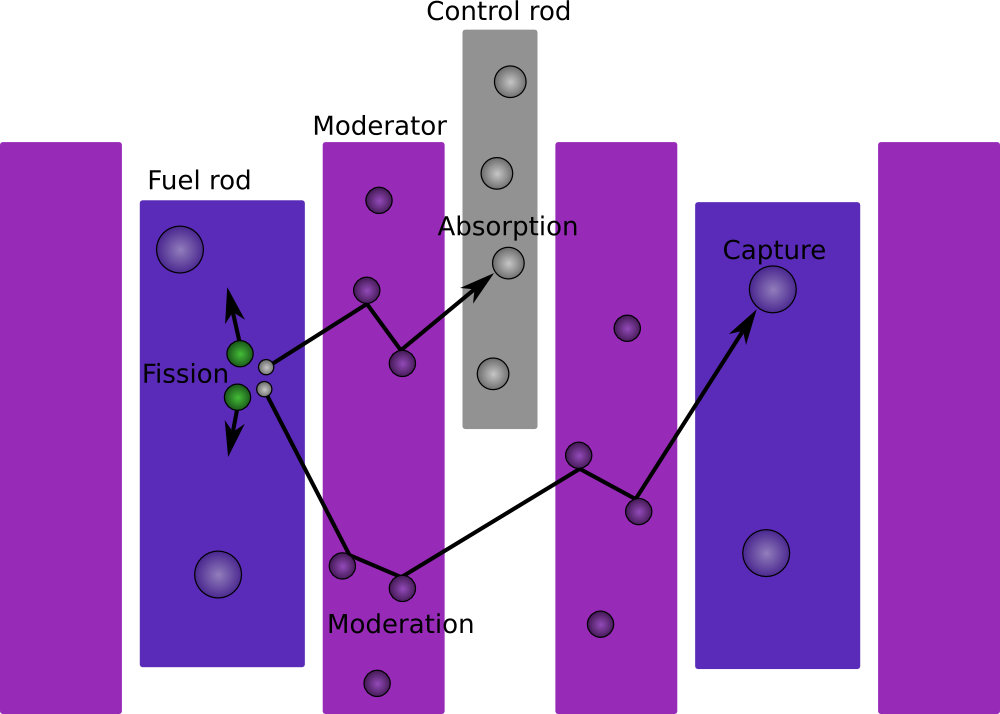
When a large fissile atomic nucleus such as uranium-235, uranium-233, or plutonium-239 absorbs a neutron, it may undergo nuclear fission. The heavy nucleus splits into two or more lighter nuclei, (the fission products), releasing kinetic energy, gamma radiation, and free neutrons. A portion of these neutrons may be absorbed by other fissile atoms and trigger further fission events, which release more neutrons, and so on. This is known as a nuclear chain reaction.
To control such a nuclear chain reaction, control rods containing neutron poisons and neutron moderators are able to change the portion of neutrons that will go on to cause more fission. Nuclear reactors generally have automatic and manual systems to shut the fission reaction down if monitoring or instrumentation detects unsafe conditions.
Heat generation
The reactor core generates heat in a number of ways:
- The kinetic energy of fission products is converted to thermal energy when these nuclei collide with nearby atoms.
- The reactor absorbs some of the gamma rays produced during fission and converts their energy into heat.
- Heat is produced by the radioactive decay of fission products and materials that have been activated by neutron absorption. This decay heat source will remain for some time even after the reactor is shut down.
A kilogram of uranium-235 (U-235) converted via nuclear processes releases approximately three million times more energy than a kilogram of coal burned conventionally (7.2 × 10¹³ joules per kilogram of uranium-235 versus 2.4 × 10⁷ joules per kilogram of coal).
The fission of one kilogram of uranium-235 releases about 19 billion kilocalories, so the energy released by 1 kg of uranium-235 corresponds to that released by burning 2.7 million kg of coal.
Cooling
A nuclear reactor coolant – usually water but sometimes a gas or a liquid metal (like liquid sodium or lead) or molten salt – is circulated past the reactor core to absorb the heat that it generates. The heat is carried away from the reactor and is then used to generate steam. Most reactor systems employ a cooling system that is physically separated from the water that will be boiled to produce pressurized steam for the turbines, like the pressurized water reactor. However, in some reactors the water for the steam turbines is boiled directly by the reactor core; for example the boiling water reactor.
Reactivity control
Main article: Nuclear reactor physics, Passive nuclear safety, Delayed neutron, Iodine pit, SCRAM, Decay heat
The rate of fission reactions within a reactor core can be adjusted by controlling the quantity of neutrons that are able to induce further fission events. Nuclear reactors typically employ several methods of neutron control to adjust the reactor's power output. Some of these methods arise naturally from the physics of radioactive decay and are simply accounted for during the reactor's operation, while others are mechanisms engineered into the reactor design for a distinct purpose.
The fastest method for adjusting levels of fission-inducing neutrons in a reactor is via movement of the control rods. Control rods are made of so-called neutron poisons and therefore absorb neutrons. When a control rod is inserted deeper into the reactor, it absorbs more neutrons than the material it displaces – often the moderator. This action results in fewer neutrons available to cause fission and reduces the reactor's power output. Conversely, extracting the control rod will result in an increase in the rate of fission events and an increase in power.
The physics of radioactive decay also affects neutron populations in a reactor. One such process is delayed neutron emission by a number of neutron-rich fission isotopes. These delayed neutrons account for about 0.65% of the total neutrons produced in fission, with the remainder (termed "prompt neutrons") released immediately upon fission. The fission products which produce delayed neutrons have half-lives for their decay by neutron emission that range from milliseconds to as long as several minutes, and so considerable time is required to determine exactly when a reactor reaches the critical point. Keeping the reactor in the zone of chain reactivity where delayed neutrons are necessary to achieve a critical mass state allows mechanical devices or human operators to control a chain reaction in "real time"; otherwise the time between achievement of criticality and nuclear meltdown as a result of an exponential power surge from the normal nuclear chain reaction, would be too short to allow for intervention. This last stage, where delayed neutrons are no longer required to maintain criticality, is known as the prompt critical point. There is a scale for describing criticality in numerical form, in which bare criticality is known as zero dollars and the prompt critical point is one dollar, and other points in the process interpolated in cents.
In some reactors, the coolant also acts as a neutron moderator. A moderator increases the power of the reactor by causing the fast neutrons that are released from fission to lose energy and become thermal neutrons. Thermal neutrons are more likely than fast neutrons to cause fission. If the coolant is a moderator, then temperature changes can affect the density of the coolant/moderator and therefore change power output. A higher temperature coolant would be less dense, and therefore a less effective moderator.
In other reactors, the coolant acts as a poison by absorbing neutrons in the same way that the control rods do. In these reactors, power output can be increased by heating the coolant, which makes it a less dense poison. Nuclear reactors generally have automatic and manual systems to scram the reactor in an emergency shut down. These systems insert large amounts of poison (often boron in the form of boric acid) into the reactor to shut the fission reaction down if unsafe conditions are detected or anticipated.
Most types of reactors are sensitive to a process variously known as xenon poisoning, or the iodine pit. The common fission product Xenon-135 produced in the fission process acts as a neutron poison that absorbs neutrons and therefore tends to shut the reactor down. Xenon-135 accumulation can be controlled by keeping power levels high enough to destroy it by neutron absorption as fast as it is produced. Fission also produces iodine-135, which in turn decays (with a half-life of 6.57 hours) to new xenon-135. When the reactor is shut down, iodine-135 continues to decay to xenon-135, making restarting the reactor more difficult for a day or two, as the xenon-135 decays into cesium-135, which is not nearly as poisonous as xenon-135, with a half-life of 9.2 hours. This temporary state is the "iodine pit." If the reactor has sufficient extra reactivity capacity, it can be restarted. As the extra xenon-135 is transmuted to xenon-136, which is much less a neutron poison, within a few hours the reactor experiences a "xenon burnoff (power) transient". Control rods must be further inserted to replace the neutron absorption of the lost xenon-135. Failure to properly follow such a procedure was a key step in the Chernobyl disaster.
Reactors used in nuclear marine propulsion (especially nuclear submarines) often cannot be run at continuous power around the clock in the same way that land-based power reactors are normally run, and in addition often need to have a very long core life without refueling. For this reason many designs use highly enriched uranium but incorporate burnable neutron poison in the fuel rods. This allows the reactor to be constructed with an excess of fissionable material, which is nevertheless made relatively safe early in the reactor's fuel burn cycle by the presence of the neutron-absorbing material which is later replaced by normally produced long-lived neutron poisons (far longer-lived than xenon-135) which gradually accumulate over the fuel load's operating life.
Electrical power generation
The energy released in the fission process generates heat, some of which can be converted into usable energy. A common method of harnessing this thermal energy is to use it to boil water to produce pressurized steam which will then drive a steam turbine that turns an alternator and generates electricity.
Life-times
Modern nuclear power plants are typically designed for a lifetime of 60 years, while older reactors were built with a planned typical lifetime of 30–40 years, though many of those have received renovations and life extensions of 15–20 years. Some believe nuclear power plants can operate for as long as 80 years or longer with proper maintenance and management. While most components of a nuclear power plant, such as steam generators, are replaced when they reach the end of their useful lifetime, the overall lifetime of the power plant is limited by the life of components that cannot be replaced when aged by wear and neutron embrittlement, such as the reactor pressure vessel. At the end of their planned life span, plants may get an extension of the operating license for some 20 years and in the US even a "subsequent license renewal" (SLR) for an additional 20 years.
Even when a license is extended, it does not guarantee the reactor will continue to operate, particularly in the face of safety concerns or incident. Many reactors are closed long before their license or design life expired and are decommissioned. The costs for replacements or improvements required for continued safe operation may be so high that they are not cost-effective. Or they may be shut down due to technical failure. Other ones have been shut down because the area was contaminated, like Fukushima, Three Mile Island, Sellafield, and Chernobyl. The British branch of the French concern EDF Energy, for example, extended the operating lives of its Advanced Gas-cooled Reactors (AGR) with only between 3 and 10 years. All seven AGR plants were expected to be shut down in 2022 and in decommissioning by 2028. Hinkley Point B was extended from 40 to 46 years, and closed. The same happened with Hunterston B, also after 46 years.
An increasing number of reactors is reaching or crossing their design lifetimes of 30 or 40 years. In 2014, Greenpeace warned that the lifetime extension of ageing nuclear power plants amounts to entering a new era of risk. It estimated the current European nuclear liability coverage in average to be too low by a factor of between 100 and 1,000 to cover the likely costs, while at the same time, the likelihood of a serious accident happening in Europe continues to increase as the reactor fleet grows older.
History
The neutron was discovered in 1932 by British physicist James Chadwick. The concept of a nuclear chain reaction brought about by nuclear reactions mediated by neutrons was first realized shortly thereafter, by Hungarian scientist Leó Szilárd, in 1933. He filed a patent for his idea of a simple reactor the following year while working at the Admiralty in London, England. However, Szilárd's idea did not incorporate the idea of nuclear fission as a neutron source, since that process was not yet discovered. Szilárd's ideas for nuclear reactors using neutron-mediated nuclear chain reactions in light elements proved unworkable.
Inspiration for a new type of reactor using uranium came from the discovery by Otto Hahn, Lise Meitner, and Fritz Strassmann in 1938 that bombardment of uranium with neutrons (provided by an alpha-on-beryllium fusion reaction, a "neutron howitzer") produced a barium residue, which they reasoned was created by fission of the uranium nuclei. In their second publication on nuclear fission in February 1939, Hahn and Strassmann predicted the existence and liberation of additional neutrons during the fission process, opening the possibility of a nuclear chain reaction. Subsequent studies in early 1939 (one of them by Szilárd and Fermi), revealed that several neutrons were indeed released during fission, making available the opportunity for the nuclear chain reaction that Szilárd had envisioned six years previously.
On 2 August 1939, Albert Einstein signed a letter to President Franklin D. Roosevelt (written by Szilárd) suggesting that the discovery of uranium's fission could lead to the development of "extremely powerful bombs of a new type", giving impetus to the study of reactors and fission. Szilárd and Einstein knew each other well and had worked together years previously, but Einstein had never thought about this possibility for nuclear energy until Szilard reported it to him, at the beginning of his quest to produce the Einstein-Szilárd letter to alert the U.S. government.
Shortly after, Nazi Germany invaded Poland in 1939, starting World War II in Europe. The U.S. was not yet officially at war, but in October, when the Einstein-Szilárd letter was delivered to him, Roosevelt commented that the purpose of doing the research was to make sure "the Nazis don't blow us up." The U.S. nuclear project followed, although with some delay as there remained skepticism (some of it from Enrico Fermi) and also little action from the small number of officials in the government who were initially charged with moving the project forward.
The following year, the U.S. Government received the Frisch–Peierls memorandum from the UK, which stated that the amount of uranium needed for a chain reaction was far lower than had previously been thought. The memorandum was a product of the MAUD Committee, which was working on the UK atomic bomb project, known as Tube Alloys, later to be subsumed within the Manhattan Project.
Eventually, the first artificial nuclear reactor, Chicago Pile-1, was constructed at the University of Chicago, by a team led by Italian physicist Enrico Fermi, in late 1942. By this time, the program had been pressured for a year by U.S. entry into the war. The Chicago Pile achieved criticality on 2 December 1942 at 3:25 PM. The reactor support structure was made of wood, which supported a pile (hence the name) of graphite blocks, embedded in which was natural uranium oxide 'pseudospheres' or 'briquettes'.
Soon after the Chicago Pile, the Metallurgical Laboratory developed a number of nuclear reactors for the Manhattan Project starting in 1943. The primary purpose for the largest reactors (located at the Hanford Site in Washington), was the mass production of plutonium for nuclear weapons. Fermi and Szilard applied for a patent on reactors on 19 December 1944. Its issuance was delayed for 10 years because of wartime secrecy.
"World's first nuclear power plant" is the claim made by signs at the site of the EBR-I, which is now a museum near Arco, Idaho. Originally called "Chicago Pile-4", it was carried out under the direction of Walter Zinn for Argonne National Laboratory. This experimental LMFBR operated by the U.S. Atomic Energy Commission produced 0.8 kW in a test on 20 December 1951 and 100 kW (electrical) the following day, having a design output of 200 kW (electrical).
Besides the military uses of nuclear reactors, there were political reasons to pursue civilian use of atomic energy. U.S. President Dwight Eisenhower made his famous Atoms for Peace speech to the UN General Assembly on 8 December 1953. This diplomacy led to the dissemination of reactor technology to U.S. institutions and worldwide.
The first nuclear power plant built for civil purposes was the AM-1 Obninsk Nuclear Power Plant, launched on 27 June 1954 in the Soviet Union. It produced around 5 MW (electrical). It was built after the F-1 (nuclear reactor) which was the first reactor to go critical in Europe, and was also built by the Soviet Union.
After World War II, the U.S. military sought other uses for nuclear reactor technology. Research by the Army led to the power stations for Camp Century, Greenland and McMurdo Station, Antarctica Army Nuclear Power Program. The Air Force Nuclear Bomber project resulted in the Molten-Salt Reactor Experiment. The U.S. Navy succeeded when they steamed the USS Nautilus (SSN-571) on nuclear power 17 January 1955.
The first commercial nuclear power station, Calder Hall in Sellafield, England was opened in 1956 with an initial capacity of 50 MW (later 200 MW).
The first portable nuclear reactor "Alco PM-2A" was used to generate electrical power (2 MW) for Camp Century from 1960 to 1963.
Table by date
| Name | Alternate names | Country | Location | Moderator | Criticality date | ||||||||||||||||||||
|---|---|---|---|---|---|---|---|---|---|---|---|---|---|---|---|---|---|---|---|---|---|---|---|---|---|
| Chicago Pile-1 | CP-1 | United States | University of Chicago, Illinois | Graphite | last=Reed | first=Bruce Cameron | title=Manhattan Project | date=2020 | publisher=Springer International Publishing | isbn=978-3-030-45733-4 | publication-place=Cham | pages=149–169 | chapter=Piles and Secret Cities | doi=10.1007/978-3-030-45734-1_5}} | |||||||||||
| Chicago Pile-2 | CP-2 | United States | Site A, Illinois | Graphite | last=Reed | first=B. Cameron | date=2021 | title=An inter-country comparison of nuclear pile development during World War II | journal=The European Physical Journal H | volume=46 | issue=1 | article-number=15 | arxiv=2001.09971 | bibcode=2021EPJH...46...15R | doi=10.1140/epjh/s13129-021-00020-x | issn=2102-6459 | doi-access=free}} | ||||||||
| Oak Ridge Graphite Reactor | X-10, Clinton Pile | United States | Clinton Laboratories, Tennessee | Graphite | 4 November 1943 | ||||||||||||||||||||
| title=Nuclear reactors built, being built, or planned 1993 | date=1993-08-01 | publisher=Office of Scientific and Technical Information (OSTI) | doi=10.2172/10141005 | page= | doi-access=free | osti=10141005 }} | United States | Hanford Site, Washington | Graphite | date=January 2025 | reason=The whole pile is very obscure I'm not sure if anyone can find this information but would be nice}} | ||||||||||||||
| Chicago Pile-3 | CP-3 | United States | Site A, Illinois | Heavy water | title=Manhattan Project: Places Metallurgical Laboratory CP-2 and CP-3 | url=https://www.osti.gov/opennet/manhattan-project-history/Places/MetLab/cp2-3.html | access-date=2024-12-25 | website=OSTI.GOV}} | |||||||||||||||||
| Los Alamos LOPO Reactor | LOPO | United States | Los Alamos Laboratory, New Mexico | Light water | date=1920-06-03 | title=Timeline | url=https://ahf.nuclearmuseum.org/ahf/nuc-history/timeline/ | access-date=2024-11-07 | website=Nuclear Museum}} | ||||||||||||||||
| B Reactor | United States | Hanford Site, Washington | Graphite | last=Reed | first=B. Cameron | date=2021 | title=An inter-country comparison of nuclear pile development during World War II | journal=The European Physical Journal H | volume=46 | issue=1 | article-number=15 | arxiv=2001.09971 | bibcode=2021EPJH...46...15R | doi=10.1140/epjh/s13129-021-00020-x | issn=2102-6459 | doi-access=free}} | |||||||||
| Los Alamos Water Boiler | HYPO | United States | Los Alamos Laboratory, New Mexico | Light water | url=https://www.osti.gov/servlets/purl/1133322 | title=Discussion Regarding Aqueous Homogeneous Reactor (AHR) Benchmarks | last1=Klein | first1=Steven | last2=Kimpland | first2=Robert | date=2014-05-28 | doi=10.2172/1133322 | page= | access-date=2024-12-30 | doi-access=free}} | ||||||||||
| D Reactor | United States | Hanford Site, Washington | Graphite | date=1994-09-30 | title=Plutonium: The First 50 Years | url=https://sgp.fas.org/othergov/doe/pu50yc.html | access-date=2024-12-24 | website=FAS Project on Government Secrecy (1991-2021)}} | |||||||||||||||||
| Dragon | United States | Los Alamos Laboratory, New Mexico | None (fast) | last1=Kimpland | first1=Robert | last2=Grove | first2=Travis | last3=Jaegers | first3=Peter | last4=Malenfant | first4=Richard | last5=Myers | first5=William | date=2021-12-03 | title=Critical Assemblies: Dragon Burst Assembly and Solution Assemblies | journal=Nuclear Technology | volume=207 | issue=sup1 | pages=S81–S99 | arxiv=2103.05780 | bibcode=2021NucTe.207S..81K | doi=10.1080/00295450.2021.1927626 | issn=0029-5450 | doi-access=free}} | |
| F Reactor | United States | Hanford Site, Washington | Graphite | February 1945 | |||||||||||||||||||||
| *Trinity, first US nuclear test* | *16 July 1945* | ||||||||||||||||||||||||
| Zero Energy Experimental Pile | ZEEP | Canada | Chalk River Laboratories, Ontario | Heavy water | title=ZEEP -- Canada's First Nuclear Reactor | url=http://www.sciencetech.technomuses.ca/english/whatson/zeep.cfm | archiveurl=https://web.archive.org/web/20140306233719/http://www.sciencetech.technomuses.ca/english/whatson/zeep.cfm | archivedate=6 March 2014 | publisher=Canada Science and Technology Museum}} | ||||||||||||||||
| Los Alamos Fast Reactor | Clementine | United States | Los Alamos Laboratory, New Mexico | None (fast) | last1=Patenaude | first1=Hannah K. | last2=Freibert | first2=Franz J. | date=2023-03-09 | title=Oh, My Darling Clementine: A Detailed History and Data Repository of the Los Alamos Plutonium Fast Reactor | journal=Nuclear Technology | publisher=Informa UK Limited | volume=209 | issue=7 | pages=963–1007 | bibcode=2023NucTe.209..963P | doi=10.1080/00295450.2023.2176686 | issn=0029-5450 | doi-access=free | url=https://digitalscholarship.unlv.edu/context/college_of_sciences_graduate_student_research/article/1000/viewcontent/Oh_My_Darling_Clementine_A_Detailed_History_and_Data_Repository_of_the_Los_Alamos_Plutonium_Fast_Reactor_2___Hannah_Patenaude.pdf }} | |||||
| F-1 | Soviet Union | Laboratory No. 2, Moscow | Graphite | 25 December 1946 | |||||||||||||||||||||
| National Research Experimental | NRX | Canada | Chalk River Laboratories, Ontario | Heavy water | last=Hurst | first=D.G. | url=https://books.google.com/books?id=3uz0AwAAQBAJ | title=Canada Enters the Nuclear Age: A Technical History of Atomic Energy of Canada Limited as Seen from Its Research Laboratories | publisher=McGill-Queen's University Press | year=1997 | isbn=978-0-7735-6653-8 | page=45 | access-date=2024-12-31}} | ||||||||||||
| Graphite Low Energy Experimental Pile | GLEEP | United Kingdom | Atomic Energy Research Establishment, Oxfordshire | Graphite | 15 August 1947 | ||||||||||||||||||||
| Reactor A | Soviet Union | Mayak Production Association, Chelyabinsk Oblast | Graphite | last=Diakov | first=Anatoli | date=2011-04-25 | title=The History of Plutonium Production in Russia | journal=Science & Global Security | volume=19 | issue=1 | pages=28–45 | bibcode=2011S&GS...19...28D | doi=10.1080/08929882.2011.566459 | issn=0892-9882}} | |||||||||||
| British Experimental Pile Operation | BEPO | United Kingdom | Atomic Energy Research Establishment, Oxfordshire | Graphite | date=2023-07-03 | title=Magnox BEPO reactor 75th Anniversary | url=https://www.gov.uk/government/news/magnox-bepo-reactor-75th-anniversary | access-date=2025-01-13 | website=GOV.UK}} | ||||||||||||||||
| Eau Lourde-1 (Heavy Water-1) | EL-1, Zoé | France | Fort de Châtillon, Paris | Heavy water | title=Irène and Frédéric Joliot-Curie | url=http://www.curie.fr/fondation/musee/irene-frederic-joliot-curie.cfm/lang/_gb.htm | url-status=dead | archive-url=https://web.archive.org/web/20100603032613/http://www.curie.fr/fondation/musee/irene-frederic-joliot-curie.cfm/lang/_gb.htm | archive-date=2010-06-03 | access-date=26 April 2010 | publisher=Institut Curie}} | ||||||||||||||
| Physical Boiler on Fast Neutrons | FKBN | Soviet Union | Design Bureau No. 11, Sarov | None (fast) | title=ФКБН / Сводный указатель объектов / Атомный проект СССР // Электронная библиотека /// История Росатома | url=https://elib.biblioatom.ru/soviet-atomic-program/objects/fizicheskiy_kotel_na_byistryih_neytronah@13272/ | access-date=2025-01-10 | website=Электронная библиотека /// История Росатома | language=ru}} | ||||||||||||||||
| TVR | TVR | Soviet Union | Laboratory No. 3, Moscow | Heavy water | last1=Loffe | first1=B. L. | last2=Shvedov | first2=O. V. | date=1999 | title=Heavy water reactors and nuclear power plants in the USSR and Russia: Past, present, and future | journal=Atomic Energy | volume=86 | issue=4 | pages=295–304 | doi=10.1007/BF02673145 | issn=1063-4258}} | |||||||||
| *RDS-1, first Soviet nuclear test* | *29 August 1949* | ||||||||||||||||||||||||
| H Reactor | United States | Hanford Site, Washington | Graphite | October 1949 |
Table by country
| Country | First reactor | Criticality date | First grid-connected reactor | Connection date | ||||||||
|---|---|---|---|---|---|---|---|---|---|---|---|---|
| United States | CP-1 | Shippingport Atomic Power Station | ||||||||||
| Canada | ZEEP | Nuclear Power Demonstration | ||||||||||
| Soviet Union | F-1 | Obninsk Nuclear Power Plant | ||||||||||
| United Kingdom | GLEEP | Calder Hall nuclear power station | ||||||||||
| France | EL-1 (Zoé) | Marcoule Nuclear Site | ||||||||||
| Norway | JEEP | None constructed | n/a | |||||||||
| Sweden | R1 | Ågesta Nuclear Plant | ||||||||||
| Belgium | ||||||||||||
| India | Apsara | **** | Tarapur Atomic Power Station | |||||||||
| Japan | 27 August 1957 | Tōkai Nuclear Power Plant | 25 July 1966 | |||||||||
| West Germany | Kahl Nuclear Power Plant | |||||||||||
| East Germany | date=1955-04-18 | title=Die Geschichte des HZDR im Überblick | url=https://www.hzdr.de/db/Cms?pOid=26670&pNid=1826 | access-date=2025-05-10 | website=Helmholtz-Zentrum Dresden-Rossendorf, HZDR}} | Rheinsberg Nuclear Power Plant | date=1960-01-01 | title=Rheinsberg | url=https://world-nuclear.org/nuclear-reactor-database/details/RHEINSBERG | access-date=2025-05-10 | website=World Nuclear Association}} | |
| China | HWRR | Qinshan Nuclear Power Plant | ||||||||||
| Italy | Latina Nuclear Power Plant |
Reactor types
( 277 : PWR : : Pressurized-Water Reactor ) ( 80 : BWR : : Boiling Water Reactor ) ( 15 : GCR : : Gas-Cooled Reactor ) ( 49 : PHWR : : Pressurized Heavy-Water Reactor ) ( 15 : LWGR : : LWGR ) ( 2 : FBR : : Fast-Breeder Reactor ) ( 257.2: PWR : : Pressurized-Water Reactor ) ( 75.5 : BWR : : Boiling Water Reactor ) ( 8.2 : GCR : : Gas-Cooled Reactor ) ( 24.6 : PHWR : : Pressurized Heavy-Water Reactor ) ( 10.2 : LWGR : : LWGR ) ( 0.6 : FBR : : Fast-Breeder Reactor )
Classifications
By type of nuclear reaction
All commercial power reactors are based on nuclear fission. They generally use uranium and its product plutonium as nuclear fuel, though a thorium fuel cycle is also possible. Fission reactors can be divided roughly into two classes, depending on the energy of the neutrons that sustain the fission chain reaction:
- Thermal-neutron reactors use slowed or thermal neutrons to keep up the fission of their fuel. Almost all current reactors are of this type. These contain neutron moderator materials that slow neutrons until their neutron temperature is thermalized, that is, until their kinetic energy approaches the average kinetic energy of the surrounding particles. Thermal neutrons have a far higher cross section (probability) of fissioning the fissile nuclei uranium-235, plutonium-239, and plutonium-241, and a relatively lower probability of neutron capture by uranium-238 (U-238) compared to the faster neutrons that originally result from fission, allowing use of low-enriched uranium or even natural uranium fuel. The moderator is often also the coolant, usually water under high pressure to increase the boiling point. These are surrounded by a reactor vessel, instrumentation to monitor and control the reactor, radiation shielding, and a containment building.
- Fast-neutron reactors use fast neutrons to cause fission in their fuel. They do not have a neutron moderator, and use less-moderating coolants. Maintaining a chain reaction requires the fuel to be more highly enriched in fissile material (about 20% or more) due to the relatively lower probability of fission versus capture by U-238. Fast reactors have the potential to produce less transuranic waste because all actinides are fissionable with fast neutrons, but they are more difficult to build and more expensive to operate. Overall, fast reactors are less common than thermal reactors in most applications. Some early power stations were fast reactors, as are some Russian naval propulsion units. Construction of prototypes is continuing (see fast breeder or generation IV reactors).
In principle, fusion power could be produced by nuclear fusion of elements such as the deuterium isotope of hydrogen. While an ongoing rich research topic since at least the 1940s, no self-sustaining fusion reactor for any purpose has ever been built.
By moderator material
Used by thermal reactors:
- Graphite-moderated reactors
- Mostly early reactors such as the Chicago pile, Obninsk am 1, Windscale piles, RBMK, Magnox, and others such as AGR use graphite as a moderator.
- Water moderated reactors
- Heavy-water reactors (Used in Canada, India, Argentina, China, Pakistan, Romania and South Korea).
- Light-water-moderated reactors (LWRs). Light-water reactors (the most common type of thermal reactor) use ordinary water to moderate and cool the reactors. Because the light hydrogen isotope is a slight neutron poison, these reactors need artificially enriched fuels. When at operating temperature, if the temperature of the water increases, its density drops, and fewer neutrons passing through it are slowed enough to trigger further reactions. That negative feedback stabilizes the reaction rate. Graphite and heavy-water reactors tend to be more thoroughly thermalized than light water reactors. Due to the extra thermalization, and the absence of the light hydrogen poisoning effects these types can use natural uranium/unenriched fuel.
- Light-element-moderated reactors.
- Molten-salt reactors (MSRs) are moderated by light elements such as lithium or beryllium, which are constituents of the coolant/fuel matrix salts "LiF" and "BeF2", "LiCl" and "BeCl2" and other light element containing salts can all cause a moderating effect.
- Liquid-metal-cooled reactors, such as those whose coolant is a mixture of lead and bismuth, may use BeO as a moderator.
- Organically moderated reactors (OMR) use biphenyl and terphenyl as moderator and coolant.
By coolant
- Water-cooled reactor. These constitute the great majority of operational nuclear reactors: as of 2014, 93% of the world's nuclear reactors are water cooled, providing about 95% of the world's total nuclear generation capacity.
- Pressurized-water reactor (PWR) Pressurized-water reactors constitute the large majority of all Western nuclear power plants.
- A primary characteristic of PWRs is a pressurizer, a specialized pressure vessel. Most commercial PWRs and naval reactors use pressurizers. During normal operation, a pressurizer is partially filled with water, and a steam bubble is maintained above it by heating the water with submerged heaters. During normal operation, the pressurizer is connected to the primary reactor pressure vessel (RPV) and the pressurizer "bubble" provides an expansion space for changes in water volume in the reactor. This arrangement also provides a means of pressure control for the reactor by increasing or decreasing the steam pressure in the pressurizer using the pressurizer heaters.
- Pressurized heavy-water reactors are a subset of pressurized water reactors, sharing the use of a pressurized, isolated heat transport loop, but using heavy water as coolant and moderator for the greater neutron economies it offers.
- Boiling-water reactor (BWR)
- BWRs are characterized by boiling water around the fuel rods in the lower portion of a primary reactor pressure vessel. A boiling water reactor uses 235U, enriched as uranium dioxide, as its fuel. The fuel is assembled into rods housed in a steel vessel that is submerged in water. The nuclear fission causes the water to boil, generating steam. This steam flows through pipes into turbines. The turbines are driven by the steam, and this process generates electricity. During normal operation, pressure is controlled by the amount of steam flowing from the reactor pressure vessel to the turbine.
- Supercritical water reactor (SCWR)
- SCWRs are a Generation IV reactor concept where the reactor is operated at supercritical pressures and water is heated to a supercritical fluid, which never undergoes a transition to steam yet behaves like saturated steam, to power a steam generator.
- Reduced moderation water reactor [RMWR] which use more highly enriched fuel with the fuel elements set closer together to allow a faster neutron spectrum sometimes called an Epithermal neutron Spectrum.
- Pool-type reactor can refer to unpressurized water cooled open pool reactors, but not to be confused with pool type LMFBRs, which are sodium cooled.
- Some reactors have been cooled by heavy water which also served as a moderator. Examples include:
- Early CANDU reactors (later ones use heavy-water moderator but light-water coolant)
- DIDO class research reactors
- Pressurized-water reactor (PWR) Pressurized-water reactors constitute the large majority of all Western nuclear power plants.
- Liquid-metal-cooled reactor. Since water is a moderator, it cannot be used as a coolant in a fast reactor. Liquid-metal coolants have included sodium, sodium–potassium alloy (NaK), lead, lead-bismuth eutectic, and in early reactors, mercury.
- Sodium-cooled fast reactor
- Lead-cooled fast reactor
- Gas-cooled reactors are cooled by a circulating gas. In commercial nuclear power plants carbon dioxide has usually been used, for example in current British AGR nuclear power plants and formerly in a number of first generation British, French, Italian, and Japanese plants. Nitrogen and helium have also been used, helium being considered particularly suitable for high temperature designs. Use of the heat varies, depending on the reactor. Commercial nuclear power plants run the gas through a heat exchanger to make steam for a steam turbine. Some experimental designs run hot enough that the gas can directly power a gas turbine.
- Molten-salt reactors (MSRs) are cooled by circulating a molten salt, typically a eutectic mixture of fluoride salts, such as FLiBe. In a typical MSR, the coolant is also used as a matrix in which the fissile material is dissolved. Other eutectic salt combinations used include "ZrF4" with "NaF" and "LiCl" with "BeCl2".
- Organic nuclear reactors use organic fluids such as biphenyl and terphenyl as coolant rather than water.
By generation
- Generation I reactor (early prototypes such as Shippingport Atomic Power Station, research reactors, non-commercial power producing reactors)
- Generation II reactor (most current nuclear power plants, 1965–1996)
- Generation III reactor (evolutionary improvements of existing designs, 1996–2016)
- Generation III+ reactor (evolutionary development of Gen III reactors, offering improvements in safety over Gen III reactor designs, 2017–2021)
- Generation IV reactor (technologies still under development; unknown start date, see below)
- Generation V reactor (designs which are theoretically possible, but which are not being actively considered or researched at present). In 2003, the French Commissariat à l'Énergie Atomique (CEA) was the first to refer to "Gen II" types in Nucleonics Week.
The first mention of "Gen III" was in 2000, in conjunction with the launch of the Generation IV International Forum (GIF) plans.
"Gen IV" was named in 2000, by the United States Department of Energy (DOE), for developing new plant types.
By type of fuel
- Uranium
- Plutonium
- Mixed oxide (MOX) fuel
- Uranium-plutonium alloy
- Transuranium element mix (neptunium, plutonium, americium, curium)
- Thorium
By phase of fuel
- Solid fueled
- Ceramic
- Oxide
- Carbide
- Nitride
- Metal
- Ceramic
- Fluid fueled
- Aqueous homogeneous reactor
- Molten-salt reactor
- Molten metal reactor (e.g. LAMPRE)
- Gas fueled (theoretical)
By shape of the core
- Cubical
- Cylindrical
- Octagonal
- Spherical
- Slab
- Annulus
By use
- Electricity
- Nuclear power plants including small modular reactors
- Propulsion, see nuclear propulsion
- Nuclear marine propulsion
- Various proposed forms of rocket propulsion
- Other uses of heat
- Desalination
- Heat for domestic and industrial heating
- Hydrogen production for use in a hydrogen economy
- Production reactors for transmutation of elements
- Breeder reactors are capable of producing more fissile material than they consume during the fission chain reaction (by converting fertile U-238 to Pu-239, or Th-232 to U-233). Thus, a uranium breeder reactor, once running, can be refueled with natural or even depleted uranium, and a thorium breeder reactor can be refueled with thorium; however, an initial stock of fissile material is required.
- Creating various radioactive isotopes, such as americium for use in smoke detectors, and cobalt-60, molybdenum-99 and others, used for imaging and medical treatment.[[File:Núcleo del reactor nuclear RA-3, «Ciencia ficción», by Luis Gauna Pereira.jpg|alt=Overhead view of the core of the RA-3 Research and Production Reactor (CNEA, Argentina)|thumb|Overhead view of the core of the RA-3 Research and Production Reactor ([[National Atomic Energy Commission|CNEA]], [[Argentina]])]]
- Production of materials for nuclear weapons such as weapons-grade plutonium
- Providing a source of neutron radiation (for example with the pulsed Godiva device) and positron radiation (e.g. neutron activation analysis and potassium–argon dating)
- Research reactor: Typically reactors used for research and training, materials testing, or the production of radioisotopes for medicine and industry. These are much smaller than power reactors or those propelling ships, and many are on university campuses. There are about 280 such reactors operating, in 56 countries. Some operate with high-enriched uranium fuel, and international efforts are underway to substitute low-enriched fuel.
Current technologies
- Pressurized water reactors (PWR) [moderator: high-pressure water; coolant: high-pressure water]
:: These reactors use a pressure vessel to contain the nuclear fuel, control rods, moderator, and coolant. The hot radioactive water that leaves the pressure vessel is looped through a steam generator, which in turn heats a secondary (nonradioactive) loop of water to steam that can run turbines. As of 2024, 308 PWRs comprise % of operating power reactors. This is a thermal neutron reactor design, the newest of which are the Russian VVER-1200, Japanese Advanced Pressurized Water Reactor, American AP1000, Chinese Hualong Pressurized Reactor and the Franco-German European Pressurized Reactor. All the United States Naval reactors are of this type.
- Boiling water reactors (BWR) [moderator: low-pressure water; coolant: low-pressure water]
:: A BWR is like a PWR without the steam generator. The lower pressure of its cooling water allows it to boil inside the pressure vessel, producing the steam that runs the turbines. Unlike a PWR, there is no primary and secondary loop. The thermal efficiency of these reactors can be higher, and they can be simpler, and even potentially more stable and safe. This is a thermal-neutron reactor design, the newest of which are the Advanced Boiling Water Reactor and the Economic Simplified Boiling Water Reactor.
- Pressurized Heavy-Water Reactor (PHWR) [moderator: high-pressure heavy water; coolant: high-pressure heavy water]
:: A Canadian design (known as CANDU), very similar to PWRs but using heavy water. While heavy water is significantly more expensive than ordinary water, it has greater neutron economy (creates a higher number of thermal neutrons), allowing the reactor to operate without fuel enrichment facilities. Instead of using a single large pressure vessel as in a PWR, the fuel is contained in hundreds of pressure tubes. These reactors are fueled with natural uranium and are thermal-neutron reactor designs. PHWRs can be refueled while at full power, (online refueling) which makes them very efficient in their use of uranium (it allows for precise flux control in the core). CANDU PHWRs have been built in Canada, Argentina, China, India, Pakistan, Romania, and South Korea. India also operates a number of PHWRs, often termed 'CANDU derivatives', built after the Government of Canada halted nuclear dealings with India following the 1974 Smiling Buddha nuclear weapon test. :[[File:Elektrownia Ignalina.jpg|thumb|The [[Ignalina Nuclear Power Plant]] – a RBMK type (closed 2009)]]
- Reaktor Bolshoy Moschnosti Kanalniy (High Power Channel Reactor) (RBMK) (also known as a Light-Water Graphite-moderated Reactor—LWGR) [moderator: graphite; coolant: high-pressure water]
:: A Soviet design, RBMKs are in some respects similar to CANDU in that they can be refueled during power operation and employ a pressure tube design instead of a PWR-style pressure vessel. However, unlike CANDU they are unstable and large, making containment buildings for them expensive. A series of critical safety flaws have also been identified with the RBMK design, though some of these were corrected following the Chernobyl disaster. Their main attraction is their use of light water and unenriched uranium. As of 2024, 7 remain open, mostly due to safety improvements and help from international safety agencies such as the U.S. Department of Energy. Despite these safety improvements, RBMK reactors are still considered one of the most dangerous reactor designs in use. RBMK reactors were deployed only in the former Soviet Union.
- Gas-cooled reactor (GCR) and advanced gas-cooled reactor (AGR) [moderator: graphite; coolant: carbon dioxide]
:: These designs have a high thermal efficiency compared with PWRs due to higher operating temperatures. There are a number of operating reactors of this design, mostly in the United Kingdom, where the concept was developed. Older designs (i.e. Magnox stations) are either shut down or will be in the near future. However, the AGRs have an anticipated life of a further 10 to 20 years. This is a thermal-neutron reactor design. Decommissioning costs can be high due to the large volume of the reactor core.
- Liquid-metal fast-breeder reactor (LMFBR) [moderator: none; coolant: liquid metal]

:: This totally unmoderated reactor design produces more fuel than it consumes. They are said to "breed" fuel, because they produce fissionable fuel during operation because of neutron capture. These reactors can function much like a PWR in terms of efficiency, and do not require much high-pressure containment, as the liquid metal does not need to be kept at high pressure, even at very high temperatures. These reactors are fast neutron, not thermal neutron designs. These reactors come in two types:
Ask Mako anything about Nuclear reactor — get instant answers, deeper analysis, and related topics.
Research with MakoFree with your Surf account
Create a free account to save articles, ask Mako questions, and organize your research.
Sign up freeThis content may have been generated or modified by AI. CloudSurf Software LLC is not responsible for the accuracy, completeness, or reliability of AI-generated content. Always verify important information from primary sources.
Report