From Surf Wiki (app.surf) — the open knowledge base
North–South Line (Singapore)
Mass Rapid Transit line in Singapore

Mass Rapid Transit line in Singapore
| Field | Value | ||||||
|---|---|---|---|---|---|---|---|
| box_width | width:12em; | ||||||
| name | [[File:MRT Singapore Destination 4.svg | 25px]] [[File:MRT Singapore Destination 5.svg | 25px]] | ||||
| North–South Line | |||||||
| color | |||||||
| logo | North South Line logo.svg | ||||||
| logo_width | 250px | ||||||
| image | NS15 Yio Chu Kang Station.jpg | ||||||
| image_width | 300px | ||||||
| caption | Yio Chu Kang station, one of the oldest stations on the line when it opened as part of the inaugural section. | ||||||
| native_name | |||||||
| 南北地铁线 | |||||||
| status | Operational | ||||||
| owner | Land Transport Authority | ||||||
| locale | Singapore | ||||||
| start | Jurong East | ||||||
| end | Marina South Pier | ||||||
| stations | 29 (27 in operation, 2 under planning) | ||||||
| type | Rapid transit | ||||||
| system | Mass Rapid Transit (Singapore) | ||||||
| routes | 2 | ||||||
| operator | SMRT Trains (SMRT Corporation) | ||||||
| depot | Bishan | ||||||
| Ulu Pandan | |||||||
| stock | Kawasaki–Sifang C151A (KSF A) | ||||||
| Kawasaki–Sifang C151B (KSF B) | |||||||
| Kawasaki–Sifang C151C (KSF C) | |||||||
| Alstom Movia R151 (ALS) | |||||||
| daily_ridership | 456,323 (July 2020) | ||||||
| mapcolour | Red (#) | ||||||
| yearcommenced | |||||||
| planopen | () | ||||||
| () | |||||||
| open | (First section) | ||||||
| (Initial line complete) | |||||||
| (Woodlands extension) | |||||||
| () | |||||||
| () | |||||||
| linelength | 45 km | ||||||
| tracklength | 45 km | ||||||
| tracks | 2; 3 (Ang Mo Kio) | ||||||
| character | Elevated (Jurong East – Ang Mo Kio) | ||||||
| Ground-level (Bishan) | |||||||
| Underground (Braddell – Marina South Pier) | |||||||
| gauge | |||||||
| electrification | |||||||
| speed | limit of 80 km/h | ||||||
| map_name | Maps | ||||||
| map | {{switcher | ||||||
| {{North–South MRT line | inline | yes}} | |||||
| {{Maplink | frame | yes | type=line | plain=yes | stroke-colour=# | text=Interactive Map | frame-align=center}} |
| map_state | hide |
North–South Line 南北地铁线
Ulu Pandan Kawasaki–Sifang C151B (KSF B) Kawasaki–Sifang C151C (KSF C) Alstom Movia R151 (ALS) () (Initial line complete) (Woodlands extension) () () Ground-level (Bishan) Underground (Braddell – Marina South Pier) | | Show route diagram | | Show interactive map
The North–South Line (NSL) is a high-capacity Mass Rapid Transit (MRT) line in Singapore. Operated by SMRT Corporation, it is coloured red on the rail map, with the line 45 km long and serving 27 stations, 11 of which, between Braddell and Marina South Pier stations, are underground. It runs from Jurong East station in the west of the country to Marina South Pier in the city-centre via Woodlands station in the north. The line operates for almost 20 hours a day (from approximately 5am to 1am the next day), with headways of 1 to 2 minutes during peak hours and 5 to 6 minutes during off-peak hours. All the trains on the NSL run with a six-car formation.
Commenced on 22 October 1983, it was the first MRT line to be built in Singapore. The inaugural section from Yio Chu Kang station to Toa Payoh station began service on 7 November 1987, followed by an extension southwards to Raffles Place station on 12 December that same year and northwards to Yishun station on 20 December 1988. After the southern extension to Marina Bay station opened on 4 November 1989, the NSL was formed and split from the East–West Line (EWL). During the 1990s, the Branch Line was extended northwards towards Woodlands, before turning south to Yishun where it became part of the NSL.
With ageing infrastructure of the NSL being the oldest and heavily utilised MRT line, significant improvements have been made since the 2010s. They include the replacement of sleepers, third rail and the introduction of new rolling stocks, the C151B, C151C and R151, gradually superseding the older rolling stocks and increasing passenger capacity. Other recent developments of the line include a new extension to Marina South Pier station on 23 November 2014 and a new infill station, Canberra station, on 2 November 2019. The NSL is also the first line to have undergone a major re-signalling project, converting it from semi-automatic to fully automated operations in 2019. Two more infill stations, Brickland and Sungei Kadut stations, have been planned and are set to be opened in the 2030s.
History
Initial developments
Main article: History of the Mass Rapid Transit (Singapore)
The Mass Rapid Transit (MRT) originated from a forecast in 1967 by the planners of the State and City Planning Project, which stated the need for a rail-based urban transport system in Singapore by 1992. Following a debate on whether a bus-only system would be more cost-effective, then-Minister for Communications Ong Teng Cheong came to the conclusion that an all-bus system would be inadequate, as it would have to compete for road space in the land-scarce country.
After deciding on a rail-based system, the construction of Phase I of the MRT system, which will be the North–South Line, was given priority as the line passes through areas having a higher demand for public transport, such as the densely populated housing estates of Toa Payoh and Ang Mo Kio and the Central Area. The line was expected to relieve the traffic congestion on the Thomson–Sembawang road corridor. Construction of the MRT line (and also the MRT system itself) started on 22 October 1983, and the first section from Yio Chu Kang station to Toa Payoh station opened on 7 November 1987. At the inauguration ceremony, Ong Teng Cheong, who backed and commissioned the planning of the MRT system, attended the ceremony as a special Guest of Honour. Dr Yeo Ning Hong, the Minister For Communications and Information, inaugurated the start of MRT operations and announced it to be the "beginning" of the MRT system.
Nine more stations from Novena station to Outram Park station via Raffles Place opened on 12 December that year. The line was extended northward to Yishun station on 20 December 1988 as part of phase 2B and it began independent operations on 4 November 1989 as the North–South Line when the extension to Marina Bay station was opened.
Woodlands extension
After the Branch Line (from the Jurong East to Choa Chu Kang stations) opened in 1990, the Woodlands MRT line was envisioned so as to close the gap between Yishun and Choa Chu Kang stations. Numerous changes were made to the number of stations for the extension mainly to accommodate the 1991 Concept Plan by the Urban Redevelopment Authority, which aimed to make Woodlands a regional centre for northern Singapore.
During the initial planning of the line, Sembawang station was only intended as a provisional station, to be built at a later date due to the underdevelopment of Sembawang, and construction began on 19 November 1992. Sembawang station and Kranji station were later included in the construction after the second round of planning (construction began at the same time on 19 November 1992) and Sungei Kadut station was then omitted. Sungei Kadut will be built later if the town's population justifies the necessity for the station.
During the construction, a total of 19 new trains were purchased for almost S$259 million for the new MRT line, designed by German company Siemens Aktiengesellschaft, to complement the 66 first-generation C151 trains. There was also a need to level the land covered in thick vegetation in Kadut, Woodlands and Sembawang for the MRT line.
With the official opening of the Woodlands extension on 10 February 1996 by then Prime Minister Goh Chok Tong, the Branch Line was incorporated into the North–South Line. The extension was built at a cost of $1.2 billion.
Subsequent developments
Main article: Marina South Pier MRT station, Canberra MRT station
The NSL platforms of the Bishan station underwent major alterations to increase the passenger capacity of the station from 1,250 to 2,020. A new air-conditioned platform to serve southbound trains then to Marina Bay was constructed and opened for service on 27 July 2008, connected to Junction 8 via Exit E. The station was expanded to handle increased passenger traffic when the CCL station opens. As the original platform, now serving northbound trains to Jurong East, remained in service, upgrading works for the platform (Platform A) was hindered and took about a year to complete. While the re-tiling of the platform was done during the day, the Platform Screen Doors (PSDs) were installed in sections through the night. An air-conditioning system was also installed as part of the upgrade. Upgrading works for the platform were fully completed on 23 May 2009.
Under the Land Transport Master Plan 2008, the Jurong East Modification Project entailed the construction of a new platform and the addition of a fourth track to Jurong East station to reduce waiting times and crowding at the station during peak hours. The modification project was completed on 27 May 2011. The track and platform was initially opened during morning peak hours only, but since December 2011, they also operate during the evening peak hours.
In the 2008 Land Transport Master Plan, the 1 km North–South Line extension was announced as one of the upcoming projects rolled out by the Land Transport Authority to expand Singapore's rail network. The one kilometre extension from Marina Bay to Marina South Pier station was opened on 23 November 2014. This extension serves the Marina South Pier, the Marina Bay Cruise Centre Singapore, and future developments in the Marina Bay Downtown area.
On 17 January 2013, the Land Transport Authority (LTA) announced that a feasibility study was conducted to construct Canberra MRT station. The feasibility study was completed in 2014 and LTA announced Canberra as a new station. Construction of Canberra station commenced on 26 March 2016. The station, which is an infill station with side platforms, was built along an operational section of the line between Sembawang and Yishun. The station cost S$90 million to build, and is meant to serve upcoming developments at the vicinity. Canberra station opened on 2 November 2019.
In 2025, the LTA announced that 40 stations on the North–South and East–West lines will gain public artworks, as part of expansion of the Art in Transit programme.
Incidents
On 3 March 2003, a 23-year-old man lost control of his vehicle along Lentor Avenue, crashed through the fence, and landed on a stretch of track between Yio Chu Kang and Khatib stations. The incident forced a train carrying hundreds of commuters to come to a screeching halt, but not before flattening the front of the car. The accident disrupted train services for more than three hours and cost SMRT between S$100,000 and $150,000 in damages and lost revenue.
On 15 December 2011, train services between Bishan and Marina Bay stations were disrupted due to damage sustained on the power rail between City Hall and Dhoby Ghaut. Trains along this stretch were stalled and caused a service disruption until 11:40pm on that day. Two days later, a similar problem caused a seven-hour disruption between Ang Mo Kio and Marina Bay. According to SMRT, the disruption was caused by damage to the third rail and the trains' collector shoes. Seven trains were damaged in this incident. These two service disruptions on the North–South line were both related to damaged rail, and became one of the worst disruption since SMRT's inception in 1987.
On 7 July 2015, train services on the North–South and East–West lines were temporarily disrupted due to massive power trips detected along both lines. A cause of the disruption was due to damaged insulators which caused a failure to properly supply power. For this disruption that brought inconvenience to 413,000 commuters, LTA imposed a 'record' fine of S$5.4 million on SMRT.
On 7 October 2017, a 20-hour long disruption started due to flooding in the tunnels between Braddell station and Bishan station due to a faulty drainage system, resulting in disruption of train services between Ang Mo Kio and Marina South Pier stations in both directions for several hours. A trackside fire between Raffles Place and Marina Bay stations further exacerbated the disruption. Train services between Marina South Pier and Newton resumed at about 9:20pm on the same day, followed by Newton and Ang Mo Kio at around 2pm the following day. Although no injuries or casualties were reported, SMRT fired a total of eight employees from the maintenance crew, and incurred a S$2 million fine, following the incident.
On 14 October 2020, train services from Jurong East to Woodlands stations were disrupted for more than three and a half hours, owing to a faulty power cable, which affected the East–West Line and Circle Line too. The power fault began at 7pm and by 7:30pm, commuters were stuck in the trains. Free bus bridging services were activated at all affected stations, and bus operators increased the frequency of regular services serving these areas. Service resumed at all stations along the North–South and East–West Lines at 10:35pm. A total of 36 stations were affected by the power fault. The incident led to a replacement of 150km of power cables for the Tuas West Extension and two SMRT staff being suspended.
On 27 October 2023, trains skipped Novena MRT station for about 2 hours during the evening travel peak, after an air-conditioning unit filled the underground station with smoke. Free bus bridging services were provided between Newton MRT station and Toa Payoh MRT station, and ended shortly after the station was reopened at around 7:30pm.
On 3 June 2024, around 5.50pm, a lightning strike caused traction power to trip, as well as a small fire breaking out in a power control box next to the train track located about 20 meters from the platform of Kranji MRT station. No injuries were reported. This resulted in train services to be suspended between Choa Chu Kang and Woodlands stations for more than two hours. According to the Singapore Civil Defence Force, the fire had burned itself out before its officers arrived. Train services were progressively restored at 8.10pm.
Future plans

Main article: Brickland MRT station, Sungei Kadut MRT station
In the Land Transport Master Plan 2040 (LTMP2040), two new infill stations are projected to be built along the existing North–South Line. Brickland station will be built between Bukit Gombak and Choa Chu Kang stations, while Sungei Kadut station will be built between Yew Tee and Kranji stations and provide an additional interchange with the Downtown Line. Both MRT stations are expected to be opened by 2034 and 2035 respectively.
Network and operations
Services
Train services on the North–South Line operates from approximately 5:30am to around midnight daily. In general, during peak hours, train frequency is 2 to 3 minutes while during non-peak hours the frequency is reduced to 5 minutes throughout the entire route. Each day, the first train begins service at the following timings:
- 4:59 am (5:19 am on Sundays and public holidays) from Jurong East to Yew Tee stations, which will reach one loop at 5:27 am.
- 5:00 am (5:22 am on Sundays and public holidays) from Ang Mo Kio to Yew Tee stations, which will reach Yew Tee at 5:33 am.
- 5:05 am (5:25 am on Sundays and public holidays) from Jurong East to Ang Mo Kio stations, which will reach Ang Mo Kio at 5:48 am.
- 5:10 am (5:30 am on Sundays and public holidays) from Ang Mo Kio as downroute to start at Bishan station, which will reach Bishan at 5:45 am.
Extra downroute trips were added to start from Newton, Bishan and Kranji to cater to the demand. From 11pm onwards, selected trains from Jurong East station will terminate at either Ang Mo Kio, Toa Payoh or Yew Tee stations. Selected trains departing from Marina South Pier station will also terminate at Kranji, Yishun or Ang Mo Kio stations in the late evenings. There are no express services. Additionally, short-working trips do run from Yishun to Marina South Pier, which only operate during peak hours.
In the late 2010s, services on the North–South Line were also subjected to maintenance and renewal works, usually on selected Fridays, Saturdays or Sundays, with shuttle bus services occasionally provided throughout the duration of the early closures and late openings for affected commuters. Operations of the North–South Line were affected by the COVID-19 pandemic, leading to the drop in ridership.
Route
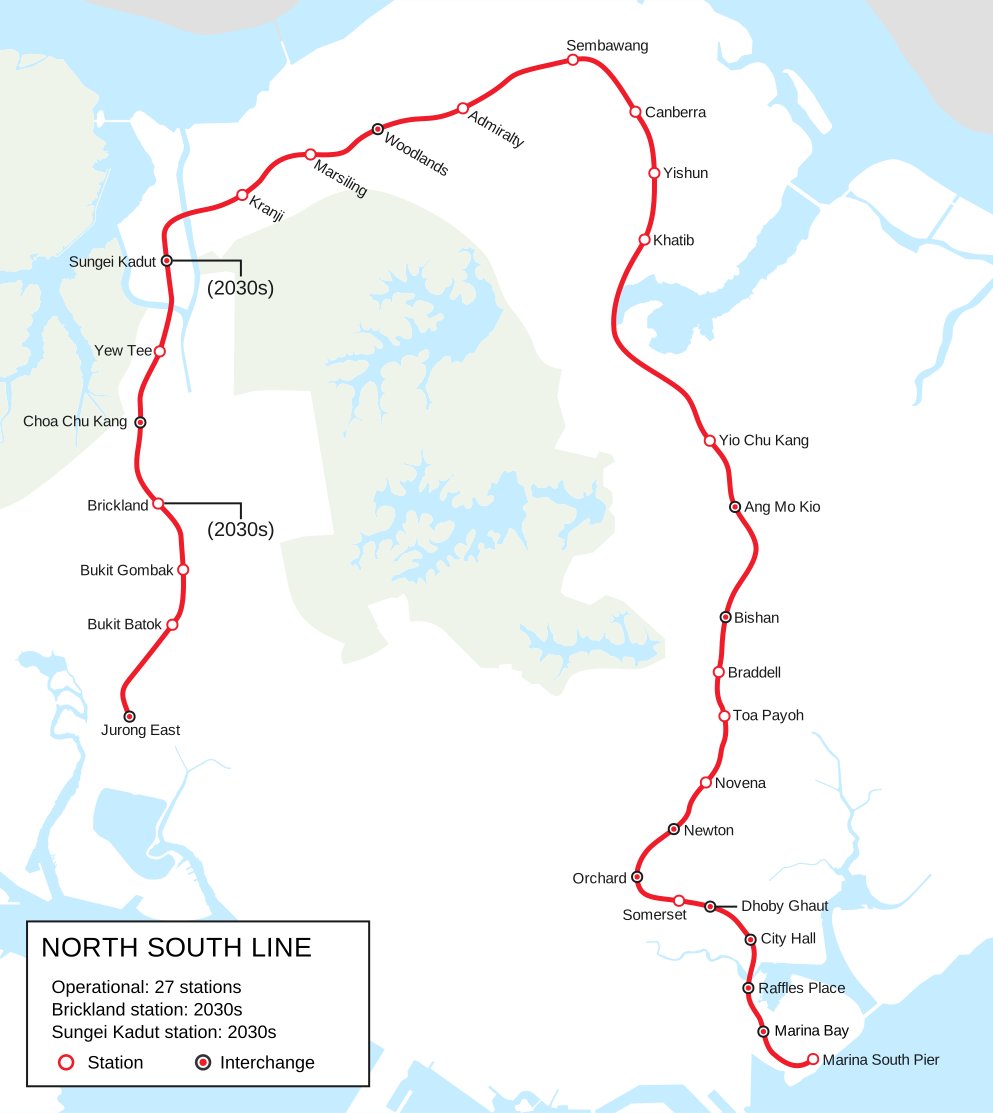
The North–South line forms an incomplete loop from Jurong East in the West Region of Singapore, north to Woodlands and Sembawang, and south to the Central Area. It is 45 km long and is predominantly double-tracked, but certain short sections at the Woodlands, Yishun and Ang Mo Kio stations widen to three tracks, and four tracks at Jurong East station. The line begins above ground at Jurong East station from where it continues north on a set of elevated viaducts, with the exception of a short tunnel between the Bukit Batok and Bukit Gombak stations, and a surface section of track between the Bukit Gombak and Choa Chu Kang stations. The line curves from the Yew Tee to Kranji stations and continues eastwards, paralleling Woodlands Avenue 3 (which the line briefly cuts underneath between Kranji and Marsiling stations) and Avenue 7 main roads.
After Sembawang station, the line follows the route of Canberra Link and Yishun Avenue 2, curving southwards. Between Khatib and Yio Chu Kang stations parallel to Lentor Avenue, the line continues at surface level; this section is the longest distance between any two MRT stations in Singapore. The line continues above ground for the Yio Chu Kang and Ang Mo Kio stations, then it goes back to surface level for Bishan station, the MRT system's only at-grade station. A branch line to Bishan Depot exists between the Ang Mo Kio and Bishan stations. After Bishan, the line goes underground through the Central Area. The North–South Line runs parallel to the East–West Line at the City Hall and Raffles Place stations, which are also cross-platform interchanges to the East–West Line. The line ends at Marina South Pier station.
Stations
The line serves 27 MRT stations across 45 km of track, and station codes for the line are red, corresponding to the line's colour on the system map. 11 stations, from Braddell to Marina South Pier are underground, with the rest being ground-level or elevated. With the exception of Bishan, Braddell and Canberra stations, the other stations have island platforms.
| Date | Project | Description |
|---|---|---|
| 7 November 1987 | Phase 1 | Yio Chu Kang – Toa Payoh |
| 12 December 1987 | Toa Payoh – Outram Park (Direct train service to Outram Park via Raffles Place) | |
| 12 March 1988 | Phase 1A | Outram Park – Clementi (Now part of the East–West Line) |
| 5 November 1988 | Phase 1B | Clementi – Lakeside (Now part of the East–West Line) |
| 20 December 1988 | Yio Chu Kang – Yishun | |
| 4 November 1989 | Phase 2A | Raffles Place – Marina Bay (Separation of the North–South Line & East–West Line) |
| 10 March 1990 | Phase 2B | Jurong East – Choa Chu Kang (Operates as a branch line from Jurong East) |
| 10 February 1996 | Woodlands Extension | Choa Chu Kang – Yishun |
| 23 November 2014 | North–South Line Extension | Marina Bay – Marina South Pier |
| 2 November 2019 | Canberra Station | Canberra station between Sembawang and Yishun |
| 2034 | Future infill stations between existing stations | Brickland station between Bukit Gombak and Choa Chu Kang |
| 2035 | Sungei Kadut station between Yew Tee and Kranji |
Legend
| [[File:Aiga escalator down.svg | 15px | link=]] | |||||||||||
|---|---|---|---|---|---|---|---|---|---|---|---|---|---|
| Underground | [[File:ISO 7010 W003.svg | 15px | link=]] | ||||||||||
| Civil Defence Shelter | [[File:Aiga carrental cropped.svg | 10px | link=]] [[File:BSicon Mono-CHN.svg | 10px | link=]] [[File:BSicon AETRAM.svg | 10px | link=]] [[File:Aiga watertransportation.svg | 10px | link=]] [[File:20 airtransportation.svg | 10px | link=]] [[File:Aiga immigration.svg | 10px | link=]] |
| Other transportation modes |
List
| SMRT | North South}}" | Station code | SMRT | North South}}" | Station name | SMRT | North South}}" | Images | SMRT | North South}}" | Interchange; | ||
|---|---|---|---|---|---|---|---|---|---|---|---|---|---|
| Adjacent transportation | SMRT | North South}}" | Opening | SMRT | North South}}" | Cost | |||||||
| Jurong East | [[File:Jurong East MRT Station NSL 2.jpg | 120px]] | |||||||||||
| (2028) | |||||||||||||
| ― | |||||||||||||
| [[File:Bus-logo.svg | 15px | link=]]Jurong East | S$5 billion | ||||||||||
| Bukit Batok | [[File:Bukit Batok MRT Station 202407.jpg | 120px]] | [[File:Bus-logo.svg | 15px | link=]]Bukit Batok | ||||||||
| Bukit Gombak | [[File:Bukit Gombak MRT Station.jpg | 120px]] | rowspan="2" | ||||||||||
| *Brickland* | |||||||||||||
| Choa Chu Kang | [[File:Choa Chu Kang MRT Station 202407.jpg | 120px]] | |||||||||||
| (2027) | |||||||||||||
| ― | |||||||||||||
| [[File:Bus-logo.svg | 15px | link=]]Choa Chu Kang | S$5 billion | ||||||||||
| Yew Tee | [[File:Yew Tee MRT Station 202407.jpg | 120px]] | S$1.2 billion | ||||||||||
| *Sungei Kadut* | (2035) | ||||||||||||
| Kranji | [[File:Kranji MRT Station.jpg | 120px]] | rowspan="2" | S$1.2 billion | |||||||||
| Marsiling | [[File:Marsiling MRT Station.jpg | 120px]] | |||||||||||
| Woodlands | [[File:Woodlands MRT Station 202407.jpg | 120px]] | |||||||||||
| ― | |||||||||||||
| [[File:Bus-logo.svg | 15px | link=]]Woodlands | |||||||||||
| [[File:Bus-logo.svg | 15px | link=]]Woodlands Temporary | |||||||||||
| Admiralty | [[File:Admiralty MRT Station.jpg | 120px]] | |||||||||||
| Sembawang | [[File:Sembawang MRT Station.jpg | 120px]] | [[File:Bus-logo.svg | 15px | link=]]Sembawang | ||||||||
| Canberra | [[File:Canberra MRT Station 2.jpg | 120px]] | S$274 million | ||||||||||
| Yishun | [[File:Yishun MRT Station 202407.jpg | 120px]] | [[File:Bus-logo.svg | 15px | link=]]Yishun | S$5 billion | |||||||
| Khatib | [[File:Khatib MRT Station.jpg | 120px]] | |||||||||||
| Yio Chu Kang | [[File:Yio Chu Kang MRT Station 202407 2.jpg | 120px]] | [[File:Bus-logo.svg | 15px | link=]]Yio Chu Kang | ||||||||
| Ang Mo Kio | [[File:Ang Mo Kio MRT Station.jpg | 120px]] | (2030) | ||||||||||
| ― | |||||||||||||
| [[File:Bus-logo.svg | 15px | link=]]Ang Mo Kio | |||||||||||
| Bishan | [[File:Bishan MRT Station.jpg | 120px]] | |||||||||||
| ― | |||||||||||||
| [[File:Bus-logo.svg | 15px | link=]]Bishan | |||||||||||
| Braddell | [[File:Braddell MRT Station 202407.jpg | 120px]] | |||||||||||
| Toa Payoh | [[File:Toa Payoh MRT Station 202407.jpg | 120px]] | [[File:Bus-logo.svg | 15px | link=]]Toa Payoh | ||||||||
| Novena | [[File:Novena MRT Station 202407.jpg | 120px]] | |||||||||||
| – | Newton | [[File:Newton MRT Station 202407.jpg | 120px]] | [[File:Barrier turnstile icon.svg | 15px | link=]] | |||||||
| Orchard | [[File:Orchard MRT Station 202407.jpg | 120px]] | |||||||||||
| Somerset | [[File:Somerset MRT Station 202407 2.jpg | 120px]] | |||||||||||
| Dhoby Ghaut | [[File:Dhoby Ghaut MRT Station 202407 2.jpg | 120px]] | |||||||||||
| City Hall | [[File:City hall MRT Station.jpg | 120px]] | |||||||||||
| Raffles Place | [[File:Raffles Place MRT Station 202407.jpg | 120px]] | |||||||||||
| Marina Bay | [[File:Marina Bay MRT Station 202407.jpg | 120px]] | |||||||||||
| Marina South Pier | [[File:Marina South Pier MRT Station 202407.jpg | 120px]] | [[File:Aiga watertransportation.svg | 15px | link=]]Marina South Pier[[File:Aiga immigration.svg | 15px | link=]] | ||||||
| [[File:Aiga watertransportation.svg | 15px | link=]]Marina Bay Cruise Centre[[File:Aiga immigration.svg | 15px | link=]] | url=http://www.lta.gov.sg/projects/proj_maps_rail_l.htm | title=Projects | publisher=Land Transport Authority | date=3 May 2010 | access-date=14 June 2022 | archive-date=5 June 2011 | archive-url=https://web.archive.org/web/20110605124529/http://www.lta.gov.sg/projects/proj_maps_rail_l.htm | url-status=live }} |
Depots
| SMRT | North South}}" | Depot name; | |||||||
|---|---|---|---|---|---|---|---|---|---|
| Lines | SMRT | North South}}" | Location | SMRT | North South}}" | Image | SMRT | North South}}" | Line-specific |
| stabling capacity | SMRT | North South}}" | Cost | SMRT | North South}}" | Opening | |||
| Bishan | [[File:NSL Bishan MRT Depot 20201013 183038.jpg | 100px]] | 59 trains | S$300 million | |||||
| Jurong East | [[File:Ulu Pandan Depot.jpg | 100px]] | 45 trains | S$130 million |
Infrastructure
Rolling stock
Electric Multiple Unit (EMU) trains on the North–South Line operate in a six-car formation, based out of Bishan Depot and Ulu Pandan Depot, which provide train maintenance, inspection and overhaul facilities. This rolling stock is shared with the East–West Line, with an electrification of 750 V DC powered by a third rail. With the exception of the C651 and R151 trains, the current rolling stock was manufactured by Kawasaki Heavy Industries, in a joint venture with CRRC Qingdao Sifang for the subsequent rolling stocks of the C151A, C151B and C151C trains. When the initial line opened, the rolling stock of the North–South Line consisted of 66 first-generation C151 trains only. The 19 second-generation C651 trains were introduced during the Woodlands extension to complement the existing 66 first-generation C151 trains. The 21 third-generation C751B trains were introduced during the Changi Airport extension to complement the existing 66 first-generation C151 trains and 19 second-generation C651 trains. In 2011, the fourth-generation C151A trains were introduced, increasing the passenger capacity of both the North–South and East–West lines by 15%. The C151A trains were the first successful joint venture between Kawasaki Heavy Industries and CSR Qingdao Sifang in the international market.
As part of efforts to further increase passenger capacity on the line, newer C151B and C151C trains were subsequently delivered in 2017 and 2018 respectively. The introduction of the C151B trains saw the introduction of STARiS (SMRT Active Route Map Information System) 2.0, which is also seen in subsequent rolling stocks. The C151C trains are also the first MRT rolling stock on the NSEWL to be fitted with tip-up seats, in addition to the current features of the C151B trains.
Another generation of rolling stock, the R151 trains, will be delivered from 2022 to 2026, to replace all 66 first-generation C151 trains which were fully retired in 2025, as well as all 19 second-generation C651 and 21 third-generation C751B trains which were fully retired in 2024. The R151 trains will be the first rolling stock on the North–South Line to be manufactured by Bombardier Transportation (Bought by Alstom in 2021), which has also supplied trains for the Downtown Line.
Signalling
Initially, the North–South line used a semi-automatic signalling system consisting of the Westinghouse fixed block signalling system with automatic train control under automatic train operation Grades of Automation (GoA) 2. However, the ageing system had undermined the rail reliability on the line, requiring the NSL to upgrade its signalling system. Since 2019, the North–South Line is fully equipped with Thales SelTrac Communications-based train control moving block signalling system with automatic train control under automatic train operation (ATO) GoA 3. The subsystems consist of automatic train protection to govern train speed, NetTrac MT Automatic Train Supervision (ATS) to track and schedule trains and a Computer-based interlocking system that prevents incorrect signal and track points to be set.
A new moving-block signalling system, supplied by Thales, replaced the ageing fixed-block signalling system on the North–South Line. The upgrading works were completed in phases from 2016. With the upgraded signalling system, trains are now able to run closer to each other. The new system was tested on the evening of 28 March 2017. Train services were paused for ten minutes as the old signalling system was being changed to the new system. From 16 April 2017, the new system commenced full-day testing on Sundays for two months. The new C151B rolling stock were first introduced to the line on these testing days. Since 28 May 2017, the new signalling system has been operating full-day on the North–South Line. The old signalling system then ceased operations on 2 January 2019.
Platform screen doors

When the line was first opened, full-height platform screen doors supplied by Westinghouse were installed at underground stations. These doors serve to prevent suicides, enable climate control within the station, better security control by restricting access to the tunnels and tracks and for overall passenger safety considerations. The authorities initially rejected calls for platform screen doors to be installed at elevated stations by casting doubts over functionality and concerns about the high installation costs. Nevertheless, the LTA reversed its decision and made plans to install half-height platform screen doors on elevated stations on 25 January 2008. The first platform screen doors by ST Electronics were installed at Pasir Ris, Jurong East and Yishun stations in 2009 as trial runs. Subsequently, installation began in May 2011 at Ang Mo Kio station. On 14 March 2012, platform screen doors became operational at all elevated stations on the North–South Line.
Rail
The NSL was built with wooden sleepers, which needed to be replaced when they neared the end of their lifespan of 15 to 25 years. The replacement sleepers, made out of concrete, have a significantly longer lifespan and enable smoother and safer rides. Since 2014, train services on the line have ended earlier for critical maintenance works, with the exception of a break between September 2016 and December 2016.
Trains on the NSL are powered via a third rail. However, constant contact between the train's Current Collector Devices (CCD) and the line saw the need for replacement works on the third rail, which were completed in August 2017. The new third rail replaced its 30-year-old predecessor, which was used since the opening of the line. The new electrical system is expected to make train services more reliable.
References
References
- "Land Transport DataMall".
- "Expect faster rides soon on North-South Line".
- "LTA {{!}} North–South Line".
- . (20 September 1967). ["'Unique nation State' plan"](https://eresources.nlb.gov.sg/newspapers/Digitised/Article/straitstimes19670920-1.2.22). *[[The Straits Times]]*.
- (1981). "Southeast Asian Affairs.". Singapore: Institute of Southeast Asian Studies.
- Sharp, Ilsa. (2005). "The Journey — Singapore's Land Transport Story". SNP:Editions.
- Fwa Tien Fang. (4 September 2004). "Sustainable Urban Transportation Planning and Development — Issues and Challenges for Singapore". Department of Civil Engineering, [[National University of Singapore]].
- "1982 – The Year Work Began". Land Transport Authority.
- "In Memoriam — Ong Teng Cheong: A Profile". [[Channel NewsAsia]].
- (8 July 1986). "Project to go on line in three stages". The Straits Times.
- (1983). "Annual report / Provisional Mass Rapid Transit Authority, Republic of Singapore.". Singapore: Provisional Mass Rapid Transit Authority.
- (29 August 1982). "North–south line off first". The Straits Times.
- (29 October 1983). "Work begins on the first part of MRT system". The Straits Times.
- (8 November 1987). "All aboard for the Subway Age". The Straits Times.
- "MRT system begins operations – Singapore History".
- (7 November 1987). "Speech by Dr Yeo Ning Hong, Minister For Communications and Information And Second Minister For Defence (Policy), at the inauguration of public service of the MRT system at the Toa Payoh Station on Saturday, 7 November 1987 at 9.00 am".
- Rav, Dhaliwal. (12 December 1987). "Shopping for Xmas the MRT way...". Straits Times.
- (20 December 1988). "MRT Yishun opens, two-thirds of system now complete". The New Paper.
- (30 November 1982). "New names for eight stations". Singapore Monitor.
- Dhaliwal, Rav. "East-enders get ticket to ride as MRT opens line". The Straits Times.
- Goh, Chok Tong. (10 February 1996). "Speech by Prime Minister Goh Chok Tong at the Opening of Woodlands MRT Line on Saturday, 10 February 1996 at 10.00 AM".
- (11 March 1988). "MRTC considering extending line to Woodlands". The Straits Times.
- "Woodlands MRT line {{!}} Infopedia". [[National Library Board]].
- Leong, C. T.. (26 February 1991). "Work on Woodlands MRT line to begin later this year". The Straits Times.
- "Past Concept Plans".
- (1991). "Living the next lap: towards a tropical city of excellence.". Urban Redevelopment Authority.
- (19 November 1992). "Better layouts for six new MRT stations". The Straits Times.
- (19 November 1992). "Another station added to Woodlands MRT line". The Straits Times.
- Thulaja, Naidu Ratnala. (11 November 2003). "Kranji MRT station". National Library Board Singapore.
- (20 November 1991). "Station names for Woodlands line have ties to surroundings". The Straits Times.
- (4 October 1994). "Woodlands MRT closer". The Straits Times.
- (10 February 1996). "Speech by Prime Minister Goh Chok Tong at the opening of Woodlands MRT line on Saturday, 10 February 1996 at 10.00 am".
- (26 July 2008). "New Platform at Bishan Station ready". The Straits Times.
- (22 May 2009). "Bishan MRT station ready for Circle crowds". The Straits Times.
- "Jurong East Modification Project".
- (16 May 2011). "New Platform At Jurong East Station To Open On 27 May". Land Transport Authority of Singapore.
- "New Platform At Jurong East Station To Open On 27 May {{!}} Press Room {{!}} Land Transport Authority".
- (February 2008). "Land Transport Master Plan 2008 (Pg 34)".
- (22 November 2014). "Marina South Pier MRT Station on North–South Line to open on Sunday".
- (17 November 2014). "Marina South Pier Station to Open on 23 November".
- "North–South Line Extension {{!}} Projects {{!}} Public Transport {{!}} Land Transport Authority".
- (17 January 2013). "Speech by Mr Lui Tuck Yew at visit to DTL1 Chinatown Station on 17 January 2013".
- (17 January 2013). "Two New Rail Lines And Three New Extensions To Expand Rail Network By 2030". Land Transport Authority.
- (27 June 2014). "New MRT station for North–South Line: Canberra". The Straits Times.
- (26 March 2016). "Work Starts for Canberra MRT Station on North–South Line".
- "Work starts on Canberra MRT station".
- (20 May 2019). "Canberra MRT station to open on Nov 2". CNA.
- Loi, Esther. (2025-10-21). "New artworks to enliven 40 MRT stations". The Straits Times.
- (March 2003). "Car accident on the MRT track". RIMAS.
- (15 December 2011). "North–South MRT line breakdown hits thousands". Channel News Asia.
- "2nd Update – SMRT statement: Service disruption on North–South Line (Northbound): Marina Bay Station to Bishan Station".
- (17 December 2011). "MRT breaks down again". Channel NewsAsia.
- (17 December 2011). "North–South Line service resumes after 7-hour disruption". Channel NewsAsia.
- "Service disruption on North–South Line on 17 Dec 2011".
- (9 January 2012). "Minister Updates Parliament on MRT Disruptions". Ministry Of Transport.
- LTA. "Power trip on MRT network due to power fault on NSEWL".
- Tan, Christopher. (7 July 2015). "Full train service resumes; no suspension of North–South line at 11am".
- Tang, Louisa. (7 July 2015). "MRT breakdown: North–South, East–West lines down for hours". Mediacorp.
- Malinda, Kyle. (22 August 2015). "Cause of massive NSEWL train disruption in July identified, says SMRT". Mediacorp.
- (23 September 2015). "SMRT to be fined a record S$5.4m for July 7 MRT breakdown". Channel NewsAsia.
- "NSL disruption: No train services between Ang Mo Kio, Newton 'till further notice', says SMRT". Channel NewsAsia.
- "NSL disruption: Malfunctioning water pumping system resulted in flooded MRT tunnel, says LTA". Channel NewsAsia.
- Tan, Christopher. (14 October 2020). "Train services restored on North–South, East–West, Circle lines after disruption due to power fault".
- "Oct 14 MRT breakdown: Manufacturer to replace power cables along Tuas West Extension, 2 SMRT staff suspended".
- Hamzah, Aqil. (2023-10-27). "Novena MRT station reopens after closure caused by smoke from air-con unit". The Straits Times.
- Ang, Qing. (2024-06-03). "Lightning strike sparks power trip that disrupted MRT services on NSL for over 2 hours". The Straits Times.
- (25 May 2019). "New Sungei Kadut MRT station linking North–South and Downtown lines could shorten trips by 30 mins".
- "Land Transport Master Plan 2040".
- "Land Transport Master Plan 2040: Bringing Singapore Together {{!}} Press Room {{!}} Land Transport Authority".
- (25 May 2019). "At a glance: Key updates to MRT, bus network and more for 2040 master plan". TODAYonline.
- "LTA {{!}} Getting Around {{!}} Public Transport {{!}} Rail Network".
- "SMRT Journeys".
- "SMRT Journeys".
- "Early Closure of Selected North–South Line Stations from January to March 2020".
- "Last train services for MRT and LRT (Annex B)".
- "Changes to Public Bus and Train Operating Hours and Frequency".
- [[OpenStreetMap]] contributors. (28 March 2020). "OpenStreetMap".
- [[OpenStreetMap]] contributors. (28 March 2020). "OpenStreetMap".
- [[OpenStreetMap]] contributors. (28 March 2020). "OpenStreetMap".
- [[OpenStreetMap]] contributors. (28 March 2020). "OpenStreetMap".
- "OneMap".
- "MRT System Map".
- [[OpenStreetMap]] contributors. (28 March 2020). "OpenStreetMap".
- [[OpenStreetMap]] contributors. (28 March 2020). "OpenStreetMap".
- [[OpenStreetMap]] contributors. (28 March 2020). "OpenStreetMap".
- [[OpenStreetMap]] contributors. (31 March 2020). "OpenStreetMap".
- [[OpenStreetMap]] contributors. (28 March 2020). "OpenStreetMap".
- [[OpenStreetMap]] contributors. (31 March 2020). "OpenStreetMap".
- "North–South Line". Land Transport Authority.
- "North–South Line Extension".
- . (2017). "Singapore Bilingual Street Directory". *Mighty Minds Publishing Pte Ltd*.
- "Woodlands MRT line".
- "Woodlands MRT line".
- "Revenue & Expenditure Estimates".
- (3 May 2010). "Projects". Land Transport Authority.
- (10 June 1984). "10 shortlisted for Bishan Depot deal". The Straits Times.
- (17 October 1986). "Building the MRT's third depot". The Straits Times.
- "North–South Line signalling system to take up to 6 months to stabilise". Channel NewsAsia.
- "海外向け車両 {{!}} 鉄道車両".
- (16 August 1992). "$290 million contracts for Woodlands MRT line". The Straits Times.
- "EMU Trains for the Singapore Land Transport Authority". Kawasaki Heavy Industries.
- "Rapid Transit {{!}} Kawasaki Heavy Industries".
- (7 May 2009). "Extra metro trains for Singapore". [[Railway Gazette International]].
- (16 May 2011). "Five new trains added to boost capacity of North–South and East–West Lines". [[SMRT Corporation]].
- "Train capacity to rise by up to 50% in 4 years".
- (13 May 2009). "CSR Sifang and Kawasaki Heavy Industries Won the Bid in the Subway Vehicle Project of Singapore".
- (12 April 2017). "New signalling system trials extended to full day every Sunday: SMRT, LTA". Channel NewsAsia.
- (29 April 2016). "LTA Singapore Orders 12 MRT Trains (72 cars) for North–South/East–West Lines {{!}} Kawasaki Heavy Industries, Ltd.".
- (21 January 2016). "SMRT Boosts Service Excellence Efforts with first Customer Experience Innovation Conference". SMRT Corporation.
- Tan, Christopher. (14 August 2018). "SMRT adding 12 trains to two most heavily used lines". The Straits Times.
- "LTA {{!}} News Room {{!}} News Releases {{!}} 12 More Trains to Boost Capacity of North–South and East–West Lines".
- "LTA {{!}} News Room {{!}} News Releases {{!}} Bombardier to Supply 66 New Trains for North–South and East–West Lines".
- "New fleet to replace 66 oldest MRT trains from 2021". Channel NewsAsia.
- Qing, Ang. (25 July 2018). "Bombardier awarded $1.2 billion contract to replace 66 oldest MRT trains". The Straits Times.
- Woodland, Daniel. (August 2004). "Optimisation of Automatic Train Protection Systemstion Systems".
- "Oral Reply by Minister for Transport Khaw Boon Wan to Parliamentary Question on North–South Line Resignalling".
- "Speech by Minister Khaw Boon Wan at the Fourth Joint Forum on Infrastructure Maintenance".
- "Thales awarded signalling contracts for Singapore North–South, East–West lines and Tuas West Extension".
- "Metro automation facts, figures and trends".
- (6 February 2012). "Thales awarded signalling contracts for Singapore North–South, East–West lines and Tuas West Extension". Thales Group.
- "THALES Urban Rail Signalling Singapore – North–South / East-West Lines".
- "North–South Line Signal Upgrade".
- (28 March 2017). "Joint Media Release by the Land Transport Authority (LTA) & SMRT – New Signalling System Trial on North–South Line Begins on 28 March 2017".
- (16 April 2017). "Factsheet by the Land Transport Authority (LTA) & SMRT: Full-day Sunday Trial of New Signalling System for North–South Line from 16 April 2017".
- (6 June 2017). "7 Questions about SMRT Trains' New Signalling System – SMRT Blog".
- [http://www.platformscreendoors.com/psd/projects/massrapid.php Westinghouse Platform Screen Doors – Completed Projects] {{webarchive. link. (13 February 2008)
- (20 November 2005). "Safety at MRT and LRT Stations — Respect The Yellow line". Land Transport Authority.
- (25 January 2008). "Platform screen doors for all above-ground MRT stations by 2012". The Straits Times.
- (25 January 2008). "Speech by Mr Raymond Lim, Minister for Transport, at the Visit to Kim Chuan Depot, 25 January 2008, 9.00am". Ministry of Transport.
- Yeo Ghim Lay. (3 September 2008). "Platform doors for elevated MRT stations". The Straits Times.
- "LTA completes installing elevated MRT station screen doors early". Channel NewsAsia.
- (17 October 2016). "SMRT Rail Improvements – Updates – SMRT Blog".
- (25 December 2016). "Project to replace MRT sleepers done". The Straits Times.
- "Factsheet on Power Rail Replacement Programme for the North–South and East–West Lines (NSEWL)".
- "Third Rail Replacement on North South and East West Line".
This article was imported from Wikipedia and is available under the Creative Commons Attribution-ShareAlike 4.0 License. Content has been adapted to SurfDoc format. Original contributors can be found on the article history page.
Ask Mako anything about North–South Line (Singapore) — get instant answers, deeper analysis, and related topics.
Research with MakoFree with your Surf account
Create a free account to save articles, ask Mako questions, and organize your research.
Sign up freeThis content may have been generated or modified by AI. CloudSurf Software LLC is not responsible for the accuracy, completeness, or reliability of AI-generated content. Always verify important information from primary sources.
Report