From Surf Wiki (app.surf) — the open knowledge base
Multiplication
Arithmetical operation
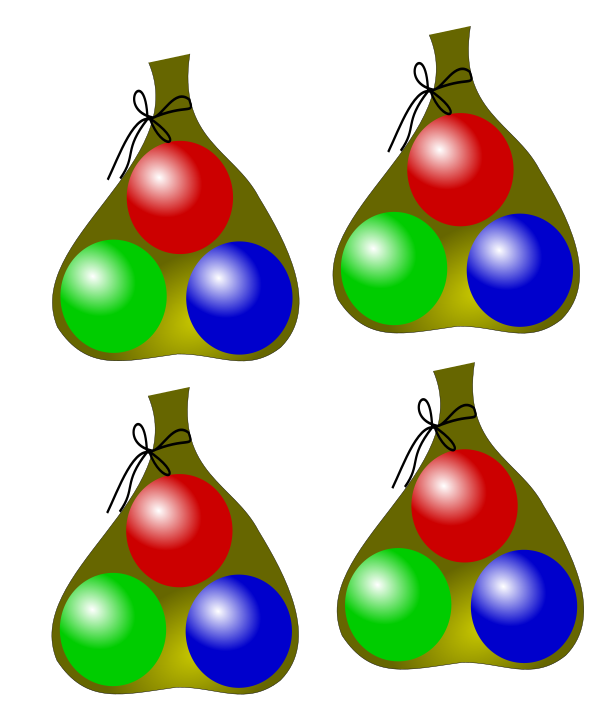
Arithmetical operation
the mathematical operation
Multiplication is one of the four elementary mathematical operations of arithmetic, with the other ones being addition, subtraction, and division. The result of a multiplication operation is called a product. Multiplication is often denoted by the cross symbol, , by the mid-line dot operator, , by juxtaposition, or, in programming languages, by an asterisk, .
The multiplication of whole numbers may be thought of as repeated addition; that is, the multiplication of two numbers is equivalent to adding as many copies of one of them, the multiplicand, as the quantity of the other one, the multiplier; both numbers can be referred to as factors. This is to be distinguished from terms, which are added. :a\times b = \underbrace{b + \cdots + b}_{a \text{ times}} .
Whether the first factor is the multiplier or the multiplicand may be ambiguous or depend upon context. For example, the expression 3 \times 4 can be phrased as "3 times 4" and evaluated as 4+4+4, where 3 is the multiplier, but also as "3 multiplied by 4", in which case 3 becomes the multiplicand. One of the main properties of multiplication is the commutative property, which states in this case that adding 3 copies of 4 gives the same result as adding 4 copies of 3. Thus, the designation of multiplier and multiplicand does not affect the result of the multiplication.
Systematic generalizations of this basic definition define the multiplication of integers (including negative numbers), rational numbers (fractions), and real numbers.
Multiplication can also be visualized as counting objects arranged in a rectangle (for whole numbers) or as finding the area of a rectangle whose sides have some given lengths. The area of a rectangle does not depend on which side is measured first—a consequence of the commutative property.
The product of two measurements (or physical quantities) is a new type of measurement (or new quantity), usually with a derived unit of measurement. For example, multiplying the lengths (in meters or feet) of the two sides of a rectangle gives its area (in square meters or square feet). Such a product is the subject of dimensional analysis.
The inverse operation of multiplication is division. For example, since 4 multiplied by 3 equals 12, 12 divided by 3 equals 4. Indeed, multiplication by 3, followed by division by 3, yields the original number. The division of a number other than 0 by itself equals 1.
Several mathematical concepts expand upon the fundamental idea of multiplication. The product of a sequence, vector multiplication, complex numbers, and matrices are all examples where this can be seen. These more advanced constructs tend to affect the basic properties in their own ways, such as becoming noncommutative in matrices and some forms of vector multiplication or changing the sign of complex numbers.
Notation
Main article: Multiplication sign
In arithmetic, multiplication is often written using the multiplication sign (either or ) between the factors (that is, in infix notation).{{cite book :2\times 3 = 6, ("two times three equals six") :3\times 4 = 12 , :2\times 3\times 5 = 6\times 5 = 30, :2\times 2\times 2\times 2 \times 2 = 32.
There are other mathematical notations for multiplication:
- To reduce confusion between the multiplication sign × and the common variable x, multiplication is also denoted by dot signs, usually a middle-position dot (rarely period): 5 \cdot 2. The middle dot notation or dot operator is now standard in the United States{{cite book
- ImplicitIn algebra, multiplication involving variables is often written as a juxtaposition (e.g., xy for x times y or 5x for five times x), also called implied multiplication. The notation can also be used for quantities that are surrounded by parentheses (e.g., 5(2), (5)2 or (5)(2) for five times two).{{cite journal
- In vector multiplication, there is a distinction between the cross and the dot symbols. The cross symbol generally denotes the taking a cross product of two vectors, yielding a vector as its result, while the dot denotes taking the dot product of two vectors, resulting in a scalar.
In computer programming, the asterisk (as in 5*2) is still the most common notation. This is because most computers historically were limited to small character sets (such as ASCII and EBCDIC) that lacked a multiplication sign (such as × or ⋅), while the asterisk appeared on every keyboard.{{cite book
Terminology The numbers to be multiplied are generally called the "factors" (as in factorization). The number to be multiplied is the "multiplicand", and the number by which it is multiplied is the "multiplier". Usually, the multiplier is placed first, and the multiplicand is placed second; however, sometimes the first factor is considered the multiplicand and the second the multiplier. Also, as the result of multiplication does not depend on the order of the factors, the distinction between "multiplicand" and "multiplier" is useful only at a very elementary level and in some multiplication algorithms, such as the long multiplication. Therefore, in some sources, the term "multiplicand" is regarded as a synonym for "factor". In algebra, a number that is the multiplier of a variable or expression (e.g., the 3 in 3xy^2) is called a coefficient.
The result of a multiplication is called a product. When one factor is an integer, the product is a multiple of the other or of the product of the others. Thus, 2\times \pi is a multiple of \pi, as is 5133 \times 486 \times \pi. A product of integers is a multiple of each factor; for example, 15 is the product of 3 and 5 and is both a multiple of 3 and a multiple of 5.
Definitions
The product of two numbers or the multiplication between two numbers can be defined for common special cases: natural numbers, integers, rational numbers, real numbers, complex numbers, and quaternions.
Product of two natural numbers
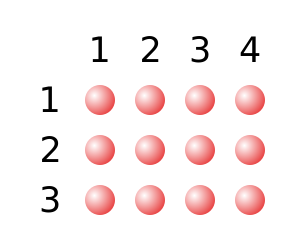
The product of two natural numbers r,s\in\mathbb{N} is defined as:
r \cdot s \equiv \sum_{i=1}^s r = \underbrace{ r+r+\cdots+r }{s\text{ times}} \equiv \sum{j=1}^r s = \underbrace{ s+s+\cdots+s }_{r\text{ times}} .
Product of two integers
An integer can be either zero, a nonzero natural number, or minus a nonzero natural number. The product of zero and another integer is always zero. The product of two nonzero integers is determined by the product of their positive amounts, combined with the sign derived from the following rule:
| × | + | − | + | − |
|---|---|---|---|---|
| + | − | |||
| − | + |
(This rule is a consequence of the distributivity of multiplication over addition, and is not an additional rule.)
In words:
- A positive number multiplied by a positive number is positive (product of natural numbers),
- A positive number multiplied by a negative number is negative,
- A negative number multiplied by a positive number is negative,
- A negative number multiplied by a negative number is positive.
Product of two fractions
Two fractions can be multiplied by multiplying their numerators and denominators:
: \frac{z}{n} \cdot \frac{z'}{n'} = \frac{z\cdot z'}{n\cdot n'} , :which is defined when n,n'\neq 0 .
Product of two real numbers
There are several equivalent ways to define formally the real numbers; see Construction of the real numbers. The definition of multiplication is a part of all these definitions.
A fundamental aspect of these definitions is that every real number can be approximated to any accuracy by rational numbers. A standard way for expressing this is that every real number is the least upper bound of a set of rational numbers. In particular, every positive real number is the least upper bound of the truncations of its infinite decimal representation; for example, \pi is the least upper bound of {3,; 3.1,; 3.14,; 3.141,\ldots}.
A fundamental property of real numbers is that rational approximations are compatible with arithmetic operations, and, in particular, with multiplication. This means that, if a and b are positive real numbers such that a=\sup_{x\in A} x and b=\sup_{y\in B} y, then a\cdot b=\sup_{x\in A, y\in B}x\cdot y. In particular, the product of two positive real numbers is the least upper bound of the term-by-term products of the sequences of their decimal representations.
As changing the signs transforms least upper bounds into greatest lower bounds, the simplest way to deal with a multiplication involving one or two negative numbers, is to use the rule of signs described above in . The construction of the real numbers through Cauchy sequences is often preferred in order to avoid consideration of the four possible sign configurations.
Product of two complex numbers
Two complex numbers can be multiplied by the distributive law and the fact that i^2=-1, as follows: :\begin{align} (a + b, i) \cdot (c + d, i) &= a \cdot c + a \cdot d, i + b , i \cdot c + b \cdot d \cdot i^2\ &= (a \cdot c - b \cdot d) + (a \cdot d + b \cdot c) , i \end{align}

The geometric meaning of complex multiplication can be understood by rewriting complex numbers in polar coordinates:
:a + b, i = r \cdot ( \cos(\varphi) + i \sin(\varphi) ) = r \cdot e ^{ i \varphi}
Furthermore, :c + d, i = s \cdot ( \cos(\psi) + i\sin(\psi) ) = s \cdot e^{i\psi},
from which one obtains :(a \cdot c - b \cdot d) + (a \cdot d + b \cdot c) i = r \cdot s \cdot e^{i(\varphi + \psi)}.
The geometric meaning is that the magnitudes are multiplied and the arguments are added.
Product of two quaternions
The product of two quaternions can be found in the article on quaternions. Note, in this case, that a \cdot b and b \cdot a are in general different.
Computation
Main article: Multiplication algorithm
Many common methods for multiplying numbers using pencil and paper require a multiplication table of memorized or consulted products of small numbers (typically any two numbers from 0 to 9). However, one method, the peasant multiplication algorithm, does not. The example below illustrates "long multiplication" (the "standard algorithm", "grade-school multiplication"):
23958233 × 5830 ——————————————— 00000000 ( = 23,958,233 × 0) 71874699 ( = 23,958,233 × 30) 191665864 ( = 23,958,233 × 800)
- 119791165 ( = 23,958,233 × 5,000) ——————————————— 139676498390 ( = 139,676,498,390 ) In some countries such as Germany, the multiplication above is depicted similarly but with the original problem written on a single line and computation starting with the first digit of the multiplier: 23958233 · 5830 ——————————————— 119791165 191665864 71874699 00000000 ——————————————— 139676498390 Multiplying numbers to more than a couple of decimal places by hand is tedious and error-prone. Common logarithms were invented to simplify such calculations, since adding logarithms is equivalent to multiplying. The slide rule allowed numbers to be quickly multiplied to about three places of accuracy. Beginning in the early 20th century, mechanical calculators, such as the Marchant, automated multiplication of up to 10-digit numbers. Modern electronic computers and calculators have greatly reduced the need for multiplication by hand.
Historical algorithms
Methods of multiplication were documented in the writings of ancient Egyptian, and Chinese civilizations.
The Ishango bone, dated to about 18,000 to 20,000 BC, may hint at a knowledge of multiplication in the Upper Paleolithic era in Central Africa, but this is speculative.
Egyptians
Main article: Ancient Egyptian multiplication
The Egyptian method of multiplication of integers and fractions, which is documented in the Rhind Mathematical Papyrus, was by successive additions and doubling. For instance, to find the product of 13 and 21 one had to double 21 three times, obtaining , , . The full product could then be found by adding the appropriate terms found in the doubling sequence: :13 × 21 = (1 + 4 + 8) × 21 = (1 × 21) + (4 × 21) + (8 × 21) = 21 + 84 + 168 = 273.
Babylonians
The Babylonians used a sexagesimal positional number system, analogous to the modern-day decimal system. Thus, Babylonian multiplication was very similar to modern decimal multiplication. Because of the relative difficulty of remembering 60 × 60 different products, Babylonian mathematicians employed multiplication tables. These tables consisted of a list of the first twenty multiples of a certain principal number n: n, 2n, ..., 20n; followed by the multiples of 10n: 30n 40n, and 50n. Then to compute any sexagesimal product, say 53n, one only needed to add 50n and 3n computed from the table.
Chinese
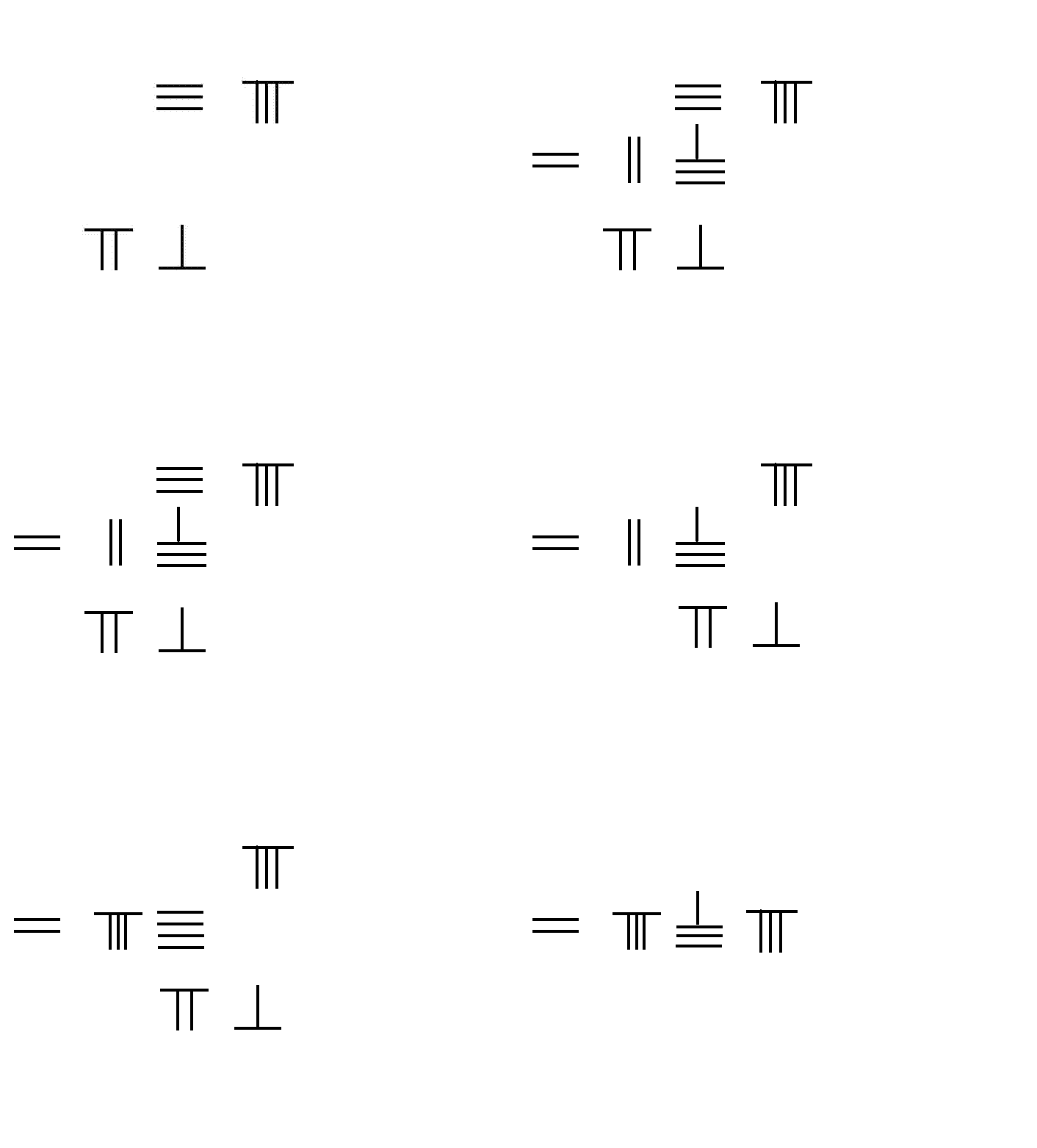
In the mathematical text Zhoubi Suanjing, dated prior to 300 BC, and the Nine Chapters on the Mathematical Art, multiplication calculations were written out in words, although the early Chinese mathematicians employed Rod calculus involving place value addition, subtraction, multiplication, and division. The Chinese were already using a decimal multiplication table by the end of the Warring States period.
Modern methods
The modern method of multiplication based on the Hindu–Arabic numeral system was first described by Brahmagupta. Brahmagupta gave rules for addition, subtraction, multiplication, and division. Henry Burchard Fine, then a professor of mathematics at Princeton University, wrote the following: :The Indians are the inventors not only of the positional decimal system itself, but of most of the processes involved in elementary reckoning with the system. Addition and subtraction they performed quite as they are performed nowadays; multiplication they effected in many ways, ours among them, but division they did cumbrously. These place value decimal arithmetic algorithms were introduced to Arab countries by Al Khwarizmi in the early 9th century and popularized in the Western world by Fibonacci in the 13th century.
Grid method
Grid method multiplication, or the box method, is used in primary schools in England and Wales and in some areas of the United States to help teach an understanding of how multiple digit multiplication works. An example of multiplying 34 by 13 would be to lay the numbers out in a grid as follows:
:{| class="wikitable" style="text-align: center;" ! scope="col" | × ! scope="col" | 30 ! scope="col" | 4 |- ! scope="row" | 10 |300
| 40 |
|---|
| ! scope="row" |
| 90 |
| 12 |
| } |
and then add the entries.
Computer algorithms
Main article: Multiplication algorithm#Fast multiplication algorithms for large inputs
The classical method of multiplying two n-digit numbers requires n2 digit multiplications. Multiplication algorithms have been designed that reduce the computation time considerably when multiplying large numbers. Methods based on the discrete Fourier transform reduce the computational complexity to O(n log n log log n). In 2016, the factor log log n was replaced by a function that increases much slower, though still not constant. In March 2019, David Harvey and Joris van der Hoeven submitted a paper presenting an integer multiplication algorithm with a complexity of O(n\log n). The algorithm, also based on the fast Fourier transform, is conjectured to be asymptotically optimal. The algorithm is not practically useful, as it only becomes faster for multiplying extremely large numbers (having more than 2172912 bits).
Products of measurements
Main article: Dimensional analysis
One can only meaningfully add or subtract quantities of the same type, but quantities of different types can be multiplied or divided without problems. For example, four bags with three marbles each can be thought of as: :[4 bags] × [3 marbles per bag] = 12 marbles.
When two measurements are multiplied together, the product is of a type depending on the types of measurements. The general theory is given by dimensional analysis. This analysis is routinely applied in physics, but it also has applications in finance and other applied fields.
A common example in physics is the fact that multiplying speed by time gives distance. For example: :50 kilometers per hour × 3 hours = 150 kilometers. In this case, the hour units cancel out, leaving the product with only kilometer units.
Other examples of multiplication involving units include: :2.5 meters × 4.5 meters = 11.25 square meters :11 meters/second × 9 seconds = 99 meters :4.5 residents per house × 20 houses = 90 residents
Product of a sequence{{anchor|Product of sequences|Products of sequences}}==
Capital pi notation{{Anchor|Capital Pi notation}}===
The product of a sequence of factors can be written with the product symbol \textstyle \prod, which derives from the capital letter Π (pi) in the Greek alphabet (much like the same way the summation symbol \textstyle \sum is derived from the Greek letter Σ (sigma)). The meaning of this notation is given by :\prod_{i=1}^4 (i+1) = (1+1),(2+1),(3+1), (4+1), which results in :\prod_{i=1}^4 (i+1) = 120.
In such a notation, the variable i represents a varying integer, called the multiplication index, that runs from the lower value 1 indicated in the subscript to the upper value 4 given by the superscript. The product is obtained by multiplying together all factors obtained by substituting the multiplication index for an integer between the lower and the upper values (the bounds included) in the expression that follows the product operator.
More generally, the notation is defined as :\prod_{i=m}^n x_i = x_m \cdot x_{m+1} \cdot x_{m+2} \cdot ,,\cdots,, \cdot x_{n-1} \cdot x_n, where m and n are integers or expressions that evaluate to integers. In the case where , the value of the product is the same as that of the single factor x**m; if m n, the product is an empty product whose value is 1—regardless of the expression for the factors.
Properties of capital pi notation
By definition, :\prod_{i=1}^{n}x_i=x_1\cdot x_2\cdot\ldots\cdot x_n.
If all factors are identical, a product of n factors is equivalent to exponentiation: :\prod_{i=1}^{n}x=x\cdot x\cdot\ldots\cdot x=x^n.
Associativity and commutativity of multiplication imply :\prod_{i=1}^{n}{x_iy_i} =\left(\prod_{i=1}^{n}x_i\right)\left(\prod_{i=1}^{n}y_i\right) and :\left(\prod_{i=1}^{n}x_i\right)^a =\prod_{i=1}^{n}x_i^a if a is a non-negative integer, or if all x_i are positive real numbers, and :\prod_{i=1}^{n}x^{a_i} =x^{\sum_{i=1}^{n}a_i} if all a_i are non-negative integers, or if x is a positive real number.
Infinite products
Main article: Infinite product
One may also consider products of infinitely many factors; these are called infinite products. Notationally, this consists in replacing n above by the infinity symbol ∞. The product of such an infinite sequence is defined as the limit of the product of the first n factors, as n grows without bound. That is, :\prod_{i=m}^\infty x_i = \lim_{n\to\infty} \prod_{i=m}^n x_i.
One can similarly replace m with negative infinity, and define: :\prod_{i=-\infty}^\infty x_i = \left(\lim_{m\to-\infty}\prod_{i=m}^0 x_i\right) \cdot \left(\lim_{n\to\infty} \prod_{i=1}^n x_i\right), provided both limits exist.
Exponentiation
Main article: Exponentiation
When multiplication is repeated, the resulting operation is known as exponentiation. For instance, the product of three factors of two (2×2×2) is "two raised to the third power", and is denoted by 23, a two with a superscript three. In this example, the number two is the base, and three is the exponent. In general, the exponent (or superscript) indicates how many times the base appears in the expression, so that the expression :a^n = \underbrace{a\times a \times \cdots \times a}n = \prod{i=1}^{n}a indicates that n copies of the base a are to be multiplied together. This notation can be used whenever multiplication is known to be power associative.
Properties
For real and complex numbers, which includes, for example, natural numbers, integers, and fractions, multiplication has certain properties:
;Commutative property :The order in which two numbers are multiplied does not matter:
Ask Mako anything about Multiplication — get instant answers, deeper analysis, and related topics.
Research with MakoFree with your Surf account
Create a free account to save articles, ask Mako questions, and organize your research.
Sign up freeThis content may have been generated or modified by AI. CloudSurf Software LLC is not responsible for the accuracy, completeness, or reliability of AI-generated content. Always verify important information from primary sources.
Report