From Surf Wiki (app.surf) — the open knowledge base
Meyer–Schuster rearrangement
Chemical reaction

Chemical reaction
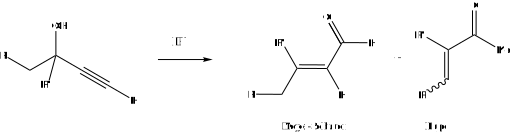
Kurt Schuster The Meyer–Schuster rearrangement is the chemical reaction described as an acid-catalyzed rearrangement of secondary and tertiary propargyl alcohols to α,β-unsaturated ketones if the alkyne group is internal and α,β-unsaturated aldehydes if the alkyne group is terminal.
Mechanism

The reaction proceeds by three major steps: (1) the rapid protonation of oxygen, (2) the slow, rate-determining step comprising the 1,3-shift of the protonated hydroxy group, and (3) the keto-enol tautomerism followed by rapid deprotonation. Formation of the unsaturated carbonyl compound is irreversible. Solvent is important and solvent caging is proposed to stabilize the transition state.
Rupe rearrangement
The reaction of tertiary alcohols containing an α-acetylenic group does not produce the expected aldehydes, but rather α,β-unsaturated methyl ketones via an enyne intermediate. This alternate reaction is called the Rupe reaction, and competes with the Meyer–Schuster rearrangement in the case of tertiary alcohols.

Use of catalysts
The traditional Meyer–Schuster rearrangement is induced by strong acids, which introduces competition with the Rupe reaction if the alcohol is tertiary. Milder conditions are possible with transition metal-based and Lewis acid catalysts (for example, Ru- and Ag-based catalysts). Microwave-radiation with catalyst to give excellent yields with short reaction times and good stereoselectivity.

Use in organic synthesis
The Meyer–Schuster rearrangement has been used in several syntheses. ω-Alkynyl-ω-carbinol lactams convert into enamides using catalytic PTSA α,β-Uunsaturated thioesters have been prepared from γ-sulfur substituted propargyl alcohols. 3-Alkynyl-3-hydroxyl-1H-isoindoles rearrange under mildly acidic conditions to the α,β-unsaturated carbonyl compounds. The synthesis of a part of paclitaxel exploits this rearrangement for a diastereomerically-selective route to the E-alkene.

The step shown above had a 70% yield (91% when the byproduct was converted to the Meyer-Schuster product in another step). The authors used the Meyer–Schuster rearrangement because they wanted to convert a hindered ketone to an alkene without destroying the rest of their molecule.
History
The reaction is named after Kurt Meyer and Kurt Schuster. Reviews have been published by Swaminathan and Narayan,
Applications
- Used in Butaclamol synthesis.
References
References
- Swaminathan, S.; Narayan, K. V. "The Rupe and Meyer-Schuster Rearrangements" ''[[Chem. Rev.]]'' '''1971''', ''71'', 429–438. ([https://dx.doi.org/10.1021/cr60273a001 Review])
- Vartanyan, S. A.; Banbanyan, S. O. ''Russ. Chem. Rev.'' '''1967''', ''36'', 670. ([https://dx.doi.org/10.1070/RC1967v036n09ABEH001681 Review])
- Engel, D.A.; Dudley, G.B. ''[[Organic and Biomolecular Chemistry]]'' '''2009''', ''7'', 4149–4158. ([https://dx.doi.org/10.1039/b912099h Review])
- Li, J.J. In ''Meyer-Schuster rearrangement''; Name Reactions: A Collection of Detailed Reaction Mechanisms; Springer: Berlin, 2006; pp 380–381.({{doi. 10.1007/978-3-642-01053-8_159)
- Edens, M.; Boerner, D.; Chase, C. R.; Nass, D.; Schiavelli, M. D. ''[[J. Org. Chem.]]'' '''1977''', ''42'', 3403–3408. ({{doi. 10.1021/jo00441a017)
- Andres, J.; Cardenas, R.; Silla, E.; Tapia, O. ''[[J. Am. Chem. Soc.]]'' '''1988''', ''110'', 666–674. ({{doi. 10.1021/ja00211a002)
- Tapia, O.; Lluch, J.M.; Cardena, R.; Andres, J. ''[[J. Am. Chem. Soc.]]'' '''1989''', ''111'', 829–835. ({{doi. 10.1021/ja00185a007)
- Rupe, H.; Kambli, E. ''[[Helv. Chim. Acta]]'' '''1926''', ''9'', 672. ({{doi. 10.1002/hlca.19260090185)
- Li, J.J. In ''Rupe rearrangement''; Name Reactions: A Collection of Detailed Reaction Mechanisms; Springer: Berlin, 2006; pp 513–514.({{doi. 10.1007/978-3-642-01053-8_224)
- Cadierno, V.; Crochet, P.; Gimeno, J. ''[[Synlett]]'' '''2008''', 1105–1124. ({{doi. 10.1055/s-2008-1072593)
- Sugawara, Y.; Yamada, W.; Yoshida, S.; Ikeno, T.; Yamada, T. ''[[J. Am. Chem. Soc.]]'' '''2007''', ''129'', 12902-12903. ({{doi. 10.1021/ja074350y)
- Cadierno, V.; Francos, J.; Gimeno, J. ''[[Tetrahedron Lett.]]'' '''2009''', ''50'', 4773–4776.({{doi. 10.1016/j.tetlet.2009.06.040)
- (2000). "Reactivity of ''N'' -benzyl-3-nitrophthalimide: A facile access to isoindolo[1,2- ''d'' ][3,5]benzothiazocine derivatives". Journal of Heterocyclic Chemistry.
- (1995). "Meyer-Schuster Rearrangement of .gamma.-Sulfur-Substituted Propargyl Alcohols: A Convenient Synthesis of .alpha.,.beta.-Unsaturated Thioesters". The Journal of Organic Chemistry.
- (1992). "The meyer-schuster rearrangement and hydrohalide addition of 3-alkynyl-3-hydroxy-1 ''H'' -isoindol-1-ones". Journal of Heterocyclic Chemistry.
- (1997). "Synthesis of the taxol AB-system by olefination of an A-ring C1 ketone and direct B-ring closure". Tetrahedron.
- (1922). "Umlagerung tertiärer Äthinyl-carbinole in ungesättigte Ketone". Berichte der Deutschen Chemischen Gesellschaft (A and B Series).
This article was imported from Wikipedia and is available under the Creative Commons Attribution-ShareAlike 4.0 License. Content has been adapted to SurfDoc format. Original contributors can be found on the article history page.
Ask Mako anything about Meyer–Schuster rearrangement — get instant answers, deeper analysis, and related topics.
Research with MakoFree with your Surf account
Create a free account to save articles, ask Mako questions, and organize your research.
Sign up freeThis content may have been generated or modified by AI. CloudSurf Software LLC is not responsible for the accuracy, completeness, or reliability of AI-generated content. Always verify important information from primary sources.
Report