From Surf Wiki (app.surf) — the open knowledge base
Maxwell–Stefan diffusion
Model for describing diffusion
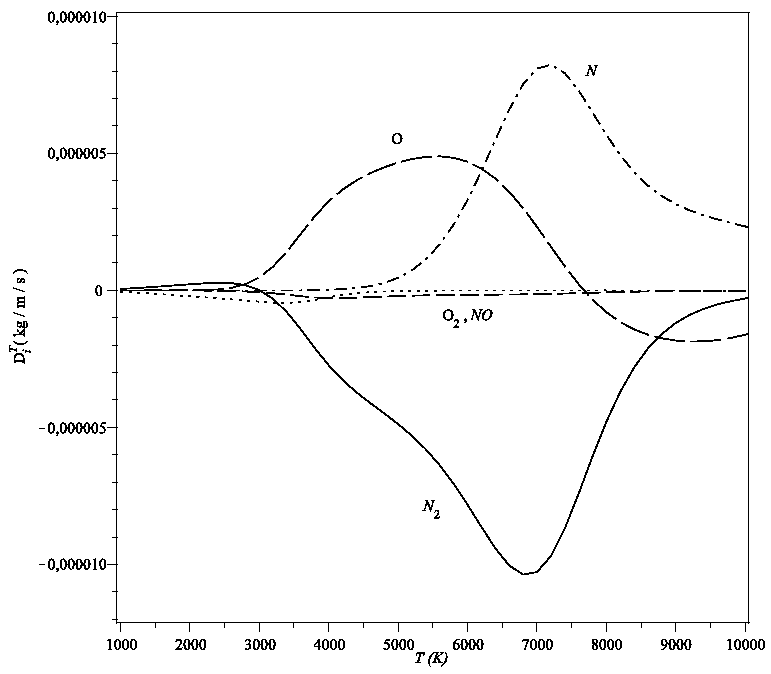
Model for describing diffusion
The Maxwell–Stefan diffusion (or Stefan–Maxwell diffusion) is a model for describing diffusion in multicomponent systems. The equations that describe these transport processes have been developed independently and in parallel by James Clerk Maxwell for dilute gases and Josef Stefan for liquids. The Maxwell–Stefan equation is
a_i\frac{\nabla \mu_i}{R,T} = \nabla a_i = \sum_{j=1\atop j\neq i}^{n}{\frac{\chi_j}{\mathfrak{D}{ij}}(\vec v_j-\vec v_i)} = \sum{j=1\atop j\neq i}^{n}{\frac{c_j}{c\mathfrak{D}_{ij}}\left(\frac{\vec J_j}{c_j}-\frac{\vec J_i}{c_i}\right)}
- ∇: vector differential operator
- χ: Mole fraction
- μ: Chemical potential
- a: Activity
- i, j: Indexes for component i and j
- n: Number of components
- \mathfrak{D}_{ij}: Maxwell–Stefan-diffusion coefficient
- \vec v_i: Diffusion velocity of component i
- c_i: Molar concentration of component i
- c: Total molar concentration
- \vec J_i: Flux of component i
The equation assumes steady state, i.e., the neglect of time derivatives in the velocity.
The basic assumption of the theory is that a deviation from equilibrium between the molecular friction and thermodynamic interactions leads to the diffusion flux. The molecular friction between two components is proportional to their difference in speed and their mole fractions. In the simplest case, the gradient of chemical potential is the driving force of diffusion. For complex systems, such as electrolytic solutions, and other drivers, such as a pressure gradient, the equation must be expanded to include additional terms for interactions.
A major disadvantage of the Maxwell–Stefan theory is that the diffusion coefficients, with the exception of the diffusion of dilute gases, do not correspond to the Fick's diffusion coefficients and are therefore not tabulated. Only the diffusion coefficients for the binary and ternary case can be determined with reasonable effort. The Maxwell-Stefan diffusion coefficients can be, for example, estimated using the empirical Vignes correlation model or the physically-motivated entropy scaling. In a multicomponent system, a set of approximate formulas exist to predict the Maxwell–Stefan-diffusion coefficient.
The Maxwell–Stefan theory is more comprehensive than the "classical" Fick's diffusion theory, as the former does not exclude the possibility of negative diffusion coefficients. It is possible to derive Fick's theory from the Maxwell–Stefan theory.
References
References
- J. C. Maxwell: ''On the dynamical theory of gases'', The Scientific Papers of J. C. Maxwell, 1965, '''2''', 26–78.
- J. Stefan: ''Über das Gleichgewicht und Bewegung, insbesondere die Diffusion von Gemischen'', Sitzungsberichte der Kaiserlichen Akademie der Wissenschaften Wien, 2te Abteilung a, 1871, '''63''', 63–124.
- (2007). "[[Transport Phenomena (book)". Wiley.
- (1993). "Multicomponent Mass Transfer". Wiley.
- (1997). "Diffusion – Mass Transfer in Fluid Systems". Cambridge University Press.
- S. Rehfeldt, J. Stichlmair: ''Measurement and calculation of multicomponent diffusion coefficients in liquids'', Fluid Phase Equilibria, 2007, '''256''', 99–104
- Vignes, Alain. (May 1966). "Diffusion in Binary Solutions. Variation of Diffusion Coefficient with Composition". Industrial & Engineering Chemistry Fundamentals.
- (2025-03-17). "Entropy scaling for diffusion coefficients in fluid mixtures". Nature Communications.
This article was imported from Wikipedia and is available under the Creative Commons Attribution-ShareAlike 4.0 License. Content has been adapted to SurfDoc format. Original contributors can be found on the article history page.
Ask Mako anything about Maxwell–Stefan diffusion — get instant answers, deeper analysis, and related topics.
Research with MakoFree with your Surf account
Create a free account to save articles, ask Mako questions, and organize your research.
Sign up freeThis content may have been generated or modified by AI. CloudSurf Software LLC is not responsible for the accuracy, completeness, or reliability of AI-generated content. Always verify important information from primary sources.
Report