From Surf Wiki (app.surf) — the open knowledge base
Malaysia–Singapore Second Link
Bridge connecting Singapore and Johor Bahru, Malaysia

Bridge connecting Singapore and Johor Bahru, Malaysia
| Field | Value |
|---|---|
| fetchwikidata | coordinates |
| bridge_name | Malaysia–Singapore Second Link |
| image | Malaysia-Singapore Second Link Linkedua.jpg |
| official_name | Malaysia–Singapore Second Link |
| native_name | Laluan Kedua Malaysia–Singapura |
| 馬新第二通道 | |
| location | Tanjung Kupang, Johor, Malaysia, Kompleks Sultan Abu Bakar and Tuas, Singapore, Tuas Checkpoint |
| carries | Motor vehicles |
| crosses | Straits of Johor |
| mainspan | 150 m |
| length | 1.92 km (bridge) |
| 6 km (between checkpoints) | |
| width | 25 m |
| open | 2 January 1998 |
| inaugurated | 18 April 1998 |
| maint | PLUS Expressways (Malaysia) |
| Land Transport Authority (Singapore) | |
| design | Box girder bridge |
| designer | Government of Malaysia |
| Malaysian Highway Authority | |
| United Engineers Malaysia Berhad | |
| Government of Singapore | |
| Land Transport Authority | |
| builder | United Engineers Malaysia Berhad |
馬新第二通道 6 km (between checkpoints) Land Transport Authority (Singapore) Malaysian Highway Authority United Engineers Malaysia Berhad Government of Singapore Land Transport Authority The Malaysia–Singapore Second Link (, 馬新第二通道) is a bridge connecting Singapore and Johor, Malaysia. In Singapore, it is officially known as the Tuas Second Link. The bridge was built to reduce traffic congestion on the Johor–Singapore Causeway and was opened to traffic on 2 January 1998. It was opened officially by Singapore's Prime Minister Goh Chok Tong with Mahathir Mohamad, Prime Minister of Malaysia. The bridge supports a dual-three lane carriageway linking Kampong Ladang at Tanjung Kupang, Johor to Jalan Ahmad Ibrahim at Tuas, Singapore. The total length of the bridge over water is 1.92 km. The distance between checkpoints is approximately 6 km. On the Malaysian side, the bridge is connected to the Second Link Expressway (Malay: Lebuhraya Laluan Kedua Malaysia–Singapura) E3 also known as Linkedua Expressway, which links from Senai North Interchange Exit 253 at North–South Expressway E2, Senai Airport and Taman Perling, Johor Bahru via its extension known as Johor Bahru Parkway E3. In Singapore, the bridge connects to the Ayer Rajah Expressway.
The checkpoint on the Malaysia side is the Sultan Abu Bakar CIQ Complex (Kompleks Sultan Abu Bakar). The checkpoint on the Singapore side, the Tuas Checkpoint, was built on 19.6 ha of reclaimed land at a cost of S$485 million. Designed by CPG Corporation, it involved the use of 54000 m3 of concrete and 18000 t of reinforcing steel, and won the Architectural Design Award and Best Buildable Design Award awarded by the Singapore Institute of Architects and the Building and Construction Authority respectively. Travelling along the Second Link usually takes less time than the Causeway due to smoother traffic in both directions; however, during festive periods (especially Chinese New Year, Hari Raya, Christmas and Deepavali) the dense traffic between Malaysia and Singapore still leads to massive jams on both bridges.
Unlike its shorter counterparts in Woodlands, as Tuas Checkpoint is designated as a vehicular checkpoint only, travellers are not allowed to arrive at the checkpoint by foot.
Access from other roads
From Malaysia


The approach to the bridge is via the Second Link Expressway, which can be accessed by exiting the North–South Expressway (E2) at Exit 253 Senai North Interchange. Alternatively, motorists can also enter the expressway via Taman Perling which also joins with Pasir Gudang Highway (Federal Route 17 and Skudai Highway (Federal route 1). The expressway link to Taman Perling is also known as Pontian–Johor Bahru Parkway.
From Singapore
The bridge is directly accessed via the Ayer Rajah Expressway, along with other supporting roads around the vicinity of the Tuas industrial area.
History
The idea of building a second link between Malaysia and Singapore was first raised in July 1980 by then-Menteri Besar of Johor, Othman Saat. Gelang Patah was raised as a viable site due to its distant proximity from Johor Bahru, and the suggestion was raised to tackle growing traffic jams on the causeway. The Malaysian federal Government welcomed Othman's plan, and the Johor State Government formed a committee to study the feasibility of building the second link.
In July 1989, United Engineers Malaysia Berhad (UEM) submitted a proposal to the government of Malaysia to privatise the construction of a second link to Singapore. The acceptance of the proposal brought about the signing of a concession agreement in July 1993, giving exclusive rights and authority to UEM to design, construct, manage, operate and maintain the bridge and expressways for a period of 30 years commencing 27 July 1993.
Following this, a novation agreement was executed in May 1994, whereby UEM assigned all its rights, liabilities and obligations in respect of the concession agreement to Linkedua (Malaysia) Berhad, a wholly owned subsidiary of UEM.
The construction of the bridge required the co-operation of the government of Malaysia and the government of Singapore. On 22 March 1994, an inter-government agreement was signed defining the responsibilities of both governments with regard to the design, construction, operation, and maintenance of the bridge. Each government was responsible for the construction of the portion the bridge which fell within its borders, based on a common agreed design. A joint committee comprising representatives of each government was formed to oversee the implementation of this Malaysia–Singapore Second Crossing project.
The major components of the project are the Second Crossing bridge, forty-four kilometres of expressways, a Customs, Immigration and Quarantine complex, three toll plazas, two rest and service areas and other ancillary facilities. The bridge was designed to accommodate up to 200,000 vehicles a day.
The Second Link was opened to traffic on 2 January 1998. It was officially opened on 18 April the same year by the Prime Ministers of both countries, namely Dato' Seri Dr. Mahathir Mohamad of Malaysia and Goh Chok Tong of Singapore.
Toll charges
Tanjung Kupang Toll Plaza (Heading into Malaysia)
| Class | Type of vehicles | Rate | ||
|---|---|---|---|---|
| (in Malaysian Ringgit (RM)) | ||||
| **0** | ||||
| **1** | ||||
| **2** | ||||
| **3** | ||||
| **4** | ||||
| **5** |
:
Tuas Checkpoint (heading into Singapore)
| Class | Type of vehicles | Rate (in Singapore Dollar (S$)) | ||
|---|---|---|---|---|
Payment Modes
| Country | Payment | Acceptance | Notes |
|---|---|---|---|
| Malaysia | Cash payment | ||
| *MyRFiD*(using Touch n' Go and Credit/Debit Card) | |||
| Singapore | Autopass Card | Non-Singapore registered vehicles only | |
| CEPAS CBT EZ-Link and Concession Card | |||
| SimplyGo EZ-Link and Concession Card | |||
| CEPAS EZ-Link x Touch n' Go Card | |||
| CEPAS EZ-Link Motoring | |||
| CEPAS NETS Motoring | |||
| NETS Contactless CashCard | |||
| NETS Prepaid | |||
| CEPAS NETS FlashPay | |||
| Cash payment | |||
| Mastercard | |||
| Visa | |||
| NETS Tap | |||
| NETS CashCard (1st generation) | Obsolete | ||
| American Express |
2020 Malaysia movement control order
On 16 March 2020, in response to the COVID-19 pandemic in Malaysia, Malaysia Prime Minister Muhyiddin Yassin announced that Malaysia would be implementing a movement control order which would start from 18 March. Due to the movement order, the Causeway faced immense jams due to a surge of Malaysians returning to Malaysia and back to Singapore before the order took effect. All bus services could not enter Johor Bahru for two weeks from 18 March to 31 March 2020. However, the flow of cargo, goods and food supplies carried on as normal.
Technical specifications
Bridge Specifications
- Overall length of bridge: 1920 m
- Distance between both checkpoints: 6000 m
- Length within Malaysian waters: 1769 m
- Construction period: Oct 1994 to Oct 1997
- Total length of piles: 10230 m
- Total volume of concrete: 54000 m3
- Total weight of reinforcing steel: 18000 t
- Total number of precast box segments: 840 units
- Longest span: 165 m
Navigational Channels
- Malaysian main navigational channel: 75 m wide by 25 m high.
- Malaysian secondary navigational channel: 50 m wide by 9 m high.
- Singaporean navigational channel: 75 m wide by 12 m high
Public transport
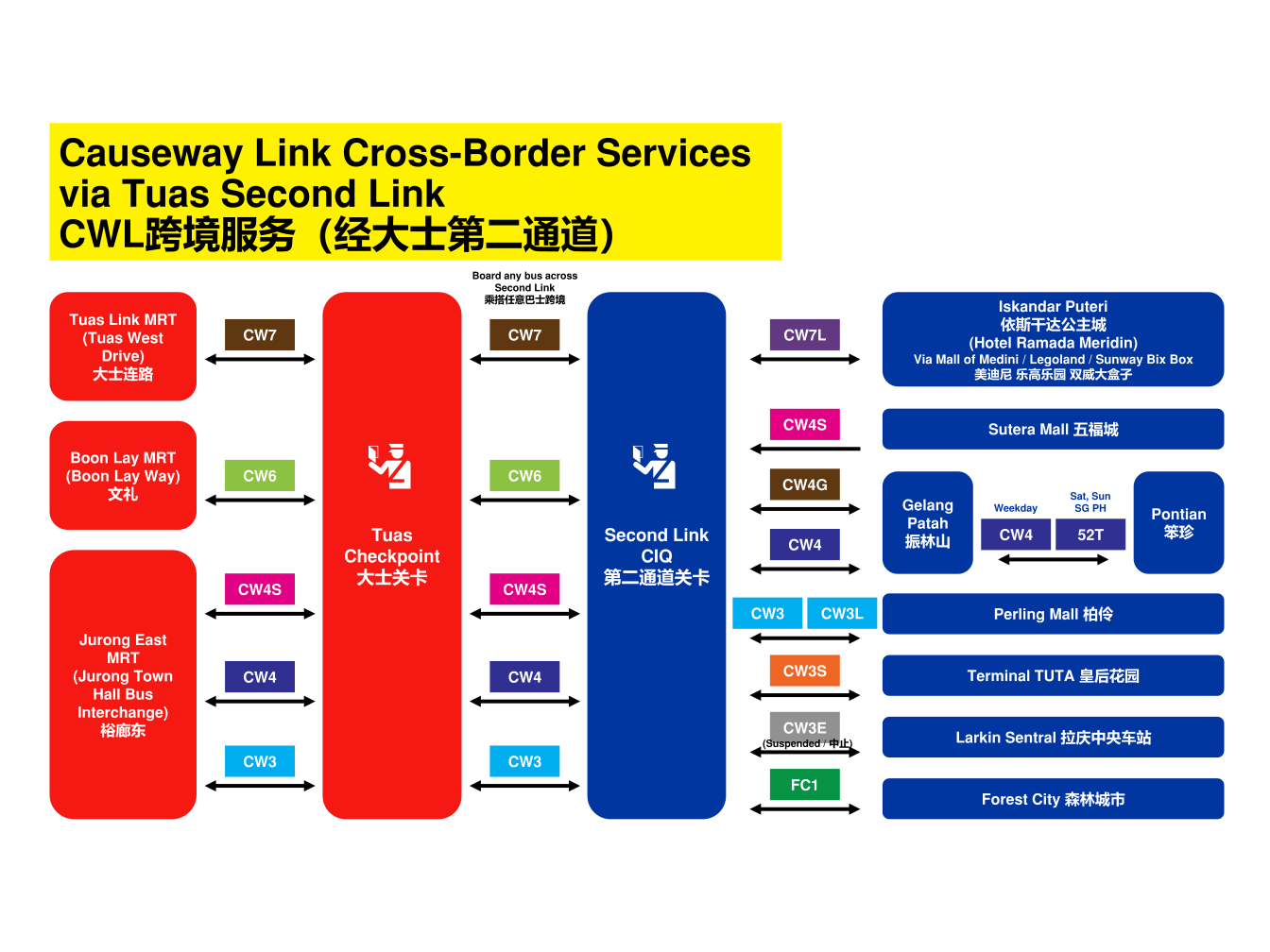
Causeway Link Routes CW3, CW4, CW6 and CW7 from Jurong East, Boon Lay & Tuas Link in Singapore to Bukit Indah, Gelang Patah, Pontian & Legoland in Malaysia cross the Second Link daily.
Transtar Travel Routes TS6 & TS6A from Buona Vista & Changi Airport via one-north & Tuas Link in Singapore to Legoland, Puteri Harbour & Gelang Patah Sentral in Malaysia cross the Second Link daily. Both routes stop at intermediate points on request.
References
References
- "Malaysia-Singapore Second Link | Infopedia".
- "CPG Corporation".
- "Ministry of International Trade and Industry, Malaysia".
- Bernama, ''Causeway or Free Trade Zone request'', p. 12, 14 July 1980, [[New Straits Times]]
- "Panel set up to study link Proposal", p. 8, 17 December 1980, ''New Straits Times''
- "Lower Toll Charges At Second Link".
- "Malaysians brave long queues and traffic jams to beat the clock and avoid lockdown".
- (17 March 2020). "Coronavirus: Bus services 170X and 950 suspended till March 31, other services halt Malaysia legs ahead of lockdown".
- "Flow of goods, food supplies, cargo to continue between Singapore and Malaysia: PM Lee".
This article was imported from Wikipedia and is available under the Creative Commons Attribution-ShareAlike 4.0 License. Content has been adapted to SurfDoc format. Original contributors can be found on the article history page.
Ask Mako anything about Malaysia–Singapore Second Link — get instant answers, deeper analysis, and related topics.
Research with MakoFree with your Surf account
Create a free account to save articles, ask Mako questions, and organize your research.
Sign up freeThis content may have been generated or modified by AI. CloudSurf Software LLC is not responsible for the accuracy, completeness, or reliability of AI-generated content. Always verify important information from primary sources.
Report