From Surf Wiki (app.surf) — the open knowledge base
Liège Province
Province of Belgium
Province of Belgium
| Field | Value |
|---|---|
| name | fr |
| native_name | de |
| nl | |
| wa | |
| native_name_lang | |
| settlement_type | Province of Belgium |
| image_alt | Liègois landscape scene: The Coo Waterfalls |
| image_shield | Wapen van Luik (provincie).svg |
| shield_size | 100x90px |
| image_blank_emblem | Liège.svg |
| blank_emblem_type | Brandmark |
| blank_emblem_size | 120px |
| coordinates | |
| image_map | Province de Liège in Belgium.svg |
| subdivision_type | Country |
| subdivision_name | |
| subdivision_type1 | Region |
| subdivision_name1 | Wallonia |
| seat_type | Capital (and largest city) |
| seat | Liège |
| leader_title | Governor |
| leader_name | Hervé Jamar |
| area_total_km2 | 3857 |
| area_footnotes | |
| population_footnotes | |
| population_total | 1,119,038 |
| population_as_of | 1 January 2024 |
| population_density_km2 | auto |
| demographics_type1 | GDP |
| demographics1_footnotes | |
| demographics1_title1 | Total |
| demographics1_info1 | €34.715 billion (2021) |
| iso_code | BE-WLG |
| blank_name_sec2 | HDI (2021) |
| blank_info_sec2 | 0.908 |
| · 8th of 11 | |
| website |
nl wa · 8th of 11
Liège ( ; ; ; ; ) is the easternmost province of Wallonia, the primarily French-speaking region of Belgium.
Liège Province is the only Belgian province that has borders with three countries. It borders (clockwise from the north) the Dutch province of Limburg, the German states of North Rhine-Westphalia and Rhineland-Palatinate, the Luxembourgish canton of Clervaux, the Belgian Walloon (French-speaking) provinces of Luxembourg, Namur and Walloon Brabant and the Belgian Flemish (Dutch-speaking) provinces of Flemish Brabant and Limburg.
Part of the eastern-most area of the province, bordering Germany, is the German-speaking region of Eupen-Malmedy, which became part of Belgium in the aftermath of World War I.
The capital and the largest city of the province is the city of the same name, Liège. The province has an area of 3857 km2, and a population of 1.12 million as of January 2024.
History
The modern borders of the province of Liège date from 1795, which saw the unification of the Principality of the Prince-Bishopric of Liège with the revolutionary French Department of the Ourthe (sometimes spelled Ourte). (Parts of the old Principality of Liège also went into new French départements Meuse-Inférieure, and Sambre-et-Meuse.)
The province of Ourthe, as it was known then, was under French control during the reign of Napoleon, who visited the city during one of his campaigns. Napoleon ordered the destruction of its vineyards in order to prevent the Liège wine industry from competing with those elsewhere in France.
Following Napoleon's fall from power in 1815, Liège became part of the Kingdom of the Netherlands, while eastern half of modern Verviers became part of the Kingdom of Prussia. Liège University scholars helped to write the new Dutch constitution after the Napoleonic Wars. Despite these contributions there was a widespread perception among the people of Liège that they were discriminated against by the Dutch government due to religious and language differences.
In September 1830, rumors spread of a revolt in Brussels to expel the Dutch. Liège intellectuals responded to these events by contacting Walloon scholars living in Paris to discuss Belgian independence. A militia was formed to press these demands led by Charlier "Wooden Leg" leading (eventually) to the formation of an independent Kingdom of Belgium.
In the 19th century, the province was an early center of the Industrial Revolution. Its rich coal deposits and steel factories helped Belgium to form the basis of the region's increasing economic power.
During the 20th century, due to Liège's borders with Germany, it saw fierce fighting in both World Wars. In World War I, Liège's strong line of reinforced concrete military forts temporarily halted the German advance through Belgium, giving time to construct trenches in Flanders which subsequently saw some of the worst fighting of that war. It also saw some of the war's worst civilian casualties as the Imperial German Army performed collective punishments against local villagers for acts of resistance. In 1925 the East Cantons and Neutral Moresnet, that had become part of Belgium as a result of the Treaty of Versailles, were absorbed into the province of Liège.
In World War II, Liège was the site of major fighting during the Battle of the Bulge. There, the Germans orchestrated their final offensive move against the combined Allied armies. Malmedy and Saint-Vith in particular saw intense battles against the Nazis. Malmedy was the site of a Waffen-SS massacre of U.S. Army prisoners of war.
Liège's heavy industry thrived in the 1950s and 1960s, but has been in decline since that time. Nevertheless, Liège remains the last city of Wallonia to maintain a functioning steel industry.
Liège continues to be the economic and cultural capital of Wallonia, with its university, medieval heritage and heavy industry.
Politics
Provincial Council
2006–2012

| Party | Seats | Parti socialiste | Mouvement réformateur | Centre démocrate humaniste | Ecolo | Christlich Soziale Partei | National Front | Sozialistische Partei |
|---|---|---|---|---|---|---|---|---|
| 32 | ||||||||
| 24 | ||||||||
| 13 | ||||||||
| 11 | ||||||||
| 2 | ||||||||
| 1 | ||||||||
| 1 |
2012–2018

| Party | Seats | Parti socialiste | Mouvement réformateur | Centre démocrate humaniste | Ecolo | Parti du travail de Belgique | Christlich Soziale Partei | Sozialistische Partei |
|---|---|---|---|---|---|---|---|---|
| 20 | ||||||||
| 17 | ||||||||
| 7 | ||||||||
| 8 | ||||||||
| 2 | ||||||||
| 1 | ||||||||
| 1 |
2018–2024

| Party | Seats | PS-SP | Mouvement réformateur | Ecolo | CDH-CSP | Parti du travail de Belgique |
|---|---|---|---|---|---|---|
| 17 | ||||||
| 15 | ||||||
| 12 | ||||||
| 6 | ||||||
| 6 |
Geography
Rivers
- Meuse
- Berwinne
- Jeker
- Yerne
- Ourthe
- Ambiève
- Roannay
- Ambiève
Economy
The Gross domestic product (GDP) of the province was 31.6 billion € in 2018, accounting for 6.9% of Belgium's economic output. GDP per capita adjusted for purchasing power was 25,200 € or 84% of the EU27 average in the same year. GDP per person employed was 108% of the EU27 average.
Subdivisions
The province has an area of 3857 km2, which is divided into four administrative districts (arrondissements in French) containing a total of 84 municipalities.
Arrondissements
The Province of Liège is divided into four administrative arrondissements: Image:Arrondissement Huy Belgium Map.png|Huy Image:Arrondissement Liège Belgium Map.png|Liège Image:Arrondissement Verviers Belgium Map.png|Verviers Image:Arrondissement Waremme Belgium Map.png|Waremme
Municipalities
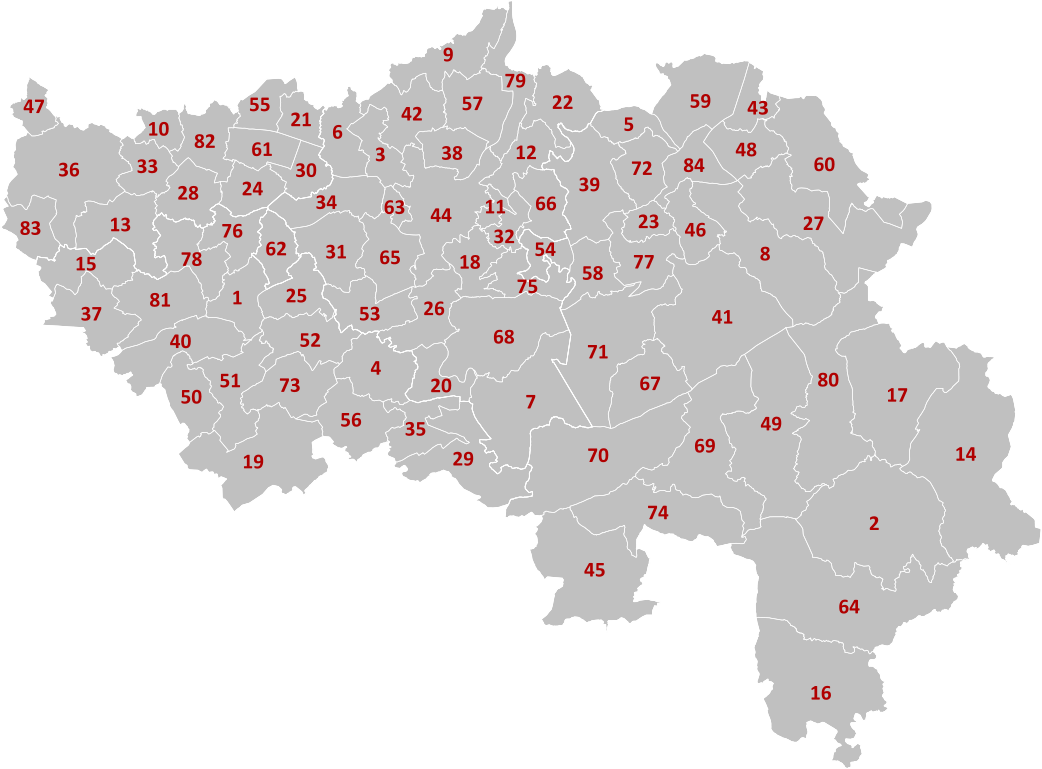
Municipalities that have city status have a (city) behind their name.
- Amay
- Amel
- Ans
- Anthisnes
- Aubel
- Awans
- Aywaille
- Baelen
- Bassenge
- Berloz
- Beyne-Heusay
- Blegny
- Braives
- Büllingen
- Burdinne
- Burg-Reuland
- Bütgenbach
- Chaudfontaine
- Clavier
- Comblain-au-Pont
- Crisnée
- Dalhem
- Dison
- Donceel
- Engis
- Esneux
- Eupen (city)
- Faimes
- Ferrières
- Fexhe-le-Haut-Clocher
- Flémalle
- Fléron
- Geer
- Grâce-Hollogne
- Hamoir
- Hannut (city)
- Héron
- Herstal (city)
- Herve (city)
- Huy (city)
- Jalhay
- Juprelle
- Kelmis
- Liège (city)
- Lierneux
- Limbourg (city)
- Lincent
- Lontzen
- Malmedy (city)
- Marchin
- Modave
- Nandrin
- Neupré
- Olne
- Oreye
- Ouffet
- Oupeye
- Pepinster
- Plombières
- Raeren
- Remicourt
- Saint-Georges-sur-Meuse
- Saint-Nicolas
- Sankt Vith (city)
- Seraing (city)
- Soumagne
- Spa (city)
- Sprimont
- Stavelot (city)
- Stoumont
- Theux
- Thimister-Clermont
- Tinlot
- Trois-Ponts
- Trooz
- Verlaine
- Verviers (city)
- Villers-le-Bouillet
- Visé (city)
- Waimes
- Wanze
- Waremme (city)
- Wasseiges
- Welkenraedt
Nine municipalities of Liège form the German-speaking Community of Belgium. From north to south they are: Kelmis (43), Lontzen (48), Raeren (60), Eupen (27), Bütgenbach (17), Büllingen (14), Amel (2), Sankt Vith (64), and Burg-Reuland (16) municipalities. Malmedy (49) and Waimes (80) are municipalities with language facilities for German speakers. The other municipalities of Liège are part of the French Community of Belgium.
List of governors
- 1830–1831: Etienne de Sauvage (Liberal)
- 1831–1832: Jean-François Tielemans (Liberal)
- 1832–1844: Charles van den Steen de Jehay
- 1844–1846: Henri de Brouckère (Liberal)
- 1846–1847: Edmond de la Coste (Liberal)
- 1847–1863: Ferdinand de Macar (Liberal)
- 1863–1882: Charles de Luesemans (Liberal)
- 1882–1908: Léon Pety de Thozée
- 1908–1919: Henry Delvaux de Fenffe (Catholic Party)
- 1919–1927: Gaston Gregoire (Liberal)
- 1927–1937: Henri Pirard
- 1937–1943: Jules Mathieu
- 1944–1953: Joseph Leclercq (PSB)
- 1953–1971: Pierre Clerdent (PRL)
- 1972–1990: Gilbert Mottard (PS)
- 1990–2004: Paul Bolland
- 2004–2015: Michel Foret (MR)
- 2015–present Hervé Jamar (MR)
References
References
- "Be.STAT".
- "Structuur van de bevolking | Statbel".
- "EU regions by GDP, Eurostat".
- "Sub-national HDI - Area Database - Global Data Lab".
- "Liège". [[HarperCollins]].
- (September 2022). "Liège". [[Oxford University Press]].
- {{Cite Merriam-Webster. Liège
- "Structuur van de bevolking | Statbel".
- Hastings, Max. (2013). "Catastrophe 1914 : Europe goes to war".
- O’Connell, Vincent. (2013). ""Left to their own devices". Belgium's Ambiguous Assimilation of Eupen-Malmedy (1919-1940)". Journal of Belgian History.
- "Conseil provincial {{!}} Province de Liège".
- "Regional GDP per capita ranged from 30% to 263% of the EU average in 2018".
This article was imported from Wikipedia and is available under the Creative Commons Attribution-ShareAlike 4.0 License. Content has been adapted to SurfDoc format. Original contributors can be found on the article history page.
Ask Mako anything about Liège Province — get instant answers, deeper analysis, and related topics.
Research with MakoFree with your Surf account
Create a free account to save articles, ask Mako questions, and organize your research.
Sign up freeThis content may have been generated or modified by AI. CloudSurf Software LLC is not responsible for the accuracy, completeness, or reliability of AI-generated content. Always verify important information from primary sources.
Report