From Surf Wiki (app.surf) — the open knowledge base
La Tène culture
Iron Age culture of Europe
Iron Age culture of Europe
| Field | Value |
|---|---|
| name | La Tène culture |
| mapcaption | Celtic expansion in Europe |
| region | Western/Central Europe |
| period | Iron Age |
| dates | c. 450 BC – c. 1 BC |
| typesite | La Tène, Neuchâtel |
| precededby | Hallstatt culture |
| followedby | Roman Republic, Roman Empire, Roman Gaul, Roman Britain, Hispania, Germania, Rhaetia, Noricum, Roman Iron Age |
The La Tène culture (; ) was a European Iron Age culture. It developed and flourished during the late Iron Age (from about 450 BC to the Roman conquest in the 1st century BC), succeeding the early Iron Age Hallstatt culture without any definite cultural break, under considerable Mediterranean influence from the Greeks in pre-Roman Gaul, the Etruscans, and the Golasecca culture, but whose artistic style nevertheless did not depend on those Mediterranean influences.
La Tène culture's territorial extent corresponded to what is now France, Belgium, Switzerland, Austria, England, Southern Germany, the Czech Republic, Northern Italy and Central Italy, Slovenia, Hungary and Liechtenstein, as well as adjacent parts of the Netherlands, Slovakia, Serbia, Croatia, Transylvania (western Romania), and Transcarpathia (western Ukraine). The Celtiberians of western Iberia shared many aspects of the culture, though not generally the artistic style. To the north extended the contemporary Pre-Roman Iron Age of Northern Europe, including the Jastorf culture of Northern Germany and Denmark and all the way to Galatia in Asia Minor (today Turkey).
Centered on ancient Gaul, the culture became very widespread, and encompasses a wide variety of local differences. It is often distinguished from earlier and neighbouring cultures mainly by the La Tène style of Celtic art, characterized by curving "swirly" decoration, especially of metalwork.
It is named after the type site of La Tène on the north side of Lake Neuchâtel in Switzerland, where thousands of objects had been deposited in the lake, as was discovered after the water level dropped in 1857 (due to the Jura water correction).
In the popular understanding, La Tène describes the culture and art of the ancient Celts, a term that is firmly entrenched in the popular understanding, but it is considered controversial by modern scholarship.
Periodization

]] Extensive contacts through trade are recognized in foreign objects deposited in elite burials; stylistic influences on La Tène material culture can be recognized in Etruscan, Italic, Greek, Dacian and Scythian sources. Datable Greek pottery and analysis employing scientific techniques such as dendrochronology and thermoluminescence help provide date ranges for an absolute chronology at some La Tène sites.
La Tène history was originally divided into "early", "middle" and "late" stages based on the typology of the metal finds (Otto Tischler 1885), with the Roman occupation greatly disrupting the culture, although many elements remain in Gallo-Roman and Romano-British culture. A broad cultural unity was not paralleled by overarching social-political unifying structures, and the extent to which the material culture can be linguistically linked is debated. The art history of La Tène culture has various schemes of periodization.
The archaeological period is now mostly divided into four sub-periods, following Paul Reinecke.
| Tischler (1885) | Reinecke (1902) | Date |
|---|---|---|
| La Tène I | La Tène A | 450–380 BC |
| La Tène I | La Tène B | 380–250 BC |
| La Tène II | La Tène C | 250–150 BC |
| La Tène III | La Tène D | 150–1 BC |
History
The preceding final phase of the Hallstatt culture, HaD, c. 650–450 BC, was also widespread across Central Europe, and the transition over this area was gradual, being mainly detected through La Tène style elite artefacts, which first appear on the western edge of the old Hallstatt region.
Though there is no agreement on the precise region in which La Tène culture first developed, there is a broad consensus that the centre of the culture lay on the northwest edges of Hallstatt culture, north of the Alps, within the region between in the West the valleys of the Marne and Moselle, and the part of the Rhineland nearby. In the east the western end of the old Hallstatt core area in modern Bavaria, the Czech Republic, Austria and Switzerland formed a somewhat separate "eastern style Province" in the early La Tène, joining with the western area in Alsace. In 1994 a prototypical ensemble of elite grave sites of the early 5th century BCE was excavated at Glauberg in Hesse, northeast of Frankfurt-am-Main, in a region that had formerly been considered peripheral to the La Tène sphere. The site at La Tène itself was therefore near the southern edge of the original "core" area (as is also the case for the Hallstatt site for its core).
The establishment of a Greek colony, soon very successful, at Massalia (modern Marseilles) on the Mediterranean coast of France led to great trade with the Hallstatt areas up the Rhône and Saône river systems, and early La Tène elite burials like the Vix Grave in Burgundy contain imported luxury goods along with artifacts produced locally. Most areas were probably controlled by tribal chiefs living in hilltop forts, while the bulk of the population lived in small villages or farmsteads in the countryside.
By 500 BCE the Etruscans expanded to border Celts in north Italy, and trade across the Alps began to overhaul trade with the Greeks, and the Rhône route declined. Booming areas included the middle Rhine, with large iron ore deposits, the Marne and Champagne regions, and also Bohemia, although here trade with the Mediterranean area was much less important. Trading connections and wealth no doubt played a part in the origin of the La Tène style, though how large a part remains much discussed; specific Mediterranean-derived motifs are evident, but the new style does not depend on them.
Barry Cunliffe notes localization of La Tène culture during the 5th century BCE when there arose "two zones of power and innovation: a Marne – Moselle zone in the west with trading links to the Po Valley via the central Alpine passes and the Golasecca culture, and a Bohemian zone in the east with separate links to the Adriatic via the eastern Alpine routes and the Venetic culture".
From their homeland, La Tène culture expanded in the 4th century BCE to more of modern France, Germany, and Central Europe, and beyond to Hispania, northern and central Italy, the Balkans, and even as far as Asia Minor, in the course of several major migrations. La Tène style artefacts start to appear in Britain around the same time, and Ireland rather later. The style of "Insular La Tène" art is somewhat different and the artefacts are initially found in some parts of the islands but not others. Migratory movements seem at best only partly responsible for the diffusion of La Tène culture there, and perhaps other parts of Europe.
By about 400 BCE, the evidence for Mediterranean trade becomes sparse; this may be because the expanding Celtic populations began to migrate south and west, coming into violent conflict with the established populations, including the Etruscans and Romans. The settled life in much of the La Tène homelands also seems to have become much more unstable and prone to wars. In about 387 BCE, the Celts under Brennus defeated the Romans and then sacked Rome, establishing themselves as the most prominent threats to the Roman homeland, a status they would retain through a series of Roman-Gallic wars until Julius Caesar's final conquest of Gaul in 58–50 BCE. The Romans prevented the Celts from reaching very far south of Rome, but on the other side of the Adriatic Sea groups passed through the Balkans to reach Greece, where Delphi was attacked and sacked in 279 BCE, and Asia, where Galatia was established as a Celtic area of Anatolia. By this time, the La Tène style was spreading to the British Isles, though apparently without any significant movements in population.
After about 275 BCE, Roman expansion into the La Tène area began with the conquest of Gallia Cisalpina. The conquest of Gallia Celtica followed in 121 BCE and was complete with the Gallic Wars of the 50s BCE. Gaulish culture quickly assimilated to Roman culture, giving rise to the hybrid Gallo-Roman culture of Roman Gaul.
Ethnology
Main article: Continental Celts, Gauls
.jpg)
The bearers of the La Tène culture were the people known as Celts or Gauls to ancient ethnographers. Ancient Celtic culture had no written literature of its own, but rare examples of epigraphy in the Greek or Latin alphabets exist allowing the fragmentary reconstruction of Continental Celtic.
Current knowledge of this cultural area is derived from three sources comprising archaeological evidence, Greek and Latin literary records, and ethnographical evidence suggesting some La Tène artistic and cultural survivals in traditionally Celtic regions of far western Europe. Some of the societies that are archaeologically identified with La Tène material culture were identified by Greek and Roman authors from the 5th century onwards as Keltoi ("Celts") and Galli ("Gauls"). Herodotus (iv.49) correctly placed Keltoi at the source of the Ister/Danube, in the heartland of La Tène material culture: "The Ister flows right across Europe, rising in the country of the Celts".
Whether the usage of classical sources means that the whole of La Tène culture can be attributed to a unified Celtic people is difficult to assess; archaeologists have repeatedly concluded that language, material culture, and political affiliation do not necessarily run parallel. Frey (2004) notes that in the 5th century, "burial customs in the Celtic world were not uniform; rather, localised groups had their own beliefs, which, in consequence, also gave rise to distinct artistic expressions".
The archaeologist Miranda Aldhouse-Green describes the material culture of the La Tène period as "the floruit of Celtic civilisation". Ancient literary sources, archaeological evidence and (to a lesser extent) language, all combine to present "a picture of a Celtic world which, in its heyday (the later first millennium BC), stretched from Ireland and Spain in the west and Scotland in the north to Czechoslovakia in the east and northern Italy in the south, and even beyond Europe to Asia Minor."
Artefacts typical of the La Tène culture have been discovered in stray finds as far afield as Scandinavia, Northern Germany, Poland and in the Balkans. It is therefore common to also talk of the "La Tène period" in the context of those regions even though they were never part of the La Tène culture proper, but connected to its core area via trade.
Culture

Settlements
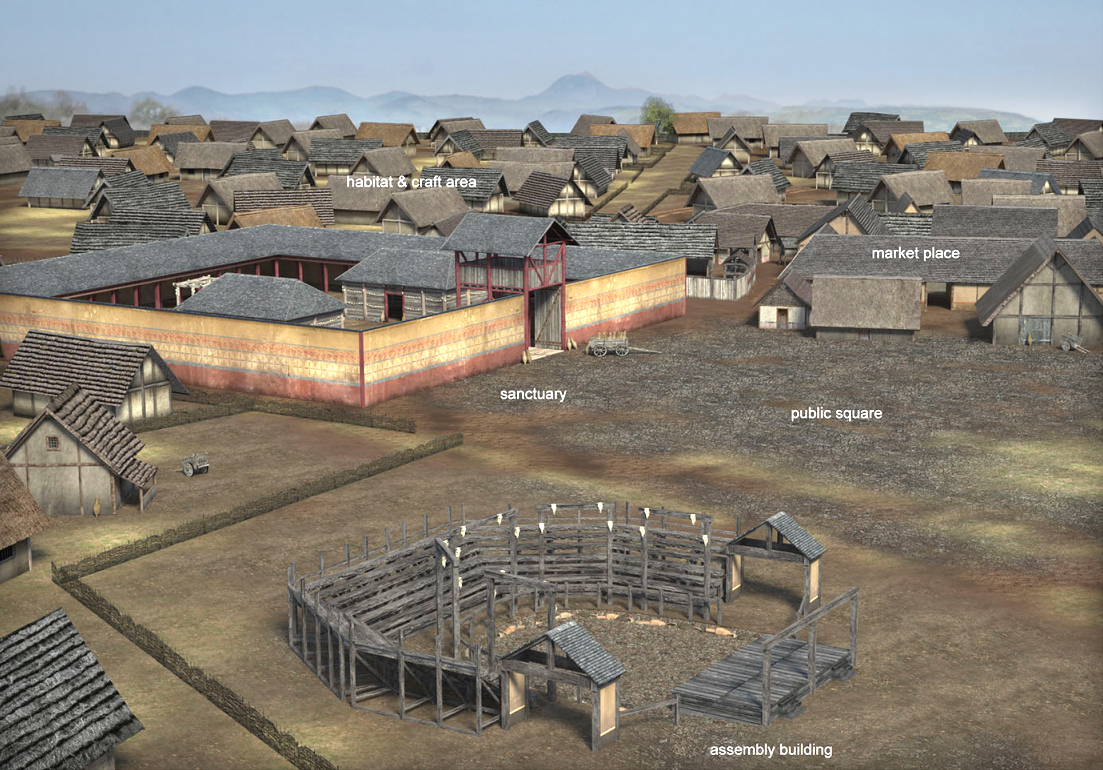
Initially La Tène people lived in open settlements that were dominated by the chieftains' hill forts. The development of walled towns and cities—known as oppida—appears during the mid-La Tène culture in the 2nd century BC. The name of oppida (singular oppidum) was given by Julius Caesar to the Celtic towns and cities that he encountered during the conquest of Gaul, some of which he explicitly described as urbs (cities). Oppida were characterized by very large surface areas (up to hundreds of hectares) and were defended by often massive ramparts and walls. They are often described as 'the first cities north of the Alps', though this description has also been applied to earlier settlements of the Hallstatt and Urnfield periods. Oppida served as centres of craft production and commerce and were also important political and religious centres, with major oppida functioning as the capitals of Celtic states.
Oppida appeared more or less simultaneously from the Atlantic to central Europe in the second century BC. More than 180 oppida are known today, stretching from France in the west to Hungary in the east, including oppida in Germany, Switzerland, Belgium, Luxembourg, Austria, the Czech Republic and Slovakia. Oppida-like settlements are also known from Britain and northern Spain.
Many oppida had planned layouts and some had standardised building designs, indicating a high level of central organization. At the oppidum of Manching in Germany all the buildings were constructed with the same standardised measurements, and a metal measuring rod conforming to this standard was found within the settlement. Similar standards have been identified at multiple other oppida. The layout and structure of oppidum buildings demonstrates a knowledge of geometric principles that suggests the role of specialized craftsmen, surveyors or master builders in their construction.{{cite thesis |last= Wassong |first=Rémy |date=2018 |title=Architectures et métrologie en Europe celtique entre le VIIe et le Ier siècle avant notre ère |url=https://theses.hal.science/tel-02965061/|location=Strasbourg University |degree=PhD |pages=317–357}} Large buildings inside the oppida included temples, assembly spaces and other public buildings. At the oppidum of Bibracte a monumental stone basin was constructed in the centre of the oppidum based on a precise geometric design with an astronomical alignment.
La Tène buildings were typically built of wood, though stone was used in massive quantities for the construction of oppida walls, known as Murus Gallicus. Some oppida walls were several kilometres long. The construction and effectiveness of these walls was described by Julius Caesar in his account of the Gallic Wars.
Major oppida were connected by a network of roads. Wooden bridges and causeways are also known from archaeological remains and historical accounts.
A significant number of oppida developed into Roman cities following the expansion of the Roman empire. These include Vesontio (Besançon), Durocororum (Reims), Lutetia (Paris) and Avaricum (Bourges) among others.
Social organisation
Celtic society in the La Tène period was hierarchically structured with different classes including nobles, a priestly class known as Druids, merchants, artisans and craftsmen, and farmers. Status within society was partly based on birth and partly on individual achievement. Celtic peoples were divided into tribes usually ruled by kings, with some tribes having dominion over other tribes or patron-client relations with them. Sacral kingship, in which the roles of ruler and priest are combined, may have existed in some cases. War leaders could also be appointed to command alliances of tribes in the face of a common enemy, such as Vercingetorix during the war against Rome, who was chosen as supreme leader by an assembly of Gauls who gathered at Bibracte from all over the country. Women were able to attain the highest ranks in Celtic society (including rulership as queens, particularly in Britain) and some of the richest graves in central Europe are those of women. Slavery and the trade in slaves also existed within Celtic society at this time.
In his account of the Gallic War, Julius Caesar refers to Celtic societies as civitates or states with three main classes: knights, Druids and commoners. Caesar further describes Celtic societies as being divided into 'parties', headed by individuals with authority recognised by and derived from the people they led and represented:
By the time of Caesar's account of Celtic society (c. 50 BC), government by elected magistrates (known as Vergobrets) had replaced kingship among certain tribes, similar to the consuls and senate of Rome. Caesar refers to Vergobrets with the Latin terms princeps, civitatis, principatus, and magistratus. He also refers to ruling councils or governments of various Gaulish states as 'senates' and their members as 'senators', such as Diviciacus of the Aedui, who was both a noble, a war leader and a Druid.
Druids
Main article: Druid
The Druids were religious leaders as well as legal authorities, adjudicators, lorekeepers, medical professionals and political advisors. Classical accounts describe them as philosophers and educators who possessed a knowledge of science (natural philosophy), astronomy, and mathematics and adhered to 'Pythagorean' beliefs and practices.
Trade
By the Iron Age, trade operated intensively and extensively throughout Europe. Trade within Celtic lands involved raw materials and manufactured goods, with a large increase in the trade of manufactured goods occurring in the last two centuries BC. Goods were mass produced within the oppida by specialist industrial workers and craftsmen and distributed to surrounding areas. Items such as pottery, iron weapons, bronze vessels and glass jewellery were produced for export. Goods were transported by merchants with packhorses, wagons and on freight boats along rivers, and tolls were charged on trade routes by local rulers or states. Weighing balances and coins are found in both small and large settlements. Ships of Celtic design were used for trade with the British Isles and along the Atlantic coast. Metal production, mining and textile production were noted by the Greek author Strabo, who writes: "among the Petrocorii there are fine iron-works, and also among the Bituriges Cubi; among the Cadurci, linen factories; among the Ruteni, silver mines; and the Gabales, also, have silver mines." Exports from La Tène cultural areas to the Mediterranean cultures included salt, tin, copper, amber, wool, leather, furs and gold, whilst wine, luxury products and materials such as coral were imported northwards from the Mediterranean region.
Writing
Some Celtic-language inscriptions are known from this period, written in Lepontic, Greek and Latin scripts. Writing appears on Celtic coins (such as the names of Celtic rulers or peoples), and writing equipment in the form of wax tablets and styli has also been found within settlements. Markings on pottery have been interpreted as a possible distinct 'La Tène alphabet'. Historical accounts by Greek and Roman authors provide descriptions of the use of writing by Celtic peoples at this time, such as the keeping of public records.
Coinage
Celtic coinage originated in the late 4th century BC in a period of intensified contact with Greek states through trade and the employment of Celtic mercenaries in Greek armies. Coins were minted by individual Celtic rulers or states and are found in large quantities in settlements and hoards throughout Europe. Designs on coins include stylized portraits, abstract symbols, mythological imagery (including motifs such as the solar boat), and possibly star constellations such as the Pleiades. Coins were made from gold, silver and bronze and were used for official payments, taxes, tribute, fines, religious offerings, dowries and other customary payments.
Technology
The La Tène period saw a vast increase in iron production, with huge quantities and varieties of iron objects becoming common on all types of settlements. According to Collis (2010), "iron industry and coin use were more advanced than in the Mediterranean, and indicate indigenous changes." By the second century BC, 200 distinct types of iron tools were in common use, serving a wide range of purposes. Iron nails used in the production of Murus Gallicus were mass-produced in enormous quantities. The oppidum of Manching is estimated to have used many tons of nails just in the construction of its outer wall. The production of high-carbon steel is also attested from c. 500 BC. By the 1st century BC Noric steel was famous for its quality and was sought after by the Roman military.
Technological developments by Celtic craftsmen in this period include the invention of shrunk-on iron tyres for wagons and chariots, the creation of wagons with front-axel steering, and the incorporation of roller-bearings within wheel hubs. Chariots are thought to have incorporated suspension systems made from tightened ropes or leather straps to reduce vibrations during movement on uneven ground. In the 1st century BC the Greek historian Diodorus Siculus noted that "In their journeyings and when they go into battle the Gauls use chariots drawn by two horses." Chariots were used in warfare until the later La Tène period, continuing in use in Britain until the late 1st century BC.
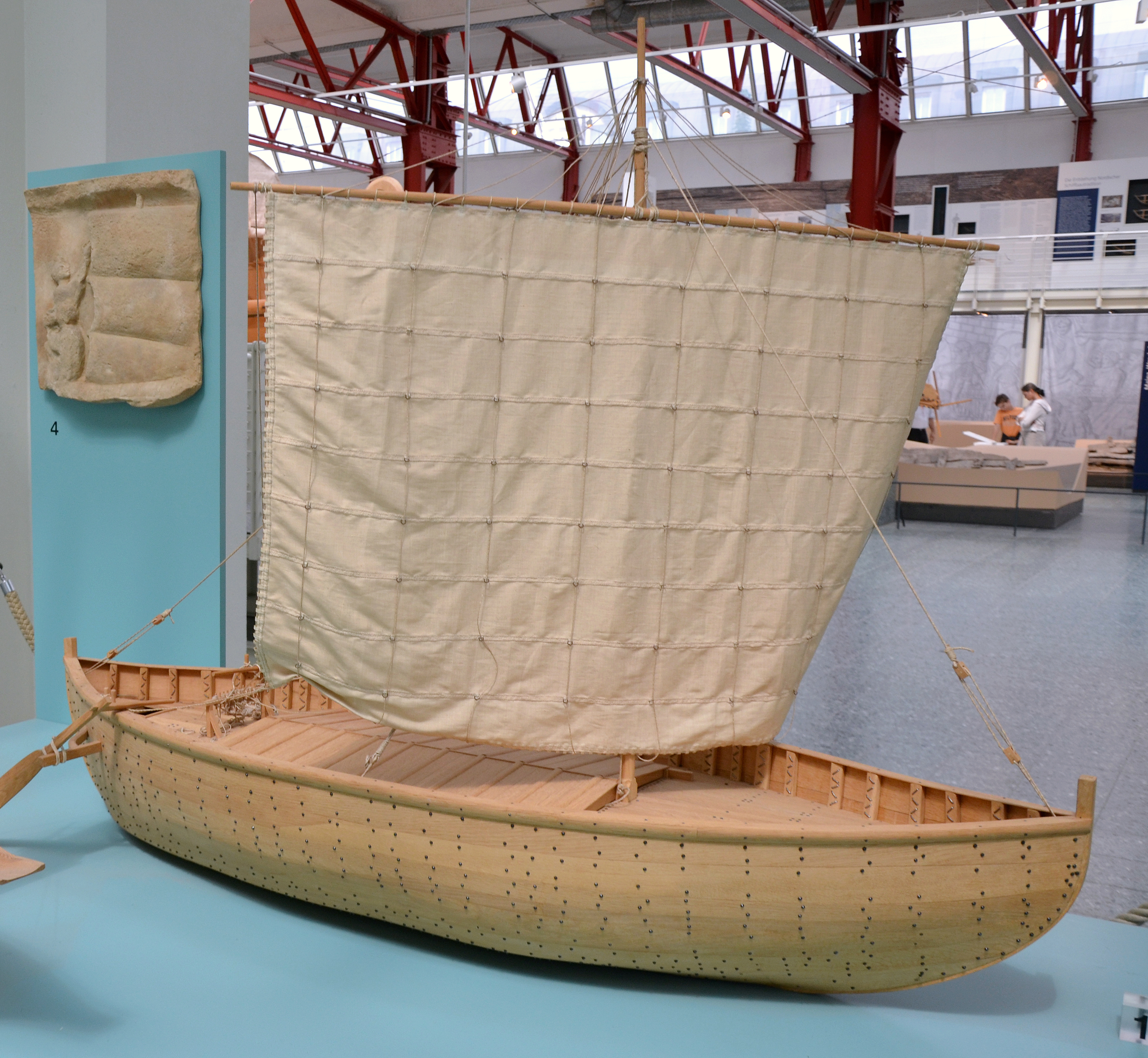
According to Julius Caesar trade with the British Isles was dominated by the Veneti from Armorica, who commanded "a very great number of ships", which he described as follows:
Close similarities have been noted between Caesar's description and shipwrecks discovered at Blackfriars in London (dating from the 2nd century AD) and at St Peter Port in Guernsey (dating from the 3rd century AD), which are described as indigenous Romano-Celtic ships built according to a native Celtic tradition, distinct from that of the Mediterranean.{{cite web |url=https://museums.gov.gg/romanship |title=Gallo-Roman Ship
Wooden barrels bound with metal hoops were also invented by Celtic craftsmen during the La Tène period and gradually replaced the use of amphorae within the Roman empire from the 2nd century AD.
The 3rd century BC saw the development of iron chain mail, the invention of which is credited to Celtic armourers by the Roman author Varro. Celtic helmet designs also served as the basis for the design of Roman imperial helmets following Caesar's campaigns in Gaul. The spatha, a long sword of Celtic design, was introduced to the Romans by Celtic mercenaries and auxilaries, gradually becoming a standard heavy infantry weapon within the Roman army by the 2nd century AD and replacing the earlier gladius.
The 1st century Roman author Pliny the Elder attributed the invention of soap and mattresses to the Gauls. The 2nd century Greek physician Aretaeus of Cappadocia also attributed the invention of soap to the Gauls.
At the site of the in Brittany the remains of a wooden structure thought to be a 'machine for drawing water' incorporating a crank and connecting-rod mechanism were discovered at the bottom of a well, dating from 68-27 BC. This is the earliest known evidence for such a mechanism, which is also known from later Roman machines. In his account of the siege of Avaricum Julius Caesar provides a brief glimpse of other devices used by the Gauls:
Art and music
La Tène metalwork in bronze, iron and gold, developing technologically out of Hallstatt culture, is stylistically characterized by inscribed and inlaid intricate spirals and interlace, on fine bronze vessels, helmets and shields, horse trappings, and elite jewelry, especially the neck rings called torcs and elaborate clasps called fibulae. It is characterized by elegant, stylized curvilinear animal and vegetal forms, allied with the Hallstatt traditions of geometric patterning.
The Early Style of La Tène art and culture mainly featured static, geometric decoration, while the transition to the Developed Style constituted a shift to movement-based forms, such as triskeles. Some subsets within the Developed Style contain more specific design trends, such as the recurrent serpentine scroll of the Waldalgesheim Style.
La Tène objects frequently feature complex designs based on geometric principles and precisely laid out with the use of compasses, displaying a sophisticated knowledge of geometry as well as other aspects of mathematics. A similar knowledge of geometry is displayed in the design of the monumental stone basin of Bibracte, which has been described as a 'Druidic monument'.
Mythological themes are also depicted in La Tène art, often in a highly stylized, abstracted or decorative form.
Evidence for music in this period includes sculptures of lyre players, thought to be Bards (e.g. at the oppidum of Paule in Brittany, France), and fragmentary remains of string instruments. Large metal horns known as Carnyxes have been found in various locations, as well as artistic depictions of horn players such as on the Gunderstrup cauldron. The Greek historian Diodorus Siculus gave a brief description of Celtic Bards in his 1st century BC account of the Gauls:
Burial rites
Burial sites included weapons, chariots, and both elite and household goods, evoking a strong continuity with an afterlife.
La Tène peoples also dug ritual shafts, in which votive offerings and even human sacrifices were cast. Severed heads (particularly of defeated enemies) appear to have held great power and were often represented in carvings. Ritual depositions of were also made into lakes and rivers, such as the La Tène site in Switzerland.
File:Celtic.warriors.garments-replica.jpg|Celtic warrior garments (reconstruction) File:Iron Age Europe Celtic Bronze Helmets (28755977795).jpg|alt=Bronze helmet from Iron Age Europe|Bronze helmets, Germany File:Axle cover for a charriot. Gold. Rheinland-Pfalz,400 BC. Neues Museum.jpg|Gold chariot axle cover, Germany, 4th century BC File:Museum of ScotlandDSCF6355.jpg|Torrs Pony-cap, Scotland, c. 200 BC File:Röhrenkanne.jpg|Bronze flagon, Germany, c. 320 BC File:The Gaulish army, Interpretation Centre of the Muséo Parc, Alésia (7700615978).jpg|Gaulish military equipment including chain mail File:Roquepertuse. Statue de guerrier.jpg|Stone statue, Roquepertuse, France File:MAN - casque de la Gorge Meillet (7).jpg|Gaulish bronze helmet, France, 4th century BC File:Celtic Gold-plated Disc, Auvers-sur-Oise, Val-d'Oise.jpg|Celtic gold-plated disc, France, 4th century BC File:Iron Age Europe La Tene Culture Burial Goods (28755919625).1.png|Burial goods including pottery and torc necklaces File:Celtic sword.jpg|Celtic short sword, c. 60 BC File:Monnaie 9 MAN.jpg|Gallic gold coin, France File:Romano-Celtic mirror (Desborough).jpg|Celtic mirror, England, c. 50 BC File:Museum of Pre- and Early History, Saarbrücken 46.jpg|Gold bracelet, Reinheim, Germany, c. 370 BC File:British Museum Basse Yutz flagons (1).jpg|Flagons from Basse Yutz, France, 5th century BC File:1911 Britannica-Archaeology-Chariot burial.png|Chariot burial in Somme-Bionne, France, c. 400 BC
Type site
The La Tène type site is on the northern shore of Lake Neuchâtel, Switzerland, where the small river Thielle, connecting to another lake, enters the Lake Neuchâtel. In 1857, prolonged drought lowered the waters of the lake by about 2 m. On the northernmost tip of the lake, between the river and a point south of the village of Epagnier (), Hansli Kopp, looking for antiquities for Colonel Frédéric Schwab, discovered several rows of wooden piles that still reached up about 50 cm into the water. From among these, Kopp collected about forty iron swords.
The Swiss archaeologist Ferdinand Keller published his findings in 1868 in his influential first report on the Swiss pile dwellings (Pfahlbaubericht). In 1863 he interpreted the remains as a Celtic village built on piles. Eduard Desor, a geologist from Neuchâtel, started excavations on the lakeshore soon afterwards. He interpreted the site as an armory, erected on platforms on piles over the lake and later destroyed by enemy action. Another interpretation accounting for the presence of cast iron swords that had not been sharpened, was of a site for ritual depositions.
With the first systematic lowering of the Swiss lakes from 1868 to 1883, the site fell completely dry. In 1880, Emile Vouga, a teacher from Marin-Epagnier, uncovered the wooden remains of two bridges (designated "Pont Desor" and "Pont Vouga") originally over 100 m long, that crossed the little Thielle River (today a nature reserve) and the remains of five houses on the shore. After Vouga had finished, F. Borel, curator of the Marin museum, began to excavate as well. In 1885 the canton asked the Société d'Histoire of Neuchâtel to continue the excavations, the results of which were published by Vouga in the same year.
All in all, over 2500 objects, mainly made from metal, have been excavated in La Tène. Weapons predominate, there being 166 swords (most without traces of wear), 270 lanceheads, and 22 shield bosses, along with 385 brooches, tools, and parts of chariots. Numerous human and animal bones were found as well. The site was used from the 3rd century, with a peak of activity around 200 BCE and abandonment by about 60 BCE. Interpretations of the site vary. Some scholars believe the bridge was destroyed by high water, while others see it as a place of sacrifice after a successful battle (there are almost no female ornaments).
An exhibition marking the 150th anniversary of the discovery of the La Tène site opened in 2007 at the Musée Schwab in Biel/Bienne, Switzerland, then Zürich in 2008 and Mont Beuvray in Burgundy in 2009.
Sites
Some sites are:
- oppidum, Germany
- Bern, Engehalbinsel oppidum
- Jolimont
- Manching: oppidum
- Ehrenbürg hillfort
- Mormont
- Münsingen, burial field
- Petinesca
- Basel oppidum
- Bibracte, oppidum of the Aedui at Mont Beuvray in Burgundy
- Erstfeld hoard
- Turicum–Lindenhof
- Bopfingen: Viereckschanze, a characteristic rectangular enclosure
- Fellbach-Schmiden, near Stuttgart: Viereckschanze; ritual objects recovered from a well
- Rodenbach: The Princely Grave of Rodenbach
- Havranok, Slovakia
- Reisberg oppidum
- Kleinaspergle: elite graves of La Tène I
- Waldalgesheim chariot burial: an elite chariot burial, 4th century
- Glauberg, oppidum and elite graves
- Dürrnberg near Hallein: Burial field and earthworks of late Hallstatt–early La Tène
- Donnersberg oppidum
- Steinsburg oppidum
- Vill near Innsbruck: remains of dwellings
- Sandberg Celtic city near Platt and Roseldorf in Lower Austria
- Vix/Mont Lassois: oppidum and elaborate graves
- Titelberg: oppidum in Luxembourg
- Reinheim: Tomb of a princess/priestess with burial gifts
- Mihailovac: in Serbia
- , Czech Republic
- , Czech Republic
- Dünsberg hillfort, Germany
- , Austria
Gallery
File:Manching model 2.jpg|Part of the Manching oppidum, Germany File:Bibracte, 1st century B.C.jpg|Bibracte oppidum, France File:Entremont - fortification wall 2 from SW (2007).jpg|Fortification wall, Entremont oppidum File:Entremont - Habitat 1 (ville haute) 05 (2007).jpg|Entremont oppidum remains, France File:Mont Vully Maquette.jpg|, Switzerland File:Dorf La Roche Blanche.JPG|View of the hilltop site of Gergovia, France File:Gergovie mur pano2.jpg|Wall remains at Gergovia, France File:Vesontio oppidum.jpg|Vesontio oppidum, France File:Avaricum westpoint july 2006.jpg|Model of the siege of Avaricum, France, 52 BC File:Ringwall Otzenhausen.jpg|Otzenhausen hillfort wall remains, Germany File:Glauberg oppidum Stockheim Gate (reconstruction).jpg|Glauberg oppidum, Germany File:Rekonstruierte Pfostenschlizmauer am Ipf bei Bopfingen.JPG|Fortifications at Ipf hillfort, Germany File:Heidengraben-6687.jpg|Heidengraben oppidum ramparts, Germany. File:Staffelberg Franken.jpg|Site of the Staffelberg oppidum, Germany File:Aerial photograph of Maiden Castle, 1935.jpg|Maiden Castle hillfort, Britain File:Donnesberg 2.jpg|Donnersberg hillfort, Germany File:Archéosite d'Aubechies 2.jpg|Sanctuary of Gournay-sur-Aronde, France File:ÉvocationCérémonieÀTintignac.jpg|Tintignac sanctuary, France File:Archéosite d'Aubechies 4.jpg|Temple buildings at Acy-Romance, France File:MaquetteFermeDeVerberie2.jpg|Gallic farm at Verberie, France File:Maquette de la ferme du Patural, Musée Bargoin - vue de dessus.jpg|Gallic farm at Le Patural, France
Artifacts
Some outstanding La Tène artifacts are:
- Mšecké Žehrovice Head, a stone head from the modern Czech Republic
- A life-sized sculpture of a warrior that stood above the Glauberg burials
- Chariot burial found at La Gorge Meillet (St-Germain-en-Laye: Musée des Antiquités Nationales)
- Basse Yutz Flagons 5th century
- Agris Helmet, with gold covering, c. 350
- Waldalgesheim chariot burial, Bad Kreuznach, Germany, late 4th century BCE, Rheinisches Landesmuseum Bonn; the "Waldalgesheim phase/style" of the art takes its name from the jewellery found here.
- A gold-and-bronze model of an oak tree (3rd century BCE) found at the Oppidum of Manching.
- Sculptures from Roquepertuse, a sanctuary in the south of France
- The silver Gundestrup cauldron (2nd or 1st century BCE), found ritually broken in a peat bog near Gundestrup, Denmark, but probably made near the Black Sea, perhaps in Thrace. (National Museum of Denmark, Copenhagen)
- Battersea Shield (350–50 BCE), found in London in the Thames, made of bronze with red enamel. (British Museum, London)
- Waterloo Helmet, 150–50 BCE, Thames
- "Witham Shield" (4th century BCE). (British Museum, London)
- Torrs Pony-cap and Horns, from Scotland
- Cordoba Treasure
- Turoe stone in Galway and Killycluggin Stone in Cavan Ireland
- Great Torc from Snettisham, 100–75 BCE, gold, the most elaborate of the British style of torcs
- Meyrick Helmet, post-conquest Roman helmet shape, with La Tène decoration
- Noric steel
File:Scissors Oppidum Manching.jpg|Scissors, found at Oppidum of Manching File:KMH - Schnabelkanne aus Grab 112 unterhalb der Hexenwand am Nordhang des Mosersteins am Dürnberg (1).jpg|Celtic flagon from Hallein, Austria, 5th century BC File:Phalère 06007.JPG|Chariot fitting, Bourcq, France, 5th century BC File:Vor und Fruehgeschichte (89).jpg|Gold armlets, Reinheim, Germany, 370 BC File:Hallein, Keltenmuseum, 03.jpg|Bronze flask from the salt mines at Dürrnberg File:KMM - Bemalte Keramik.jpg|Mass-produced pottery from Manching, 2nd century BC File:British Museum - Room 50 (21045342106).jpg|Chariot mounts from Somme-Bionne, c. 400 BC File:MAN - Bracelet gaulois a.jpg|Bronze bracelet, France File:Museum für Vor- und Frühgeschichte Berlin 001.jpg|Helmet made of iron, bronze, and coral, Italy, 4th century BC File:Barde à la lyre.jpg|Statue of a bard with a Gallic lyre, found at the Paule oppidum, France File:Tr409-2-2009s02.jpg|Gold ring, Germany, 5th-4th century BC File:Musée de Bretagne Expo Celtique - Figure d'un aristocrate gaulois Morandais 20220917-02.jpg|Figure of a Gallic aristocrat, Trémuson, France, 2nd-1st cent. BC File:Villeneuve d'Ascq Eté2016 Asnapio poignards gaulois.jpg|Gallic knives File:Musée de Bretagne Expo Celtique - Vase de Saint-Pol 20220917-01.jpg|Saint-Pol-de-Léon Vase, (a cinerary urn) File:KMM - Hirsch.jpg|Deer sculpture found in Salzburg File:Silver torque.jpg|Silver torque, 1st Century BC, Germany
Genetics
A genetic study published in PLOS One in December 2018 examined 45 individuals buried at a La Tène necropolis in Urville-Nacqueville, France. The people buried there were identified as Gauls. The mtDNA of the examined individuals belonged primarily to haplotypes of H and U. They were found to be carrying a large amount of steppe ancestry, and to have been closely related to peoples of the preceding Bell Beaker culture, suggesting genetic continuity between Bronze Age and Iron Age France. Significant gene flow with Great Britain and Iberia was detected. The results of the study partially supported the notion that French people are largely descended from the Gauls.
A genetic study published in the Journal of Archaeological Science in October 2019 examined 43 maternal and 17 paternal lineages for the La Tène necropolis in Urville-Nacqueville, France, and 27 maternal and 19 paternal lineages for La Tène tumulus of Gurgy Les Noisats near modern Paris, France. The examined individuals displayed strong genetic resemblance to peoples of the earlier Yamnaya culture, Corded Ware culture and Bell Beaker culture. They carried a diverse set of maternal lineages associated with steppe ancestry. The paternal lineages were on the other hand characterized by a "striking homogeneity", belonging entirely to haplogroup R and R1b, both of whom are associated with steppe ancestry. The evidence suggested that the Gauls of the La Tène culture were patrilineal and patrilocal, which is in agreement with archaeological and literary evidence.
A genetic study published in the Proceedings of the National Academy of Sciences of the United States of America in June 2020 examined the remains of 25 individuals ascribed to the La Tène culture. The nine examples of individual Y-DNA extracted were determined to belong to either the paragroups or subclades of haplogroups R1b1a1a2 (R-M269; three examples), R1b1a1a2a1a2c1a1a1a1a1 (R-M222), R1b1 (R-L278), R1b1a1a (R-P297), I1 (I-M253), E1b1b (E-M215), or other, unspecified, subclades of haplogroup R. The 25 samples of mtDNA extracted was determined to belong to various subclades of haplogroup H, HV, U, K, J, V and W. The examined individuals of the Hallstatt culture and La Tène culture were genetically highly homogeneous and displayed continuity with the earlier Bell Beaker culture. They carried about 50% steppe-related ancestry.
A genetic study published in iScience in April 2022 examined 49 genomes from 27 sites in Bronze Age and Iron Age France. The study found evidence of strong genetic continuity between the two periods, particularly in southern France. The samples from northern and southern France were highly homogeneous, with northern samples displaying links to contemporary samples form Great Britain and Sweden, and southern samples displaying links to Celtiberians. The northern French samples were distinguished from the southern ones by elevated levels of steppe-related ancestry. R1b was by far the most dominant paternal lineage, while H was the most common maternal lineage. The Iron Age samples resembled those of modern-day populations of France, Great Britain and Spain. The evidence suggested that the Gauls of the La Tène culture largely evolved from local Bronze Age populations.
Laffranchi et al. 2024 examined 12 samples of Cenomani Cisalpine Gauls from Verona who lived between the 3rd and 1st centuries BCE. The five examples of individual Y-DNA extracted were determined to belong to either haplogroup I2a1b1a1b1 or subclades of R1b1a1b (R-M269). The 12 samples of mtDNA extracted belonged to various subclades of haplogroup H, T, U, K, J and X.
Gallery
File:Hallein, Keltenmuseum, 04.jpg|Jug (glass replica) with bronze mounting found in Hallein, Austria File:Céramique Gallo romaine musée Bargoin.jpg|Painted pottery, France File:Head of druid from Mšecké Žehrovice, La Tène culture, NM Prague, 188090.jpg|The Mšecké Žehrovice Head, Bohemia, c. 150–50 BC File:Celtic neck ring.jpg|Celtic torc File:Bronze-Grabfund (330-320 v. Chr.) der Keltenfürstin von Waldalgesheim.jpg|Waldalgesheim chariot burial, bronze situla, Germany File:Gundestrup Cauldron.jpg|Gundestrup Cauldron, Denmark File:Goldschmuck Erstfeld2.jpg|Gold jewelry from Erstfeld, Switzerland File:CoinsOfTheParisii.jpg|Gold stater (currency) File:Chambre funéraire B de Goeblange-Nospelt, MNHA.jpg|Bucket made of Yew wood with bronze decoration, from Luxembourg File:Celtic sword scabbards, La Tene culture.png|Decorated metal sword scabbards, Britain & Ireland File:Bibracte basin 1.jpg|Bibracte oppidum, monumental stone basin, France File:Archéodrome Beaune 05.jpg|Chariot burial File:Gentleman, La Tène culture, c. 450 BC, replica - Naturhistorisches Museum Nürnberg - Nuremberg, Germany -DSC04213.jpg|Reconstruction of clothing, Germany, c. 450 BC File:0881 Tracht der Kelten in Südpolen im 3. Jh. v. Chr.JPG|Reconstruction of clothing, Poland, c. 300 BC File:Bibracte Musee Casque Tintignac.jpg|Helmet in the form of a swan from Tintignac, France File:Prunay Vase.jpg|Pottery vase from Prunay with intricate design pattern, northeastern France, c.400-350 BC
Notes
References
- Garrow, Duncan (ed), Rethinking Celtic Art, 2008, Oxbow Books, , 9781842173183, google books
- Green, Miranda, Celtic Art, Reading the Messages, 1996, The Everyman Art Library,
- Laing, Lloyd and Jenifer. Art of the Celts, Thames and Hudson, London 1992
- McIntosh, Jane, Handbook to Life in Prehistoric Europe, 2009, Oxford University Press (USA),
- Megaw, Ruth and Vincent (2001). Celtic Art.
References
- [https://books.google.com/books?id=31LFIITb3LUC&pg=PA354 Sarunas Milisauskas, ''European Prehistory: a survey'', p. 354]
- Venceslas Kruta, ''La grande storia dei Celti. La nascita, l'affermazione, la decadenza'', (Newton & Compton), Roma, 2003 {{ISBN. 978-88-8289-851-9, a translation of ''Les Celtes, histoire et dictionnaire. Des origines à la romanisation et au christianisme'', Robert Laffont, Paris, 2000, without the dictionary
- McIntosh, 89-91
- McNair, Raymond F.. (22 March 2012). "Key to Northwest European Origins". Author House.
- (1996). "Manufatti in ferro di tipo La Tène in area italiana: le potenzialità non-sfruttate". Mélanges de l'École Française de Rome. Antiquité.
- The La Tène culture was present in the southwestern part of Slovakia, bordering on or overlapping with the [[Púchov culture]] of north/central Slovakia.
- Mócsy, András (1974). Pannonia and Upper Moesia. A History of the Middle Danube Provinces of the Roman Empire. Translated by S. Frere. Routledge & Kegan Paul. ISBN 978-0-7100-7714-1.
- Croatia was part of the Eastern Hallstatt zone, and the [[Illyrians]] of classical antiquity were culturally influenced both by Celtic (La Tène) and by Hellenistic culture.
- G. Kazakevich, "The La Tène culture of the Trans-Carpathian area: Is the migration model still relevant?", UDK 94(477.87:364): "The only region of the present day Ukraine where the La Tène sites are sufficiently widespread is the Trans-Carpathian area which lies south-westwards of the Carpathian mountains."
- Garrow, Ch 1 and 2
- Or just "La Tene" in English. More rarely also spelt "Latène" (especially in French adjectival forms) or "La-Tène". In German ''Latènezeit'' or ''La-Tène-Zeit'' equate to "La Tène culture. "
- Megaw, 9-16; Green, 11-17
- Megaw, 228-244
- Laing, Chapter 3, especially 41-42
- Sabine Rieckhoff, [https://www.gko.uni-leipzig.de/fileadmin/user_upload/historisches_seminar/02urundfruehgeschichte/Online_Beitraege/OnlBei30.pdf Geschichte der Chronologie der Späten Eisenzheit in Mitteleuropa und das Paradigma der Kontinuität] {{Webarchive. link. (13 July 2020 , Leipziger online-Beiträge zur Ur- und Frühgeschichtlichen Archäologie 30 (2008).)
- Megaw, 51
- [http://www.frankfurtlounge.de/Mystery_of_the_Celts.htm Mystery of the Celts] {{webarchive. link. (15 January 2010)
- McIntosh, 89
- McIntosh, 89-91
- Cunliffe 1997:66.
- Green, 26
- Garrow, chapter 2; Laing, chapter 4; Megaw, chapter 6
- McIntosh, 91-92
- "Le Dôme aux Dragons de Roissy".
- Pearson, Lionel. (1934). "Herodotus on the Source of the Danube". Classical Philology.
- (1995). "The Celtic World". Routledge.
- "Digital reconstruction of the Manching oppidum".
- (2009). "Prehistoric Europe". Left Coast Press.
- (2004). "Ancient Europe, Vol. II". Thomson-Gale.
- (2017). "Cultural Interactions and Changing Landscapes in Europe (2nd century BC/2nd century AD)". Braga.
- Fichtl, Stephan. (2023). "The Oxford Handbook of the European Iron Age". Oxford University Press.
- Fernández-Götz, Manuel. (2018). "Urbanization in Iron Age Europe: Trajectories, Patterns, and Social Dynamics". Journal of Archaeological Research.
- Fichtl, Stephan. (2023). "The Oxford Handbook of the European Iron Age". Oxford University Press.
- Fichtl, Stephan. (2023). "The Oxford Handbook of the European Iron Age". Oxford University Press.
- Fernandez-Gotz, Manuel. (2020). "Regional Urban Systems in the Roman World, 150 BCE - 250 CE". Brill.
- (2004). "Ancient Europe, Vol. II". Thomson-Gale.
- Fichtl, Stephan. (2023). "The Oxford Handbook of the European Iron Age". Oxford University Press.
- Vandemoortele, Kathleen. (2011). "Late La Tene oppida in West and Central Europe".
- Vandemoortele, Kathleen. (2011). "Late La Tene oppida in West and Central Europe".
- (1993). "Metrological research into the foot measurement found in the celtic oppidum of Manching". Complutum.
- Fernandez-Gotz, Manuel. (2020). "Chapter 2: A World of 200 Oppida: Pre-Roman Urbanism in Temperate Europe". Brill.
- (2020). "The PC15 Building: a Wood-Built Public Place at the Center of the Oppidum of Bibracte (France)". Chronika.
- (January 1991). "El Estanque Monumentale de Bibracte".
- (January 1991). "El Estanque Monumentale de Bibracte".
- (January 1991). "El Estanque Monumentale de Bibracte".
- (2018). "The Monumental Basin of Mont Beuvray and its Possible Orientation towards the Constellation of Gemini". Journal of Skyscape Archaeology.
- (1995). "The Celtic World". Routledge.
- Fernandez-Gotz, Manuel. (2020). "Chapter 2: A World of 200 Oppida: Pre-Roman Urbanism in Temperate Europe". Brill.
- "Julius Caesar, ''Gallic War'', 7.23".
- Ellis, Peter. (2003). "A Brief History of the Celts". Constable.
- (2011). "Britannia Superior: Why Roman roads may not be quite as Roman as we think".
- (2003). "The Roman Remains of Northern and Eastern France: A Guidebook". Routledge.
- (2021). "La Tène Culture".
- Fichtl, Stephan. (2023). "The Oxford Handbook of the European Iron Age". Oxford University Press.
- (1995). "The Celtic World". Routledge.
- (1995). "The Celtic World". Routledge.
- "Le Dôme aux Dragons de Roissy".
- (2019). "Celtic Warfare".
- (2018). "The Ancient Celts". Oxford University Press.
- (1995). "The Celtic World". Routledge.
- Simmons, Victoria. (2006). "Celtic Culture: A Historical Encyclopedia". [[ABC-CLIO]].
- "3D reconstruction of Corent oppidum, France".
- (1995). "The Celtic World". Routledge.
- "Julius Caesar, ''Gallic War'', 5.13".
- "Julius Caesar, ''Gallic War'', 5.11".
- (1995). "The Celtic World". Routledge.
- (2018). "The Ancient Celts". Oxford University Press.
- Julius Caesar, ''Commentaries on the Gallic War'', Book I, 16
- "Julius Caesar: The Gallic War".
- "Le Dôme aux Dragons de Roissy".
- "Diodorus Siculus, Library of History, Book 5".
- "Strabo, Geography, Book 4, chapter 4, section 4".
- "Diogenes Laertius, Lives of Eminent Philosophers".
- "Pomponius Mela, The Situation of the World, 3.2.18-19".
- "Julius Caesar, The Gallic War, Book 6, chapter 14".
- "Ammianus Marcellinus, Roman Antiquities, Book 15, chapter 9".
- "M. Tullius Cicero, ''Divination'', Book 1, Section 90".
- "Hippolytus, The Refutation of All Heresies, XXII".
- (1995). "The Celtic World". Routledge.
- Watt, D. Cameron. (1989). "The Veneti: A Pre-Roman Atlantic Sea Power". Naval History.
- "Strabo, Geography, Book IV Chapter 2".
- (1995). "The Celtic World". Routledge.
- (1995). "The Celtic World". Routledge.
- Stifter, David. (2009). "Vernacular Celtic Writing Traditions in the East-Alpine Region in the Iron-Age Period?". Studien zur Kulturgeschichte von Oberösterreich.
- Zeidler, Jurgen. (2003). "A Celtic script in the eastern La Tène culture?". Études Celtiques.
- "The Gallic War, by Julius Caesar. Book 1, chapter 29".
- "The Gallic War, by Julius Caesar. Book 6, chapter 14".
- "Coinage in Celtic society".
- (1995). "The Celtic World". Routledge.
- (1995). "The Celtic World". Routledge.
- "Reading the images on lron-Age coins: I. the sun-boat and its passengers".
- (2017). "Of Barbarians and Boundaries: The Making and Remaking of Transcultural Discourse". Oxbow Books.
- (1995). "The Celtic World". Routledge.
- (1995). "The Celtic World". Routledge.
- (1995). "The Celtic World". Routledge.
- (1995). "The Celtic World". Routledge.
- (1995). "The Celtic World". Routledge.
- (1995). "The Celtic World". Routledge.
- (15 January 2014). "East Lothian's Broxmouth fort reveals edge of steel".
- (1995). "The Celtic World". Routledge.
- (2019). "Weaponry of the Przeworsk Culture in the light of metallographic examinations. The case of the cemetery in Raczkowice". Praehistorische Zeitschrift.
- (2005). "Norican Steel - An Assessment of the Archaeological Finds at the Magdalensberg Site, Carinthia, Compared to the "Celtic Trove" of Gründberg Hill, Linz". Steel Research International.
- (2002). "Selected Writings on Chariots, other Early Vehicles, Riding and Harness". Leiden.
- (1995). "The Celtic World". Routledge.
- (1995). "The Celtic World". Routledge.
- (2014). "The Motor Car: Past, Present and Future". Springer.
- Stifter, David. (2009). "The Old-Irish Chariot and its Technology. A Case of Creative Transmission in Medieval Irish Literature". Proceedings of the 13th International Congress of Celtic Studies.
- Siculus, Diodorus. "Library of History, Book 5, Chapter 29".
- (2025). "Harnessing Horses From Prehistory to History". Sidestone Press.
- "The Gallic Wars By Julius Caesar, Book 3, Chapter 13".
- McGrail, Sean. (1995). "Romano-Celtic boats and ships: characteristic features". The International Journal of Nautical Archaeology.
- "Blackfriars Ship 1".
- McGrail, Sean. (1995). "The Celtic World". Routledge.
- (1995). "The Celtic World". Routledge.
- "Encyclopedia Romana:Amphora".
- (1995). "The Celtic World". Routledge.
- Gabriel, Richard A.. (2006). "Soldiers' Lives Through History - The Ancient World". Bloomsbury.
- Elliott, Simon. (2018). "Roman Legionaries: Soldiers of Empire". Casemate Publishers.
- Feugère, Michel. (2002). "The Arms of the Romans". Tempus Publishers.
- Bishop, M.C. (2020). "The Spatha: The Roman Long Sword". Bloomsbury Publishing.
- "Pliny the Elder, The Natural History, Plin. Nat. 28.51".
- "Pliny the Elder, The Natural History, Plin. Nat. 8.73".
- Aretaeus of Cappadocia. (1856). "Ἀρεταίου Καππαδόκου Τὰ Σωζόμενα". Sydenham Society.
- "Machine hydraulique".
- "L'exposition « Les Premières Villes de l'ouest »".
- "Les Premières villes de l'Ouest".
- "L'exposition « Les Premières Villes de l'ouest »".
- "C. Julius Caesar, Gallic War, 7.22".
- Harding, D. W. ''The Archaeology of Celtic Art''. New York: Routledge, 2007; other schemes of classification are available, indeed more popular; see [[Vincent Megaw]] in Garrow
- "Le Dôme aux Dragons de Roissy".
- (2015). "Celts: Art and Identity". British Museum Press.
- (2014–2015). "Constructions à la règle et au compas".
- (2016). "Eurasia at the Dawn of History: Urbanization and Social Change". Cambridge University Press.
- (2017). "Architecture, style and structure in the early iron age in Central Europe". Uniwersytet Wrocławski, Instytut Archeologii.
- (2003). "Schémas de construction des décors au compas des phalères laténiennes de champagne". Supplément à la Revue archéologique du centre de la France.
- (2020). "Barbaric Splendour: The use of image before and after Rome". Archaeopress.
- (2009). "The primary plan of the Battersea Shield". The Antiquaries Journal.
- (January 1991). "El Estanque Monumentale de Bibracte".
- (2014–2015). "Constructions à la règle et au compas".
- Waddell, John. (2012). "Reflections on the past: Essays in honour of Frances Lynch". Cambrian Archaeological Association.
- (2003). "Schémas de construction des décors au compas des phalères laténiennes de champagne". Supplément à la Revue archéologique du centre de la France.
- (28 March 2012). "Skye cave find western Europe's 'earliest string instrument'".
- "Diodorus Siculus, Library of History, Book 5, Chapter 31".
- Megaw, chapters 2-5; Laing, chapter 3
- Megaw, chapters 2-5; Laing, chapter 3
- [[Swisstopo]] map (1931) [https://s.geo.admin.ch/7dae336550 geo.admin.ch]
- Megaw, 132-133
- "Digital reconstruction of the oppidum of Gondole, France".
- (2022). "Reconstruction of the Zavist oppidum".
- (4 December 2020). "Digital reconstruction of the Heidengraben oppidum".
- (2 May 2022). "Digital reconstruction of the Staffelberg oppidum".
- "Tintignac, le mystère d'un sanctuaire gaulois".
- (20 January 2020). "Digital reconstruction of Acy-Romance".
- "Acy-Romance".
- "Site aristocratique de Batilly: Une ferme aristocratique Gauloise".
- "Digital reconstruction of Batilly-en-Gâtinais aristocratic Gallic farm".
- [https://www.britishmuseum.org/explore/highlights/highlight_objects/pe_prb/t/the_witham_shield.aspx British Museum – The Witham Shield] {{webarchive. link. (3 November 2015)
- {{harvnb. Fischer et al.. 2019
- (2024-02-14). ""Until death do us part". A multidisciplinary study on human- Animal co- burials from the Late Iron Age necropolis of Seminario Vescovile in Verona (Northern Italy, 3rd-1st c. BCE)". PLOS ONE.
This article was imported from Wikipedia and is available under the Creative Commons Attribution-ShareAlike 4.0 License. Content has been adapted to SurfDoc format. Original contributors can be found on the article history page.
Ask Mako anything about La Tène culture — get instant answers, deeper analysis, and related topics.
Research with MakoFree with your Surf account
Create a free account to save articles, ask Mako questions, and organize your research.
Sign up freeThis content may have been generated or modified by AI. CloudSurf Software LLC is not responsible for the accuracy, completeness, or reliability of AI-generated content. Always verify important information from primary sources.
Report