From Surf Wiki (app.surf) — the open knowledge base
Iğdır
| Field | Value |
|---|---|
| type | municipality |
| name | Iğdır |
| image_skyline | Iğdır ve Ağrı Dağı.jpg |
| image_caption | Mount Ararat from Iğdır |
| image_map | Iğdır_within_Iğdır_Central_District.png |
| map_caption | Location within Iğdır Province |
| coordinates | |
| province | Iğdır |
| district | Iğdır |
| leader_title | Mayor |
| leader_name | Mehmet Nuri Güneş |
| leader_party | DEM Party |
| elevation_m | 850 |
| population_footnotes | |
| population_total | 101700 |
| population_as_of | 2022 |
| postal_code | 76000 |
| area_code | 0476 |
| website |
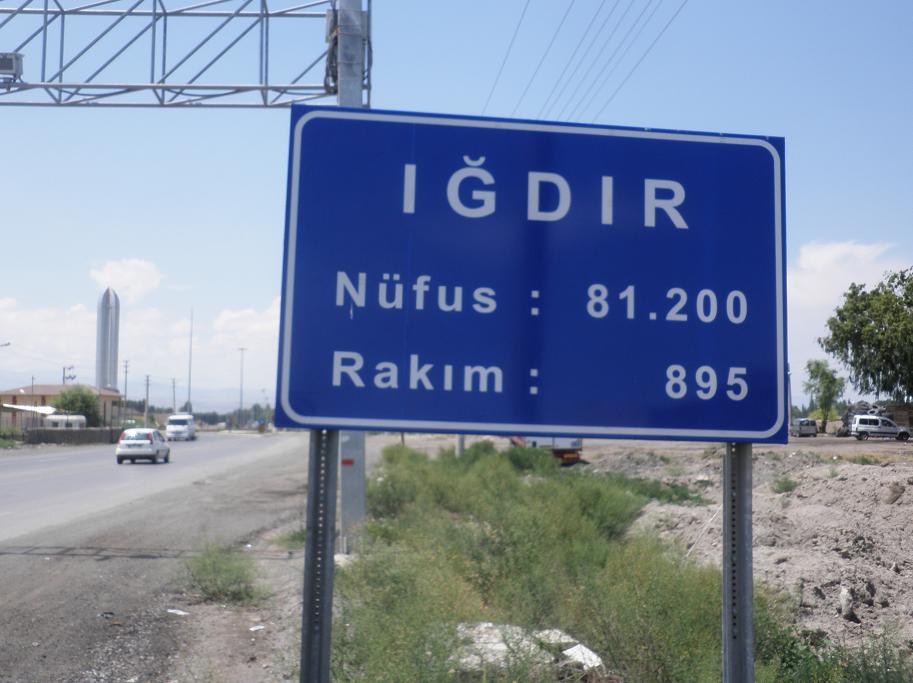
Iğdır (; or ; ; or Reşqelas) is a city in the Eastern Anatolia region of Turkey. It is the seat of Iğdır Province and Iğdır District. Its population is 101,700 (2022).
History
Iğdır went by the Armenian name of Tsolakert during the Middle Ages. When the Spanish traveler Ruy González de Clavijo passed through this region in the early 15th century, he stayed a night in a castle he called Egida, located at the foot of Mount Ararat. Clavijo describes it as being built upon a rock and ruled by a woman, the widow of a brigand that Timur had put to death. Because modern Iğdır has no such rock, and is a considerable distance from the Ararat foothills, it is believed that medieval Iğdır was located at a different site, at a place also known as Tsolakert, now called Taşburun. Russian excavations there at the end of the 19th century discovered the ruins of houses and what was identified as a church, as well as traces of fortifications. The settlement may have been abandoned after an earthquake in 1664. In 1555 the town became a part of the Safavid Empire, remaining under Persian rule (with brief military occupations by the Ottomans in 1514, between 1534–35, 1548–49, 1554–55, 1578–1605, 1635–36 and 1722–46) until it fell into the hands of the Russian Empire after the Russo-Persian War of 1826-1828.
Modern history

Iğdır, or Igdir, was taken by the Russian Empire from Persia after the latter's defeat in the Russo-Persian War of 1826-1828. It was organized as part of the Armenian Oblast in 1828 and made a part of the Georgia-Imeretia Governorate in 1840, and then the Surmalu Uyezd of the Erivan Governorate in 1850. According to the Russian family lists accounts from 1886, of the total 30,647 inhabitants of the district 11,868 were Tatars (38.7%, later known as Azerbaijanis), 15,204 Armenians (49.6%) and 3,575 Kurds (11.7%). An 1894 publication counted 2,912 Armenians living in the town. Under Russian rule, two primary schools, one for boys and the other for girls, and three churches were opened and 100 Armenian families were allowed to move to Igdir. The town's population rose to 10,000 in 1914 and largely busied itself with agriculture and commerce.
Following the Russian Revolution of October 1917, the area came under the control of a temporary administrative committee created by the three main ethnic groups (Armenians, Azerbaijanis and Georgians) in the South Caucasus. Though it attempted to negotiate a truce with the Ottoman Empire, Ottoman forces launched an eastward offensive and took Igdir on May 20, 1918. They occupied it until the signing of the Armistice of Mudros in November 1918. The Republic of Armenia then assumed control over Igdir. The Armenian population suffered heavily during the grueling winter of 1918–19, as famine, disease and the cold killed many.{{cite book
Based on the boundaries drawn by U.S. State Department in November 1920, Igdir was envisaged to become a part of the Republic of Armenia. However, in September 1920 the government of the Grand National Assembly of Turkey led by Mustafa Kemal launched a war to eliminate the republic and overran Igdir. Turkish General Kâzım Karabekir commanded the armies but his forces were initially unable to take Igdir due to strong Armenian resistance. However, within a few days, on October 20, 1920, the Turkish Army managed to drive the Armenian forces out of the city and went on to capture Gyumri. According to official Turkish documents, after their defeat in the Shahtahti area, Armenian forces abandoned Iğdır. They burned the Markara Bridge which spanned the Aras river and retreated to the northern bank on November 13, 1920. Turkey annexed the region of Iğdır after the conclusion of several peace treaties, and its territorial gains were mainly formalized under the 1921 Treaty of Kars.
In the early years of the Republic of Turkey, Igdir, now Iğdır, was a district of the province of Bayazıt. It was made a part of the Kars Province in 1934 and remained part of it until it became the seat of the newly formed Iğdır Province on 27 May 1992.
Government
In the municipal elections of March 2019, Yaşar Akkuş from the Peoples' Democratic Party (HDP) was elected mayor. He was dismissed due to terror related investigations on 15 May 2020, and Enver Ünlü, the Governor of the province, was appointed as a trustee for the municipality on the same day.
Geography
The city of Iğdır sits on a plain at a lower altitude than most of Turkey's eastern provinces. This allows agricultural production including apples, tomatoes, cucumbers, peaches, pears, sugar beet, watermelons and melons. However, the most famous produce of Iğdır are cotton and apricots.
.jpg)
Climate
Iğdır has a continental semi-arid climate (Köppen: BSk, Trewartha: BS) with hot, dry summers and cold, snowy winters. Iğdır is the driest city in Turkey, averaging 261 mm of precipitation per year.
|Jan record high C = 18.3 |Feb record high C = 22.2 |Mar record high C = 29.5 |Apr record high C = 33.4 |May record high C = 35.9 |Jun record high C = 39.2 |Jul record high C = 41.5 |Aug record high C = 42.0 |Sep record high C = 38.4 |Oct record high C = 33.0 |Nov record high C = 26.2 |Dec record high C = 22.2 |year record high C = 42.0 |Jan record low C = -28.4 |Feb record low C = -28.0 |Mar record low C = -22.2 |Apr record low C = -7.6 |May record low C = 0.1 |Jun record low C = 2.4 |Jul record low C = 8.0 |Aug record low C = 7.2 |Sep record low C = 1.6 |Oct record low C = -7.0 |Nov record low C = -15.6 |Dec record low C = -30.3 |year record low C = -30.3 | access-date = 11 April 2021}}
Health
Air pollution is a chronic problem in Iğdır, mainly due to the burning of coal.
.jpg)
Turkish MPs and specialists claim that the Armenian Nuclear Power Plant in Metsamor, a border town in Armenia, poses a health risk to Iğdır residents. Turkish sources allege that cancer cases have increased in the region because of the power plant.
Architecture
On a peninsula close to the closed border with Armenia, and currently within a military zone, near the village of , stands the ruins of the medieval city of Surmari, with a citadel whose surviving walls date from 1224. A restored 13th-century Armenian caravanserai known as the Caravanserai of Zor is another historical structure in the vicinity.
Iğdır Genocide Memorial and Museum

The Iğdır Genocide Memorial and Museum, is a memorial-museum complex which promotes Armenian-genocide denial. Construction on the memorial began in August 1997, and was opened to the public on October 5, 1999 by the Turkish Minister of State Ramazan Mirzaoğlu. The memorial was built to commemorate the alleged massacres and persecution by Armenians of Muslims during World War I and the Turkish–Armenian War. Most scholars see it as a case of Armenian Genocide denial, seeking to promote an alternate psuedohistoric narrative that blames the genocide on Armenians.
Cuisine
Increasing agricultural production and the opening of a border gate with Nakhchivan in 1992 have enabled the town to be livelier and wealthier than its neighbours in the generally impoverished eastern Turkey. There are many cafes and restaurants. The best-known dish is a meat stew called bozbaş.
Economy
The main economic activities in Iğdır are the commerce of agricultural and animal products.
The city of Iğdır is located between Kars and Ağrı. Despite the fact that it has three strategically important neighbours, the border gate to Armenia is closed and there is no direct access to Iran, therefore this situation diminishes economic possibilities.
About 70% percent of Mount Ararat's area lies within Iğdır's borders, however the investments for developing tourism in Mt. Ararat is paid to Ağrı Municipality.
Demographics
According to the Russian family lists accounts from 1886, of the total 71,066 inhabitants of the districts 34,351 were Azerbaijanis (48.3%, mentioned as 'Tatars' in the source), 22,096 Armenians (31.1%) and 14,619 Kurds (20.6%). According to the Russian Empire Census in 1897 Iğdır had a population of 4,680, of which 3,934 (84%) were Armenians, and 559 (12%) were Russians. The province is populated by Azerbaijanis and Kurds.

|1970|21420 |1975|29542 |1980|24352 |1985|29460 |1990|35858 |1997|45941 |2007|75927 |2012|82656 |2017|91261 |2022|101700
Transport
Transport to Iğdır is via roads or air. Turkish state route D.080 and European route E99 pass through Iğdır. Iğdır Airport, opened in 2012, serves the city with internal flights to Istanbul and Ankara. Regular bus services connect the city to major national and regional centres. There is, as of 2016, no rail transport to Iğdır, but it will be a stop on the Nakhchivan-Kars railway when it is completed.
Notable people
- Avetis Aharonian, Armenian politician
- Servet Çetin, Turkey national football team player of Azerbaijani descent
- Eduard Isabekyan, Armenian painter
- Drastamat Kanayan, Armenian military commander
- Verjaluys Mirijanyan, Armenian actress and Honored Artist of Armenia.
- Sinan Oğan, Turkish politician; won a seat in the Turkish parliament in 2011 with the right-wing Nationalist Movement Party
- Şahin Yakut, Turkish kickboxer and MMA fighter
International relations
Diplomatic missions
Azerbaijan maintains a consular mission in Iğdır.
Twin towns — sister cities
Iğdır is twinned with:
- [[File:Flag of Azerbaijan.svg|20px]] Sharur, Nakhchivan Autonomous Republic, Azerbaijan
- [[File:Flag of Azerbaijan.svg|20px]] Shamakhi, Azerbaijan
Sport In Iğdır
- Iğdırspor
- Iğdır FK
References
References
- (2009). "Adını arayan coğrafya". Özedönüş Yayınları.
- [https://www.e-icisleri.gov.tr/Anasayfa/MulkiIdariBolumleri.aspx İlçe Belediyesi], Turkey Civil Administration Departments Inventory. Retrieved 1 March 2023.
- {{in lang. hy s.v. "Igdir," [[Armenian Soviet Encyclopedia]], 1978, vol. 4, p. 309.
- [[Ruy González de Clavijo]]. ''The Broadway Travellers: Embassy to Tamerlane: 1403-1406''. Trans. Guy le Strange. London: Routledge, 2004, p. 76.
- Sinclair, Thomas A. ''Eastern Turkey: An Architectural and Archaeological Survey'', vol. 1. London: Pindar Press, 1987, pp. 406-409.
- {{in lang. ru ''[http://www.ethno-kavkaz.narod.ru/igdyr1886.html Свод статистических данных о населении Закавказского края, ИГДЫРСКИЙ УЧАСТОК (1886 г.)]''. Tiflis, 1893.
- "ЭСБЕ/Игдырь — Викитека".
- Chater, Melville. "[http://www.virtualani.org/accounts/igdir.htm The Land Of The Stalking Death: a Journey Through Starving Armenia on an American Relief Train]." ''[[National Geographic Society. National Geographic]]'' 36 (November 1919). Retrieved July 24, 2009.
- Hovannisian. ''Republic of Armenia'', p. 449, note 3.
- Hovannisian, Richard G.. (1996). "The Republic of Armenia: Vol. 4: Between Crescent and Sickle, Partition and Sovietization". University of California Press.
- {{in lang. tr ''Genelkurmay Askerî Tarih ve Stratejik Etüt Başkanlığı Yayınları'', ''Türk İstiklâl Harbi IIIncü Cilt: Doğu Cephesi (1919-1921)''. Ankara: Genelkurmay Basım Evi, 1995, p. 221.
- ''[https://books.google.com/books?id=6GhpAAAAMAAJ&q=%22On+the+20th+October+the+Armenian+troops+were+forced+out+of+Igdir+by+the+Turks,+who+were+now+appioaching+the+Armenian%22 British Documents on Foreign Affairs--Reports and Papers from the Foreign Office Confidential Print: From the First to the Second World War. The Soviet Union, 1917-1939]'', Volume 4, p. 388.
- (1999). "Iğdır". Türk Diyanet Vakfı.
- "Iğdır Seçim Sonuçları - 31 Mart 2019 Yerel Seçimleri".
- "Enver Ünlü".
- admin. (2020-05-15). "A trustee has been appointed to 6 municipalities with HDP!".
- "WMO Climate Normals for 1991-2020: Igdir". [[National Oceanic and Atmospheric Administration]].
- (August 2020). "Kara Rapor 2020: Hava Kirliliği ve Sağlık Etkileri". [[Right to Clean Air Platform Turkey]].
- "2021 Dünya Hava Kirliliği Raporu: Avrupa bölgesinde havası en kirli kent Iğdır". BBC News Türkçe.
- "HDP, Ermenistan'daki nükleer santral için uyardı: Önlem alın".
- (4 December 2020). "Iğdır'da kanser vakalarında artış: Nedeni Ermenistan'daki Metsamor Nükleer Santrali mi?".
- [http://www.virtualani.org/zor/ Caravansarai of Zor]. VirtualAni.org.
- "[http://www.ermenisorunu.gen.tr/english/massacres/igdir.html Igdir Genocide Monument and Museum]."
- "IĞDIR SOYKIRIM ANITI - Iğdır". Türkiye Kültür Portalı.
- (2018). "The Destruction of the Monument to Humanity: Historical Conflict and Monumentalization". International Public History.
- "Sürmeli Çukurda Iğdır", Ziya Zakir Acar, 2002
- {{in lang. ru ''Первая всеобщая перепись населения Российской Империи, 1897 г.'' (Erivanskaya Guberniya), N. A. Troynitskii, Saint Petersburg, 1904, p. 144.
- {{in lang. tr Yilmaer, Esat. [http://webarsiv.hurriyet.com.tr/2002/08/05/162199.asp Sevilen valiyle ‘savaş’ MHP'ye kaybettirmiş] {{Webarchive. link. (2015-07-02 ." ''[[Hürriyet]]''. August 5, 2002.)
- (1970). "1970 General Census". [[Turkish Statistical Institute]].
- (1975). "1975 General Census". [[Turkish Statistical Institute]].
- (1980). "1980 General Census". [[Turkish Statistical Institute]].
- (1986). "1985 General Census". [[Turkish Statistical Institute]].
- (1991). "1990 General Census". [[Turkish Statistical Institute]].
- (1999). "1997 Population Count". [[Turkish Statistical Institute]].
- "Population Of Municipalities, Villages And Quarters". [[Turkish Statistical Institute.
- "Iğdır'ın Sosyoekonomik Durumu". Turkish Agency on the Development of Border Areas.
- [http://www.news.az/articles/38287 Head of Turkey-Azerbaijan association becomes deputy of Turkish parliament] {{webarchive. link. (2014-10-27)
- [http://news.day.az/politics/272936.html Azeri Elected to Turkish Parliament]. ''Day.az''. 13 June 2011.
This article was imported from Wikipedia and is available under the Creative Commons Attribution-ShareAlike 4.0 License. Content has been adapted to SurfDoc format. Original contributors can be found on the article history page.
Ask Mako anything about Iğdır — get instant answers, deeper analysis, and related topics.
Research with MakoFree with your Surf account
Create a free account to save articles, ask Mako questions, and organize your research.
Sign up freeThis content may have been generated or modified by AI. CloudSurf Software LLC is not responsible for the accuracy, completeness, or reliability of AI-generated content. Always verify important information from primary sources.
Report