From Surf Wiki (app.surf) — the open knowledge base
Helgakviða Hundingsbana I
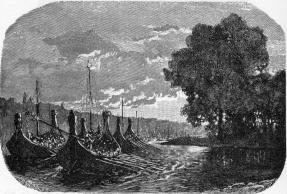
"Völsungakviða" or "Helgakviða Hundingsbana I" ("The First Lay of Helgi Hundingsbane") is an Old Norse poem found in the Poetic Edda. It is only preserved in the Icelandic manuscript Codex Regius (ca. 1270). It constitutes one of the Helgi lays, together with Helgakviða Hundingsbana II and Helgakviða Hjörvarðssonar.
The locations in the poem have been fervently debated with a Danish school maintaining Danish origins and locations and a Swedish one pointing out that locations (e.g. Brávellir and Brandey) and characters (Ylfings, Högni and Granmarr) place the events in Östergötland and Södermanland. The poem is also ambiguous in attributing Helgi to the Ylfing, Yngling and Völsung clans, which suggests a merging of originally unrelated traditions.
In the Edda, the poem is a sequel to Helgakviða Hjörvarðssonar whose heroes Helgi Hjörvarðsson and Sváfa are reborn as Helgi Hundingsbane and Sigrún. However, in Codex Regius, it is actually followed by Helgakviða Hjörvarðssonar.
The poem begins in a location called Brálund with the birth of Helgi Hundingbane, the son of Sigmund and Borghild. Norns arrived at the dwelling to shape his future as a hero.
-
Ár var alda, þat er arar gullu, hnigu heilög vötn af Himinfjöllum; þá hafði Helga inn hugumstóra Borghildr borit í Brálundi.
-
Nótt varð í bæ, nornir kómu, þær er öðlingi aldr of skópu; þann báðu fylki frægstan verða ok buðlunga beztan þykkja. |
-
In olden days, when eagles screamed, And holy streams from heaven's crags fell, Was Helgi then, the hero-hearted, Borghild's son, in Bralund born.
-
'Twas night in the dwelling, and Norns there came, Who shaped the life of the lofty one; They bade him most famed of fighters all And best of princes ever to be.}}
When Helgi was but fifteen years old, he slew a man named Hunding. This caused Hunding's sons Eyjólfr, Álfr, Hjörvarðr and Hávarðr to approach Helgi asking for wergild and the return of the booty Helgi had taken from their father. When Helgi refused them this, Hunding's sons declared war and in the ensuing battle, Helgi killed all of Hunding's sons.
Helgi met the Valkyrie Sigrún who informed him that her father Högni has betrothed her to Höðbroddr, the unworthy son of king Granmarr of the Hniflung clan. Helgi promised to take on Höðbroddr and to claim her as his own. Helgi then assembled a mighty host and departed to wage war on Höðbrodd's family.
When they had arrived at Granmar's kingdom, the poem deals with a flyting between Helgi's half-brother Sinfjötli and Höðbrodd's brother Guðmundr. Then, the armies clashed at Frekastein and Helgi was victorious winning Sigrún as his bride.
Notes
References
- See Bellow's commentaries and references to [[Sophus Bugge]].
- Nerman, B. ''Det svenska rikets uppkomst''. Stockholm, 1925.
- [http://www.heimskringla.no/wiki/Helgakvi%C3%B0a_Hundingsbana_I ''Helgakviða Hundingsbana I''], [[Guðni Jónsson]]'s edition of the text with normalized spelling.
- [http://www.sacred-texts.com/neu/poe/poe19.htm ''The First Lay of Helgi Hundingsbane''] in translation by [[Henry Adams Bellows (businessman). Henry Adams Bellows]] (1936), at Sacred Texts.
- There is no mention here of Hunding's battles with Helgi's father Sigmund.
- In the ''[[Völsunga saga]]'', Hunding's sons kill Sigmund and his father-in-law [[Eylimi]], whereupon [[Sigurd]] takes revenge.
This article was imported from Wikipedia and is available under the Creative Commons Attribution-ShareAlike 4.0 License. Content has been adapted to SurfDoc format. Original contributors can be found on the article history page.
Ask Mako anything about Helgakviða Hundingsbana I — get instant answers, deeper analysis, and related topics.
Research with MakoFree with your Surf account
Create a free account to save articles, ask Mako questions, and organize your research.
Sign up freeThis content may have been generated or modified by AI. CloudSurf Software LLC is not responsible for the accuracy, completeness, or reliability of AI-generated content. Always verify important information from primary sources.
Report