From Surf Wiki (app.surf) — the open knowledge base
Green–Davies–Mingos rules
Organometallic chemistry rule

Organometallic chemistry rule
In organometallic chemistry, the Green–Davies–Mingos rules predict the regiochemistry for nucleophilic addition to 18-electron metal complexes containing multiple unsaturated ligands. The rules were published in 1978 by organometallic chemists Stephen G. Davies, Malcolm Green, and Michael Mingos. They describe how and where unsaturated hydrocarbon generally become more susceptibile to nucleophilic attack upon complexation.
Rule 1
Nucleophilic attack is preferred on even-numbered polyenes (even hapticity). center|400px
Rule 2
Nucleophiles preferentially add to acyclic polyenes rather than cyclic polyenes.
Rule 3
Nucleophiles preferentially add to even-hapticity polyene ligands at a terminus. Nucleophiles add to odd-hapticity acyclic polyene ligands at a terminal position if the metal is highly electrophilic, otherwise they add at an internal site.
Simplified: even before odd and open before closed
The following is a diagram showing the reactivity trends of even/odd hapticity and open/closed π-ligands.
:[[File:Green–Davies–Mingos rules hapticity trend.png|354px|none]]
The metal center is electron withdrawing. This effect is enhanced if the metal is also attached to a carbonyl. Electron poor metals do not back bond well to the carbonyl. The more electron withdrawing the metal is, the more triple bond character the CO ligand has. This gives the ligand a higher force constant. The resultant force constant found for a ligated carbonyl represents the same force constant for π ligands if they replaced the CO ligand in the same complex.
Nucleophilic addition does not occur if kCO* (the effective force constant for the CO ligand) is below a threshold value
The following figure shows a ligated metal attached to a carbonyl group. This group has a partial positive charge and therefore is susceptible to nucleophilic attack. If the ligand represented by Ln were a π-ligand, it would be activated toward nucleophilic attack as well.
:\ce{L_\mathit{n}-{}}\overset{\color{Red}\delta+}\ce{M}\ce{-C#}\overset{\color{Red}\delta+}\ce{O} Incoming nucleophilic attack happens at one of the termini of the π-system in the figure below:
:[[File:Green–Davies–Mingos rule 3 example.png|385px|none]]
In this example the ring system can be thought of as analogous to 1,3-butadiene. Following the Green–Davies–Mingos rules, since butadiene is an open π-ligand of even hapticity, nucleophilic attack will occur at one of the terminal positions of the π-system. This occurs because the LUMO of butadiene has larger lobes on the ends rather than the internal positions.
Effects of types of ligands on regiochemistry of attack
Nucleophilic attack at terminal position of allyl ligands when π accepting ligand is present.
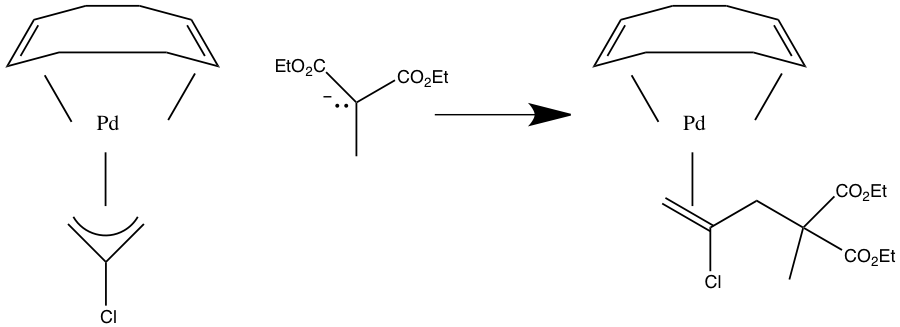
If sigma donating ligands are present they pump electrons into the ligand and attack occurs at the internal position.

Effects of asymmetrical ligands
When asymmetrical allyl ligands are present attack occurs at the more substituted position.

In this case the attack will occur on the carbon with both R groups attached to it since that is the more substituted position.
Uses in synthesis
Nucleophilic addition to π ligands can be used in synthesis. One example of this is to make cyclic metal compounds. Nucleophiles add to the center of the π ligand and produces a metallobutane.
Internal attack
References
References
- (1978). "Nucleophilic Addition to Organotransition Metal Cations Containing Unsaturated Hydrocarbon Ligands: A Survey and Interpretation". [[Tetrahedron (journal).
- Bush Russell C.. (1986). "Metal carbonyl νCO force constants as predictors of π-ethylene and π-benzene complex reactivity with nucleophiles". [[Journal of the American Chemical Society]].
- Aranyos, Attila. (1997). "Central versus Terminal Attack in Nucleophilic Addition to (π-Allyl)palladium Complexes. Ligand Effects and Mechanism". [[Organometallics]].
- Delbecq, F.. (2000). "Regioselectivity of the Nucleophilic Addition to (η3-allyl) Palladium Complexes. A Theoretical Study". [[Organometallics]].
- Periana, Roy A. (1986). "Carbon-carbon activation of organic small ring compounds by arrangement of cycloalkylhydridorhodium complexes to rhodacycloalkanes. Synthesis of metallacyclobutanes, including one with a tertiary metal-carbon bond, by nucleophilic addition to π-allyl complexes". [[Journal of the American Chemical Society]].
This article was imported from Wikipedia and is available under the Creative Commons Attribution-ShareAlike 4.0 License. Content has been adapted to SurfDoc format. Original contributors can be found on the article history page.
Ask Mako anything about Green–Davies–Mingos rules — get instant answers, deeper analysis, and related topics.
Research with MakoFree with your Surf account
Create a free account to save articles, ask Mako questions, and organize your research.
Sign up freeThis content may have been generated or modified by AI. CloudSurf Software LLC is not responsible for the accuracy, completeness, or reliability of AI-generated content. Always verify important information from primary sources.
Report