Skip to content
Surf Wiki
Save to docs
general/grapefruit

From Surf Wiki (app.surf) — the open knowledge base

Grapefruit
Citrus fruit

Grapefruit

Citrus fruit

Note

the fruit

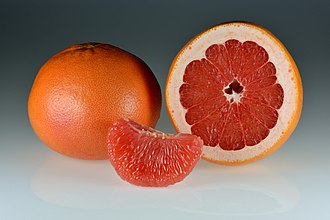
The grapefruit (Citrus × paradisi) is a subtropical citrus tree known for its relatively large, sour to semi-sweet, somewhat bitter fruit. The flesh of the fruit is segmented and varies in color from pale yellow to dark red.

Grapefruits originated in Barbados in the 18th century. They are a citrus hybrid that was created through an accidental cross between the sweet orange (C. × sinensis) and the pomelo (C. maxima), both of which were introduced to the Caribbean from Asia in the 17th century. It has also been called the 'forbidden fruit'. but that term is now mostly used as the common name for Citrus maxima.

Grapefruit–drug interactions are common, as the juice contains furanocoumarins that interfere with the metabolism of many drugs. This can prolong and intensify the effects of those drugs, leading to multiple side-effects such as abnormal heart rhythms, bleeding inside the stomach, low blood pressure, difficulty breathing, and dizziness.

Description

Grapefruit growing in the grape-like clusters from which their name may derive

The evergreen grapefruit trees usually grow to around 4.5 – tall, although they may reach 13.7 m. The leaves are up to 15 cm long, thin, glossy, and dark green. They produce 5 cm white flowers with four or five petals. The fruit is yellow-orange skinned and generally an oblate spheroid in shape; it ranges in diameter from 10 to. Its flesh is segmented and acidic, varying in color depending on the cultivars, which include white, pink, and red pulps of varying sweetness (generally, the redder varieties are the sweetest).

Varieties

"Red" grapefruit

White grapefruit varieties include Camulos, Cecily, Duncan, Frost Marsh, Genetic Dwarf Marsh, Hall, Jochimsen, Marsh seedy, Nicholson navel, Perlis, Reed Marsh, Tetraploid, Warren Marsh, and Whitney Marsh.

Red or pink grapefruit varieties include Flame, Foster Pink, Henderson Ruby, Hudson Foster, Marsh Pink, Ray Ruby, Redblush, Rio Red, Shambar, and Star Ruby.

Ruby RedThe 1929 'Ruby Red' (or 'Redblush') patent was associated with real commercial success, which came after the discovery of a red grapefruit growing on a pink variety.

Using radiation to trigger mutations, new varieties were developed to retain the red tones that typically faded to pink. The 'Rio Red' variety is a 1984 registered Texas grapefruit with registered trademarks Rio Star and Ruby-Sweet, also sometimes promoted as Reddest and Texas Choice. The 'Rio Red' is a mutation-bred variety that was developed by treatment of bud sticks with thermal neutrons. Its improved attributes of mutant variety are fruit and juice color, deeper red, and wide adaptation.

The 'Star Ruby' is the darkest of the red varieties. it has found limited commercial success because it is more difficult to grow than other varieties.

As food

Nutrition

Raw white grapefruit is 90% water, 8% carbohydrates and 1% protein, with negligible fat (table). In a reference amount of 100 g, raw grapefruit provides 138 kJ of food energy and is a rich source of vitamin C (37% of the Daily Value), with no other micronutrients in significant amounts (table).

Culinary

Like other citrus fruits, grapefruits are sour because of their citric acid content; grapefruit juice contains about half the citric acid content of lemon juice, and nearly 50% more than orange juice. In Costa Rica, especially in Atenas, grapefruit are often cooked with sugar to balance their sourness, rendering them as sweets; or they are stuffed with dulce de leche as a dessert. In Haiti, grapefruit is used primarily for its juice (), but also is used to make jam ().

Grapefruit varieties are differentiated by the flesh color of fruit they produce. Common varieties are yellow and pink pulp colors. Flavors range from highly acidic and somewhat sour to sweet and tart, resulting from composition of sugars (mainly sucrose), organic acids (mainly citric acid), and monoterpenes and sesquiterpenes providing aromas. Grapefruit mercaptan, a sulfur-containing terpene, is one of the aroma compounds influencing the taste and odor of grapefruit, compared with other citrus fruits.

File:Caramelized Grapefruit at Palace Diner in Biddeford ME.jpg |Caramelized grapefruit File:Roasted Grapefruit Chicken.jpg|Roasted grapefruit chicken File:Laksetatar med spinat og rød grape (4357301784).jpg|Salmon tartar with spinach and red grapefruit File:Greyhound Cocktail.jpg|Greyhound cocktail, with gin and juice

Drug interactions

Main article: Grapefruit–drug interactions

Grapefruit and grapefruit juice interact with many drugs, resulting in numerous adverse effects including bone marrow suppression, nephrotoxicity, abnormal heart rhythm, rhabdomyolysis, hypotension, gastrointestinal bleeding, dizziness, and respiratory depression, according to the drug involved.

One interaction occurs from grapefruit furanocoumarins, such as bergamottin and 6',7'-dihydroxybergamottin, which occur in both flesh and peel. Furanocoumarins inhibit the CYP3A4 enzyme (among others from the cytochrome P450 enzyme family responsible for metabolizing 90% of drugs). The action of the CYP3A4 enzyme itself is to metabolize many medications. If a drug's breakdown for removal is lessened, then the level of that drug in the blood may become and remain high, leading to adverse effects. On the other hand, some drugs must be metabolized to become active, and inhibiting CYP3A4 may lead to reduced drug effects.

Another effect is that grapefruit compounds may inhibit the absorption of drugs in the intestine. If a drug is not absorbed, then not enough of it is in the blood to have a therapeutic effect. Each affected drug has either a specific increase of effect or decrease.

One whole grapefruit or a glass of 200 ml of grapefruit juice is enough to cause drug overdose toxicity. Typically, drugs that are incompatible with grapefruit are marked as such on the container or package insert.

Production

Source: FAOSTAT
of the United Nations

In 2023, world production of grapefruits (combined with pomelos) was 9.93 million tonnes, led by China with 52% of the total and Vietnam as a secondary producer (table).

Pests and diseases

Grapefruits are hosts for fruit flies (family Tephritidae) such as A. suspensa, which lay their eggs in overripe or spoiled grapefruits, sometimes causing serious damage in plantations in the Americas. In sub-Saharan Africa, the Citrus swallowtail, Papilio demodocus, is a minor pest of Citrus plantations. Grapefruits are subject to several diseases of Citrus trees, including citrus tristeza virus, citrus canker (caused by a bacterium, Xanthomonas), and the vector-transmitted citrus greening disease, where the vector is a psyllid bug, and the pathogen is a bacterium, Liberibacter.

File:Caribbean fruit fly Anastrepha suspensa.jpg|The fruit fly Anastrepha suspensa, a serious pest in the New World File:Citrus swallowtail caterpillar.jpg|Citrus swallowtail, Papilio demodocus caterpillar, Africa

History

Grapefruit originated as a natural hybrid. One ancestor of the grapefruit was the Jamaican sweet orange (Citrus sinensis), itself an ancient hybrid of Asian origin; the other was the Indonesian pomelo (C. maxima). Both C. sinensis and C. maxima were present in the West Indies by 1692. One story of the fruit's origin is that a 17th-century trader named 'Captain Shaddock' brought pomelo seeds to Jamaica and bred the first fruit, which were then called shaddocks. The grapefruit then probably originated as a naturally occurring hybrid between the two plants some time after they had been introduced there.

Kimball Chase Atwood founded the Atwood Grapefruit Company in the late 19th century. It became the largest grapefruit grove in the world.<ref name=&quot;Herald Tribune 2004&quot;/>

A hybrid fruit, called forbidden fruit, was first documented in 1750 (along with 14 other citrus fruits including the guiney orange) by a Welshman, the Rev. Griffith Hughes, in his The Natural History of Barbados.

In 1814, the British naturalist and plantation owner John Lunan published the term grapefruit to describe a similar Jamaican citrus plant. An alternative explanation is that this name may allude to clusters of the fruit on the tree, which often appear similar to bunches of grapes.

In 1830, the Jamaican version of the plant was given the botanical name Citrus paradisi by the Scottish physician and botanist James Macfadyen. Macfadyen identified two varieties – one called forbidden fruit, the other Barbadoes Grape Fruit. Macfadyen distinguished between the two plants by fruit shape with the Barbados grapefruit being piriform (pear shaped) while the forbidden fruit was "maliformis" (apple shaped). Macfadyen's and Hughes's descriptions differ, so it is not clear that the two reports are describing the same plant. It has been suggested that Hughes's golden orange may actually have been a grapefruit, while his forbidden fruit was a different variety that may since have been lost. A citrus called forbidden fruit or shaddette has been discovered in Saint Lucia; it may be the plant described by Hughes and Macfadyen.

The name grape-fruit was used during the 19th century to refer to pomelos. It was brought to Florida by the French businessman Count Odet Philippe in 1823, in what is now known as Safety Harbor. An early pioneer in the American citrus industry was Kimball C. Atwood, a wealthy entrepreneur who founded the Atwood Grapefruit Company in the late 19th century. The Atwood Grove became the largest grapefruit grove in the world, with a yearly output of 80,000 boxes of fruit. There, pink grapefruit was discovered in 1906.

References

References

  1. Morton, Julia Frances. (1987). "Grapefruit, ''Citrus paradisi'', In: Fruits of Warm Climates". NewCROP, New Crop Resource Online Program, Center for New Crops and Plant Products, Department of Horticulture and Landscape Architecture, [[Purdue University]].
  2. (2003). "A~Z of Barbados Heritage". Macmillan Caribbean.
  3. In the past it was called the ''pomelo'',The [[American Heritage Dictionary of the English Language]] (1973) defines "pomelo" simply as "The grapefruit".
  4. Li, Xiaomeng. (July 2010). "The Origin of Cultivated Citrus as Inferred from Internal Transcribed Spacer and Chloroplast DNA Sequence and Amplified Fragment Length Polymorphism Fingerprints". Journal of the American Society for Horticultural Science.
  5. "White grapefruits". University of California Riverside.
  6. "Red/Pink grapefruits". University of California Riverside.
  7. Broad, William J.. (28 August 2007). "Useful Mutants, Bred With Radiation". [[The New York Times]].
  8. "MVD".
  9. Sauls, Julian W.. (1998). "Home fruit Production-Grapefruit".
  10. "Star Ruby grapefruit".
  11. (2008). "Quantitative Assessment of Citric Acid in Lemon Juice, Lime Juice, and Commercially-Available Fruit Juice Products". Journal of Endourology.
  12. (1993). "1994 Mexico & Central America Handbook". Trade and Travel Publications.
  13. Monrose, Gregory Salomon. (2006). "Standardisation d'une formulation de confiture de chadèque et évaluation des paramètres physico-chimiques, microbiologiques et sensoriels". Université d'Etat d'Haiti.
  14. (1984). "Le point sur la transformation des fruits tropicaux". Groupe de recherche et d'echanges technologiques (GRET).
  15. (2016). "Determination of sugars, organic acids, aroma components, and carotenoids in grapefruit pulps". Food Chemistry.
  16. (1999). "Characterization of the Most Odor-Active Volatiles in Fresh, Hand-Squeezed Juice of Grapefruit (''Citrus paradisi Macfayden'')". J. Agric. Food Chem..
  17. (2004). "6',7'-Dihydroxybergamottin contributes to the grapefruit juice effect". Clinical Pharmacology and Therapeutics.
  18. "CYP3A4 cytochrome P450 family 3 subfamily A member 4 [Homo sapiens (human)]".
  19. (29 September 2022). "How the "Don't take this medication with grapefruit juice" warning originated {{!}} Science-Based Medicine".
  20. (2012). "Grapefruit-medication interactions: Forbidden fruit or avoidable consequences?". Canadian Medical Association Journal.
  21. (2025). "Grapefruit production in 2023, Crops/Regions/World list/Production Quantity/Year (pick lists)". UN Food and Agriculture Organization, Corporate Statistical Database (FAOSTAT).
  22. van Whervin, L. Walter. (March 1974). "Some Fruitflies (Tephritidae) in Jamaica". Pest Articles & News Summaries.
  23. (2022). "Papilio demodocus (citrus swallowtail)". CABI.
  24. (2021). "Grapefruit: history, use, and breeding". Horttechnology.
  25. "Genetic origin of cultivated citrus determined: Researchers find evidence of origins of orange, lime, lemon, grapefruit, other citrus species".
  26. [https://web.archive.org/web/20080502135258/http://findarticles.com/p/articles/mi_m0JAW/is_87/ai_n25336559 Grapefruit: a fruit with a bit of a complex] in ''Art Culinaire'' (Winter, 2007)
  27. Lunan, John. (1814). "Hortus Jamaicensis". St. Iago de la Vega Gazette.
  28. "How did the grapefruit get its name?".
  29. Macfadyen, James. (1830). "Some remarks on the species of genus ''Citrus'' which are cultivated in Jamaica.". Botanical Miscellanea.
  30. California. (1895). "Appendix to the Journals of the Senate and Assembly of the twenty-first Session of the Legislature of the State of California". Legislature of the State of California.
  31. (16 August 2004). "Manatee County a big part of citrus history". Herald-Tribune.
Info: Wikipedia Source

This article was imported from Wikipedia and is available under the Creative Commons Attribution-ShareAlike 4.0 License. Content has been adapted to SurfDoc format. Original contributors can be found on the article history page.

Want to explore this topic further?

Ask Mako anything about Grapefruit — get instant answers, deeper analysis, and related topics.

Research with Mako

Free with your Surf account

Content sourced from Wikipedia, available under CC BY-SA 4.0.

This content may have been generated or modified by AI. CloudSurf Software LLC is not responsible for the accuracy, completeness, or reliability of AI-generated content. Always verify important information from primary sources.

Report