From Surf Wiki (app.surf) — the open knowledge base
Gold–aluminium intermetallic
Any intermetallic compound of gold and aluminium

Any intermetallic compound of gold and aluminium
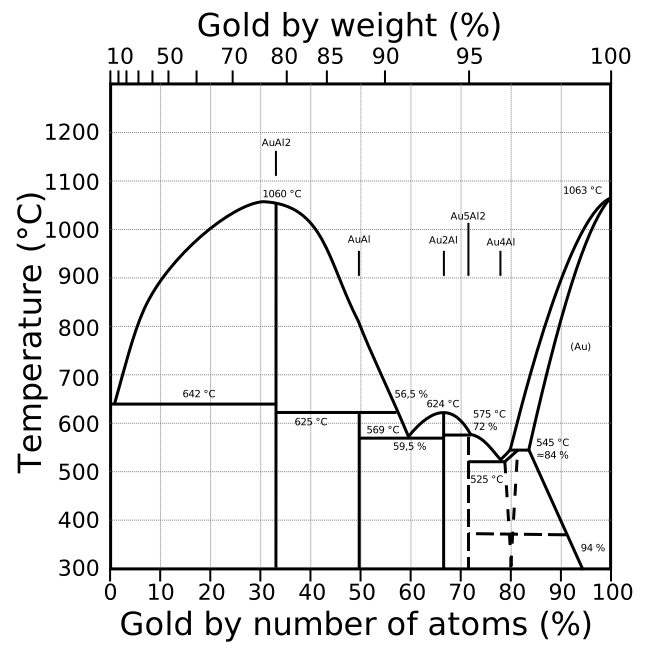
Gold–aluminium intermetallic is a type of intermetallic compound of gold and aluminium that usually forms at contacts between the two metals. Gold–aluminium intermetallics have different properties from the individual metals, such as low conductivity and high melting point depending on their composition. Due to the difference of density between the metals and intermetallics, the growth of the intermetallic layers causes reduction in volume, and therefore creates gaps in the metal near the interface between gold and aluminium.
The production of gaps lowers the strength of the metal compound, which can cause mechanical failure at the joint, fostering the problems that the intermetallics causes in metal compounds. In microelectronics, these properties can cause problems in wire bonding.
The main compounds formed are usually Au5Al2 (white plague) and AuAl2 (purple plague), both of which form at high temperatures, then Au5Al2 and AuAl2 can further react with Au to form more stable compound, Au2Al.
Properties
Au5Al2 has low electrical conductivity and relatively low melting point. Au5Al2's formation at the joint causes increase of electrical resistance, which can lead to electrical failure. Au5Al2 typically forms at 95% of Au and 5% of Al by mass, its melting point is about 575 °C, which is the lowest among the major gold-aluminum intermetallic compounds. AuAl2 is a brittle bright-purple compound, with a composition of about 78.5% Au and 21.5% Al by mass.
AuAl2 is the most thermally stable species of the Au–Al intermetallic compounds, with a melting point of 1060 °C (see phase diagram), which is similar to the melting point of pure gold. AuAl2 can react with Au, therefore is often replaced by Au2Al, a tan-colored substance, which forms at composition of 93% of Au and 7% of Al by mass. It is also a poor conductor and can cause electrical failure of the joint, which can further lead to mechanical failure.
Voiding
At lower temperatures, about 400–450 °C, an interdiffusion process takes place at the junction, leading to formation of layers of different gold-aluminum intermetallic compounds with different growth rates. Gaps are formed as the denser and faster-growing layers consume the slower-growing layers. This process is known as the Kirkendall voiding, which leads to both increased electrical resistance and mechanical weakening of the wire bond. When the voids forms along the diffusion front, this process is aided by contaminants present in the lattice, and is known as the Horsting voiding, which is a similar process to the Kirkendall voiding.
References
References
- (January 2020). "2020 IEEE Conference of Russian Young Researchers in Electrical and Electronic Engineering (EIConRus)". IEEE.
- (January 2019). "Brittle-to-ductile transition of Au2Al and AuAl2 intermetallic compounds in wire bonding". Journal of Materials Science: Materials in Electronics.
- (2023-12-26). "Optimization of Wire-bonding Process Parameters for Gold Wire and Aluminium Substrate using Response Surface Method". International Journal of Nanoelectronics and Materials.
This article was imported from Wikipedia and is available under the Creative Commons Attribution-ShareAlike 4.0 License. Content has been adapted to SurfDoc format. Original contributors can be found on the article history page.
Ask Mako anything about Gold–aluminium intermetallic — get instant answers, deeper analysis, and related topics.
Research with MakoFree with your Surf account
Create a free account to save articles, ask Mako questions, and organize your research.
Sign up freeThis content may have been generated or modified by AI. CloudSurf Software LLC is not responsible for the accuracy, completeness, or reliability of AI-generated content. Always verify important information from primary sources.
Report